Profiling: Jim Williams
Te Tumu’s Research Blog will be posting occasional profiles of our academic staff, highlighting their research interests and publication.
Introducing Dr Jim Williams.
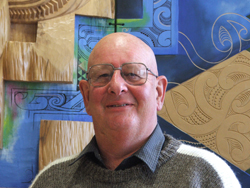 Jim is a Senior Lecturer and has been with Te Tumu since 1992.
Research direction
* Ngāi Tahu history and language.
* Resource management including mahika kai, and comparisons with other Indigenous peoples.
Jim is currently exploring the dynamics of oral transmission of traditional stories, with a view to publishing a book, which will examine the extent to which Māori families pass on Māui stories, compared with Navajo and their stories about Mai’I (coyote – the trickster that predominates amongst Native Americans). A secondary theme will be looking at Europeans attitudes to those stories.
Jim is most interested in talking to prospective students about comparison of traditional ways with the views of contemporary Māori.
Recent supervisions
PhD
Delyn Day, “Te Awhio-Rangi: Te Toki Mata Ngero o Te Ao Whetu” 2009 – 2013
Anne-Marie Jackson, “The Taiapure Process and to What Extent it Needs to be Altered to Achieve Tangata Whenua Objectives”, 2009 – 2011
David McKay, “Indigenous Perspectives in Environmental Education” 2009 – 2013
MA
Henare Mita, “The Ngāi Tahu Claims Settlement Act 1998: The Quest for Ngāi Tahu Tino Rangatiratanga” 2008 – 2009
Katrina Bryant, “Hauā Matau Māori”, 2012 – 2014
BA(Hons)
Hori Barsdell “Pā” 2014.
Selected Publications
Book Chapters
(2014) “Food and the Maori” in Encyclopaedia of the History of Science, Technology and Medicine in Non-Western Cultures, Springer, Dordrecht
(2010) “Towards a Model for Indigenous Research on traditional topics” in Hokowhitu, B., Kermoal, N., Andersen, C., Reilly, M., Rewi, P. & Petersen, A. (2010, Indigenous Identity and Resistance: Researching the Diversity of Knowledge. Dunedin: University of Otago Press. Dunedin
Refereed Journal articles
2014 Williams, Jim 2014; “He Aitua nā Tamatea”, in Te Pouhere Kōrero Journal, Vol. 7, Pp.47-56.
2013 Williams, Jim 2013; “Juxtaposed Narratives of “The Battle of Crowheart Butte”, in Ethnohistory, Vol. 60 (4) Fall 2013, Pp 567-579.
2012 Williams, Jim 2012; Ngāi Tahu Kaitiakitanga, in MAI Journal 2012, Volume 1 (2):89-102.
2010 Williams, Jim 2010; ‘Mahika kai: THE HUSBANDING OF CONSUMABLES BY MĀORI IN PRE_CONTACT TE WĀIPOUNAMU”, in Journal of the Polynesian Society, Vol. 119 (2) Pp 149-180
2006 Williams, Jim 2006; ‘Resource management and Māori attitudes to water in southern New Zealand’, in New Zealand Geographer Vol 62:75-82
Contact details
Please feel free to call in or make contact with Jim to discuss supervision.
Room Richardson South Tower, Rm 4S7
Phone 64 3 479 7385
Email jim.williams@otago.ac.nz
Seminar Video: Ārihi Te Nahu and the Te Waka Maori Libel Case, 1877.
Lachy Paterson “Ārihi Te Nahu & the Te Waka Maori Libel Case, 1877.”
Te Tumu Seminar Series, University of Otago, 20 August 2014.
Short Abstract: In 1876 a letter from Ārihi Te Nahu and several others was published in Te Waka Maori o Niu Tirani, the government’s Māori-language newspaper concerning the wealthy Hawkes Bay runholder, Henry Russell. Russell sued the newspaper for libel, but the case was informed by dodgy Māori land purchases, race relations, and squabbling within the Pākehā political elite. This presentation explores how the libel case came about, and its ramifications.
He Pūtea Rangahau – Māori Research funding opportunities
News on two upcoming Māori research funding opportunities
From Ngā Pae o te Māramatanga
We will be commissioning new research around “Optimising Maori Economic performance”. What we would like you to do is be very creative when looking at the RFP and see how you can wrap it within your own discipline. We have funding for four projects so it is competitive. However, in these times we are pleased to offer this investment and look forward to your applications.
From the Website:
“NPM seeks to invest in research projects focussing on its research priocrity ‘Optimising Māori Economic Performance’ that aligns to its research direction. The total maximum budget available per project is $150,000 (fully costed, exclusive of GST, over 12 months). Funding is available for a 1 December 2014 commencement date.
NPM is seeking applications from individuals or groups within its PRE Network interested in undertaking research within the scope of the RFP. Applications should provide a concise summary of the research project including:
Up to two pages outlining the proposed research (goals and objectives, methods, details of the significance and/or relevance of the research); Excellence, Benefits and Transformations; An outline of the relevant collaborative arrangements; A dissemination plan; Biographical sketches; and Budget details.
The applications details are short but must contain in the proposal a specific research question and methodology. Applicants should have identified a research team and the study design and methods the team propose to use. Applicants should have secured access to information (or have clearly identified the pathways for access) and demonstrated mechanisms for engagement of key stakeholders, including the express support of Māori communities or other relevant parties where required. The research outlined in the application is expected to be feasible with a 12 month time frame and with a corresponding budget.
Click here for contact details.
From Te Taura Whiri i te Reo Māori (Māori Language Commission)
He pānui tōmua tēnei e pā ana ki ngā ratonga rangahau (whakaurunga kaipupuri pānga) e hiahiatia ana e Te Taura Whiri i te Reo Māori, e He Puna Whakarauora ā, ko tāna Rārangi Take Rangahau ā-Motu te kaupapa.
Ka puta tētahi Tono Marohi ki runga i a GETS i te marama o Mahuru. Ko te tikanga, hei whakamōhiotanga tōmua tēnei tuhinga i ō mātou hiahia tērā pea ka whakatakotoria, te angawā me ngā here ā-mua hoki e whai wāhi ai ngā kaiwhakarato torohū ki te whakaaroaro mehemea ka pīrangi rātou ki te tāpae i tētahi tono.
Mā te Pānui Tōmua, tēnā e ai tō aro ki te pae ipurangi.
This is an advance notice of research services (stakeholder engagement) required by Te Taura Whiri i te Reo Māori, He Puna Whakarauora, in relation to its National Research Agenda.
A Request for Proposal will be advertised on GETS in September. This is only intended to provide some advance notice of our likely requirements, timeframe and preconditions to enable potential suppliers to consider in advance whether they wish to submit a proposal.
For the full notice please refer to the Government Electronic Tender Service website
GETS RFx Id: 3432637, Whakaurunga Kaipupuri Pānga Reo Māori, Māori Language Stakeholder Engagement
Māori-language research in Teaching
It is always good when students can use their skills and research to produce a resource to benefit the university. MAOR427 “He Tuhituhinga” is a 400-level Māori history paper that looks at historical Māori-language texts. All the work and discussion is conducted in the Māori language. This year one of their assignments was the translation of a text, selected by Jeanette Wikaira, Kaituhituhi Ratonga Māori at the Hocken Library, was an account by Hauāuru Taipari of Ngāti Maru about a visit to Ngāti Awa and Whakatōhea in 1864. The students divided the text up, and transcribed and translated it. This was then given back to the Hocken Library as an accompanying resource to the original text.
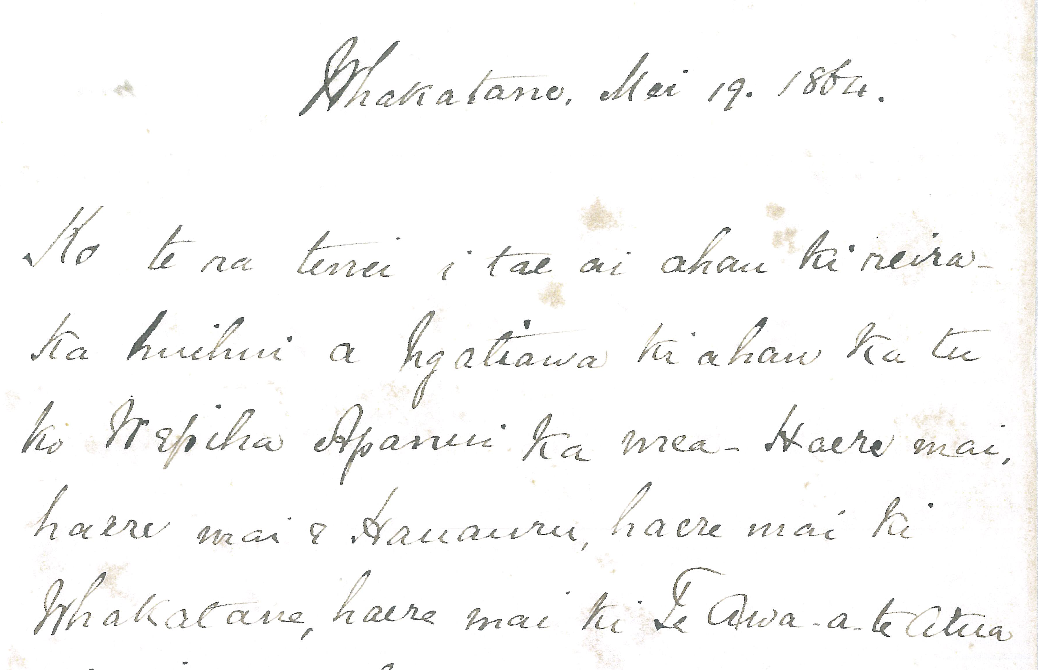
He wāhanga nō te tuhinga a Hauāuru Taipari.
Fragment of the text by Hauāuru Taipari.
He mea tino pai kia whakamahia e ngā ākonga ō rātou pūmanawa me tā rātou rangahau hei whakaputa mai i te rauemi, hei painga mō te whare wānanga. He pepa hītori, he pepa tau-tuawhā te pepa MAOR427 “He Tuhituhinga” e āta tirohia nei ētahi tuhinga reo-Māori o neherā. E mahia ana ngā mahi katoa i roto i te reo Māori. He mahi whakapākehā tētahi o ngā aromatawai. Nō te tau nei, ka whiriwhiria e Jeanette Wikaira, e te Kaituhituhi Ratonga Māori o te Uare Hākena te tuhinga nei, nā Hauāuru Taipari o Ngāti Maru i tuhi mō tāna haere ki a Ngāti Awa rāua ko Whakatōhea i te tau 1864. Wehewehea ana te tuhinga e ngā ākonga, tuhia ana ngā kupu Māori ki te rorohiko, whakapākehātia ana. Kātahi ēnei ka tukuna atu ki te Uare Hākena hei tākoha, hei rauemi hoki i te taha o ngā kupu ake a te kaituhi.
Journal News
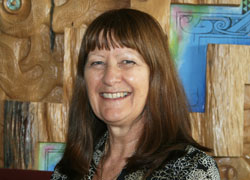
Lyn Carter
Dr Lyn Carter is a Senior Lecturer in Te Tumu, and the Coordinator of our Indigenous Development programme.
Marginalisation occurs when a group of people are pushed to the periphery of a society. Many Māori reside at the margins of ‘mainstream’ society, while others are at the margins of Māori society. The present paper explores how ‘by Māori, for Māori’ research and evaluation can create spaces for voices from the margins to be heard. The paper arose out of a series of hui in which papers on the notion of marginalisation and Māori were presented and discussed, along with the broader topic of research ethics and protocols. Three themes that emerged from these hui are considered in this paper: relationships between researchers and participants/communities, researchers knowing themselves, and the safety aspects inherent within tikanga. The discussion of these themes draws upon the papers that were written for this project, the feedback from hui participants (researchers, students, health professionals, government workers, community providers), and local and international literature on research ‘by and with’ indigenous peoples. In making the ‘knowing’ we hold about these issues more explicit, this paper aims to generate more discussion as well as provide some small guidance for those who may be new to this thing called ‘research’.
The Journal of the Polynesian Society has been going for a little longer…
 9 Reasons to Publish in the Journal of the Polynesian Society
- For nearly 125 years, an international forum for the dissemination and discussion of cross-disciplinary research of and by Pacific peoples (broadly defined), past, traditional, and contemporary.
- Submissions welcomed from anthropology, linguistics, history, politics, sociology, visual arts and material culture studies, archaeology, biological anthropology, indigenous studies, and cultural geography
- Issues published quarterly, peer-reviewed; full length research articles (up to 15,000 words) and shorter communications
- Member of CrossRef index service, articles DOI-supported, Journal of Citation Reports rated
- Rapid submission-to-print turn-around time
- Guest-edited Special Issues welcomed & available for one-off purchase
Links:
Congratulations to Assoc Prof Jenny Bryant-Tokalau
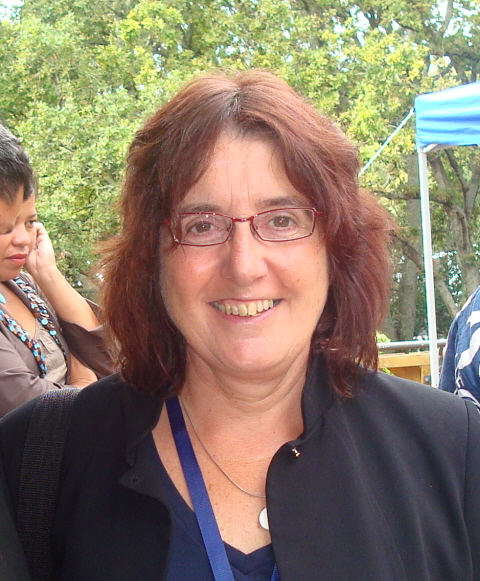
Jenny Bryant-Tokalau
Great News: Te Tumu’s Assoc Prof Jenny Bryant-Tokalau has just been appointed as Adjunct Professor in the School of Government, Development and International Affairs, Faculty of Business and Economics, at the University of the South Pacific in Suva, Fiji. Even better news…This doesn’t mean that Te Tumu will be losing Jenny, who is the Coordinator of our Pacific Islands Studies programme, and Chair of our Postgraduate Committee. The USP position is an honorary one in recognition of her research on Fijian topics.
Click here for the Otago Bulletin story.
Inaugural Te Tumu Postgraduate “Thesis Games”
We all know how difficult it can be to talk about our research, particularly when we have to do it succinctly. Te Tumu’s postgrad students were put to the test today with our first inaugural “Thesis Games”, with each presenting their research within about three minutes.
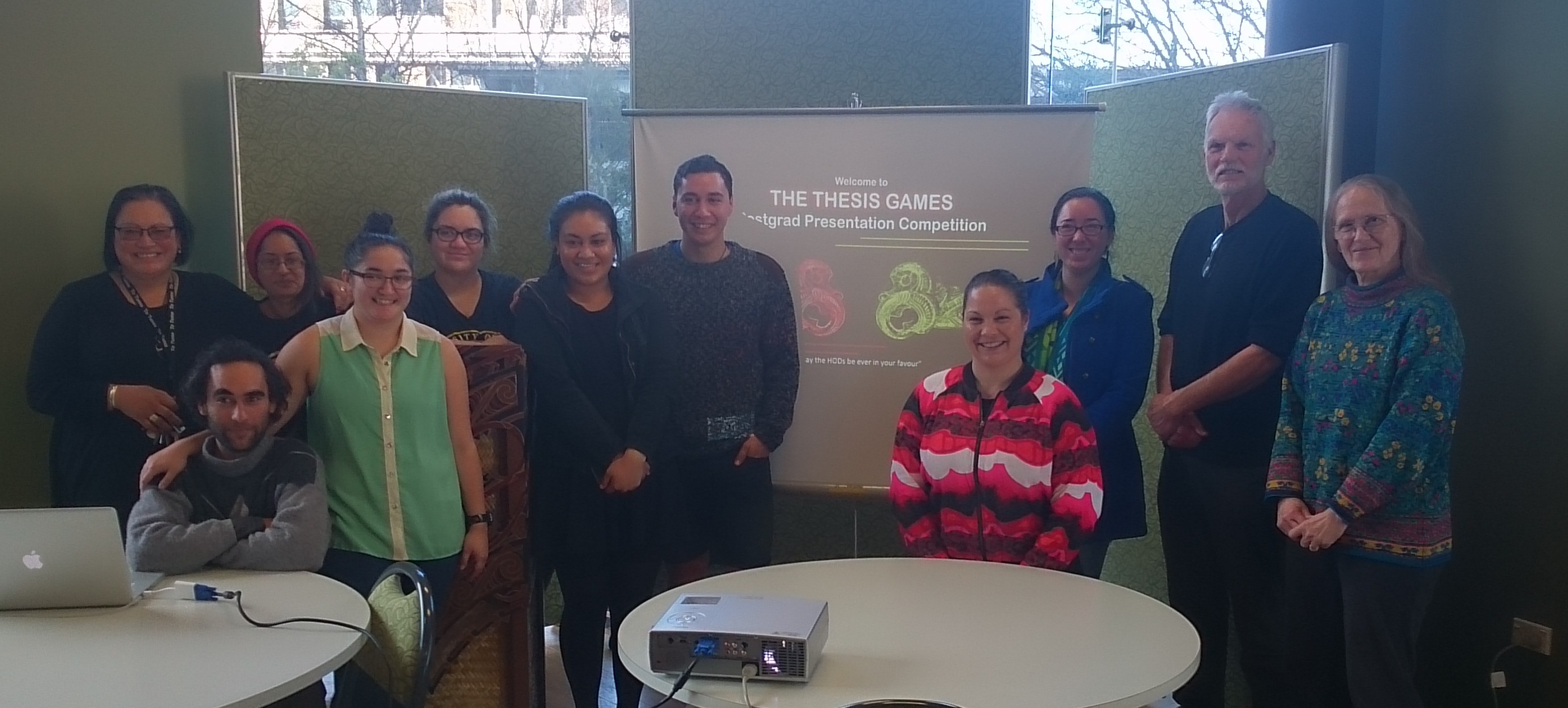
Click to enlarge. From left, Tangiwai Rewi, Hori Barsdell, Lana Arun, Gianna Leoni, Marcelle Wharerau, Ane Tatu, Tyson Tautari, Suzanne Duncan, Tawini White, John Birnie, Marsa Dodson.
The topics were many and varied: Tawini White: “He Manawa Hapū” (on hapū identity in Te Rarawa); Tyson Tautari: “Dogs Tale” (on the Polynesian dog); Ane Tatu: “Are you Dongan or Tongan? An examination of the ways in which New Zealand born and raised Tongans self-define and experience anga fakatonga (the Tongan way of life) and being Tongan”; Hori Barsdell: “What is the Significance of Pā Today?”; Lana Arun: “Archaeology and Tikanga” (on how Māori knowledge fits into the archaeoly profession; Marcelle Wharerau: “You Maaris get everything” (on perceptions of Māori privilege at university); Tangiwai Rewi: “Maaku anoo e hanga tooku nei whare…” (on intergenerational knowledge transfer within Waikato); John Birnie: “What if the mountain won’t come to Mohammed? Learner-centredness for adults learning te reo Māori”; Marsa Dodson: “Mixed blessings: Oral Histories of the War Children Born to US Servicemen and Indigenous Cook Islanders”; Gianna Leoni: “Power to Policy” (on the use of te reo Māori within government departments); and Suzanne Duncan: “Where is the whanau?” (on whānau involvement within the Māori economy).
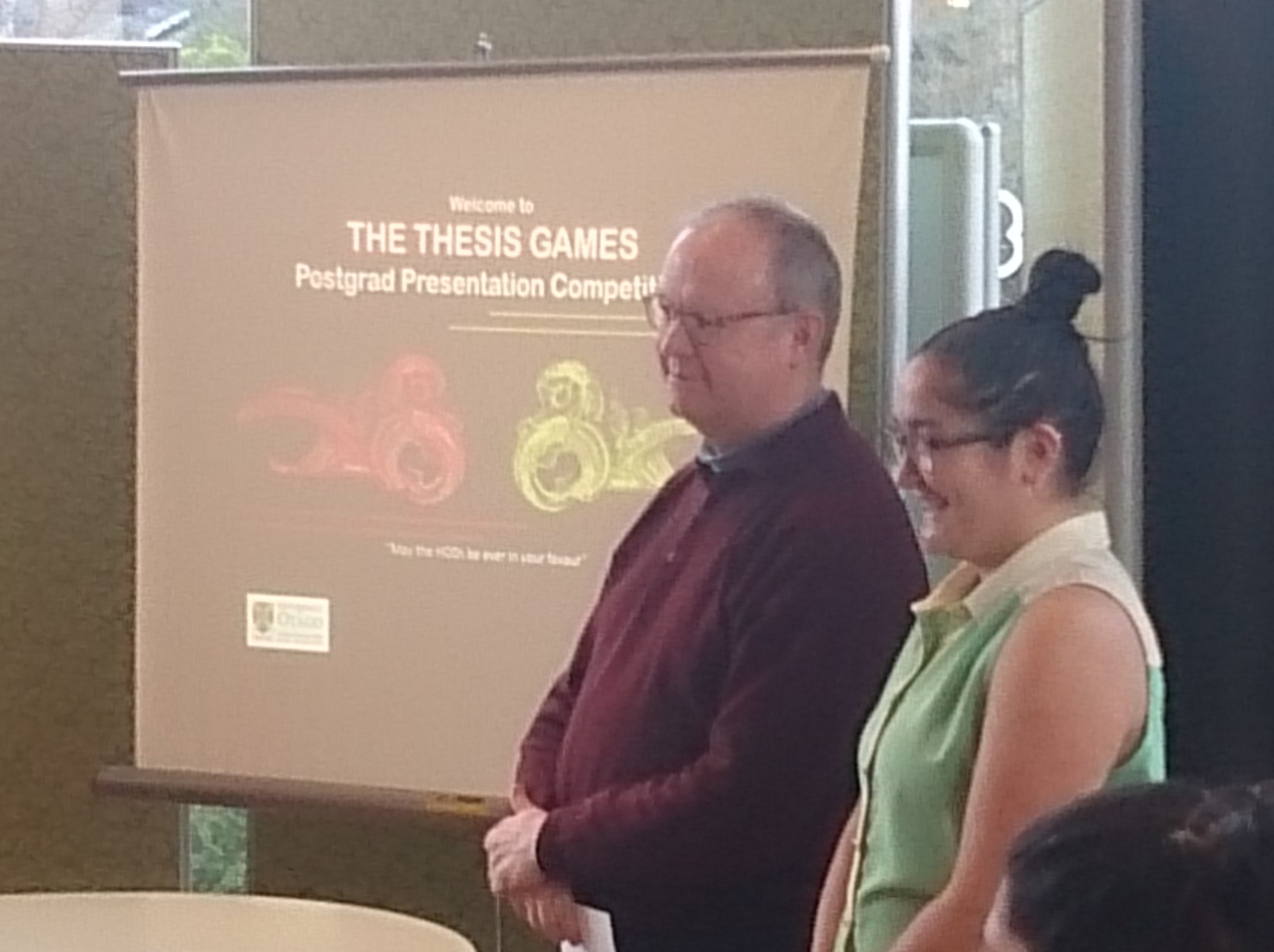
Professor Michael Reilly, Dean of Te Tumu, and the PhD winner, Gianna Leoni.
There was a great turnout of people, including a number of Te Tumu under-graduates. All the speakers were amazing and engaged the audience. Congratulations to the winners: Ane Tatu for Honours level, Marcelle Wharerau for Masters Level, and Gianna Leoni for PhD level.
Such was the success, Te Tumu is sure to hold another such event next year. There is even talk of something similar for staff.
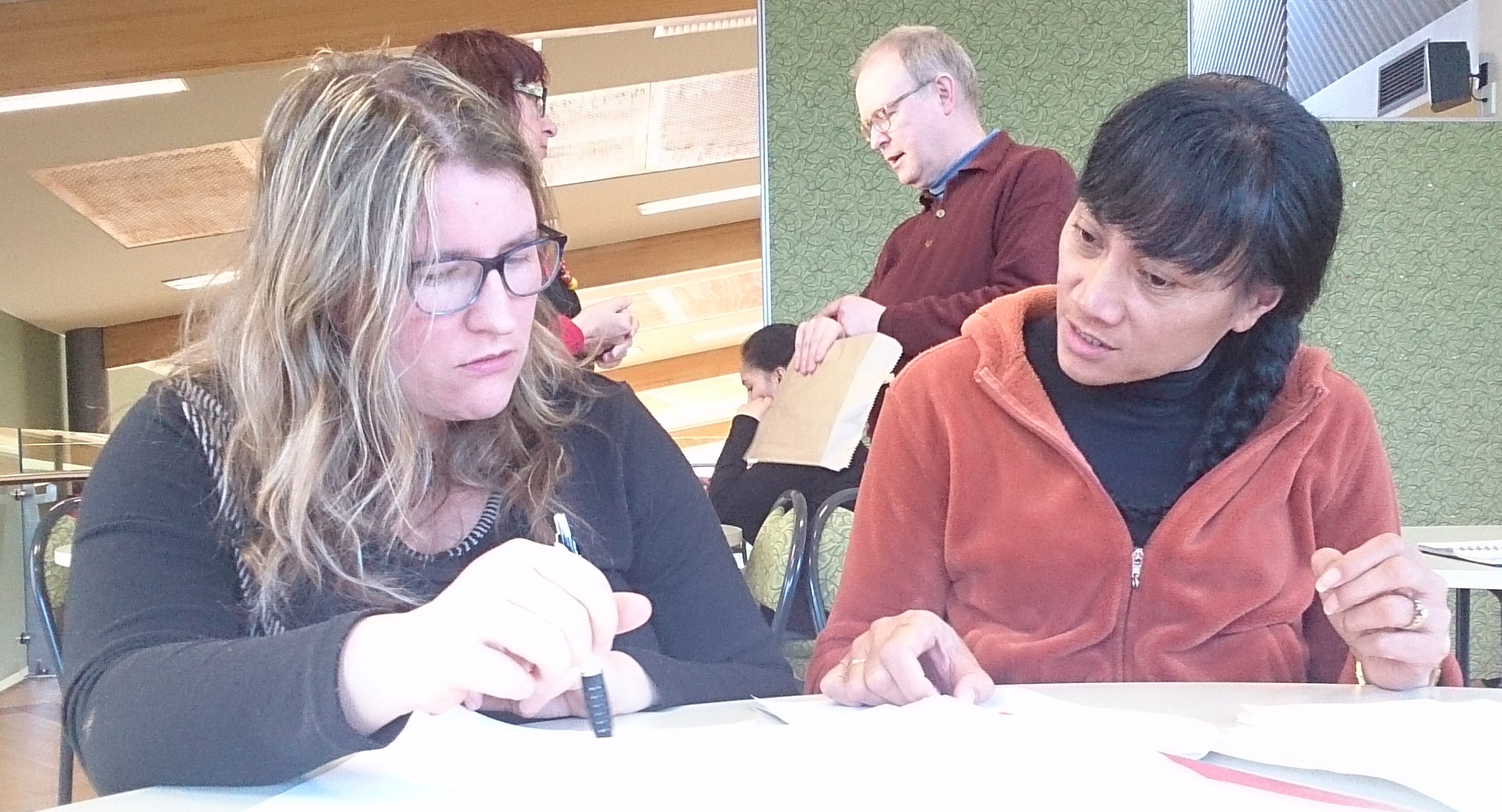
Special thanks to our judges, Shiobharn Smith, Māori, Pacific & Indigenous Subject Librarian, and Esme Eteuati, Pacific Islands Student Support Officer (Humanities).
Dr Karyn Paringatai’s success celebrated.
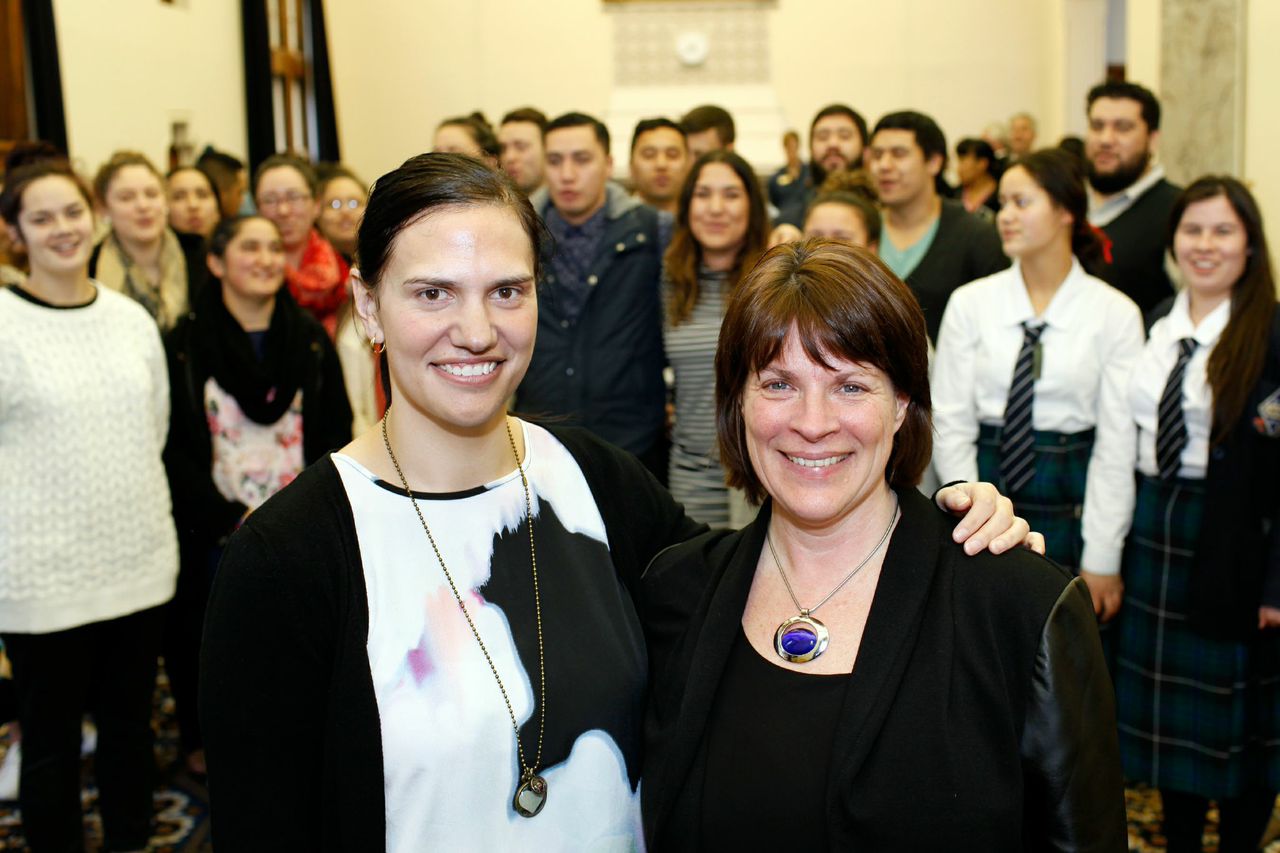
Te Tumu lecturer, Dr Karyn Paringatai and Professor Harlene Haynes, Vice Chancellor of the University of Otago.
On Monday night, the Vice-Chancellor celebrated Te Tumu staff member, Dr Karyn Paringatai’s success, with an event attended by many people from within the university, including Te Tumu staff and students. See the Otago Bulletin story here.
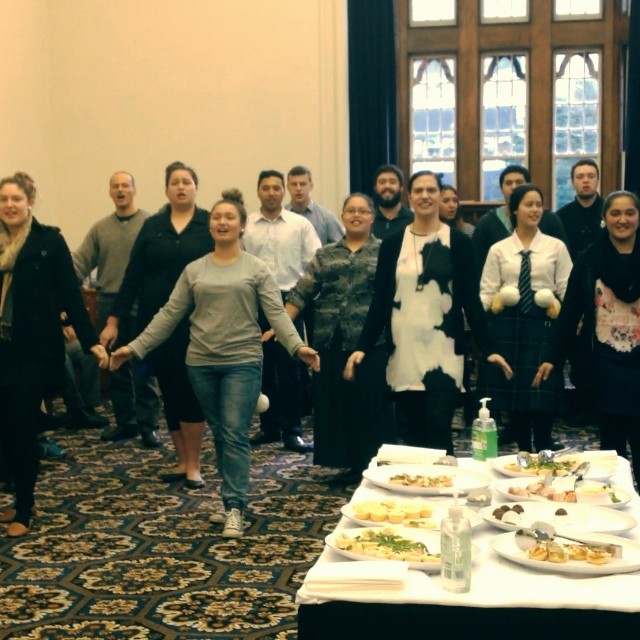
Indigenising the Academy – performing Ngoi Pewhairangi’s “Whakarongo” in the University of Otago’s Council Chambers to celebrate the success of Dr Karyn Paringatai.
Karyn won New Zealand’s top tertiary teaching award recently in Wellington, the Prime Minister’s Supreme Award for Tertiary Teaching Excellence, based on utilising the pre-contact Māori pedagogy of teaching in complete darkness, which has proved to be outstandingly successful in her performing arts paper, MAOR108 Waiata: Te Tīmatanga. Listen to the Radio NZ interview and Dunedin Television item in which Karyn explains her teaching practice.
Karyn has undertaken significant research to ensure that her teaching in the dark, and has just published on this ‘A Return to the “Dark Ages”’ in the journal Akoranga 10 (2014).
Just this week Karyn also employed the same methods in a guest lecture for the 900 students of MAOR102: Māori Society, showing that this pedagogy can be applied to more than just performing arts. She is planning to continue to use and develop “teaching in the dark” and publish more on this research.
Seminar Video: Killing Demons and Cultural Collisions
A Te Tumu Seminar by Megan Pōtiki, 16 July 2014.
“Killing Demons” is the title of a detailed account of tapu clearing activities that occurred at Ōtākou in 1865. The diary extract was written by H.K. Taiaroa. This account is an incredible example of a collision of fundamentally different religious beliefs. Christianity and Christian prayer meets one of the significant Māori demi gods.
New book on the value of the Māori Language
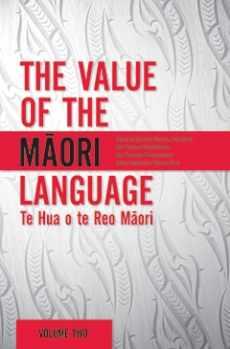 Te Tumu staff member, Associate Professor Poia Rewi and Professor Rāwinia Higgins of Te Kawa a Māui (Victoria University of Wellington) have released an edited collection, The Value of the Māori Language: Te Hua o te Reo Māori, with Huia Publishers. The book features 25 essays from an illustrious field of Māori commentators, responding to the question ‘What is the value of the Māori language?’ more than twenty five years after the passing of the Māori Language Act.
The book was launched recently in Wellington at an event attended by many of the big names of Māori-language education.
This publication is one output emerging from Poia and Rāwinia’s three-year project, Te Kura Reo – Waiora, research funded by Ngā Pae o te Māramatanga.
