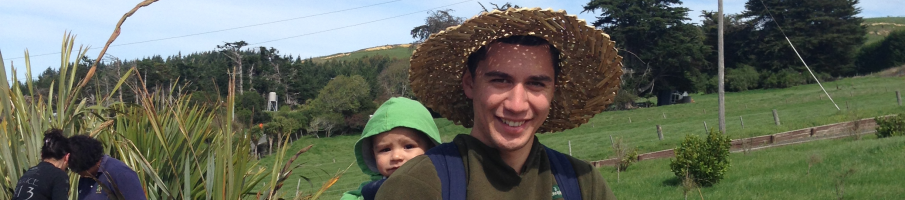
Te Kura Roa: Minority Language & Dialect Conference

click to enlarge
We are excited to announce the Te Kura Roa: Minority Language & Dialect Conference that will be hosted by Te Tumu: School of Maori, Pacific and Indigenous Studies at the University of Otago, Dunedin, 16-18 April 2015. Come along and listen to researchers and expert practitioners of minority and regional languages from around the world and Aotearoa/New Zealand, for what we hope will be an engaging and focussed forum. We see this conference as being of particular interest to minority language teachers and their students, researchers of linguistics and languages, policy makers, iwi/hapu language strategists and of course speakers of minority languages and dialects.
Te Tumu launches “Aki”.
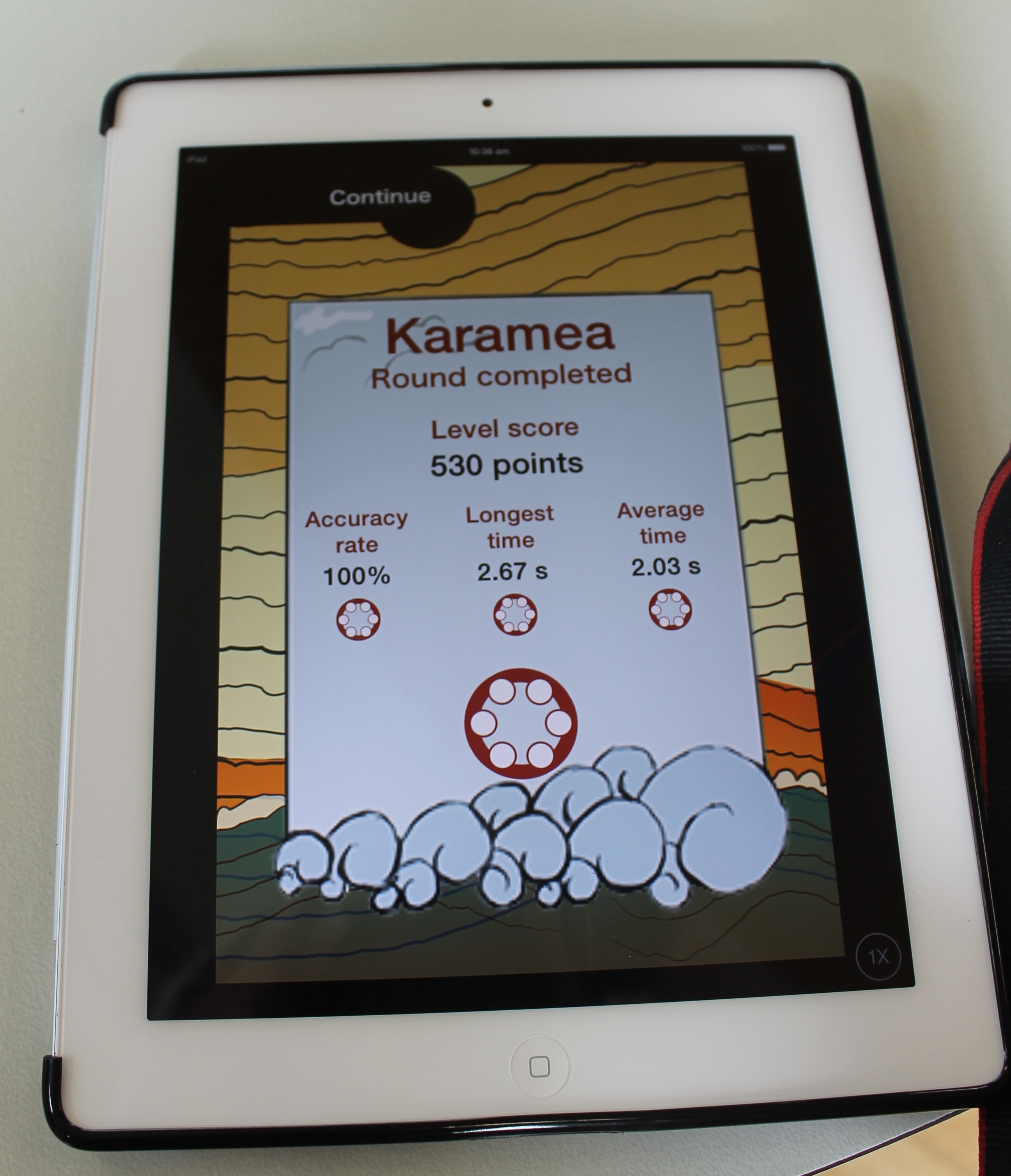
New I-Phone app to learn Māori vocabulary. click to enlarge
Te Tumu has launched “Aki”, a new I-Phone game for learning Māori-language vocabulary. The game can also be played on I-Pads.

Assoc Prof Poia Rewi and Dr Katharina Ruckstuhl
This project was headed by Associate Professor Poia Rewi of Te Tumu and Dr Katharina Ruckstuhl from Research and Enterprise. The game is informed by research by Te Tumu postgraduate students Nikita Hall and Kelly-Ann Tahitahi. Technical input from Design for Technology staff and students. Te Tumu students also assisted with the voices for the app. Learners will be able to increase their vocabulary (principally items and activities related to the home) while also competing with their friends. An Android version is currently being created.
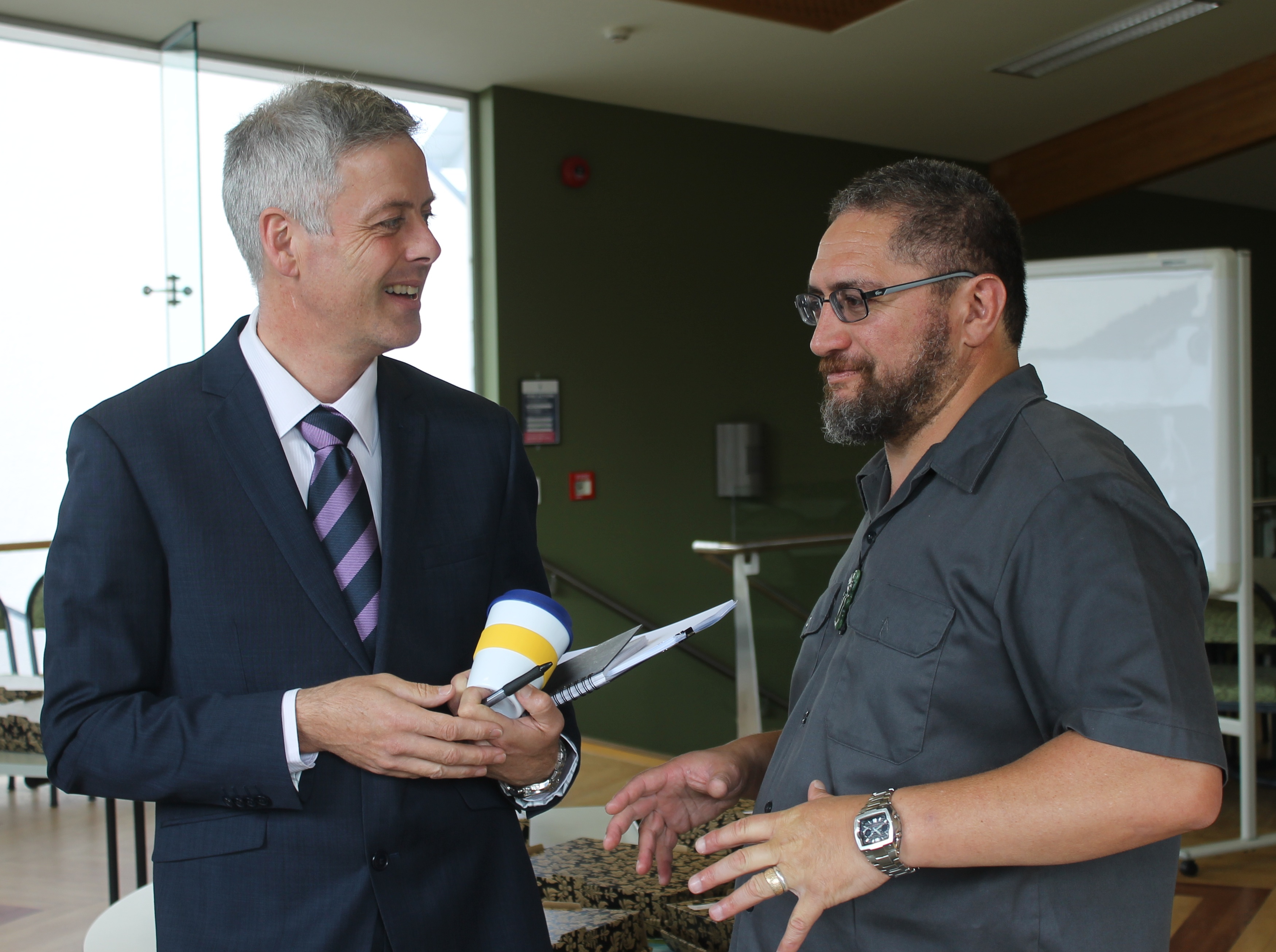
Prof. Richard Blaikie (DVC Research) and Assoc Prof Poia Rewi.
Kua whakamānutia e Te Tumu he kēmu Ī-Waea (ko “Aki te ingoa) hei ako i ngā kupu reo Māori. E pai ana hoki te pūmanawa tautono (app) mō te Ī-papa. Ko Associate Professor Poia Rewi (nō Te Tumu) rāua ko Dr Katharina Ruckstuhl (Research and Enterprise) ngā kaihautu. Nā ētahi ākonga paerunga, nā Nikita Hall rāua ko Kelly-Ann Tahitahi te rangahau mō te kēmu nei. I whakatutukitia te taha hanga kēmu e ngā kaiako me ngā ākonga o Te Toki a Rata (Design for Technology), ā, nō ētahi o ngā ākonga o Te Tumu ngā reo e rangona ana. Ka taea e ngā tāngata e ako ana i te reo te whakarahi tō rātou mōhio ki ngā kupu reo Māori (e pā ana ki ngā taputapu me ngā mahi o te kāinga), ā, ka whakataetae rātou ko ō rātou hoa. Kei te hangaia he tūmomo Android ināianei.
Story from the Otago Daily Times.
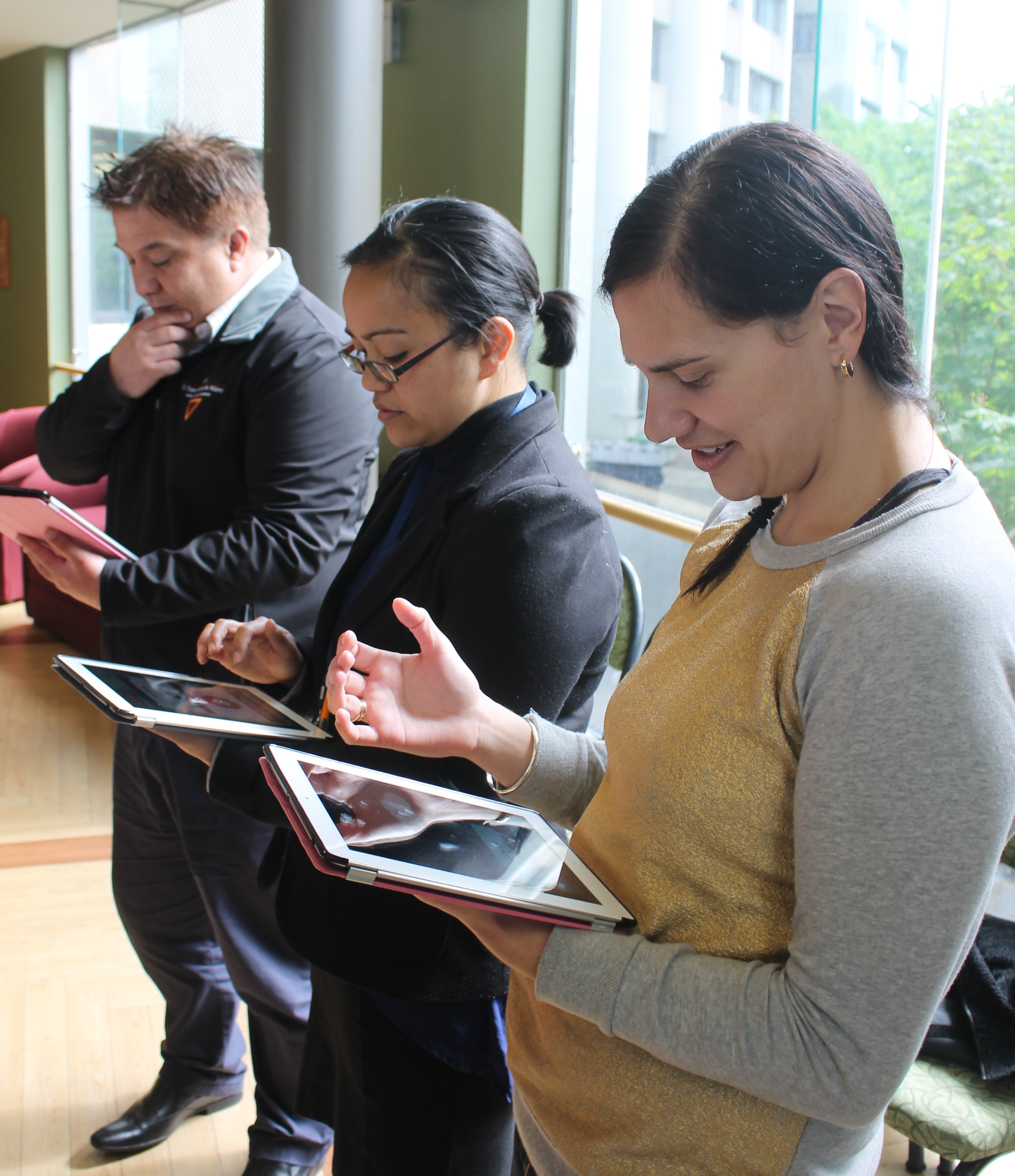
Gareth Seymour (nō Te Taura Whiri i te Reo Māori) rātou ko Migoto Eria (nō Te Whare Taoka o Ōtākou) ko Dr Karyn Paringatai (nō Te Tumu) e purei ana i te kēmu.
Public Lecture: “Scots and Indigenous Peoples in the Australian Colonies”
This might be of interest to some: Professor Ann Curthoys, a leading Australian historian who specialises in indigenous-settler interactions and relations, is giving a free public lecture entitled “Scots and Indigenous Peoples in the Australian Colonies” on Monday 24 November in Castle Lecture Theatre 1 at 3.30pm. Click here for full abstract and details.
Profiling: Jenny Bryant-Tokalau
It is an occassional feature of Te Tumu’s Research Blog that we profile members of our staff. This post features Associate Professor Jenny Bryant-Tokalau, who, amongst her many other activities, is currently Programme Coordinator for Pacific Islands Studies and Chair of the Postgraduate Committee in Te Tumu.
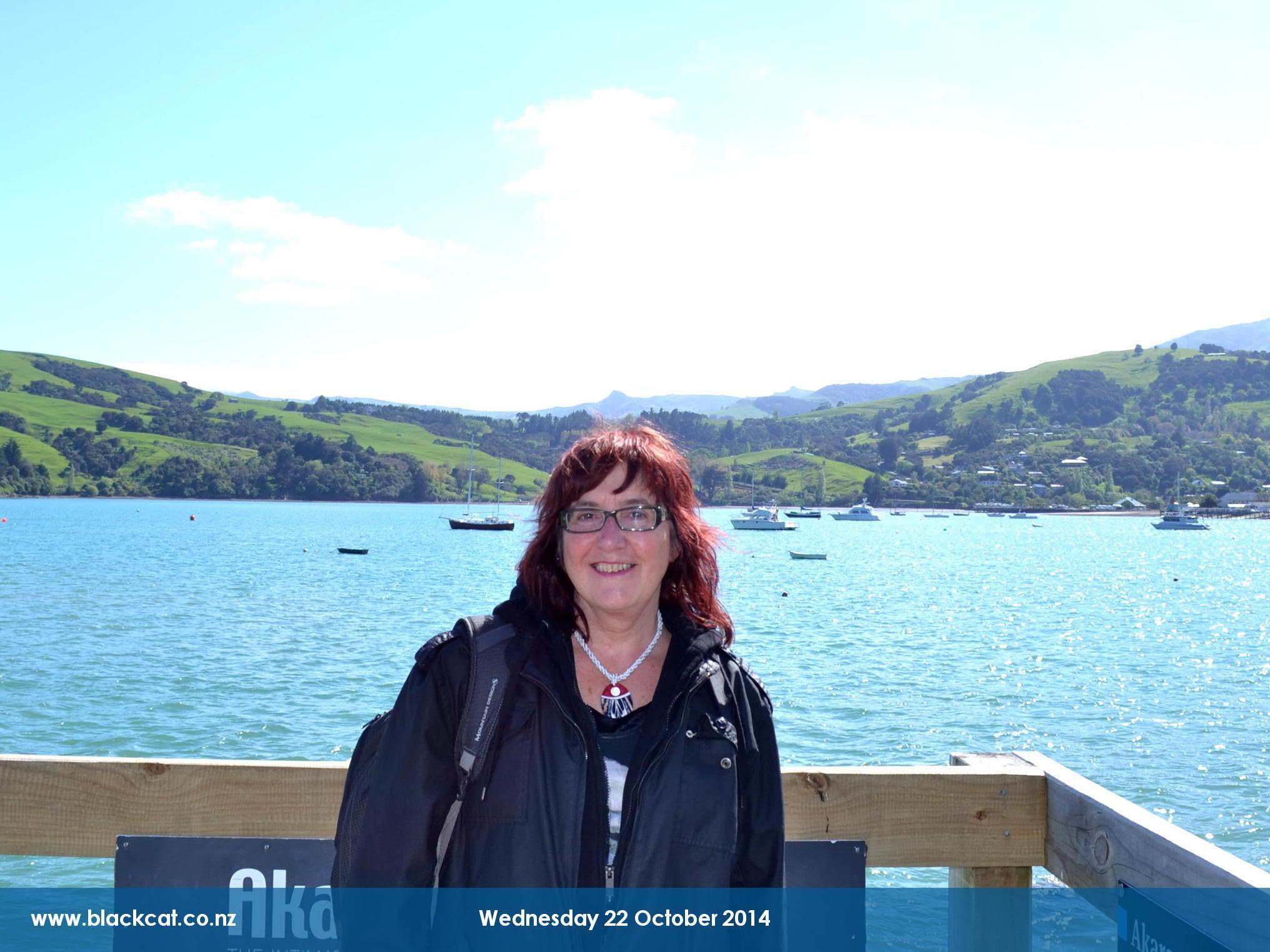
Associate Professor Jenny Bryant-Tokalau
Jenny Bryant-Tokalau (or Jenny Bryant as she was then known) was born in Dunedin and is descended from a mixture of British migrants who landed on the Otago coast between Moeraki and Surat Bay in the nineteenth century. Jenny’s mother grew up in North East Valley and was a secretary and later a teacher, and her Dad was a migrant rabbiter, saddler then electric linesman from Central Otago. Jenny is the eldest of three sisters and their Mum had hopes for them to be ‘like the Bronte sisters’. Fortunately this did not (quite) happen.
Jenny first visited the Pacific as a high school student when she was lucky enough to go on a school French trip to Noumea, New Caledonia. Later as an undergraduate Geography student, here at Otago, she went on a student exchange trip to Fiji for three months to carry out voluntary work at the National Archives in Suva. After a whole row of very old and decaying files about the island of Rotuma fell on top of her, Jenny decided to return the following year to gather material for her Post graduate dissertation. Three months of visiting Rotuman island families in the low cost housing settlements in Suva, the gold mine in Vatukoula and in the first Fiji capital of Levuka led to a successful dissertation outcome, and Jenny was on her way to a life of interesting research.
In 1975 Jenny was employed as an assistant lecturer in Geography at the University of Papua New Guinea. Her classes were large, and across the spectrum of environment, human geography and cartography. During her three years there Jenny travelled widely taking students on both biogeography and urban geography in the Highlands, visiting archaeological sites and carrying out her own MA research work on low-income housing and squatting in Port Moresby, Madang and Rabaul. Jenny also worked closely with the Lae City Council and the PNG Housing Authority. Although she loved PNG where life was very exciting and varied, a PhD and job beckoned at Monash University in Melbourne. There she tutored and lectured in Geography whilst working on her PhD on Aboriginal Housing with two years of assistance from the Australian Institute of Aboriginal Studies. Again, there was much fieldwork involved with long hours driving around Victoria from the northwest corner where the small town of Robinvale is located (where Jenny picked grapes and lived in a tent in the summer to fund her research), to the south west to the Framlingham Aboriginal Trust community, to Melbourne where she worked with the Aboriginal Housing, Health and Legal boards. Part-time consultancies with the Ministry of Housing and representations to the House of Representatives on Aboriginal housing filled in her spare time when not writing the PhD dissertation.
But the Pacific beckoned again. With the PhD almost completed Jenny took a job in Geography at the University of the South Pacific in Fiji where apart from teaching, consultancies, and running an environmental NGO she carried on with her research. At first, continuing from her by now major interest in housing for the poor, she became involved with assessing the size and conditions of squatter settlements across the country, and training students in such assessments. This lead to an involvement in growing poverty and inequalities, an appointment to the Fiji government’s committee on poverty, and then to more research on land and encroaching coastal environmental issues around the squatter settlements. All through the years at USP Jenny carried out work for various UN and regional agencies, especially the South Pacific Regional Environment Programme. Eventually she was kidnapped by UNDP and spent the next six years travelling around the Pacific and Asia working as a Sustainable Development Adviser and Head of Global Environment Facility programmes. In 2002 Jenny and family decided to return to NZ, to enable her husband Filipo to complete his PhD and for Jenny to take care of her mother. On Tino joined George St Normal School and Jenny worked firstly in Anthropology before joining Te Tumu. Her research continues in the Pacific, especially her other home of Fiji where she works largely around coastal urban land (the qoliqoli) and the urban poor, as well as on artificial islands as a response to climate change. Jenny has recently been appointed as an adjunct professor at USP where she maintains very close ties.
Click here to see Jenny’s research outputs, grants & distinctions, and supervisions on her official staff page.
Seminar: The Folk Linguistics of Māori Language Revitalisation
Nathan Albury, PhD student, will be giving a seminar in Te Tumu on 2.30-3.30pm, Tuesday 18 November in R3S10 (3rd floor, Te Tumu). Please note that this is a different day and venue to usual.
Nathan’s paper, The Folk Linguistics of Māori Language Revitalisation, “applies the folk linguistics of language policy in respect to language revitalisation as a policy project. It reports preliminary findings from research that sought to compare what young indigenous and non-indigenous youth in contemporary New Zealand claim to know about language revitalisation as a policy process, what attitudes and beliefs these youth have towards activities and themes aimed at revitalising the Māori language, and how their knowledge and beliefs manifest into folk linguistic performance when these youth are positioned as hypothetical language policy bosses of the New Zealand government.”
For the full abstract click here, or on the “Seminars” page on the left
Te Tumu Seminar: Guardianship in Early Colonial Fiji
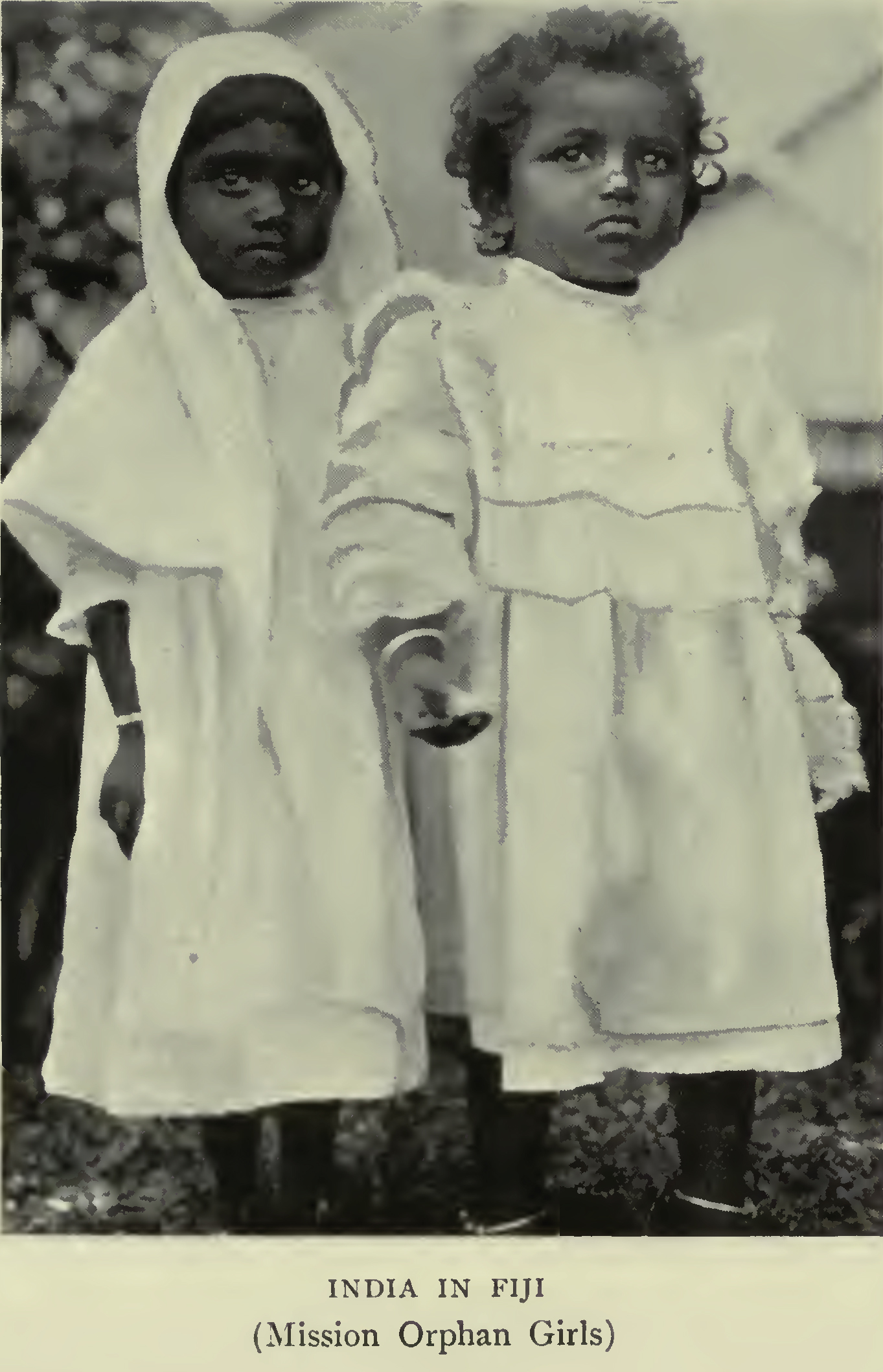
Image from: Burton, J.W. (1910). Fiji of To-Day. London: Charles H. Kelly
Te Tumu PhD student Erica Newman will be presenting the research presentation, Guardianship in Early Colonial Fiji, on 12 November. Please note that the venue and time have changed to previously advertised. It will now be 3.30-4.30 pm in R3S10 (3rd floor, Te Tumu building).
Abstract: Fiji became a British Colony in 1874 and within five years the Indian Indentured Labour Scheme was introduced to provide workers for the European owned plantations. Care of any orphaned children from these plantations was the responsibility of Colonial Office bureaucrats who applied the western systems of guardianship and adoption that they used throughout the Empire.This seminar will examine five examples of Colonial Office correspondence negotiating the approval of guardianship of children, between the years of 1889 to 1900. A study of these files reveals the circumstances of the child, those who were approved guardianship, and why they sought to become a guardian.
“Layers of History” video online
“Layers of History“, a Te Tumu seminar given by Jim Williams on 8 October is now available below.
Apologies for the delay.
Kelli Te Maiharoa featured on Otago Bulletin Board.
Te Tumu PhD student, Kelli Te Maiharoa, and her research on Māori peace legacies have just been featured on the latest Otago Bulletin. Click here to see more.
Two great talks coming up
This Wednesday, 1 October 2014, 5:30pm – 7:00pm in Archway 2 Lecture Theatre (This is a Public Lecture, open to all.)
The Fulbright/Te Tumu lecture by Sir Tamati Reedy (Ngāti Porou)
“Ngā Wai Whakaata o Hine-Kauorohia: The Reflecting Waters of Hine Kauorohia”
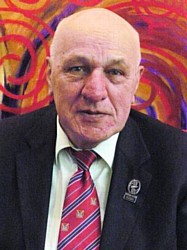
Professor Sir Tāmati Reedy
The Māori goddess Hine-kauorohia allows us to look into the stillness of her reflecting waters to see the past with clarity, gaze at ourselves in the shimmering present, and with a finger-touch, fathom a ruffled glimpse of the future.
The mauri, the life-essence, of Aotearoa New Zealand is our sense of nationhood. What is it? Who says so? I will focus on the themes of our history – Māori and Pākehā – reflecting on the hopes and promises of our partnership under the Treaty of Waitangi. I will comment especially on themes of our relationships: economic (land and people), socio-cultural (the realities of race-relations, identity and democracy), educational (the way to advantage), political (levers of power and privilege) and of course, my place as Māori in the future Aotearoa New Zealand.” – Sir Tamati Reedy
——-
Dr Jim Williams giving the Te Tumu Seminar on Wednesday 8.
To watch this LIVE, click here.
![Jim Williams[1]](https://blogs.otago.ac.nz/tetumuresearch/files/2014/07/Jim-Williams1.jpg)
Click to enlarge
Recent Te Tumu theses
Te Tumu had a number of its students honoured at the university’s recent Graduation, including several doing post-graduate research.

Sam Jackson
Samantha Jackson, “Ko Te Houhanga a Rongo marae tōku tūrangawaewae: In search of a philosophical standing place for indigenous development”, (MA Indigenous Development).
Supervisors: Professor Grant Gillett, Associate Professor Merata Kawharu, Dr. Paerau Warbrick
Abstract: Dominant paradigms of development assume a linear progression from one established point to another. These paradigms do not take into account the complexity of indigenous voice, spirit and ways of being-in-the-world, leaving indigenous peoples without a meaningful place to stand. To approach the question of indigenous development in such a straight forward manner is a methodological error which stands to obscure meaningful indigenous development and silence the indigenous spirit.
In order to appropriately investigate the question of indigenous development, I argue we must awaken ourselves to our assumptions which form the background of how we view and understand ourselves, the world and others. I draw on Martin Heidegger’s interrogation of Cartesian thought to provide a space through which indigenous development can be meaningfully approached from a tangata whenua (Māori, people of the land) philosophical perspective.
I utilise the traditions and teachings of Reverend Māori Marsden to posit a meaningful model of indigenous development must be rooted in Te Ao Mārama traditions (Māori worldview), a woven universe of connection between self, ancestors, universe and gods. This idea is mooted in an international indigenous context, before returning to the traditions pertaining to Te Houhanga a Rongo marae (Māori cultural complex), my own tūrangawaewae (place to stand). I argue marae are a manifestation of Te Ao Mārama worldview and therefore an appropriate site to investigate indigenous development. I utilise whakapapa (genealogy) and kōrero pūrākau (stories of origin) as important mechanisms through which one can come to understand and organise the relationship between a person, their world and their gods. Maintaining an intimate relationship within the woven universe validates a person’s tūrangawaewae giving them the ‘sureness of touch’ of a person firmly rooted in belonging with unlimited potential for human development.
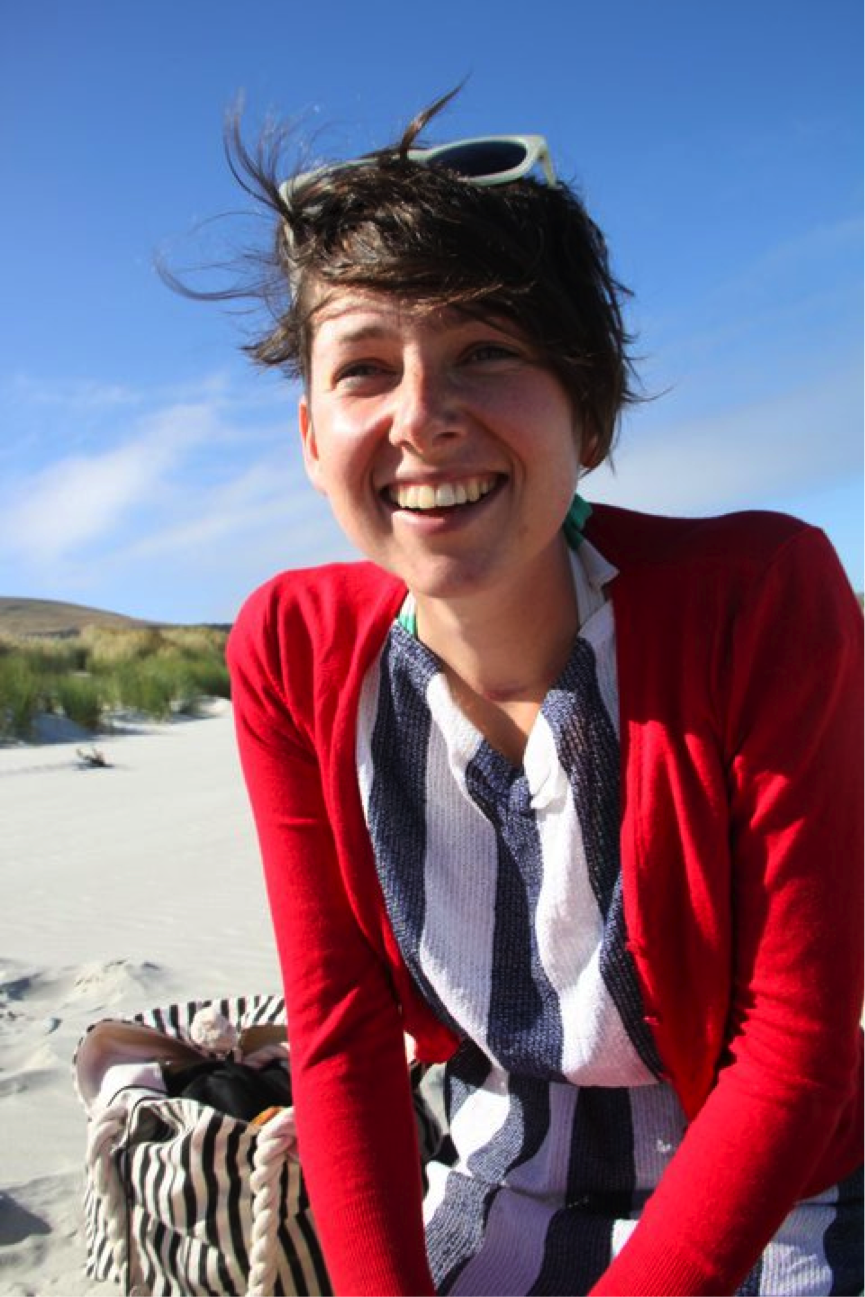
Nicole McCrossin
Nicole McCrossin, “Intention and Implementation: Piecing Together Provisions for Māori in the Resource Management Act 1991″, (MA, Indigenous Development)
Supervisors: Dr Janet Stephenson and Dr Jenny Bryant-Tokalau
Abstract: Today, it is widely recognised that indigenous people have a valuable contribution to make to the development and practice of resource management. New Zealand legislation recognises in part the importance of Māori participation; however, there appears to be a considerable gap between the recognition of these rights and their effective and widespread implementation at ground level. This study explores the intentions behind, and the implementation of Section 33 transfers of power and Sections 36B-E joint management agreements, under the Resource Management Act 1991, which support Māori participation in resource management decision-making. These provide for the devolution of power from local authorities to iwi authorities and the establishment of agreements to co-manage resources with iwi. A nationwide survey of local authorities’ use of the provisions demonstrated that they had been virtually unused. The majority of local authorities do not have any form of co-management agreements with Māori, and those that do have quite constrained arrangements which are designed to enhance consultation, rather than shared decision-making. The results of the survey are contrasted to findings from a series of semi-structured interviews with key informants involved in the crafting of the RMA, which examines the intentions behind the inclusion of these mechanisms in the legislation. The concept of institutional bricolage is used to help explain their creation and implementation, and the subsequent negotiation of the mechanisms and their alternatives by councils. The survey and interview results revealed that an intentional institutional bricolage approach was frequently employed by councils and iwi to negotiate co-management arrangements, but was not used in the crafting of the RMA co-management provisions. Instead, the provisions were a result of unintentional institutional bricolage, drawing on a range of structural and social influences.
