Latest Masters of Indigenous Studies Graduate
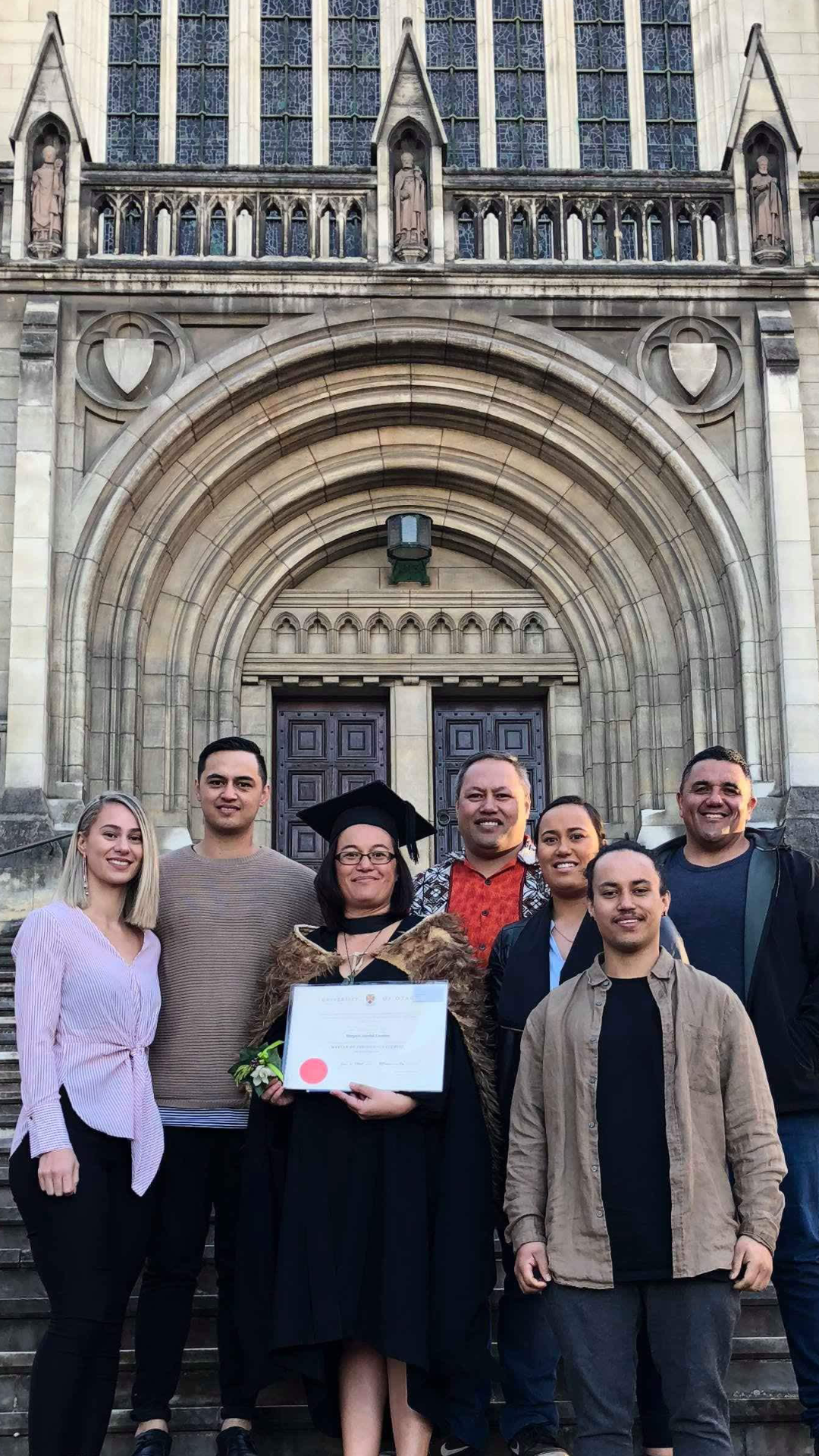
Margaret Courtney and her whānau. (Click to enlarge)
Graduation is always the culmination of a lot of hard work. At last week’s graduation, we had our latest graduate, Margaret Courtney, walk across the staff to collect her hard-earned Masters of Indigenous Studies degree certificate. Margaret, of Te Arawa (Tūhourangi,
Ngāti Whakaue, and Tapuika), also holds an LLB from Waikato University, and works as a Regional Advisor for Te Puni Kōkiri. I asked her to send me a short account of her studies, and the abstract of her research dissertation. Koia kei a koe, Margaret!
“My journey to complete my Masters qualification was a journey of personal growth, perseverance and enlightenment. Combining my experience of Whenua Māori, the Native Land Court system and integrating it with the history of our tūpuna and iwi has helped to fill knowledge gaps for my whānau. Given our ‘nuclear family’ upbringing my research emphasised the importance of Whenua Māori as a connection to our tūpuna but also strengthens our Whānau Mātauranga. It is this knowledge that we can pass onto our tamariki and mokopuna.
“The Master of Indigenous Studies programme at Te Tumu was the best option for me given I live and work in Rotorua. It provided a part time online option which complimented by mahi and lifestyle. The paper offerings provided choice and completing the dissertation cemented my learnings. I enjoyed the mixed forms of delivery and assessments.
“I am thankful for the support and patience of my supervisor Dr Paerau Warbrick. He provided good advice, steered me on track when needed, and helped me to extend my knowledge and research skills. Ka nui te mihi ki a koe, e whānaunga! To my whānau, your continued support is unwavering!”
Abstract
This research supports the view that whenua Māori is important in today’s global environment and remains a vital connection to our tūpuna, our iwi and our whānau history.
This is illustrated through an exploration of the author’s connection to Tūhourangi, an iwi of Te Arawa, the impact that the Native land legislation had on Tūhourangi and specifically the whenua, Rotomahana Parekārangi in the nineteenth century. The research explores the path of Rotomahana Parekārangi through the Native Land Court regime. The research concludes with an example of how the author’s whānau are making attempts to transmit their collective whānau mātauranga to the younger members of their whānau. This is in order to provide the whānau with experiences of the whenua, of their iwi and to understand the importance of their connection to the whenua derived from their tūpuna. It is important that the younger generation are cognisant of these connections and whānau mātauranga as, in time, they will become the kaitiaki of the whenua, and will need to pass this knowledge onto their mokopuna.
New book: Indigenous Pacific Approaches to Climate Change
 Climate Change is an issue for the Pacific. We are delighted to announce the lastest book by a Te Tumu scholar, Dr Lyn Carter, Indigenous Pacific Approaches to Climate Change, published as part of Palgrave’s Studies in Disaster Anthropology Series.
Dr Carter, a Ngāi Tahu scholar, is a member of Te Tumu’s Indigenous Development programme, and teaches the popular INDV301 course, Māori and Indigenous Development Ethics and Government.
From the publisher: “Situating Māori Ecological Knowledge (MEK) within traditional environmental knowledge (TEK) frameworks, this book recognizes that indigenous ecological knowledge contributes to our understanding of how we live in our world (our world views), and in turn, how we adapt to climate change.
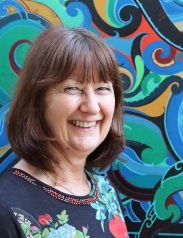
Dr Lyn Carter
“As an industrialized nation, Aotearoa/New Zealand (A/NZ) has responsibilities and obligations to other Pacific dwellers, including its indigenous populations. In this context, Lyn Carter discusses how A/NZ can benefit from the wider Pacific strategies already in place; how to meet its global obligations to reducing greenhouse gases; and how A/NZ can utilize MEK to achieve substantial inroads into long-term adaptation strategies and sustainable practices. Carter demonstrates that in all respects Māori tribal groups are well-placed to be key players: adaptation strategies, policies, and practices are integrated throughout Māori/Iwi traditional knowledge.”
Click here to access this new book.
Sudesh Mishra seminar

Professor Sudesh Mishra
Te Tumu is honoured to be hosting Professor Sudesh Mishra from the University of the South Pacific, Fiji, who is in Dunedin for the next six weeks on the Ratu Sir Kamisese Mara Fellowship. He is a noted poet and literary critic, but his research is now taking new directions, in particular looking at Indigenous responses to modern ecological crises, such as climate change.
He will be giving a lecture in the Te Tumu Seminar Series at 3pm on 24 August on the Ground Floor of Te Tumu, entitled “On Seeing a Bull’s Skull in a Bicycle Seat: Innovative Archaisms in Oceania.” More details in the poster below. Please feel free to come along, and circulate this blog post to anyone who might be interested.
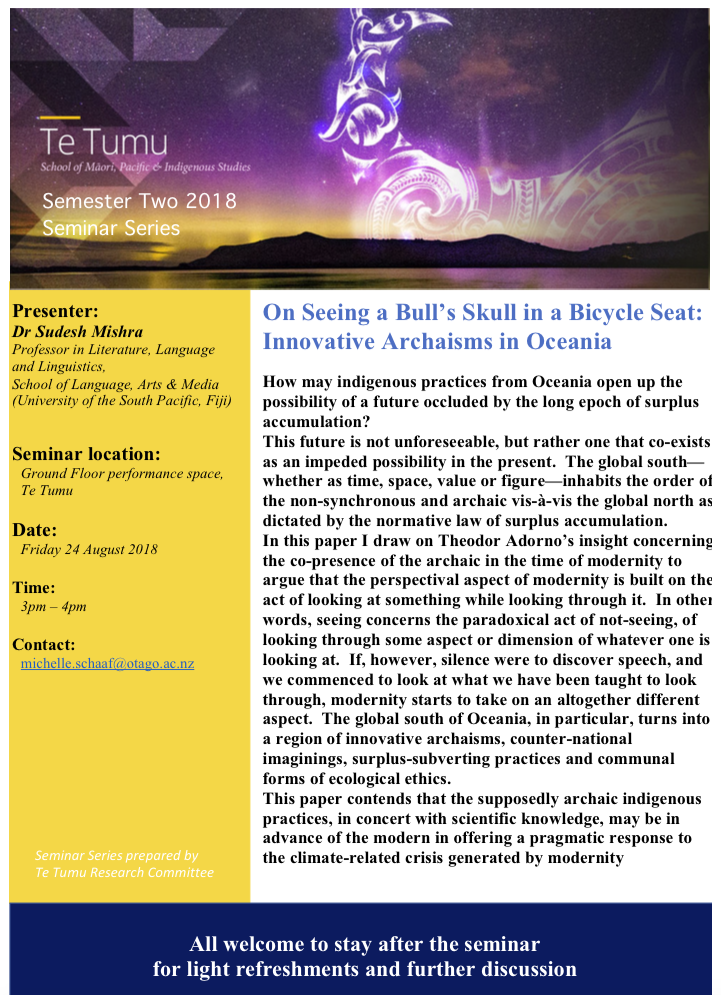
Click on image to enlarge.
Talitali fiefia, to our new Pasifika lecturer
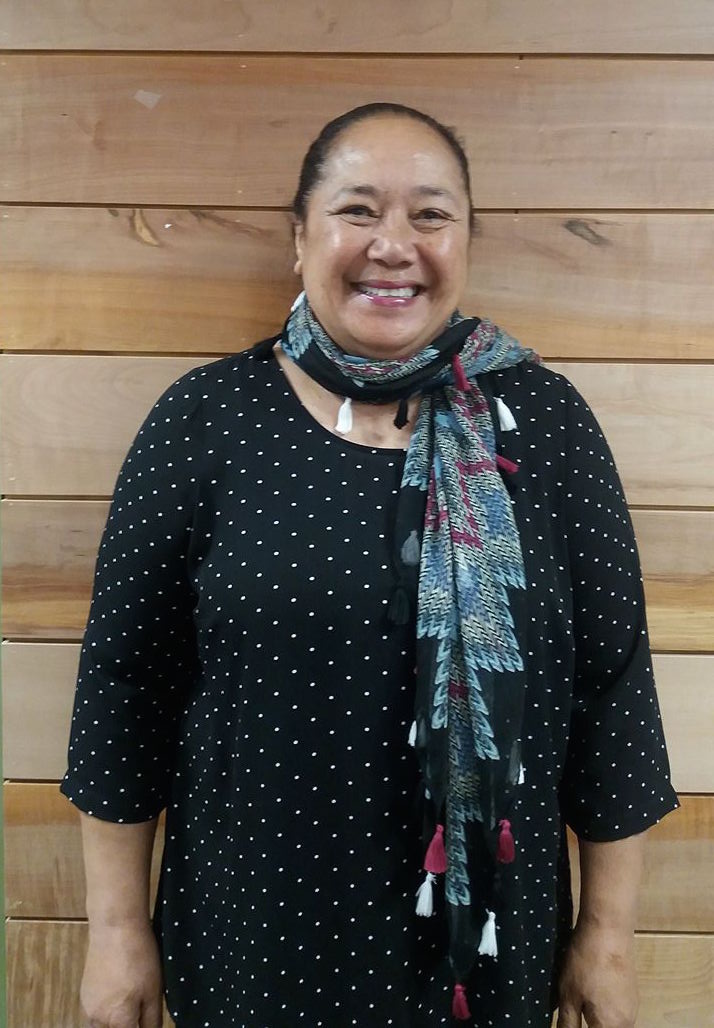
Dr. Telesia Kalavite
Mālō e lelei. Te Tumu is very pleased to introduce our new lecturer, Dr. Telesia Kalavite, who has just joined our staff. Telesia will be teaching in the Pacific Islands Studies programme, as well as in the Indigenous Development programme.
Dr Kalavite is a professional Tongan educator who has taught in Tonga, Fiji, New Zealand and Australia at primary, secondary and tertiary institutions for many years. Her tertiary education working experiences were at Tonga Institute of Education, Waikato Institute of Technology, The University of Waikato, The University of Southern Queensland and now The University of Otago. Her qualifications include: Teachers’ Certificates (TC), a Diploma in Education (DipEd), a Bachelor of Arts (BA), a Postgraduate Certificate in Education (PGCertEd), a Master of Education (MEd), a Postgraduate Diploma in Educational Leadership (PGDipEDL), and a Doctor of Philosophy (PhD). Whilst in the teaching profession Telesia worked for the development of her own Tongan people as well as Pacific peoples’ communities. She is a passionate community person who actively participated in many youth, church, university, community groups and non-government organisations.
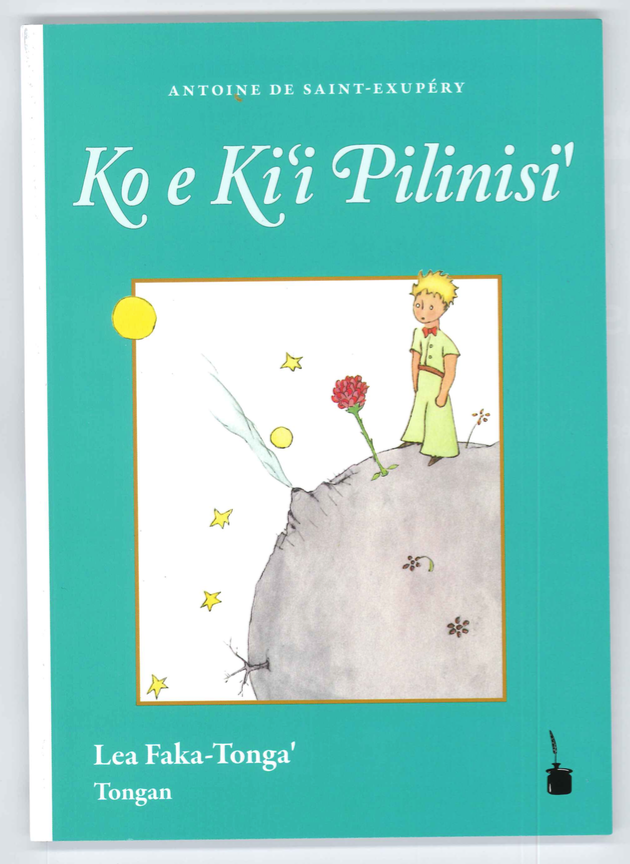
Ko e Ki’i Pilinisi’ (2018). Dr Kalavite’s translation of Le Petit Prince.
She believes in grassroots development to alleviate the harsh conditions of disadvantage. Her passion and research interest are in Pacific and indigenous educational development worldwide in particular New Zealand, Australia and the Pacific region.
Dr Kalavite is also a noted translator of works between the English and Tongan languages. One of her most recent works is Ko e Ki’i Pilinisi’, a translation of Antoine de Saint-Exupery’s famous novella, Le Petit Prince (The Little Prince). We are excited that she will be offering an introductory Tongan language paper in Summer School next year.
We are delighted to welcome Telesia, and her husband Sione, to Te Tumu, and to Dunedin.
Te Kōparapara Book Launch
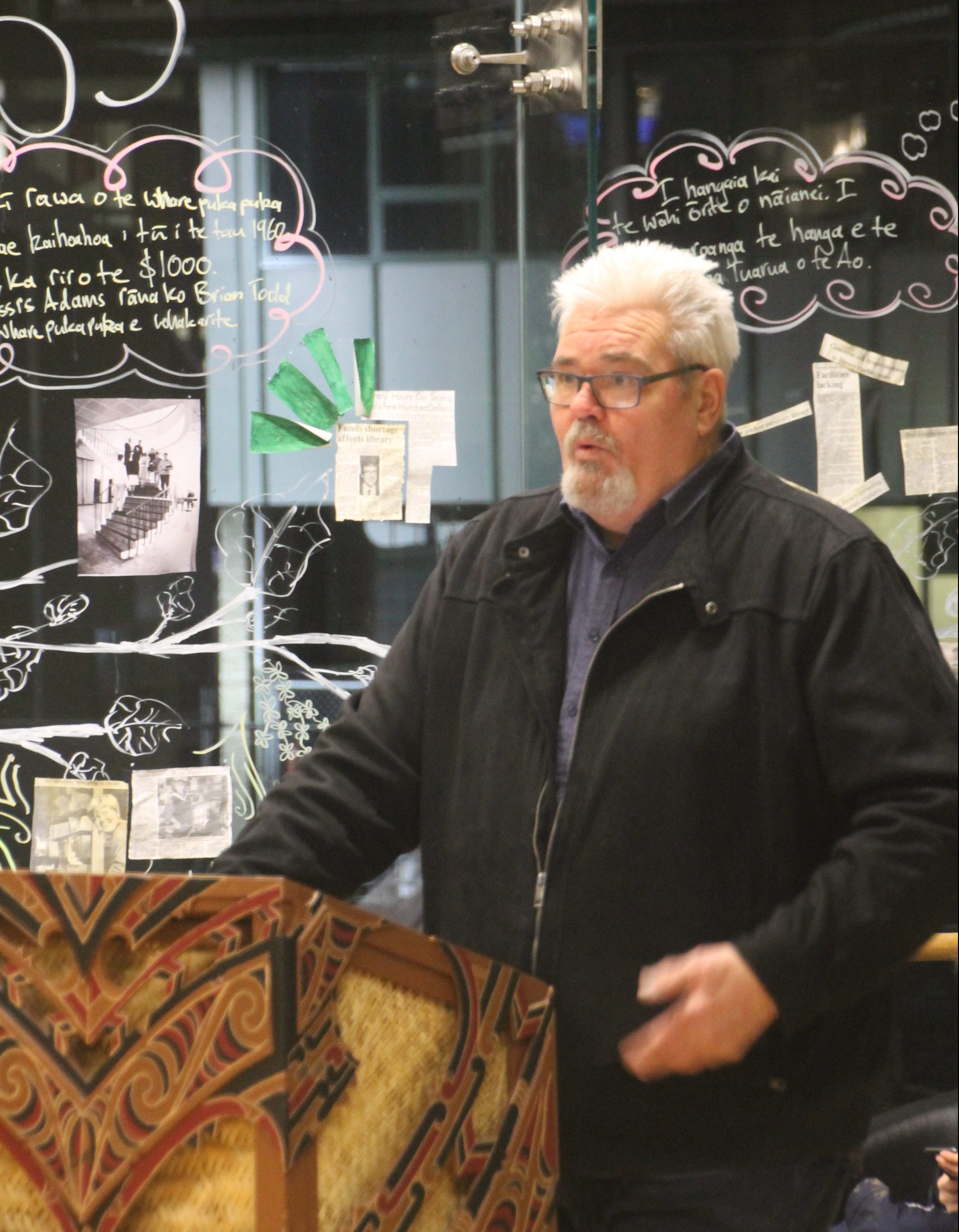
Ōtākou Rūnaka Representative, Tahu Pōtiki
Te Tumu enjoyed a great launch last night of its new book, Te Kōparapara: An Introduction to the Māori World. Published by Auckland University Press [click here to order online] , this book will be used by Māori Studies staff in their teaching, particularly for the MAOR102 Māori Society paper.
The event was MC’d by Professor Poia Rewi, the Dean of Te Tumu, then launched by local Ōtākou Rūnaka Representative, Tahu Pōtiki, who reminisced about his own time as a student at Otago, and how there was a gap in local Ngāi Tahu presence in Māori Studies at that time, something that this new book goes some way in filling. Lead editor Professor Michael Reilly spoke on the processes of wrangling such a large number of authors and editors, and of the exemplary work of Ginny Sullivan, AUP’s copy editor who sadly passed away. AUP Director, Sam Elworthy also spoke, singing the praises of the scholarly work being produced by Te Tumu.
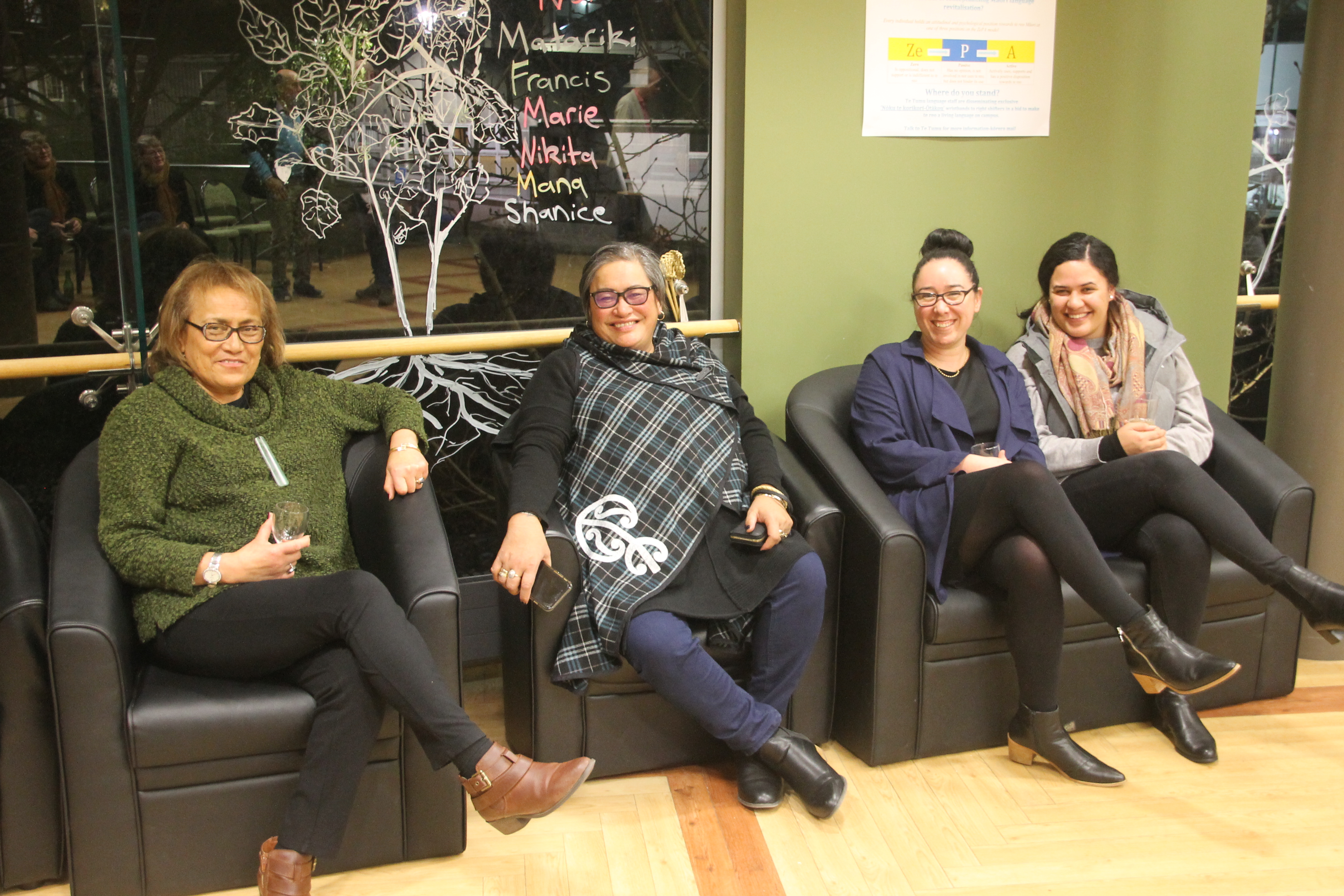
Pearl, Tangiwai, Tawini and Nadine. Click to enlarge.

A beaming Sam Elworthy, from Auckland University Press.

Good friends of Te Tumu
New book: Indigenous Pacific Approaches to Climate Change
 Jenny Bryant-Tokalau of our Pacific Islands Studies programme has just published a new book, Indigenous Pacific Approaches to Climate Change, with Palgrave Macmillan, as part of the Palgrave Studies in Disaster Anthropology. As the series editors note, this volume “is explicitly written as a companion to another study for our series, by Dr. Lyn Carter, on Maori TEK [Traditional ecological knowledge] (MEK) in Aotearoa New Zealand.” Lyn is a staff member of Te Tumu’s Indigenous Development programme.
Jenny’s new book covers a wide range of contemporary issues, such as climate change; social conflicts that result from forced re-settlement processes eventuating from environmental alterations, e.g., desertification shoreline loss, sinking islands, rising seas. See the contents below.
For more information, or to download Indigenous Pacific Approaches to Climate Change click here.
In all good bookstores soon!
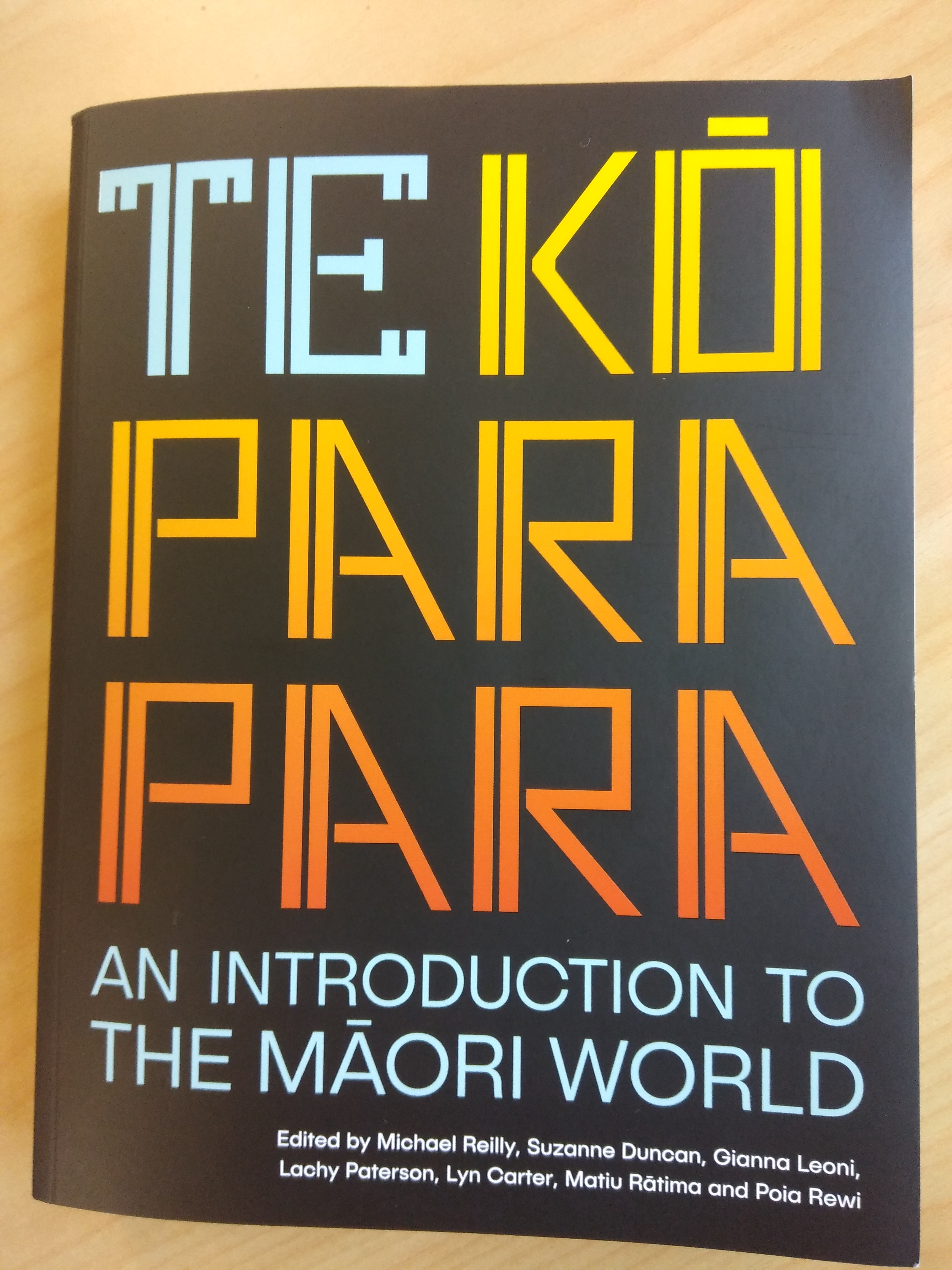
Click image to enlarge.
Ka tangi the kōparapara! Te Tumu staff are delighted with the advance copy of their new book, Te Kōparapara: An Introduction to the Māori World, which arrived a few days ago. This book, published by Auckland University Press, will be out in bookstores next month. Te Tumu will use it as a textbook for our MAOR102: Māori Society paper, replacing Ki Te Whaiao, which staff put out in 2004. But Te Kōparapara will also be of interest to anyone wanting to learn more about te ao Māori.
The kōparapara is the bellbird, the most impressive native songbird, and its tangi is used as a metaphor for the twenty-one chapters in the book. There are three sections. “Te Tumu: Foundations” looks at pre-contact history and Māori culture both from a traditional standpoint, but also in the present. The second section, “Tāhuhu Kōrero: Histories” examines the past from Māori first contacts with Pākehā newcomers to the post-war urban migrations. This leads into “Tākiri the Ata: Futures” which looks at contemporary Māori society and its future. See the contents pages for fuller details. Also click the AUP webpage to access some sample pages.

Contents. Click to enlarge.
A number of Te Tumu staff, past and present, have contributed to the book: Michael Reilly, Suzanne Duncan, Poia Rewi, Merata Kawharu, Erica Newman, Paul Tapsell, Megan Pōtiki, Lachy Paterson, Karyn Paringātai, Tangiwai Rewi, Matiu Rātima, Lyn Carter, our postdoc, Gianna Leoni, and former postgrad students Marcelle Wharerau and Tawini White.
We would also like to send out a big mihi to the other authors who also contributed chapters, including from Otago: Richard Walter (Anthropology), Erik Olssen (History, emeritus), Janine Hayward (Politics), Tom Brooking (History), Jacinta Ruru (Law), Anne-Marie Jackson and Hauiti Hakopa (PE), Joanne Baxter (Health); and from further afield, Michael Belgrave (Massey), Richard S. Hill (Victoria), Te Taka Keegan (Waikato) and Acushla Sciascia (AUT). And of course, Sam Elworthy and the team at Auckland University Press.
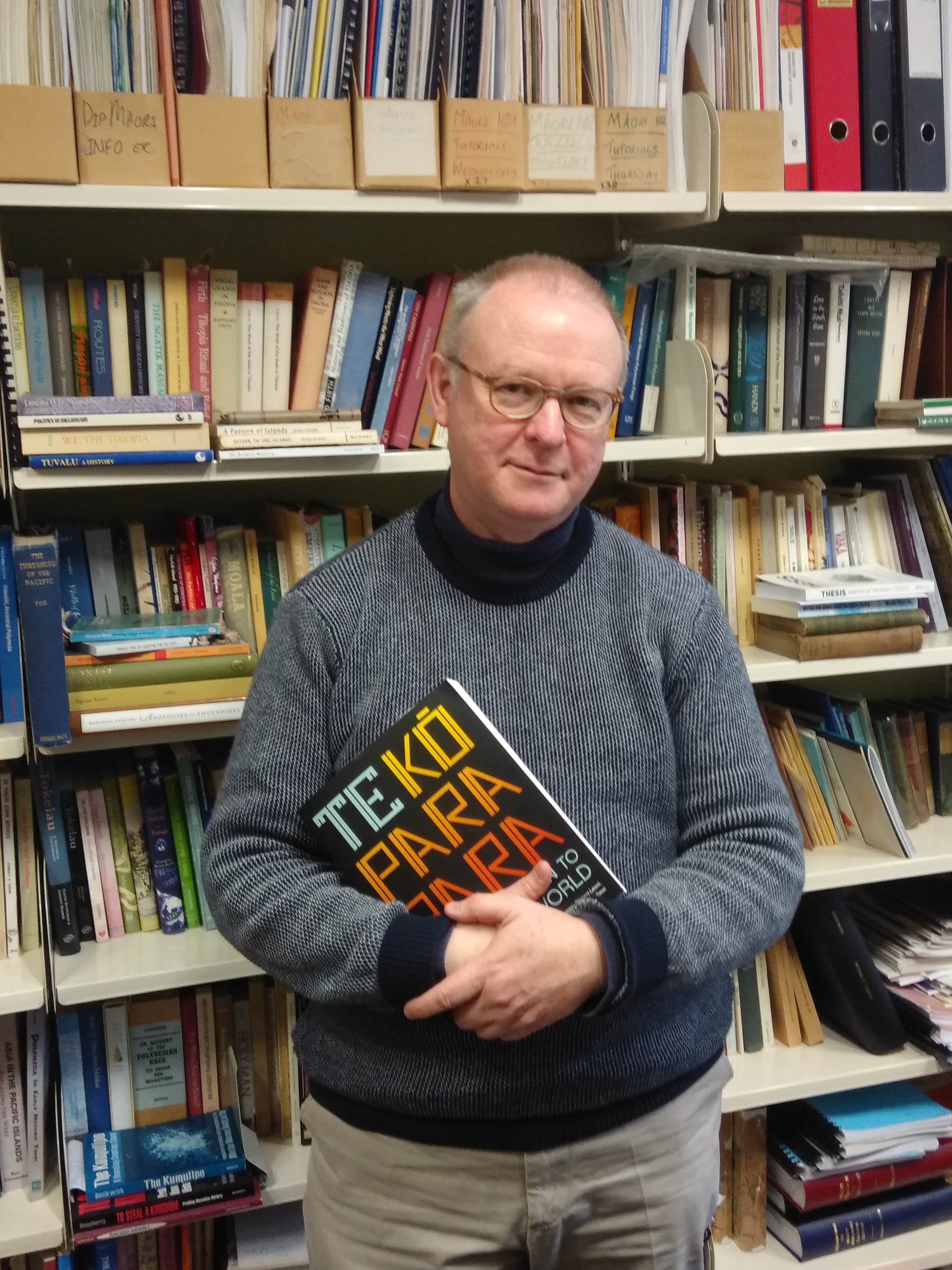
Professor Michael Reilly
In particular, we must acknowledge Professor Michael Reilly who led the project, ably assisted by Suzanne Duncan and Gianna Leoni, wrangling all the contributors (and co-editors), communicating with the publisher, and making sure all the little tasks were completed. He mihi nui ki a koe, Michael; mei kore ake koe hei hautū i te kaupapa nei.
Hard Copies Submitted
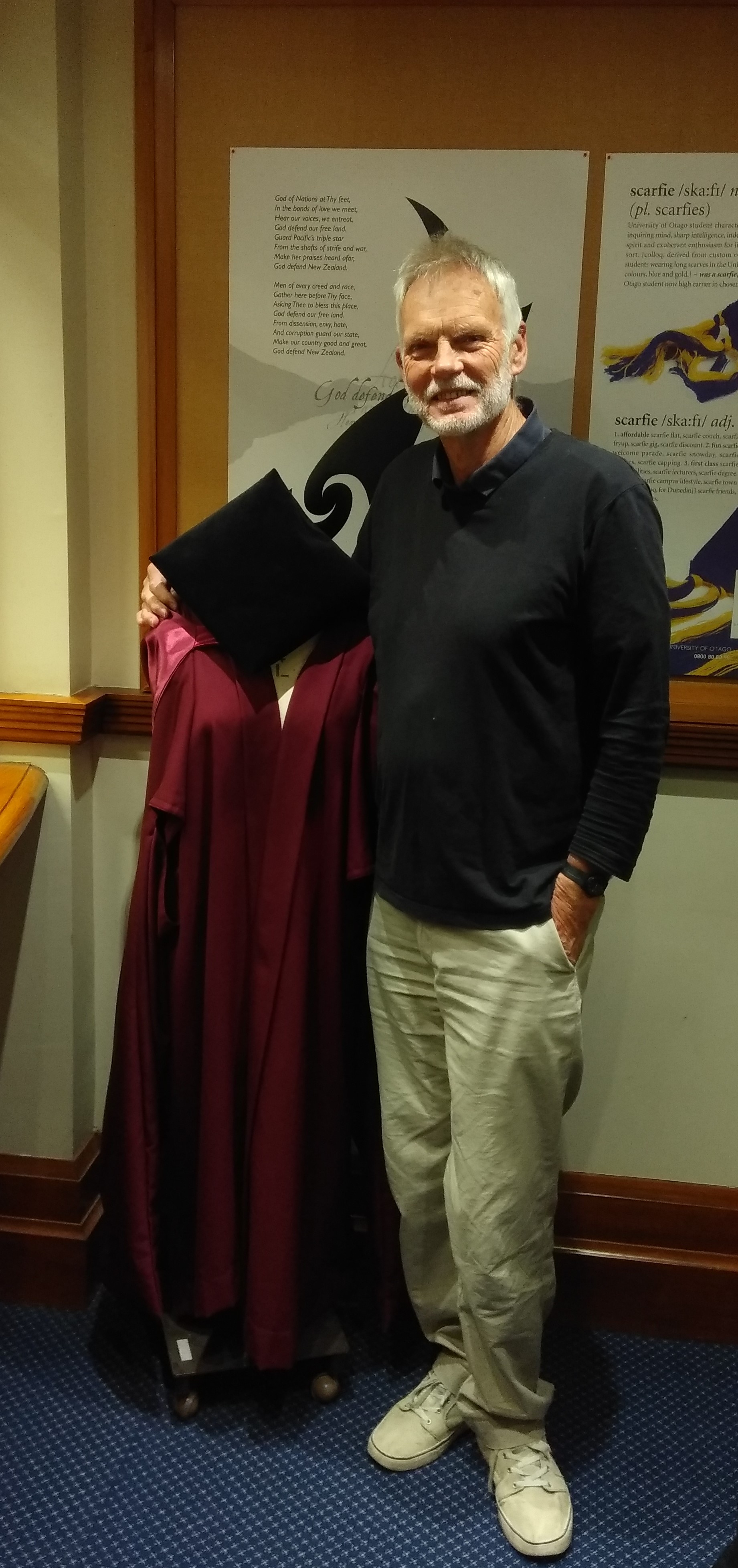 John Birnie submitted the “hard copies” of his PhD thesis today at the Graduate Research School.
John has been a fixture at Te Tumu, graduating with his MIndS in 2012. Te reo Māori is one of John’s passions. He was a former high school teacher of te reo, and completed higher level reo classes at Te Tumu. His PhD, “Exploring learner-centredness for adults learning te reo Māori: easing the path to language acquisition” combines his interests in education and Māori-language learning.
John was supervised by Prof. Poia Rewi and Assoc Prof. Lachy Paterson, and by Dr Matiu Rātima in the early stages of his study. Submitting the hard bound copies is the final act in the PhD journey – with the exception of his graduation in May. Koia kei a koe, e Hone!
Professor Tapsell’s Pūkaki book translated into te reo Māori
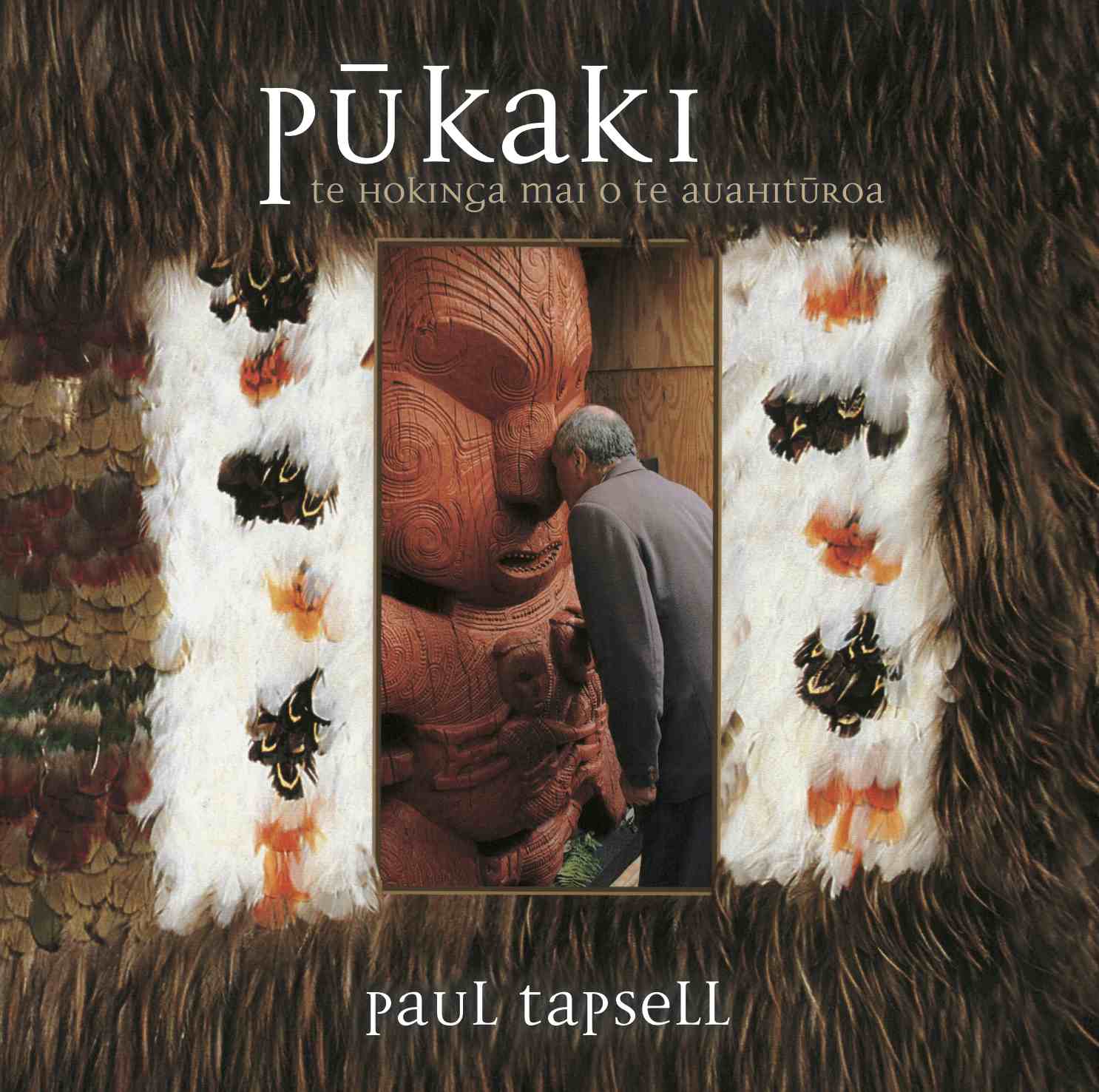 Professor Paul Tapsell‘s 2000 book, Pūkaki: The Return of the Comet is now available in te reo Māori as Pūkaki: Te Hokinga mai o te Auahitūroa. The book was translated by renowned linguist, Scotty Morrison.
Kua puta mai he whakamāoritanga o tā Professor Paul Tapsell pukapuka o te tau 2000, ko Pūkaki: Te Hokinga mai o te Auahitūroa te taitara hou. he mea whakamāori e te tohunga rāranga kupu, e Scotty Morrison.
More details of Pūkaki, the book, and the translation process can be found in a recent NZ Herald article.
Kei te wānangahia e te pukapuka nei a Pūkaki, te tipuna o Ngati Whakaue (he hapū nō Te Arawa), me te kōrero mō te whakairo, mō Pūkaki, arā, te take i whakairohia ai, te rironga atu i te Karauana, me te whakahokinga mai ki a Ngāti Whakaue i te tau 1997.
Ka pai, Pāora, kōrua ko Scotty.
Te Tumu seminar: Tahu Pōtiki
Tahu Pōtiki
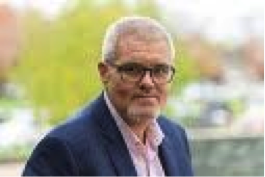
Tahu Pōtiki (Kāi Tahi, Kāti Mamoe) of Ōtākou Marae, former CEO of Te Rūnanga o Ngāi Tahu (TRONT), will be presenting the next Te Tumu seminar.
Ka aru tātou i te aha? What are we pursuing, what is the outcome?
Where: R3S10 (on third floor of Te Tumu, University of Otago)
When: 2.00 pm, Wednesday 4 October.
Has the development of the Ngāi Tahu policy framework created a new identity?
Since 1998, Ngāi Tahu has grown demographically, in size and structure. Marae and kāinga have been significantly made-over. The iwi is well known as a successful tribe and business. Tahu Pōtiki has been integrally involved within his iwi, hapū and whānau for his lifetime. In this seminar he will discuss how the Ngāi Tahu policy framework has created a new identity. He will critique key policy initiatives that he was fundamental in instigating.
All interested people are welcome to attend.
