Seminar: The Folk Linguistics of Māori Language Revitalisation
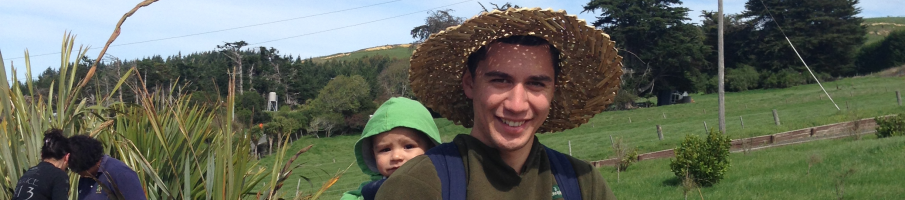
Nathan Albury, PhD student, will be giving a seminar in Te Tumu on 2.30-3.30pm, Tuesday 18 November in R3S10 (3rd floor, Te Tumu). Please note that this is a different day and venue to usual.
Nathan’s paper, The Folk Linguistics of Māori Language Revitalisation, “applies the folk linguistics of language policy in respect to language revitalisation as a policy project. It reports preliminary findings from research that sought to compare what young indigenous and non-indigenous youth in contemporary New Zealand claim to know about language revitalisation as a policy process, what attitudes and beliefs these youth have towards activities and themes aimed at revitalising the Māori language, and how their knowledge and beliefs manifest into folk linguistic performance when these youth are positioned as hypothetical language policy bosses of the New Zealand government.”
For the full abstract click here, or on the “Seminars” page on the left
Te Tumu Seminar: Guardianship in Early Colonial Fiji
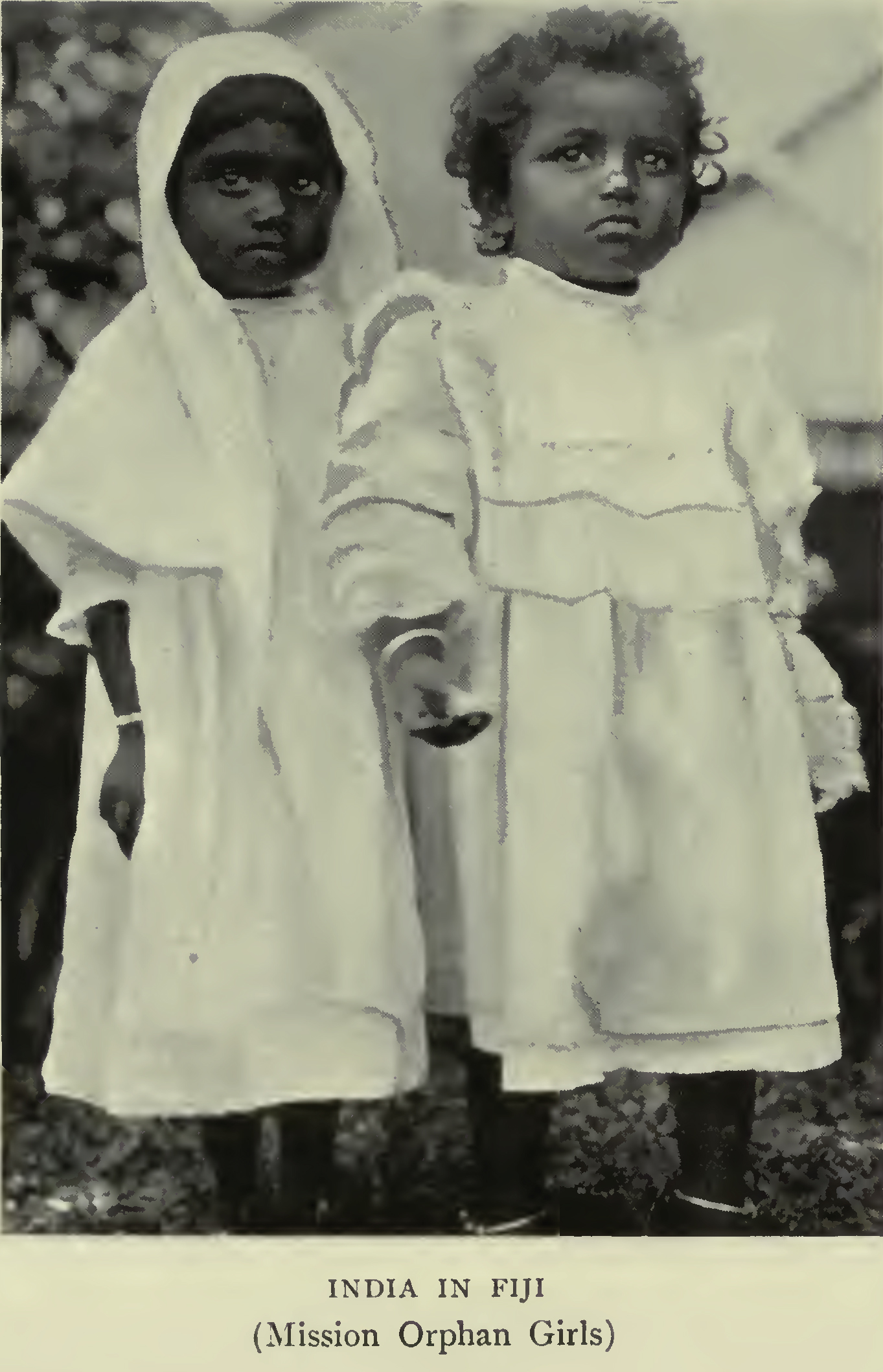
Image from: Burton, J.W. (1910). Fiji of To-Day. London: Charles H. Kelly
Te Tumu PhD student Erica Newman will be presenting the research presentation, Guardianship in Early Colonial Fiji, on 12 November. Please note that the venue and time have changed to previously advertised. It will now be 3.30-4.30 pm in R3S10 (3rd floor, Te Tumu building).
Abstract: Fiji became a British Colony in 1874 and within five years the Indian Indentured Labour Scheme was introduced to provide workers for the European owned plantations. Care of any orphaned children from these plantations was the responsibility of Colonial Office bureaucrats who applied the western systems of guardianship and adoption that they used throughout the Empire.This seminar will examine five examples of Colonial Office correspondence negotiating the approval of guardianship of children, between the years of 1889 to 1900. A study of these files reveals the circumstances of the child, those who were approved guardianship, and why they sought to become a guardian.
Recent Te Tumu theses
Te Tumu had a number of its students honoured at the university’s recent Graduation, including several doing post-graduate research.

Sam Jackson
Samantha Jackson, “Ko Te Houhanga a Rongo marae tōku tūrangawaewae: In search of a philosophical standing place for indigenous development”, (MA Indigenous Development).
Supervisors: Professor Grant Gillett, Associate Professor Merata Kawharu, Dr. Paerau Warbrick
Abstract: Dominant paradigms of development assume a linear progression from one established point to another. These paradigms do not take into account the complexity of indigenous voice, spirit and ways of being-in-the-world, leaving indigenous peoples without a meaningful place to stand. To approach the question of indigenous development in such a straight forward manner is a methodological error which stands to obscure meaningful indigenous development and silence the indigenous spirit.
In order to appropriately investigate the question of indigenous development, I argue we must awaken ourselves to our assumptions which form the background of how we view and understand ourselves, the world and others. I draw on Martin Heidegger’s interrogation of Cartesian thought to provide a space through which indigenous development can be meaningfully approached from a tangata whenua (Māori, people of the land) philosophical perspective.
I utilise the traditions and teachings of Reverend Māori Marsden to posit a meaningful model of indigenous development must be rooted in Te Ao Mārama traditions (Māori worldview), a woven universe of connection between self, ancestors, universe and gods. This idea is mooted in an international indigenous context, before returning to the traditions pertaining to Te Houhanga a Rongo marae (Māori cultural complex), my own tūrangawaewae (place to stand). I argue marae are a manifestation of Te Ao Mārama worldview and therefore an appropriate site to investigate indigenous development. I utilise whakapapa (genealogy) and kōrero pūrākau (stories of origin) as important mechanisms through which one can come to understand and organise the relationship between a person, their world and their gods. Maintaining an intimate relationship within the woven universe validates a person’s tūrangawaewae giving them the ‘sureness of touch’ of a person firmly rooted in belonging with unlimited potential for human development.
Nicole McCrossin
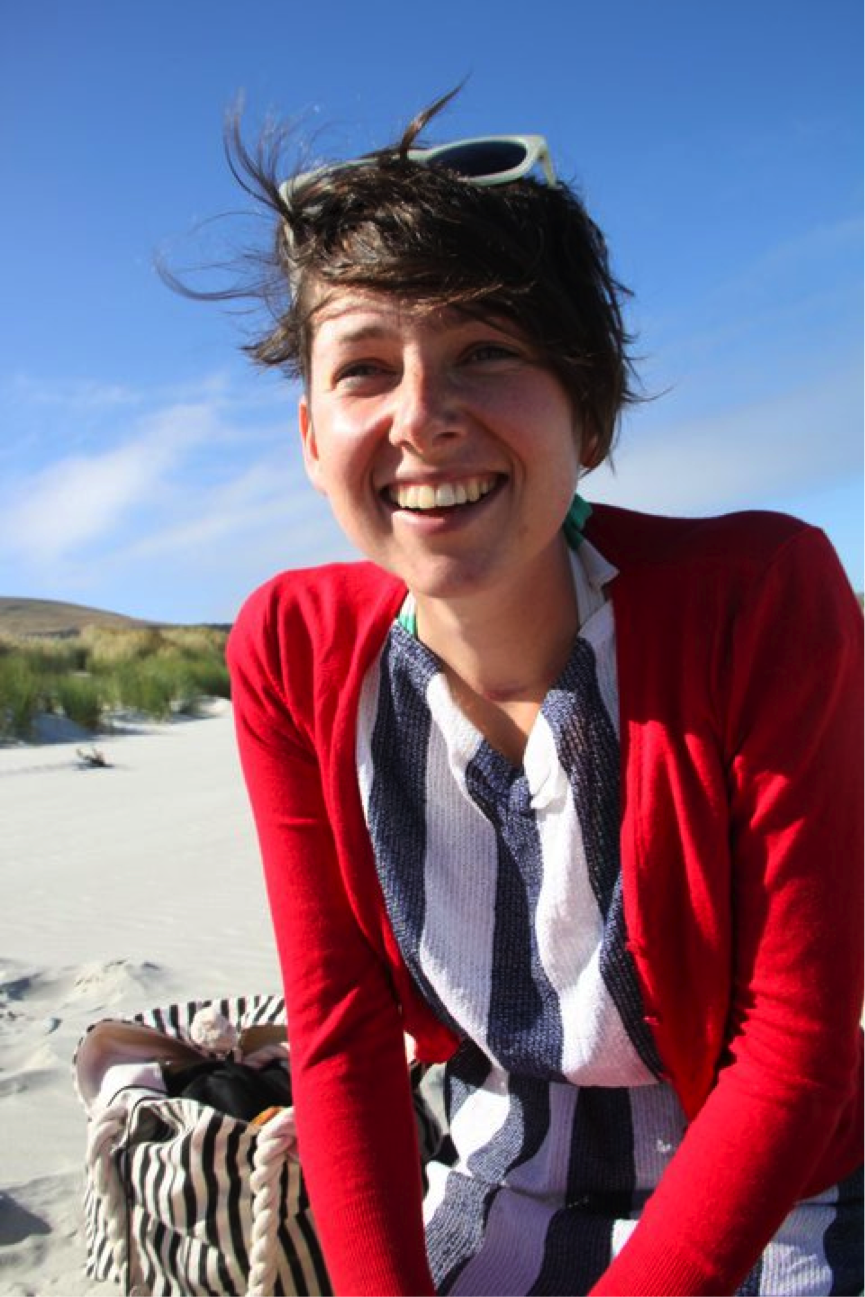
Nicole McCrossin, “Intention and Implementation: Piecing Together Provisions for Māori in the Resource Management Act 1991″, (MA, Indigenous Development)
Supervisors: Dr Janet Stephenson and Dr Jenny Bryant-Tokalau
Abstract: Today, it is widely recognised that indigenous people have a valuable contribution to make to the development and practice of resource management. New Zealand legislation recognises in part the importance of Māori participation; however, there appears to be a considerable gap between the recognition of these rights and their effective and widespread implementation at ground level. This study explores the intentions behind, and the implementation of Section 33 transfers of power and Sections 36B-E joint management agreements, under the Resource Management Act 1991, which support Māori participation in resource management decision-making. These provide for the devolution of power from local authorities to iwi authorities and the establishment of agreements to co-manage resources with iwi. A nationwide survey of local authorities’ use of the provisions demonstrated that they had been virtually unused. The majority of local authorities do not have any form of co-management agreements with Māori, and those that do have quite constrained arrangements which are designed to enhance consultation, rather than shared decision-making. The results of the survey are contrasted to findings from a series of semi-structured interviews with key informants involved in the crafting of the RMA, which examines the intentions behind the inclusion of these mechanisms in the legislation. The concept of institutional bricolage is used to help explain their creation and implementation, and the subsequent negotiation of the mechanisms and their alternatives by councils. The survey and interview results revealed that an intentional institutional bricolage approach was frequently employed by councils and iwi to negotiate co-management arrangements, but was not used in the crafting of the RMA co-management provisions. Instead, the provisions were a result of unintentional institutional bricolage, drawing on a range of structural and social influences.
Inaugural Te Tumu Postgraduate “Thesis Games”
We all know how difficult it can be to talk about our research, particularly when we have to do it succinctly. Te Tumu’s postgrad students were put to the test today with our first inaugural “Thesis Games”, with each presenting their research within about three minutes.
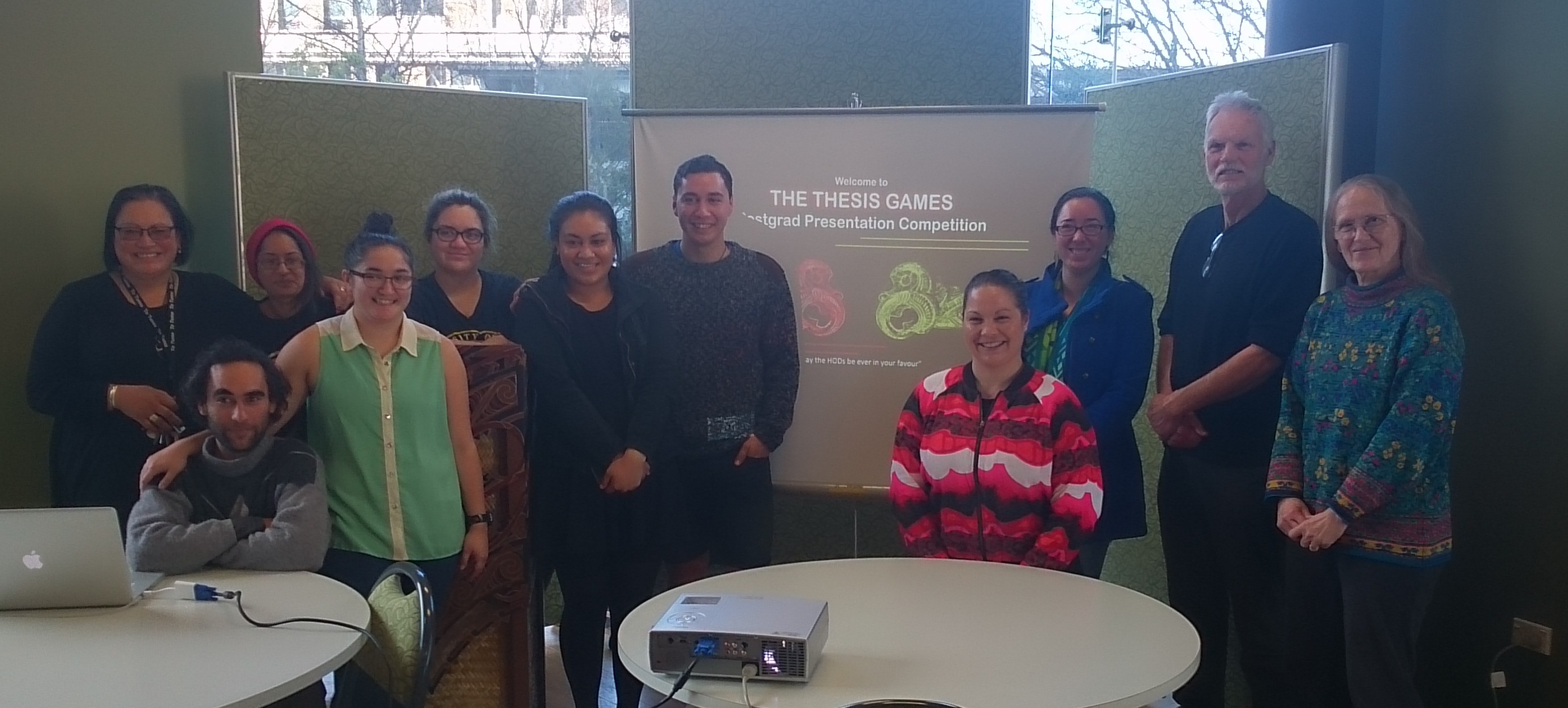
Click to enlarge. From left, Tangiwai Rewi, Hori Barsdell, Lana Arun, Gianna Leoni, Marcelle Wharerau, Ane Tatu, Tyson Tautari, Suzanne Duncan, Tawini White, John Birnie, Marsa Dodson.
The topics were many and varied: Tawini White: “He Manawa Hapū” (on hapū identity in Te Rarawa); Tyson Tautari: “Dogs Tale” (on the Polynesian dog); Ane Tatu: “Are you Dongan or Tongan? An examination of the ways in which New Zealand born and raised Tongans self-define and experience anga fakatonga (the Tongan way of life) and being Tongan”; Hori Barsdell: “What is the Significance of Pā Today?”; Lana Arun: “Archaeology and Tikanga” (on how Māori knowledge fits into the archaeoly profession; Marcelle Wharerau: “You Maaris get everything” (on perceptions of Māori privilege at university); Tangiwai Rewi: “Maaku anoo e hanga tooku nei whare…” (on intergenerational knowledge transfer within Waikato); John Birnie: “What if the mountain won’t come to Mohammed? Learner-centredness for adults learning te reo Māori”; Marsa Dodson: “Mixed blessings: Oral Histories of the War Children Born to US Servicemen and Indigenous Cook Islanders”; Gianna Leoni: “Power to Policy” (on the use of te reo Māori within government departments); and Suzanne Duncan: “Where is the whanau?” (on whānau involvement within the Māori economy).
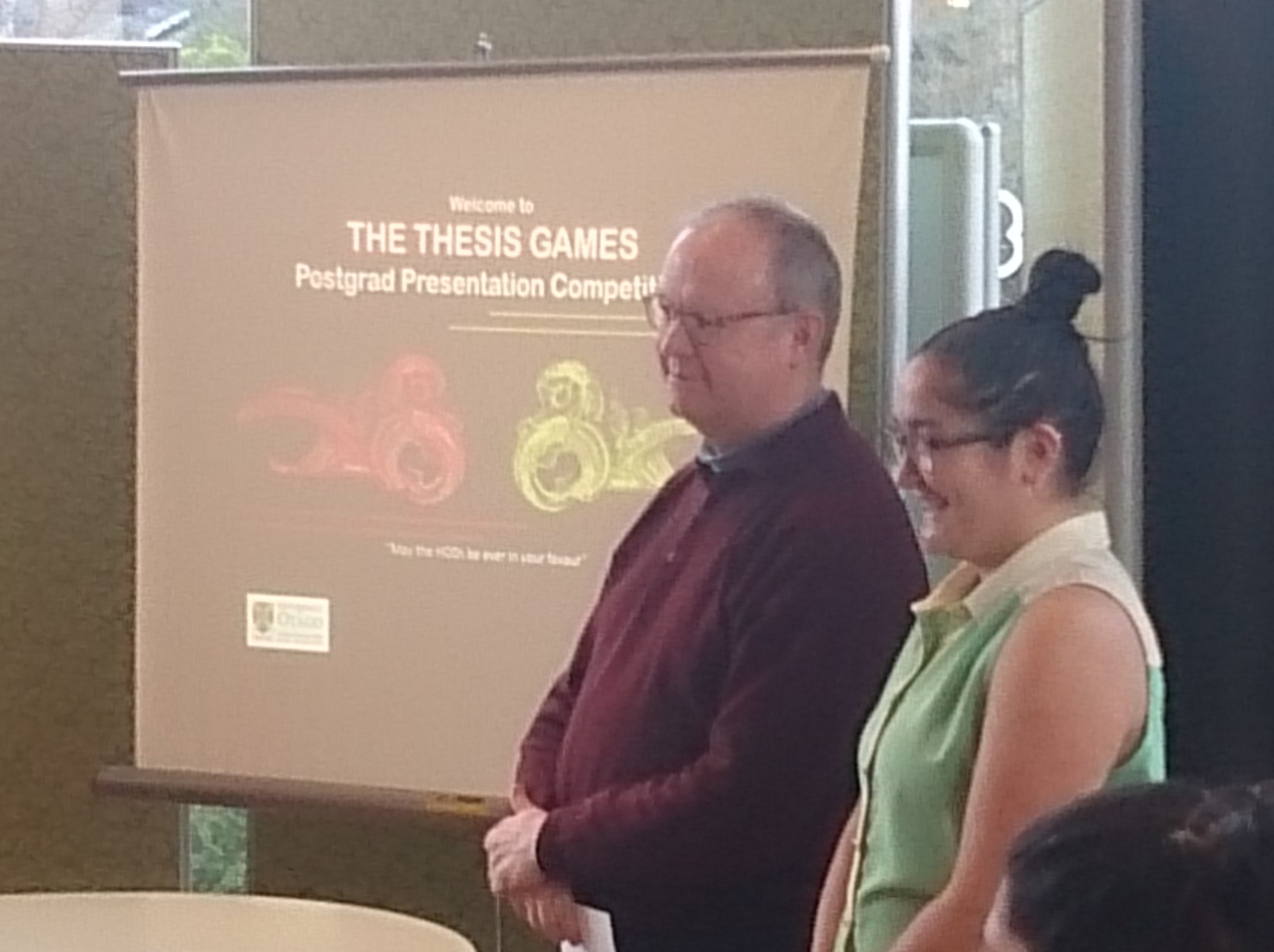
Professor Michael Reilly, Dean of Te Tumu, and the PhD winner, Gianna Leoni.
There was a great turnout of people, including a number of Te Tumu under-graduates. All the speakers were amazing and engaged the audience. Congratulations to the winners: Ane Tatu for Honours level, Marcelle Wharerau for Masters Level, and Gianna Leoni for PhD level.
Such was the success, Te Tumu is sure to hold another such event next year. There is even talk of something similar for staff.
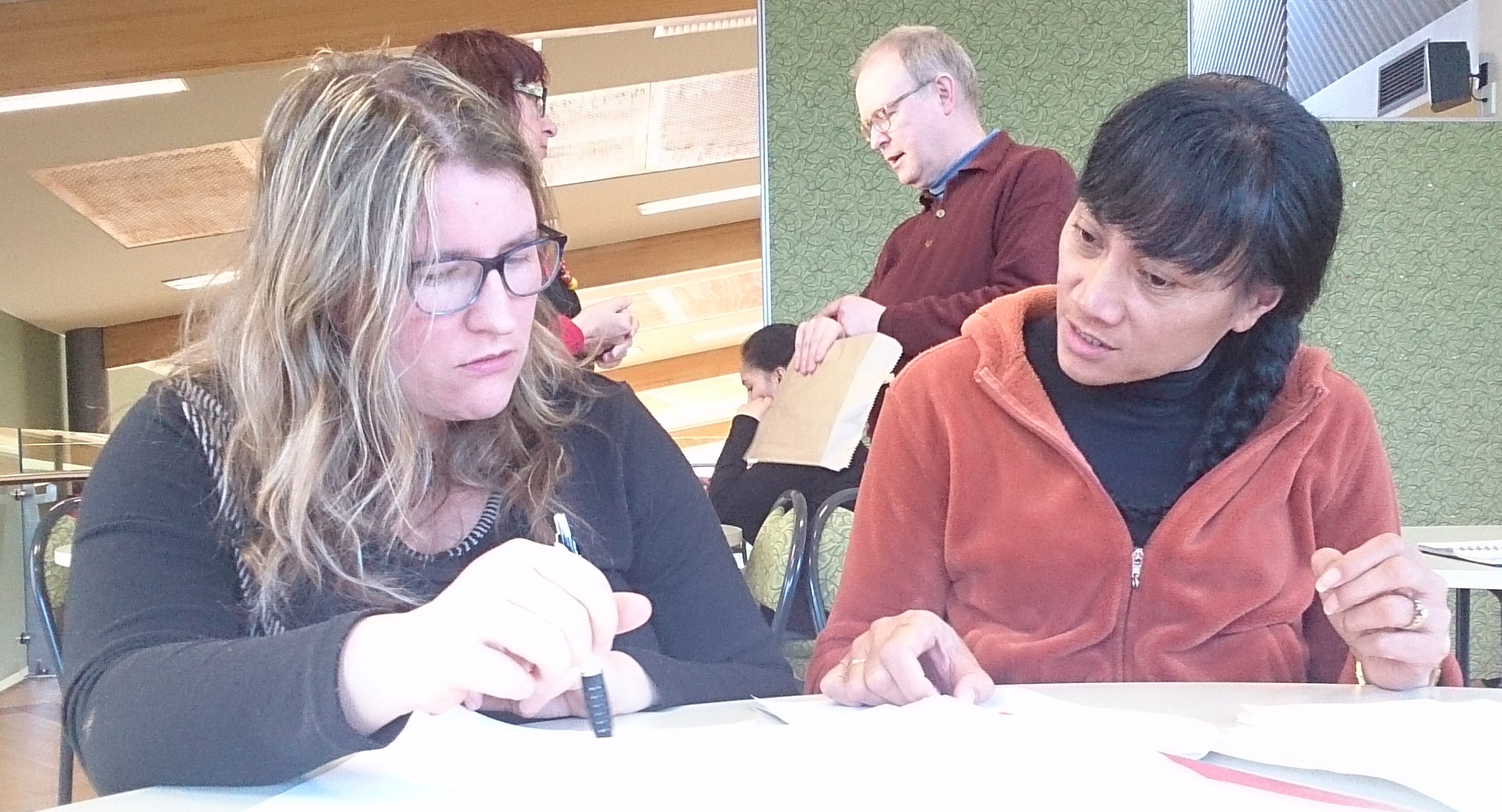
Special thanks to our judges, Shiobharn Smith, Māori, Pacific & Indigenous Subject Librarian, and Esme Eteuati, Pacific Islands Student Support Officer (Humanities).
