Cartesian Empiricisms – a Reply
Peter Anstey writes …
The forthcoming book Cartesian Empiricisms edited by Mihnea Dobre and Tammy Nyden promises to extend our knowledge of the experimental practices and philosophy of experiment amongst many of Descartes’ followers.
Dobre, however, claims that the book will offer more than a study of these writers. He says in his recent post that what we find in these neo-Cartesians ‘seems to escape the ESD’ (experimental–speculative distinction, my italics). In what sense might it be true that Cartesians doing experiments might escape the ESD? Is it that the ESD cannot explain them? Or, more strongly, is it that their experimental practices contradict the central tenets of the actors’ categories of experimental philosophy and speculative philosophy? And what is the value of persisting with the term ‘empiricism’ to describe the neo-Cartesians’ engagement with experiment?
In my view, the fact that some Cartesians performed experiments is of great interest, but it is also grist for our mill: it actually enriches the evidential base for the claims that we have made on this blog and in recent publications. For it shows that, like all other speculative systems, Cartesian natural philosophy was also subject to the court of experiment.
We have never claimed that proponents of speculative systems like Cartesianism were necessarily opposed to experimental verification of their theories. Nor have we ever claimed that all experimental philosophers were adamantly opposed to speculation: some were, but others, like Robert Boyle and Robert Hooke, were not.
We have claimed that the Cartesian vortex theory came to be regarded by many as the archetypal speculative theory in natural philosophy. Indeed, this was the virtually the standard view in England from the late 1690s when the term ‘our vortex’ starts to disappear and Newton’s arguments against the Cartesian system began to be widely appreciated. But none of this implies that our claims about the ESD need somehow to be modified. In fact, there is evidence that distaste for speculative system building and a belief in the need for the construction of Baconian natural histories were constituents of the general methodological background to mid-seventeenth-century Parisian natural philosophy. The first article of the constitution of the Montmor academy, which met in Paris from the mid-1650s to around the time of the formation of the Académie des Sciences, says:
The purpose of the company shall not be the vain exercise of the mind on useless subtleties (subtiltés inutiles), but the company shall set before itself always the clearer knowledge of the works of God, and the improvement of the conveniences of life, in the Arts and Sciences which seek to establish them.
The anti-speculative element here is hard to miss. (Interestingly, none of the articles mention experiment.) Furthermore, it is well known that Christiaan Huygens recommended to Colbert that the newly formed Adadémie construct natural histories after the manner of Verulam.
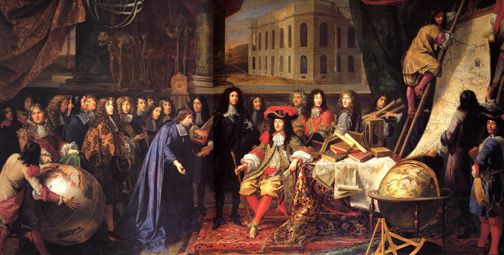
Henry Testelin: Etablissement de l'Academie des sciences et fondation de l'observatoire (1666)
What I am hoping to glean from Cartesian Empiricisms is an answer to the following question:
Did the Cartesians practise a form of experimental philosophy analogous to that of the Fellows of the early Royal Society?
This question is important for a number of reasons. The work of Trevor McClaughlin on Rohault, for example, has shown that early Cartesians carried out experiments. Yet we still lack a detailed assessment of the nature, theory and practice of experiments amongst the neo-Cartesians in the three decades after Descartes’ death. There is no doubt that they performed experiments for illustrative purposes and repeated many classic experiments for pedagogical purposes. But did they engage in experimental programs with a view to acquiring new knowledge of nature and to modifying and developing natural philosophical knowledge?
What makes this issue particularly pressing is that there is evidence from the late 1650s and early 1660s that the natural philosophers who met in the Parisian academies, such as the Montmor academy which included several prominent Cartesians, performed experiments, but were not really practising experimental natural philosophy. Henry Oldenburg reported to Michaelis in April 1659 that the philosophical academies in Paris: ‘are rich in promises, few in performance’ (Corresp. of Oldenburg, 1: 241). Three months later Oldenburg wrote to Boyle from Paris saying:
we have severall meetings here of philosophers and statists which I carry your nevew to, for to study men as well as books; though the French naturalists are more discursive, than active or experimentall. (Corresp. of Oldenburg, 1: 287)
My hope, therefore, is that Cartesian Empiricisms will answer this very pressing question.
Cartesian empiricisms
Mihnea Dobre from the universities of Bucharest and Nijmegen writes…
As readers of this blog know, the classic division between continental Rationalists and British Empiricists fails to provide an accurate picture of the early modern period. The Otago team has already offered extensive evidence of the complexity of seventeenth-century natural philosophy. Replacing the traditional-historiographical distinction between Rationalism and Empiricism (RED) with actor-category division of experimental versus speculative philosophy (ESD) is one step ahead in getting a more meaningful image of the philosophical debates that marked the formation of modern philosophy and science.
However, in this post, I would like to focus on a different aspect, which seems to escape the ESD distinction and further complicates our image of the late-seventeenth century. At the same time, I take this opportunity to announce a forthcoming volume, Cartesian Empiricisms, which Tammy Nyden and I are co-editing in the Springer series on the Studies in History and Philosophy of Science.
While this juxtaposition between “Cartesianism” (which for a long time has been associated with rationalism, armchair philosophizing, speculative thinking, or a purely theoretically driven philosophical approach) and “Empiricism” (which besides its traditional opposition to “Rationalism” is still preferred by many to describe an approach based on experiment and experimentation) might look odd at first, it sheds, in fact, a completely new light upon the development of natural philosophy in the second half of the seventeenth century.
Descartes’s philosophy has been discussed, interpreted and revaluated constantly in our histories of both philosophy and science. Yet, a more in-depth study of what happens after Descartes’s death is missing. We hope Cartesian Empiricisms will fill this gap, contributing to the exploration of some now-forgotten philosophical figures, which were not only prime representatives of the philosophical debates of their time but were opening the possibility of a more experimentally oriented natural philosophy.
After Descartes’s death in 1650, his philosophy was challenged in various ways and one of the most common forms of attack was to disprove it with empirical evidence. Take, for example, this curious case from the Philosophical Transactions, one of the first scientific journals. On June 3, 1667, an observational report described the puzzling case of a turtle that was still able to move even with her head missing:
there came a Letter from Florence, Written by M. Steno, which has also somewhat perplext the followers of Des Cartes. A Tortoise had its head cut off, and yet was found to move its foot three days after. Here was no Communication with the Conarium [i.e. the pineal gland]. As this seems to have given a sore blow to the Cartesian Doctrine, so the Disciples thereof are here endeavouring to heal the Wound (p. 480).
Such instances that do not cohere with Descartes’s natural philosophy can be found in various places in the new scientific journals, as well as in public debates and philosophical treatises. A well-known case is that of the collision rules that went through a number of critical evaluations during the 1660s. Physics, anatomy, and psychology are among the most heated areas of contestation for Descartes’s natural philosophy. Cartesians reacted to the new challenges by both trying to complement or correct Descartes’s philosophical corpus with needed additions, but also by incorporating into their practices new methods. Cartesian Empiricisms will highlight such attempts:
Ch. 1. Introduction
Section I: Cartesian Philosophy: Receptions and Context
Ch. 2. “Censorship, Condemnations, and the Spread of Cartesianism” by Roger Ariew
Ch. 3. “Was there a Cartesian Experimentalism in the 1660’s France?” by Sophie Roux
Ch. 4. “Dutch Cartesian Empiricism and the Advent of Newtonianism” by Wiep van Bunge
Ch. 5. “Heat, Action, Perception: Models of Living Beings in German Medical Cartesianism” by Justin Smith
Section II: Cartesian Disciplines
Ch. 6. “The Cartesian Psychology of Antoine Le Grand” by Gary Hatfield
Ch. 7. “Experimental Cartesianism and the Occult (1675-1720)” by Koen Vermeir
Ch. 8. “Rohault’s Cartesian Physics” by Mihnea Dobre
Ch. 9. “De Volder’s Cartesian Physics and Experimental Pedagogy” by Tammy Nyden
Ch. 10. “Empiricism without Metaphysics: Regius’ Cartesian Natural Philosophy” by Delphine Bellis
Ch. 11. “Robert Desgabets on the Physics and Metaphysics of Blood Transfusion” by Patricia Easton
Ch. 12. “Rohault, Regis and Cartesian Medicine” by Dennis Des Chene
Ch. 13. “Could a Practicing Chemical Philosopher be a Cartesian?” by Bernard Joly
It is particularly interesting how many of the individual Cartesians discussed in this volume blend theoretical and experimental elements. Experience and experimentation become – for some of them – constitutive parts of their Cartesian natural philosophies, thus making it harder to classify them with our current historiographical categories. We hope that our volume will open new discussions about such categories and will encourage the exploration of other branches of Cartesian philosophy.
Different concepts of the microscope in the 1660s
A guest post by Ian Lawson from the University of Sydney.
Ian Lawson writes…
Margaret Cavendish’s Observations upon Experimental Philosophy (1666) was a direct criticism of the Royal Society, largely focused on their most prolific work to that date – Robert Hooke’s Micrographia (1665). Cavendish was no fan of experimental philosophy generally, thinking it likely to lead to civil strife, and needing in any case to be guided by speculative thought, she criticised microscopes specifically for a few particular reasons:
- They’re difficult to make and use;
- They’re not very useful (Cavendish asks if observing a louse through a microscope can prevent it from biting); and, relatedly
- They distort nature.
This last, I would like to suggest, points to a different way of understanding and conceptualising the instrument to that of the Society microscopists (I am thinking particularly of John Wilkins, Christopher Wren, and Hooke).
Cavendish writes:
- I do not say, that no glass presents the true picture of an object: but only that magnifying, multiplying, and the like optic glasses, may, and do oftentimes present falsely the picture of an exterior object; I say, the picture, because it is not the real body of the object which the glass presents (pp. 50-51).
A louse, viewed under the microscope, looks like a lobster, and a sharp knife looks blunt. “[I]f the edge of a knife or the point of a needle were naturally and really so as the microscope presents them, they would never be so useful as they are” (p. 51). This is of course a direct reference to Hooke – a needle and a razor were the first two observations in his Micrographia.
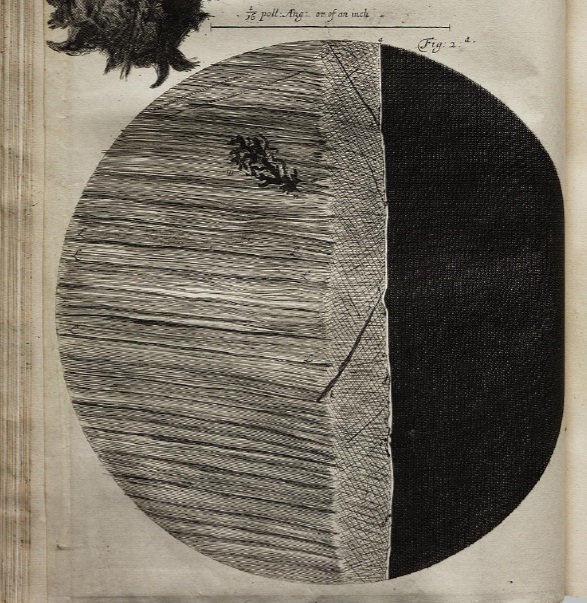
Hooke's drawing of the edge of a razor
Hooke likewise admits that if the razor were “really such as it appear’d through the Microscope, it would scarcely have serv’d to cleave wood, much less to have cut the hair of beards.” Unless, he continues, it were used
- after the manner Lucien merrily relates Charon to have made use of, when with a Carpenter’s Axe he chop’d off the beard of a sage Philosopher, whose gravity he very cautiously fear’d would indanger the oversetting of his Wherry (p. 5).
Hooke’s razor, though lacking a knife’s sharp edge, still has the capacity to rob a philosopher of his wisdom, by showing intuitive assumptions are unfounded. Cavendish appears to suggest there is one scale that an object exists ‘naturally’ at. On the other hand Hooke, Wilkins, and Wren emphasise the contingency of human senses:
- [I]f there were another Species of Intelligent Creatures in the World, they might have quite another kind of Apprehension of the same thing, and neither [theirs nor ours] perhaps as they ought to be.
(Hooke, General Scheme, or Idea of the Present State of Natural Philosophy, p. 8)
The Royal Society microscopists didn’t so much see themselves as altering the objects they were looking at, but rather modifying their own senses. They enter the micro-world, and present the razor as it would seem to someone the size of an insect. It may not retain its traditional use at this scale, but it is the observer who has been distorted rather than the object.
I’m not really sure how illustrative a difference this is to point out, but my feeling is it is tied in with a number of related themes and can possibly help to shed light on them: optimism for the new optical technologies; the new optics of Kepler and Descartes and the naturalisation of vision; experimental as opposed to mechanical philosophy; and Hooke’s approach to instruments more generally.
Politics and the Origins of Empiricism
Alberto Vanzo writes…
In earlier posts, I claimed that the now-familiar notion of empiricism was first introduced by Immanuel Kant and that it was not in use in the early modern time. However, Kant contrasts “rationalists” and “empirics” in one area in which it was customary for German writers to distinguish people who relied on experience with those who relied on reason, namely, politics. Dozens of early modern German authors distinguished between empirical politicians and rational, dogmatic, or speculative politicians. Did the pre-Kantian distinction between empirical and rational politicians provide a significant source of the Kantian distinction between empiricist and rationalist philosophers? To answer this question, let us look at the contexts in which early modern German writers typically mentioned empirical politicians.
It is only in the first decades of the seventeenth century that politics appeared as an autonomous academic discipline in the German faculties of arts. Its early exponents were preoccupied with establishing its importance and autonomy against those jurists, like Jean Bodin, who regarded it as a part of jurisprudence, identified the good politician with the good legal expert, and denied that there was any need to introduce the study of politics within the arts faculty, in addition to what one could learn in the course of legal study. To this end, academic writers on politics stressed that it is more than a mere set of practical precepts. Politics is a doctrina based on general principles which one must learn to acquire the political virtue par excellence, political prudence. In this context, the phrase “empirical politician” was used to designate and criticize those politicians as pseudo-politicians who rely only on experience, without knowing the doctrine of politics.
By the second half of the eighteenth century, the discipline of politics experienced a transformation that placed empirical politicians in a far better light. What used to be the theoretical and general part of politics was now dealt with within the discipline of universal public law (ius publicum universale). Politics became mostly concerned with identifying the best ways to govern and the most effective practical means to achieve aims established by universal public law. The necessity of being versed in a demonstrative philosophical doctrine for being a good politician was no longer obvious and discussions of the requirements for political prudence had largely been supplanted by discussions of the more fashionable and pragmatic topic of reason of State. It is in this context that Kant contrasts empirics and rationalists in politics, criticizing the former and stressing the importance for politics to be conducted in light of the philosophical foundations of public law.
Kant’s references to empirics and rationalists in politics show that the distinction between these two kinds of politicians and the notion of political empiricism were well known when the distinction between empiricist and rationalist philosophers was first introduced. However, there are only tenuous similarities between these distinctions.
Empiricists and rationalists take opposite stances on the origins of cognitions and foundations of knowledge, the former appealing to experience and the latter appealing to the a priori. Empirical politicians too relied on experience. However, their reliance on experience was not contrasted with the reliance on the a priori, whether in the form of a priori reasonings or of non-empirical cognitive faculties such as rational insight. It was contrasted with the «precepts of doctrine and rules derived from the learned schools» (Faber), on whose basis dogmatic or rational politicians justified their views and actions.
Dogmatic politicians would bear a significant resemblance with rationalist philosophers if the doctrines on which they rely were established a priori, independently from experience. However, the role of experience in the establishment of principles was the object of significant divergences between early modern authors, including the Aristotelians. According to some authors, principles could not be warranted independently from experience. Additionally, what role experience had in the establishment of political doctrine was never at stake in the characterizations of dogmatic politicians. Politicians qualified as dogmatic if their views, actions, and political prudence relied on a doctrine, regardless of its empirical or non-empirical origin. Empirical politicians relied on practice and experience as opposed not to a priori cognitions or faculties, but to a systematic theoretical apparatus of any sort.
I conclude that, although the early modern contrast between empirical and rational politicians bears some resemblance with the distinction between rationalists and empiricists, it cannot be a significant source of the latter distinction. Do you find this claim plausible? Let me know by posting a comment.
Looking back: PATS workshop on Interdisciplinarity
Juan Gomez writes…
A few weeks ago the Early Modern Thought Research Theme here at Otago hosted a colloquium on “Practical Knowledges and Skill in Early Modern England.” After two days of great talks postgraduate students were able to take part in an ANZAMEMS sponsored workshop on “Interdisciplinarity in Medieval and Early Modern Research.” I took part in the workshop and in today’s post I want to share my thoughts on what turned out to be an outstanding event.
The main purpose of the workshop was to give postgraduate students tools to enhance current and future research projects. With this in mind the speakers shared how they had each in their own way been engaged with this interdisciplinary aspect of the Early Modern period. The talks were followed by practical sessions where we had the opportunity to think about and develop our research projects from an interdisciplinary perspective. The whole workshop was a huge success and I am sure I am not the only one that now has a better idea of how beneficial it is for research in the early modern period to look at/borrow from/collaborate with other disciplines.
Of special interest to me were the talks given by Peter Harrison on “Disciplinary boundaries in intellectual history: science, religion & philosophy” and Andrew Bradstock on “Religious language in early modern texts.” Harrison’s talk was a very clear and nice example of the interdisciplinary nature of the Early Modern period. It highlighted how the three disciplines that to our modern eyes seem very distinct drew on each other constantly. As readers of this blog know, I have done some research on George Turnbull’s work on Jesus Christ and miracles that exemplify this interaction between science, religion, and philosophy in the eighteenth century.
Andrew Bradstock’s talk made me think about how my research on Turnbull can me tremendously enhanced by drawing on the purely religious context of the time. For example,Turnbull’s Principles of Christian Philosophy draws heavily on passages from the bible, some of them that I am not that familiar with or might not know it’s significance at the time. By working with someone working on the history of religion or acquiring knowledge of it I can add another layer to my research that will enrich our understanding of Turnbull’s thought.
The workshop made it clear that crossing the boundaries of a particular discipline is not only fruitful but even necessary when engaged in early modern research. Given that there is a natural characteristic of interdisciplinarity to the early modern period we must leave the comfort zone of our own discipline if we want to carry out our research projects properly. Most of us have actually done this without noticing that we are engaged in interdisciplinary research. The workshop brought this to my attention and I started thinking about the many ways in which my research would have been improved if I had consciously made an effort to enrich my understanding of any given topic by allowing myself to explore what other disciplines have to offer. And this enrichment of knowledge works both ways; there are projects stationed in other disciplines that would be enhanced by what I have to offer as a researcher from a specific discipline, with a specific skill set.
This is not to say that early modern research cannot be carried out other than in an interdisciplinary manner, but rather that through interdisciplinarity we can enhance tremendously the research projects we are all developing from our specific discipline. Borrowing a phrase by Michael Cop at the Early Modern at Otago blog, the workshop showed that through interdisciplinarity “the future of early modern and medieval research looks promising indeed.”
Early Modern HPS Session Details
History and Philosophy of Science in Australia: Looking Forward
National Committee for History and Philosophy of Science workshop, University of Sydney, New Law School Annexe 342
27 September 2012: University of Sydney
8.50 Peter Anstey (Otago/Sydney) Introductory comment
8.50 Luciano Boschiero (Campion): History of science in the liberal arts: its tradition and future
9.08 Peter Harrison (Queensland): Early Modern HPS at UQ: Current Projects and Future Prospects
9.26 Gerhard Wiesenfeldt (Melbourne): Back to the basics? Changing perspectives in the digital age
9.45 Ofer Gal (Sydney): Passionate knowledge
10.04 John Schuster (Sydney/Campion): Descartes Studies / Scientific Revolution Studies: The Historiographical Imperatives
10.23 Alan Chalmers (Sydney): Mechanical philosophy, experimental philosophy and Descartes
10.41 Peter Anstey: Concluding remarks
Reflections on HPS
Peter Anstey writes…
It is time to restart the conversation about early modern HPS as we lead up to the Sydney conference which commences in two week’s time.
I am currently in Cambridge and have had a number of talks with philosophers and people working in HPS here and in Paris. A common theme has been that they don’t believe that there is anything particularly unique about HPS in terms of methodology and the sorts of outputs of its practitioners. They are happy to work in HPS departments and hope that the discipline continues, but they are noticing changes in the disciplinary mix with a clear shift towards the social sciences and to sciences studies.
I should like to propose a tentative historical explanation of the current situation of HPS as a disciplinary division with the university sector. I raise it for discussion rather than as my own position statement.
It is very hard to do new, innovative research on a historical period, particularly one as rich as the early modern period, without doing interdisciplinary research. In the 1950s and 1960s and there was little institutional recognition of interdiciplinary research in Anglophone universities. At the same time the philosophy of science was undergoing very exciting developments. There was the hotbed at the LSE in London and Kuhn was nearing his peak in Princeton, to choose just two obvious examples. Now what is striking about these developments in the philosophy of science is that they were inextricably bound to historical episodes in the history of science – Kuhn’s paradigm shifts needed actual examples from the history of science. The combination of these two factors, and perhaps others, led to a new form of interdisciplinary research output – a hybrid if you will – that could not be written without the intersecting of history of science and philosophy. Soon institutional niches opened up to accommodate groups of researchers who were working in this overtly interdisciplinary way. (We could add another paragraph on how sociology of science and the study of technology were soon grafted on, but you get the general picture.)
That was then. It appears that today, by contrast, there is a widespread recognition of the value and the almost ineliminable need for interdisciplinary research in the traditional disciplines themselves: history, philosophy, literature, languages, music, theology. Interdisciplinarity is everywhere and is not merely tolerated but celebrated and funded. At the same time the philosophy of and the history of science have become far more specialized and diffuse. There is no unified set of problems or approaches or dominant players that provide the fulcrum around which HPS is practised. Koyré, Kuhn, Popper, Lakatos, etc. are now part of the history itself.
The result of this higher tolerance of and wider practice of interdisciplinary research, combined with the veritable explosion of and diversification of the history of science and the philosophy of science, is that there is now far less pressure for scholars to find a separate, interdisciplinary, institutional niche within which to work and there is far less of a sense that the methodology of those who do HPS is really all that different from someone studying, say, early modern theology or literature.
A positive consequence of this for HPSers is that we can now celebrate the fact that scholars in other disciplines are working in the way we always have. A negative consequence is that it’s now harder to point out what is unique to HPS either in terms of its methodology or its research outputs. It is, therefore, harder to justify the existence of institutional niches set up for HPS on methodological grounds or in terms of research outputs. The upshot of all of this is that HPS is both in a stronger position and a weaker position. It is now better understood and appreciated because its methods are widely practised by others. Yet it is less unique, less distinctive within the disciplinary matrix in which it is situated.
Denis Diderot: the last true Baconian?
Peter Anstey writes…
There were many types of Baconianism in the eighteenth century and many philosophers and natural philosophers traced their lineage from Bacon or regarded Bacon as the progenitor of views that they espoused. And yet most of these self-proclaimed ‘Baconians’ held views that Bacon himself would hardly recognize or they adhered to what, at best, could be described as a truncated form of Baconianism. A nice example is George Adams Jr whose views on the method of reasoning in natural philosophy in his Lectures on Natural and Experimental Philosophy (1794) (discussed previously on this blog) amount to little more than a summary of the first book of Bacon’s Novum organum (1620).
What would it take then for someone to be a true Baconian? Of course, the question itself is problematic because there is no principled way of determining the necessary and sufficient conditions that would settle the issue. But let us run with the question nonetheless.
Given the prominence of Bacon’s method of natural history in his conception of how we are to acquire knowledge of nature – that is, given the quality and quantity of writings that he devoted to natural history and the efforts he expended in assembling his own exemplar histories in the last years of his life – I suggest that to be a true Baconian one must (at least) be an advocate of the Baconian method of natural history. If this is right, then as far as I am aware, the last true Baconian was the French philosophe Denis Diderot (1713–1784).
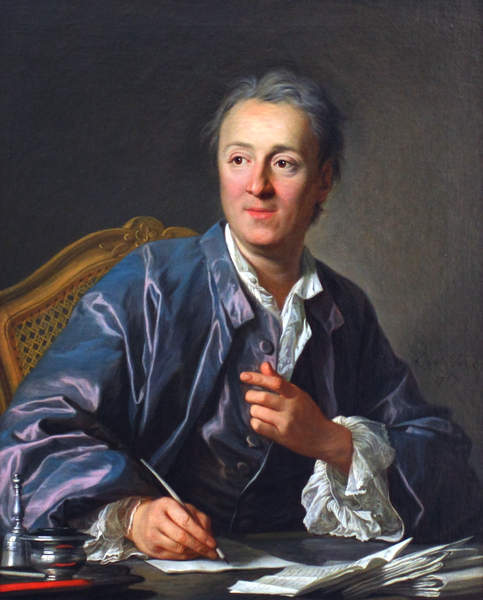
Denis Diderot (1713 - 1784)
Diderot’s ‘Prospectus’ for the Encyclopédie, was first published in 1750 and then appended in a modified form to the ‘Preliminary Discourse’ of the first volume of the Encyclopédie itself in 1751. It presents an overtly Baconian scheme of the sciences set within a tripartite faculty psychology à la Bacon, but more importantly, it shows a clear understanding and acceptance of the structure and content of Bacon’s account of the overall project of natural history. Drawing heavily on Bacon’s De augmentis scientiarum he tells us that:
The history of uniform nature is divided, following its principal objects, into: celestial history or history of the stars, of their movements, sensible appearances, etc., without explaining their cause by systems, hypotheses, etc. (It is a matter here only of pure phenomena.) Into meteorological history such as winds, rains, tempests, thunder, aurora borealis, etc. Into the history of the earth and the sea, or of mountains, rivers, streams, currents, tides, sands, soils, forests, islands, configurations of the earth, continents, etc. Into history of minerals, into history of vegetables, into history of animals. Whence results a history of the elements, of the apparent nature, sensible effects, movements, etc., of fire, air, earth, and water. (Preliminary Discourse, Chicago, 1995, 147)
(Regular readers of this blog will note the decrying of systems and hypotheses as hallmarks of a commitment to the experimental philosophy.)
Yet Diderot does not merely reproduce the structure and content of Bacon’s method of natural history, he also appreciated the heuristic structure of these histories and the fact that they needed to be subject to what Bacon called interpretatio naturae, the interpretation of nature. For, in 1754 Diderot published a work entitled On the Interpretation of Nature which, as many scholars have recognized, is very Baconian in character. It is, in effect, Diderot’s own version of Book Two of Bacon’s Novum organum. To be sure it lacks any extended discussion of Baconian induction and prerogative instances, but it is written in aphoristic form and contains many Baconian themes including advice on experimenting, the use of queries and conjectures and concrete natural philosophical examples. Surely on this evidence Diderot must qualify as a true Baconian. Was he the last?
Emilie du Châtelet on Hypotheses
Kirsten Walsh writes…
Emilie Du Châtelet (1706-1749) is best known in the popular literature as one of Voltaire’s lovers, but among her contemporaries, she was considered to be a brilliant mathematician, physicist and philosopher, whom Voltaire once described as “a great man whose only fault was being a woman”. Her work on heat and light predicted infrared radiation, and her translation and commentary of Newton’s Principia, published ten years after her death, is still considered to be the standard French translation. Today I’m interested in Du Châtelet’s views on hypotheses.

Emilie Du Châtelet (1706-1749)
Du Châtelet’s lengthiest discussion of the use of hypotheses in natural philosophy is found in her Institutions de Physique* (1740), which she wrote as a textbook for her thirteen year old son. Here, Du Châtelet explicitly set up her position on hypotheses in opposition to both Descartes and the Newtonians. She saw both positions as too extreme; and neither position as correct or useful. On the one hand:
- “Descartes, who had established much of his philosophy on hypotheses, … gave the whole learned world a taste for hypotheses; and it was not long before one fell into a taste for fictions. Thus, the books of philosophy, which should have been collections of truths, were filled with fables and reveries.”
But on the other hand, those who follow Newton “have fallen into the opposite excess”:
- “…he alone, who was able to assign and demonstrate the causes of all that we see, would be entitled to banish hypotheses from physics; but, as for us, who do not seem to be cut out for such knowledge, and who can only arrive at the truth by crawling from probability to probability, it is not for us to pronounce so boldly against hypotheses.”
Du Châtelet advocated a more moderate position. She thought that hypotheses performed several important functions:
Firstly, hypothesising is a good way to get the proverbial ball rolling. She wrote:
- “There must be a beginning in all researches, and this beginning must almost always be a very imperfect, often unsuccessful attempt. There are unknown truths just as there are unknown countries to which one can only find the good route after having tried all the others. Thus, some must run the risk of losing their way in order to mark the good path for others; so it would be doing the sciences great injury, infinitely delaying their progress, to banish hypotheses as some modern philosophers have.”
Secondly, hypotheses can provide useful explanations of the phenomena:
- “When certain things are used to explain what has been observed, and though the truth of what has been supposed is impossible to demonstrate, one is making a hypothesis. Thus, philosophers frame hypotheses to explain the phenomena, the cause of which cannot be discovered either by experiment or by demonstration.”
So, unlike Newton, Du Châtelet thought that, if we couldn’t obtain certainties, then we should make do with probabilities:
- “The true causes of natural effects and of the phenomena we observe are often so far from the principles on which we can rely and the experiments we can make that one is obliged to be content with probable reasons to explain them. Thus, probabilities are not to be rejected in the sciences, not only because they are often of great practical use, but also because they clear the path that leads to truth.”
Thirdly, hypotheses suggest new experiments:
- “Hypotheses must then find a place in the sciences, since they promote the discovery of truth and offer new perspectives; for when a hypothesis is once posed, experiments are often done to ascertain if it is a good one, experiments which would never have been thought of without it.”
Moreover, Du Châtelet thought that experimental results could increase the probability of the hypothesis:
- “If it is found that these experiments confirm it, and that it not only explains the phenomenon that one had proposed to explain with it, but also that all the consequences drawn from it agree with observations, its probability grows to such a point that we cannot refuse our assent to it, and that is almost equivalent to a demonstration.”
However, Du Châtelet warned her readers that, when hypothesising, one must proceed with caution:
- “Without a doubt there are rules to follow and pitfalls to avoid in hypotheses. The first is, that it not be in contradiction with the principle of sufficient reason, nor with any principles that are the foundations of our knowledge. The second rule is to have certain knowledge of the facts that are within our reach, and to know all the circumstances attendant upon the phenomena we want to explain.”
Moreover:
- “Since hypotheses are only made in order to discover the truth, they must not be passed off as the truth itself, before one is able to give irrefutable proofs.”
So finally:
- “With this precaution one does not run the danger of taking for certain that which is not; and one inspires those who follow us to correct the faults in our hypotheses and to provide what they lack to make them certain.”
Du Châtelet greatly admired the British philosophers, Locke and Newton in particular. But her views on hypotheses have much more in common with her fellow Continental philosophers, Leibniz and Wolff.
*Translations are quoted from Du Châtelet, E. (2009), Selected Philosophical and Scientific Writings, J. P. Zinsser (ed.), I. Bour & J. P. Zinsser (trans.), University of Chicago Press.
On the Early Modern Meanings of “Rationalism”
Alberto Vanzo writes…
In last week’s post, Juan noted that the Encyclopedia Britannica first recorded the philosophical meaning of the term “rationalism” in the early twentieth century. As Juan states, this lends support to the view that “rationalism” started to be “used to refer to early modern philosophy” in “the first decades of the twentieth century”. I am sympathetic to this view. In this post, I will defend it from two objections.
The first objection is that Bacon himself used used the term “rationalist” in a philosophical sense, for instance when he wrote:
- Empiricists are like ants; they collect and put to use; but rationalists are like spiders; they spin threads out of themselves (Cogitata et visa; see Novum Organum, I, 95)
This objection can be dispensed with rather quickly, as Peter did on this blog some time ago. Bacon did not use the term “rationalists”. He referred to those who “spin threads out of themselves” as “rationals” (rationales) and to their philosophy as philosophia rationalis (rational philosophy, e.g. in Novum Organum, I, 42, 64), not as rationalism. One cannot find a philosophical use of the English terms “rationalist” or “rationalism” in Bacon’s texts.
The second objection notes that, nevertheless, the translation of Bacon’s “rationales” as rationalists is an early modern one. Shaw’s 1733 English translation of the Novum Organum states: “Those who have treated the Sciences, were either Empirics, or Rationalists. […] the Rationalists [are] like Spiders […]”. Although this use of “Rationalist” is not recorded in the Encyclopaedia Britannica, it is recorded in other reference texts, such as the 1740 edition of Dyche’s and Pardon’s New General English Dictionary, the 1755-1756 edition of Johnson’s English Dictionary, and this entry from the 1828 edition of Webster’s American Dictionary of the English Language:
- RATIONALIST, n. One who proceeds in his certain disquisitions and practice wholly upon reason. – Bacon.
(I owe these references to Li Ling.) Webster’s entry recalls a passage by Shaftesbury, to whom, according to the Oxford English Dictionary, we owe the first recorded use of the term “empiricist” (1705). Shaftersbury characterizes rationalists as those “who walk by Reason in every thing”. This statement may sound rather similar to one that can be found in an early twentieth-century edition of the Encyclopaedia Britannica: according to rationalists, «reason is in and by itself a source of knowledge» which «has superior authority over knowledge acquired through sensation».
How can we respond to this objection? It is true that there are early modern uses of the term “rationalist” in relation to philosophers. However, the term was used for philosophers in the broad early modern sense of all those who pursue scientia, especially for natural philosophers, and has a methodological connotation: it designates their (reflected or unreflected) reliance on reason. By contrast, the twentieth-century philosophical use of “rationalism” designates the endorsement of a specific epistemological view. In the terms of the Encyclopaedia Britannica, “philosophical rationalism” is a “theory of knowledge”.
Additionally, the existence of early modern philosophical uses of the adjective “rationalist” does not entail that the noun “rationalism” was used in a philosophical sense too. The term was mostly used in a theological sense to designate those who stressed the importance of reason not over the sense, but over faith or revelation. Whereas Webster’s dictionary records a philosophical use of “rationalist” with a reference to Bacon, it does not record any philosophical use of “rationalism”. For Webster, rationalism is “[t]he practice or tenets of certain latitudinarian divines”. Shaftesbury contrasts the attitude of the rationalists, who “exalted Reason above Faith“, with the prominence that he accords to faith above reason: “We for our parts know nothing, and believe all”.
Finally, pre-Kantian writers nearly did not associate the term “rationalism” with the textbook rationalists of twentieth-century texts, namely Descartes, Spinoza and Leibniz. Indeed, the only pre-Kantian text of which I am aware which groups together Descartes, Spinoza and Leibniz is Account of Sir Newton’s Discoveries, but it does not use the term “rationalism”. One can find the association of “rationalism” with Descartes, Spinoza and Leibniz in nineteenth-century translations of German texts, but the English term “rationalism” started to be routinely associated with Descartes, Spinoza and Leibniz only around the turn of the twentieth century. It is only in this period that, as is witnessed by the changes in the Encyclopaedia Britannica highlighted by Juan, the now-standard epistemological usage of “rationalism” to refer to early modern philosophers became established.
