Tracking Terms in the Encyclopædia Britannica: Part II
Juan Gomez writes…
In my previous post I explored the use of the terms ‘experimental philosophy’ and ’empiricism’ in the Encyclopædia Britannica. Today I will look at the terms ‘speculative’ and ‘rationalism’ throughout the first nine editions of the Encyclopædia.
Speculative
There is no entry for ‘speculative philosophy’ in any of the eighteenth and nineteenth century editions. However,the term ‘speculative’ on its own appears in the first seven editions (1771-1827). It is a very short entry, it was never expanded or modified and it disappears entirely from the 1853 edition onwards.
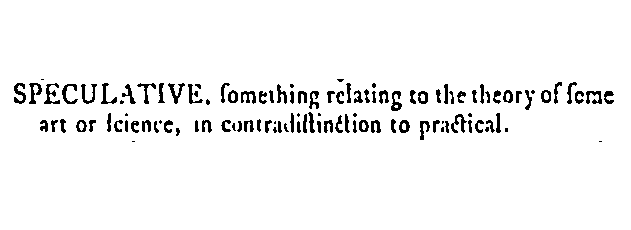
We can see Bacon’s contrast between speculative and practical present in this definition which remained in the exact same form in all the editions it appeared. It seems to be more of a dictionary definition pertaining to the standard meaning of the word at the time. This is also the case for the term ‘rational’ that appears only in the first edition (1771) of the Encyclopædia.
Rational/Rationalism
Although there was no entry for ‘rationalism’ until the 1853(8th) edition, we do find a brief entry for ‘rational’ in the first edition:
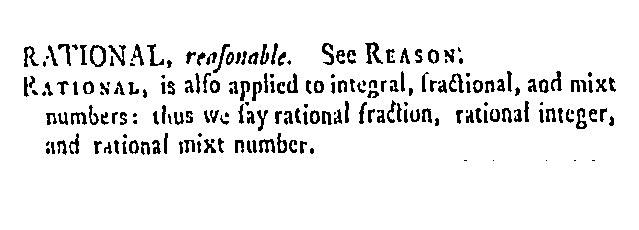
This is the only entry for ‘rational’ in any edition of the Encyclopædia. We can see that it does not have any connotation other than its specific use in mathematics and its use as an adjective meaning ‘reasonable.’
On the other hand, ‘rationalism’ appears for the first time in the same edition where the terms ’empiric’ and ‘experimental philosophy’ disappear, and there is no entry for ’empiricism’ yet (it first appeared in the 11th edition in 1910). We can see here that even by the mid-nineteenth century the term still had a restricted meaning that pertained specifically to religion.
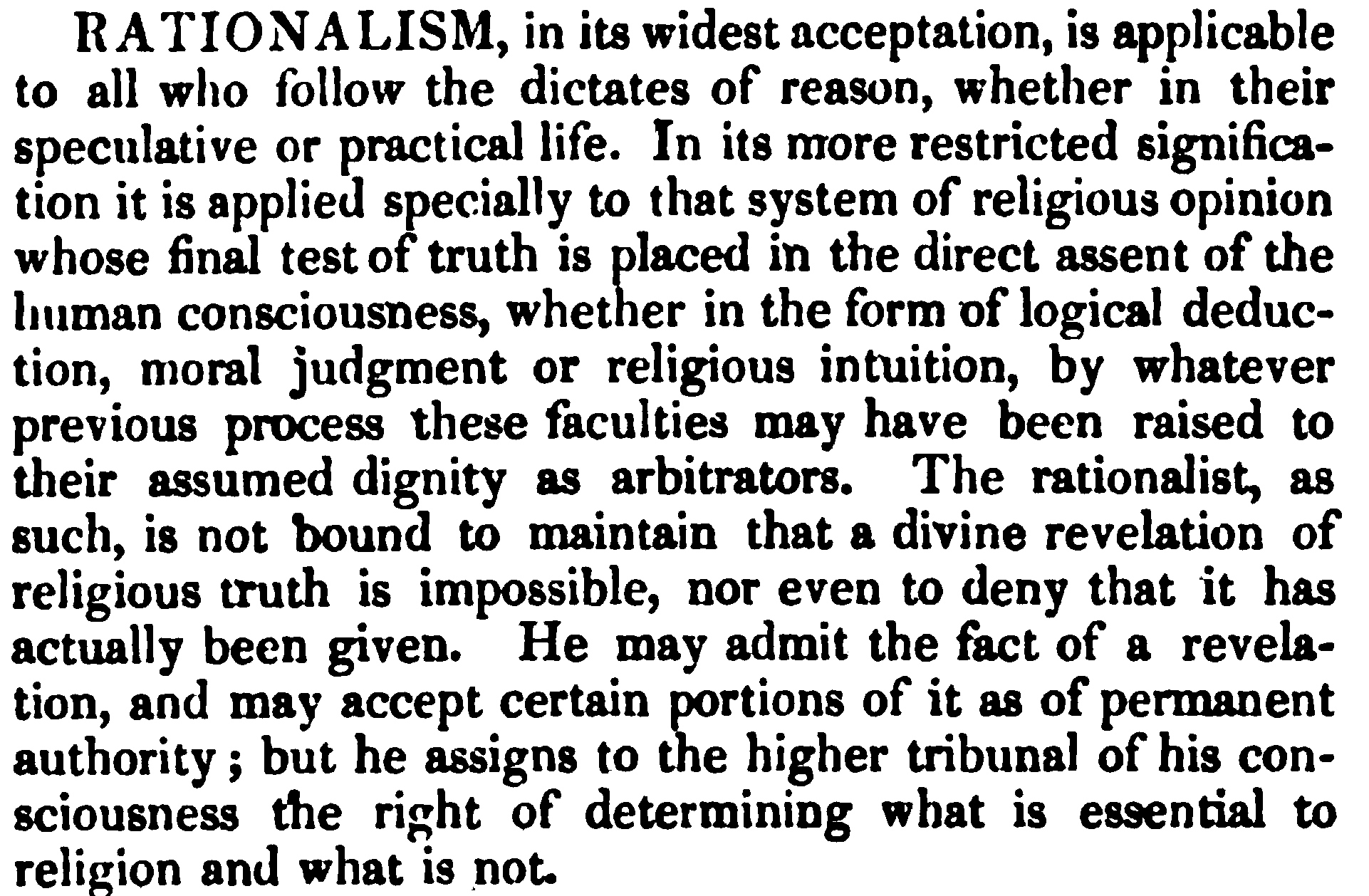
As it was the case with ’empiricism,’ ‘rationalism’ only appears in its modern sense in the twentieth century, where two definitions if the term are given: one referring to it’s use regarding religion present in the quote above, and the second one regarding its use in philosophy:
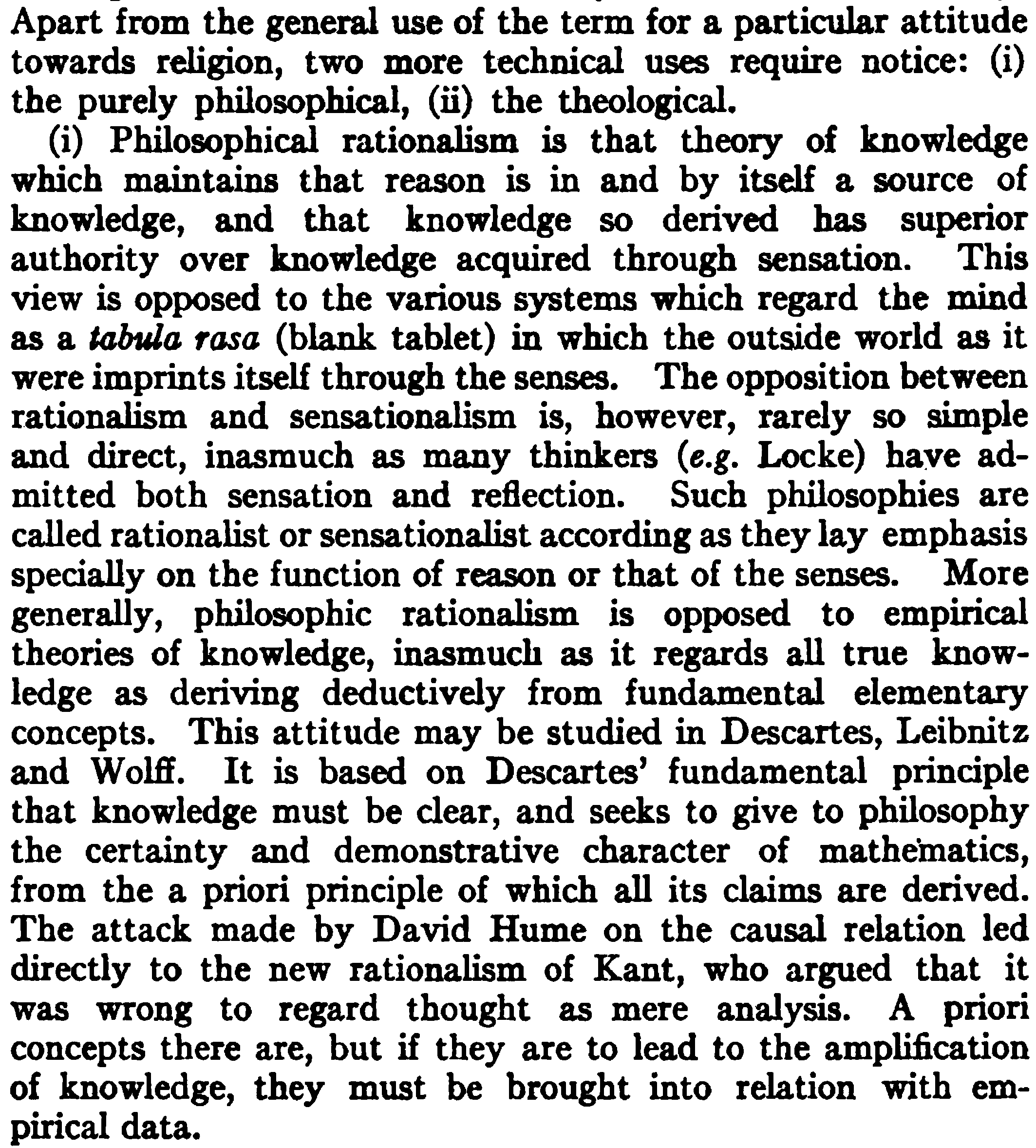
It is not until the first decades of the twentieth century that we see the terms ‘rationalism’ and ’empiricism’ being used to refer to early modern philosophy, showing that the ESD framework has some considerable advantages over the RED for interpreting the Early Modern period.
The origins of ‘solar system’
Peter Anstey writes…
The Cartesian vortex theory of planetary motions came under serious suspicion in England in the early 1680s. To be sure, many still spoke of ‘our vortex’ well into the 1680s and ’90s, such as Robert Boyle in his Notion of Nature of 1686 (Works, eds. Hunter and Davis, London, 1999–2000, 10, p. 508), but by the early 1690s the new Newtonian cosmology was coming to be widely accepted and many in England thought that the vortex theory had been disproved. By that time the vortex theory of planetary motions had come to be seen as the archetypal form of speculative natural philosophy. What was required then was a new descriptor for that cosmological structure in which the earth is located. And a new term was soon deployed, namely, ‘solar system’.
Some have claimed that it was John Locke who coined the term ‘solar system’. In fact, the OED lists Locke’s Elements of Natural Philosophy, which it dates at c.1704, as the earliest occurrence. However, the term first appears in his writings in Some Thoughts concerning Education of 1693 where speaking of Newton’s ‘admirable Book’ about ‘this our Planetary World’, he says,
his Book will deserve to be read, and give no small light and pleasure to those, who willing to understand the Motions, Properties, and Operations of the great Masses of Matter, in this our Solar System, will but carefully mind his Conclusions… (Clarendon edition, 1989, p. 249)
Interestingly, a quick word search of EEBO reveals that the term was also used by Richard Bentley in his seventh Boyle lecture of 7 November 1692, but published in 1693 in a volume that Locke owned (Folly & Unreasonableness of Atheism, London). Bentley uses the term in an argument for the existence of God on the basis of the claim that the fixed stars all have the power of gravity. It is God who prevents the whole system from collapsing into a common centre:
here’s an innumerable multitude of Fixt Starrs or Suns; all of which are demonstrated (and supposed also by our Adversaries) to have Mutual Attraction: or if they have not; even Not to have it is an equal Proof of a Divine Being, that hath so arbitrarily indued Matter with a Power of Gravity not essential to it, and hath confined its action to the Matter of its own Solar System: I say, all the Fixt Starrs have a principle of mutual Gravitation; and yet they are neither revolved about a common Center, nor have any Transverse Impulse nor any thing else to restrain them from approaching toward each other, as their Gravitating Powers incite them. Now what Natural Cause can overcome Nature it self? What is it that holds and keeps them in fixed Stations and Intervals against an incessant and inherent Tendency to desert them? (p. 37, underlining added)
There is no evidence, however, that Bentley was using the term as an alternative to ‘our vortex’. In a letter to Newton of 18 February 1693 he speaks unabashedly of matter that ‘is found in our Suns Vortex’.
Who published the word first? Bentley’s seventh Boyle lecture was not published separately, but appeared in the 1693 volume, the last lecture of which was not given its imprimatur until 30 May that year. Locke’s book was advertised in the London Gazette #2886 for 6–10 July. I have not been able to establish exactly when Bentley’s volume appeared, but it’s not mentioned in the London Gazette before #2886.
Whatever the case, it is most likely that the term was already ‘in the air’ and history shows that it was soon widely used and, of course, it is a commonplace today.
(N.B. This post also appears on the Early Modern at Otago blog.)
Oldenburg and Newton on ‘Experimental Philosophy’
Kirsten Walsh writes…
During the debate following the publication of Newton’s first paper, Newton provided a set of eight queries, in an attempt to steer the debate towards a satisfactory conclusion. When Henry Oldenburg, Secretary of the Royal Society and Editor of the Philosophical Transactions, published Newton’s queries, he added the following introduction:
- A Serie’s of Quere’s propounded by Mr. Isaac Newton, to be determin’d by Experiments, positively and directly concluding his new Theory of Light and Colours; and here recommended to the Industry of the Lovers of Experimental Philosophy, as they were generously imparted to the Publisher in a Letter of the said Mr. Newtons of July 8. 1672.
However, Newton didn’t describe his own work as ‘experimental philosophy’ until 1713, when he added the General Scholium to the Principia. He wrote:
- … and hypotheses, whether metaphysical or physical, or based on occult qualities, or mechanical, have no place in experimental philosophy. In this experimental philosophy, propositions are deduced from the phenomena and are made general by induction.
In 1672, would Newton have been comfortable with Oldenburg’s label ‘experimental philosopher’? Or did he consciously avoid the label, as Alan Shapiro suggests, in order to distance himself from the methodology of the early Royal Society?
Oldenburg on ‘Experimental Philosophy’
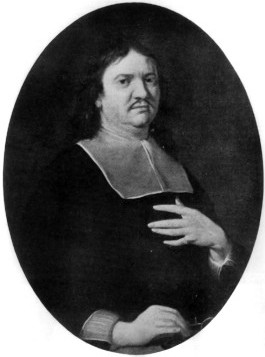
Henry Oldenburg (1619-1677)
To begin, what did Oldenburg mean by ‘experimental philosophy’? Let’s look at his prefaces to each issue of the Philosophical Transactions.
Firstly, Oldenburg was talking about the Baconian experimental philosophy. In the 1672 Preface, Oldenburg chose to adopt Bacon’s term, ‘Operative Philosophy’, which he used interchangeably with the term ‘Experimental Philosophy’. And he wrote:
- But, when our renowned Lord Bacon had demonstrated the Methods for a perfect Restauration of all parts of Real knowledge … The success became on a sudden stupendious, and Effective philosophy began to sparkle, and even to flow into beams of bright-shining Light, all over the World.
Moreover, in 1671, Oldenburg advocated Abraham Cowley’s Baconian-vision for the Royal Society. In his book, Proposition for the Advancement of Experimental Philosophy, Cowley proposed that the Royal Society appoint professors who were:
- bound to study and teach all sorts of Natural, Experimental Philosophy, to consist of the Mathematicks, Mechanicks, Medicine, Anatomy, Chymistry, the History of Animals, Plants …. and briefly all things contained in the Catalogue of Natural Histories annexed to My Lord Bacon’s Organon.
(Incidentally, in a previous post on this blog, Peter Anstey has identified this as the first English book to use the term ‘experimental philosophy’ in its title.)
Secondly, Oldenburg had in mind an experimental philosophy that emphasised the construction of natural histories. For example, in 1669, Oldenburg wrote:
- …we then made an Attempt of laying some Foundation for the Improvement of real Philosophy, and for the spreading of Useful knowledge; in publishing Advices and Directions for the writing of an Experimental Natural History…
Thirdly, Oldenburg had in mind an experimental philosophy that attempted to recover ancient knowledge. For example, in 1671, responding to critics of the experimental philosophy, Oldenburg wrote:
- they call it contemptuously the New Philosophy; when as yet perhaps themselves are not ignorant, that ‘tis so old as to have been the Discipline in Paradise; and from the First of Mankind … to have been practised and countenanced by the Best of Men…
Moreover:
- … we may not lay aside the other expedient, which is so helpful to explicate the Old Wonders of Art, and Old Histories of Nature; namely, To inquire diligently The things that are; What Rarities of Nature, and what Inventions of Men are now extant in any parts of the World.
To summarise, Oldenburg had in mind an experimental philosophy that:
- Followed Bacon’s method;
- Constructed natural histories; and
- Investigated ancient knowledge.
Newton on ‘Experimental Philosophy’
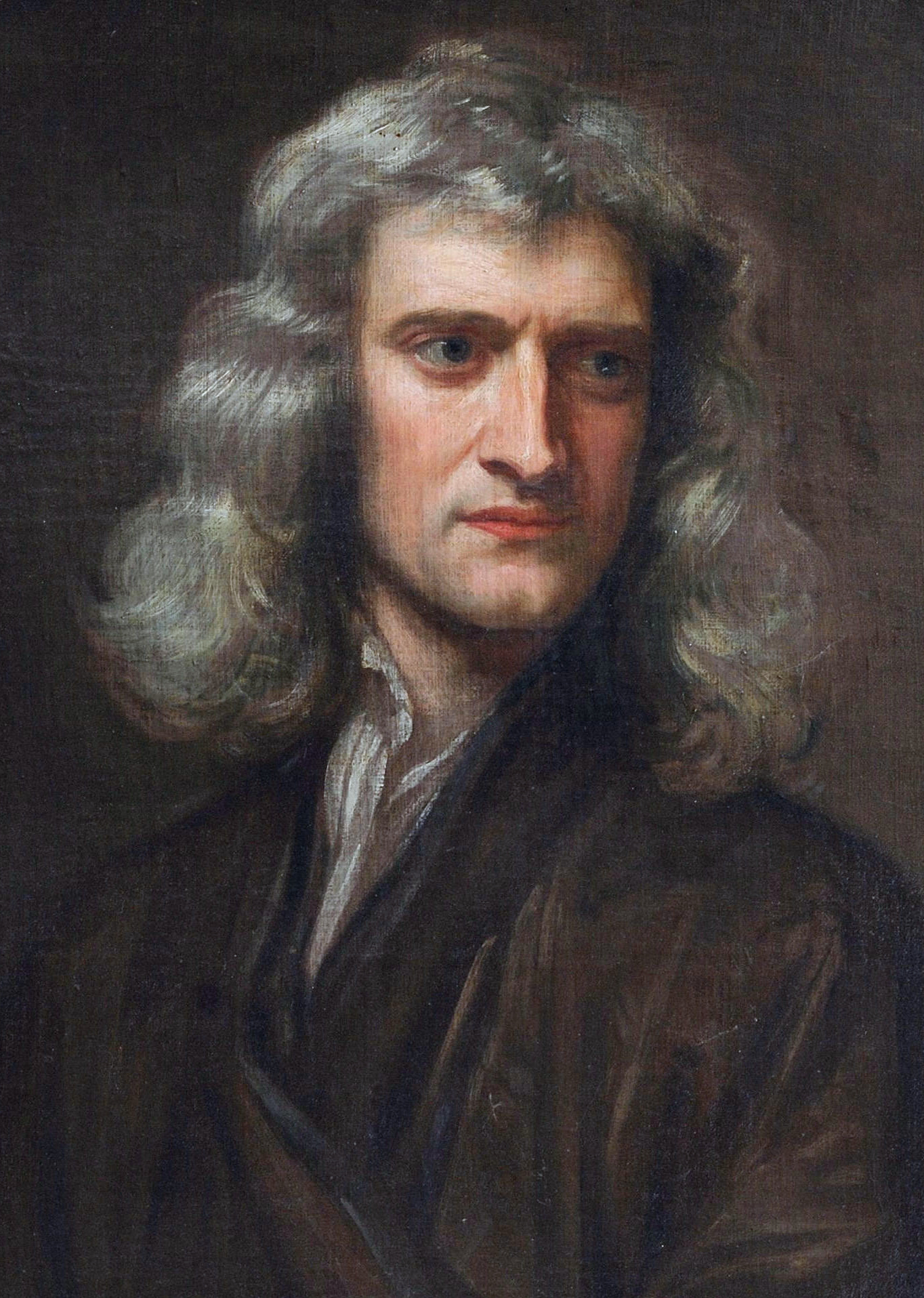
Isaac Newton (1642-1727)
Would Newton have approved of this way of describing his work?
Certainly Newton would have approved of being broadly aligned with the experimentalist philosophers, as opposed to the speculative philosophers. In his ‘Queries Paper’, he wrote:
- … the Theory … was evinced to me … not by deducing it only from a confutation of contrary suppositions, but by deriving it from Experiments concluding positively and directly.
And in the first paper, he wrote: “And I shall not mingle conjectures with certainties”.
While Newton didn’t construct natural histories, he may have approved of the Baconian overtones of the label. For, as I’ve discussed previously, Newton’s 1672 queries resemble Baconian queries.
Newton may even have approved of the suggestion that his method had ties to the Ancients. For example, as early as 1686, in his Preface to Principia, Newton emphasised the influence of the Ancients:
- Since the Ancients (according to Pappus) considered mechanics to be of the greatest importance in the investigation of nature and science and since the moderns – rejecting substantial forms and occult qualities – have undertaken to reduce the phenomena of nature of mathematical laws, it has seemed best in this treatise to concentrate on mathematics as it relates to natural philosophy.
So, I think Newton would have approved of Oldenburg’s label, even though later on, when he came to describe his own experimental philosophy, the emphasis was quite different. For example, in Query 31 of the Opticks, Newton wrote:
- This Analysis consists in making Experiments and Observations, and in drawing general Conclusions from them by Induction, and admitting of no Objections against the Conclusions, but such as are taken from Experiments, or other certain Truths. For Hypotheses are not to be regarded in experimental Philosophy.
Daunou and the Fate of Experimental Philosophy in Nineteenth-Century France
Alberto Vanzo writes…
On this blog, we have often stressed the importance of the movement of experimental philosophy between the 1660s and ca. 1800. What happened to this movement in the nineteenth century? Last week Juan noted that, after 1823, the entry “experimental philosophy” in the Encyclopedia Britannica was substantially shortened and then removed. This suggests that that notion may have disappeared from the British philosophical scene. Something similar had happened in Germany, where the tradition of experimental or, as it was mostly called, observational philosophy was eclipsed by Kantian and post-Kantian systems around 1800. The expression “observational philosophy” seems to have disappeared from the German philosophical vocabulary in the early nineteenth century.
In this post, I will highlight an exception to this trend: Pierre-Claude-François Daunou’s Recherches sur les systèmes philosophiques applicables à l’historie. This is the text of the lectures on the history of philosophy that Daunou gave at the Collège de France in 1829-1830. It was published posthumously in 1849. In this work, as late as in the mid-nineteenth century, we find a wholehearted defense of experimental philosophy and its application to philosophical historiography.
Daunou aims to outline a philosophical history of philosophy. What renders the history of philosophy philosophical? Daunou’s answer is: “history is philosophy, when it consists in a methodical series of facts that are carefully verified and presented as experimental instructions”. In fact, “only the experimental school provides the true method in the historical studies”.
Like Degérando before him, Daunou draws on the historical facts to develop a natural history of philosophy: a classification of the various types of philosophical systems which we can use to establish which is the best. To this end, “the classifications must resemble those of naturalists, that is, they must only summarize the facts. Pretending that they are given and established a priori by the nature of things is a Platonic illusion, that has introduced many prejudices and errors into the sciences”.
In 1829, Daunou could chose between plenty of alternative classifications: for instance, the old division of philosophers into sects to be found in Brucker’s manual, praised by Daunou; the empiricism/rationalism distinction used by the Kantians and by Degérando; and Cousin’s fourfold distinction between idealism, sensualism, scepticism and mysticism. Rejecting all of these classifications, Daunou follows Diderot, Condillac and Condorcet in relying on the good old division between experimental and speculative (or in his terms, contemplative) systems. On the one hand, we have the experimental approach of Aristotle, Bacon, Gassendi, Locke, and Condillac. On the other hand, we have the Platonic attempt to develop philosophical systems a priori. Kant, far from synthesizing these two trends as his disciples claimed, was responsible for perpetuating the Platonic, contemplative illusion. He “delayed the progress of science” and he induced French thinkers to accept the mistaken principle that “the abstract precedes the concrete, sheds light on it and dominates upon it”.
Given Daunou’s assumptions, it is easy to guess what moral he draws from his history of philosophy: we must abandon the Platonic “picture of an idea or imaginary world” and acknowledge that “we owe all progress of physical and moral sciences” to experimental philosophers.
What is surprising, or at least interesting, is that we find these claims in a text published as late as in 1849. Was Daunou a historian attardé, a living fossil in his own time, as Gregorio Piaia states in his very informative survey of Daunou’s work (to which this post owes much) in the Storia delle storie generali della filosofia? It is hard to deny that he was, at least to some extent. However, Daunou’s speculative-experimental distinction was paralleled in Saint-Simon’s contrast between Plato’s and Descartes’ vague speculations on the one hand, Aristotle’s and Bacon’s positive philosophy on the other. The term used by Saint-Simon is “positive”, not “experimental”. However, Saint-Simon’s positive philosophy was based on the experimental method. And in the first volume of Comte’s Course of Positive Philosophy we find the same contrast between the metaphysical spirit, to be rejected, and the positive spirit of those that Daunou regarded as experimental philosophers.
Let’s go back to our initial question on the fate of experimental philosophy in the nineteenth century. Daunou’s work, together with Saint-Simon’s and Comte’s statements, suggests that the notion of experimental philosophy was not simply abandoned in nineteenth century France. Instead, it morphed into the new notion of positive philosophy, or at least it contributed to the definition of this new important movement in the French philosophical scene. I am no expert in nineteenth century French philosophy though. I would love to hear if you find this suggestion plausible.
Tracking Terms in the Encyclopædia Britannica
Juan Gomez writes…
Some time ago I wrote a post regarding David Fordyce’s Elements. This text was used almost in its entirety as the entry for moral philosophy in the Encyclopædia Britannica from the first edition in 1771 and until the seventh edition where it was modified and the replaced by an essay on the topic by William Alexander. I want to refer to the Encyclopædia again, this time to trace the description of four terms, namely ‘empiric,’ ‘experimental philosophy,’ ‘rational’ and ‘rationalism,’ and ‘speculative.’ I will focus on the first two terms in today’s post.
Empiric
The word ‘empiric’ appears in the first eight editions (1771 to 1898 when the ninth edition appeared). It is a very short entry and it restricts its use to method in medicine:
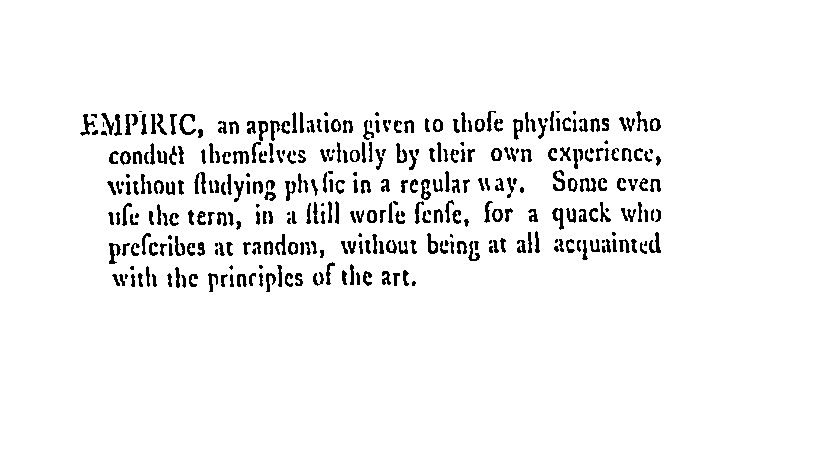
It is clear from the definition that the word had a different use than the one implied by the modern term ‘empiricism,’ which appeared for the first time in the eleventh edition(1910) of the Encyclopædia. In such editions the writer of the entry tells us that the term refers “in philosophy, [to] the theory that all knowledge is derived from sense-given data. It is opposed to all forms of intuitionalism, and holds that the mind is originally an absolute blank.” The last paragraph of the entry refers to the restricted definition of the term ‘empiric’ given in previous editions that I quoted above.
Experimental Philosophy
This term can be found in the first eight editions as well and disappears from the ninth edition onwards. The following is the definition from the first edition of the Encyclopædia:
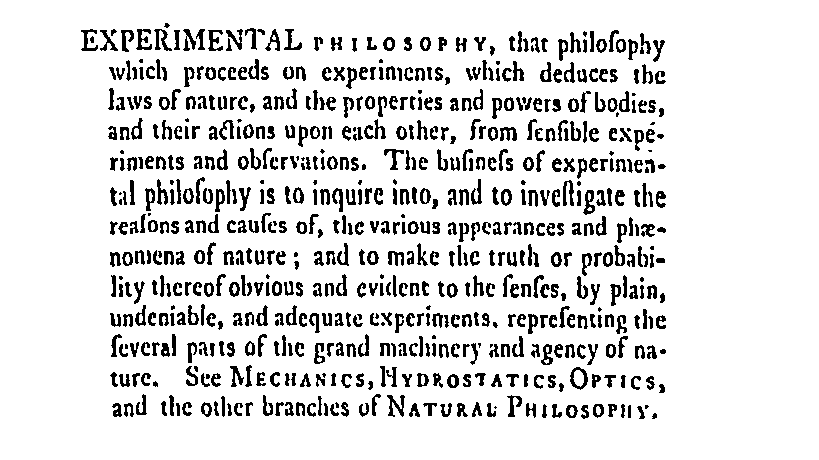
However, the definition for Experimental Philosophy was substantially expanded for editions two to six, and then reduced to one small paragraph in the eighth edition. From 1778 (second edition) to 1823 (sixth edition) the entry consists in a general description and refers to seventeen items that form “the foundations of the present system of experimental philosophy.” The items are basic definitions of the object of study of experimental philosophy: natural bodies and their properties, extension, arrangement of particles, law of gravity, properties of light, and so on. For the seventh edition the entry was reduced to this:
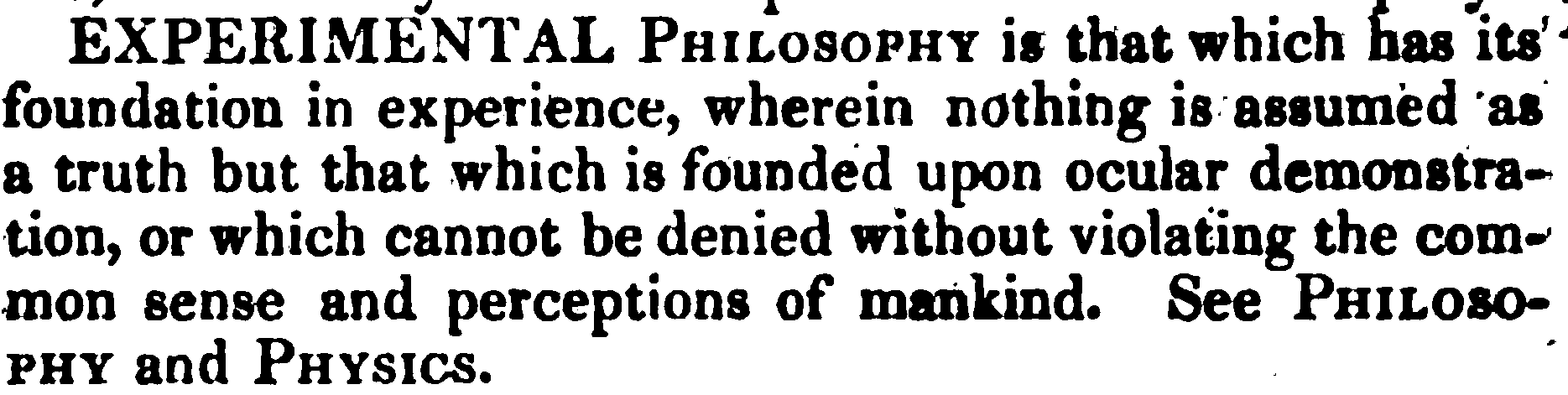
The entry is the same for the eighth edition but from the ninth edition onwards there is no entry for ‘experimental philosophy.’
As far as the Encyclopædia Britannica is concerned, we can see that the terms used in the eighteenth and nineteenth centuries are better explained by using the ESD framework instead of the RED. The contrast between the meaning of the term ’empiric’ in the medical context and the later twentieth century entry on ’empiricism’ illustrates this nicely. As we will see in my next post, the way the terms ‘speculative’ and ‘rational’ were used gives us more evidence to prefer the ESD framework for interpreting the early modern period.
Francis Bampfield: an early critic of experimental philosophy
Peter Anstey writes…
In a recent article Peter Harrison has drawn our attention to the phenomenon of experimental Christianity in seventeenth-century England (‘Experimental religion and experimental science in early modern England’, Intellectual History Review, 21 (2011)). In this post I would like to take up where Harrison left off and discuss one proponent of experimental religion whom Harrison does not mention, namely Francis Bampfield (1614–1684). Bampfield provides an interesting case study because while he was a promoter of experimental Christianity, he was also a harsh critic of the new experimental natural philosophy.
In two works from 1677, All in One and SABBATIKH, Bampfield lays out his case against experimental natural philosophy. In his view the source of all useful and certain knowledge is the Scriptures.
Practical Christianity, and experimental Religion is the highest Science, and the noblest Art, and the most honourable Profession, which gives light to all inferiour knowledges, and would admit into the Royalest Society, and draw nearest in resemblance and conformity, to the glorified Fellowship in the Heavenly College above, where their knowledge is perfected in visional intuitive light. Here is the prime Truth, the original Verity, as to the manifestativeness of it in legible visible ingravings, which would carry progressively into other Learning contained therein: all here is reducible to practice and use, to life and conversation; here existences and realilties are contemplated and proved, not mere Ideas and conceits speculated as elsewhere. (All in One, p. 12)
It is the mere ideas and conceits of the new experimental philosophy of the Royal Society, or the Fellows of Gresham College, that Bampfield is concerned to expose:
How many thousands have by their wandring after such misguiders left and lost their way in the dark, where their Souls have been filled with troublesome doubts, and with tormenting fears, exposing them to violent temptations of Atheism and Unbelief? and what wonder, that it is thus with the Scholar, when some of the learnedest of the Masters themselves have resolved upon this, as the conclusion of all their knowledge, that, All things are matter of doubtful questionings, and are intricated with knotty difficulties, and do pass into amazing uncertainties, and resolve into cosmical suspicions? And this, not only is the deliberate Judgement of particular Virtuoso’s in our day, but has been the publick determination of an whole University. (All in one, p. 3)
What are these ‘knotty difficulties’ that pass into ‘amazing uncertainties’ resolving into ‘cosmical suspicions’? The alert reader will no doubt see here a direct allusion to Robert Boyle’s Tracts of 1670 in which he discusses cosmical qualities that seem to have ‘such a degree of probability, as is want to be thought sufficient to Physicall Discourses’ (Works of Robert Boyle, eds Hunter and Davis, London, 1999–2000, 6, p. 303). Boyle appended to his essay on cosmical qualities another on cosmical suspicions which contains just the sort of speculative reflections that Bampfield is alluding to here. (As far as I can determine, Boyle’s is the first work in English that uses the term ‘cosmical suspicions’.) That Bampfield was a close reader of Boyle’s writings comes out in a later passage which I quote in extenso:
There is an honourable Virtuosus, who has travelled far in Natures way, and has made some of the deepest inquiries into Experimental, Corpuscular, or Mechanical Philosophy, that in the requisites of a good Hypothesis amongst others of them, doth make this to be one of its conditions, that it fairly comport not only with all other truths, but with all other Phaenomena of Nature, as well as those ’tis fram’d to explicate, and that, not only none of the Phaenomena of Nature, which are already taken notice of do contradict it at the present, but that, no Phaenomena that may be hereafter discovered, shall do it for the future. Let it therefore from hence be considered, whether seeing, that History of Nature, which is but of human indagation and compiling, is so incomplete and uncertain, and many things may be discovered in after-times by industry, or in some other way by providential dispensing, which are not now so much as dreamed of, and which may yet overthrow Doctrines speciously enough accommodated to the Observations, that have been hitherto made (as is by himself fore-seen and acknowledged) whether now, the only prevention and remedy in this case (which is otherwise so full of just fears, of real doubts, of endless dissatisfaction, and of perplexing difficulties) be not, to bring all sorts of necessary knowledges to the Pan-sophie, the Alness of Wisdom, in the Scriptures of Truth, where none of the forementioned Scriptures have any ground to set their foot on, in regard that Word-Revelations about Natures Secrets, are the unerring products of infinite Wisdom, and of universal fore seeingness, which are always uniform and the same, in their well-established order, and stated ordinary course without any variation, by an unchangeable Law of the All-knowing Truthful Creator, and Governour, and Redeemer. (All in One, pp. 56-7)
Bampfield is, of course, referring to Boyle’s Excellency of Theology (Works, 8, p. 89) and while he is cautious not to be overtly critical of Boyle here, the thrust of his comments is to undermine the epistemic status of the experimental philosophy, calling it ‘incomplete and uncertain’. For, as he says in his sequel SABBATIKH:
the unscriptural way they take in their researches into natural Histories and experimental Philosophy, will never so attain its useful end for the true advance of profitable Learning, till more studied in the Book of Scriptures, and suiting all experiments unto this word-knowledge. (SABBATIKH, p. 53)
It is ‘word knowledge’ and not knowledge of the world that Bampfield is defending. What Boyle himself made of all of this, if it even came to his attention, we will never know. He never mentions Bampfield in any of his works or correspondence.
The Experimental Role of Hypotheses in Newton’s Principia
Kirsten Walsh writes…
In the first edition of Principia (1687), book 3 contained nine hypotheses. But in the second edition (1713), Newton re-structured book 3 so that it contained only two hypotheses. All but one of the old hypotheses were simply re-labelled. Those that specified explanatory constraints were called ‘Rules of Reasoning’, those that were simply unsupported generalisations were called ‘Phenomena’, and only the assumptions about nature were called ‘Hypotheses’.
| 1st edition | 2nd edition |
| Hypothesis 1 | Rule 1 |
| Hypothesis 2 | Rule 2 |
| Hypothesis 3 | Replaced by Rule 3 |
| Hypothesis 4 | Hypothesis 1 |
| Hypothesis 5 | Phenomenon 1 |
| Hypothesis 6 | Phenomenon 3 |
| Hypothesis 7 | Phenomenon 4 |
| Hypothesis 8 | Phenomenon 5 |
| Hypothesis 9 | Phenomenon 6 |
| Lemma 3 | Hypothesis 2 |
Table: Book 3 changes from 1st to 2nd editions.
These changes seem to indicate that Newton’s attitude to hypotheses changed dramatically between 1687 and 1713 – probably in response to Leibnizian criticisms and Cotes’ editorial comments.
On this blog, I have given you many reasons to suppose that, as early as 1672, Newton was working with a clear epistemic distinction between theories and hypotheses. More recently, I have argued that in fact, Newton was working with a three-way epistemic distinction between theories, which are certain and experimentally confirmed, hypotheses, which are uncertain and speculative, and queries, which are not certain, but provide the proper means to establish the certainty of theories. I call this division Newton’s ‘epistemic triad’. I argued that hypotheses perform a distinctive and vital supporting role to theories and queries, and that this role is an enduring feature of Newton’s methodology.
Today I’ll compare the roles of hypotheses and rules of reasoning in book 3, and argue that Newton’s attitude to hypotheses c.1713 was a refinement of his attitude c.1687, but not a dramatic change.
To begin, consider hypothesis 1 (2nd edition): “The centre of the system of the world is at rest.”
Upon introducing this hypothesis, Newton explained that:
- “No one doubts this, although some argue that the earth, others that the sun, is at rest in the centre of the system. Let us see what follows from this hypothesis.”
This is a simplifying assumption. From this hypothesis, in conjunction with Corollary 4 of the Laws of Motion,
- “The common centre of gravity of two or more bodies does not change its state whether of motion or of rest as a result of the actions of the bodies upon one another; and therefore the common centre of gravity of all bodies acting upon one another (excluding external actions and impediments) either is at rest or moves uniformly straight forward”,
Newton derived Proposition 11: “The common centre of gravity of the earth, the sun, and all the planets is at rest.”
This enabled him to calculate the motions of the planets – that is, to deduce the observational consequences of his theory. I consider this to be the chief role of hypotheses, and it is experimental.
Now compare this with how Newton uses his rules of reasoning.
Rule 1 states: “No more causes of natural things should be admitted than are both true and sufficient to explain their phenomena.”
And Rule 2 states: “Therefore, the causes assigned to natural effects of the same kind must be, so far as possible, the same.”
In his discussion of Proposition 4, Newton explained:
- “And therefore that force by which the moon is kept in its orbit, in descending from the moon’s orbit to the surface of the earth, comes out equal to the force of gravity here on earth, and so (by rules 1 and 2) is that very force which we generally call gravity.”
These rules didn’t help Newton to deduce the observational consequences of his theory in the same way as his hypothesis 1. They provide an important supporting role for his theory, but it is not an experimental role.
To the second edition, Newton also added the General Scholium, in which he (in)famously declared “hypotheses non fingo”. Recently I argued that, in this passage, Newton was not railing against hypotheses in general, but rather, against the use of ‘causal hypotheses’ to illustrate more abstract theories. Given that the first edition did not contain any causal hypotheses, I consider this addition to indicate Newton’s increasing conviction in his method, rather than any dramatic change.
So finally, to summarise the developments between the first and second editions of Principia:
In the first edition:
- Hypotheses are temporarily assumed, untestable propositions that provide a supportive role; and
- There are no causal hypotheses.
In the second edition:
- Hypotheses are temporarily assumed, untestable propositions that provide a supportive experimental role;
- Other temporarily assumed, untestable propositions are given other labels to distinguish them from hypotheses; and
- Emphatically, there are no causal hypotheses.
I see these changes as developments of Newton’s epistemic triad, rather than dramatic methodological changes.
Empirical Physicians vs Experimental Physicians
Alberto Vanzo writes…
As we have already noted on this blog, “empiricism” was mainly used as a medical term in the early modern period. It referred to empirical physicians, a movement that had its origins in ancient Greece. Greek empirical physicians claimed that our knowledge of medical cures derives entirely from experience and derives its justification from experience. It does not derive from any insight into “hidden natures, causes, and actions, not open to observation, but only accessible to reason, e.g., atoms, invisible pores, functions of organs, or essences” (Michael Frede).
These views of ancient empirical physicians were remarkably close to those of the early modern physicians who were associated with the experimental philosophy. They too rejected reasonings from principles and speculations on hidden essences and claimed to derive their cures from experience alone. The early moderns were conscious of this similarity between ancient empirical physicians and modern experimental physicians. They acknowledged that, since empirical physicians relied on “experiments” (that is, experience), their teachings contain “something that is certaine & experimentall” (Hartlib Papers).
In the light of this, it is puzzling that the upholders of the “experimentall” approach to medicine used to criticize medical empiricism and empirical physicians. They generally accepted the then common association of empirical physicians with “Mountebanks, pretended Chymists, Apothecaries, Chirurgeons, Midwives, &c. in which piece of Folly the English surpass all the Nations of Christendom.”
To be sure, there were some cases in which early modern experimental physicians praised ancient medical empiricism, portraying it as a forerunner of experimental medicine. But as far as I know, these were rare exceptions. Why were they exceptions and not the rule? Why did experimental physicians see themselves as opponents, rather than followers, of medical empiricism?
I have found some answers to these questions in the writings of two prominent eighteenth-century physicians. They are the German physician Friedrich Hoffman, a leading systematist of the early eighteenth-century, and the Scottish physician John Gregory, who taught at Edinburgh in the latter half of the century. They both associate medical empiricism with the application of medicines that happened to work in past cases to patients which display similar symptoms. This approach was epitomized in the “empirical books” that were compilations of medical recipes and cures for all sorts of diseases. According to Gregory, this approach raises two problems.
Firstly, it relies on experience in the wrong way. Empirical physicians rely on the recipes that have been shown to work by experience, but true physicians should also rely on experience to improve their remedies and practice.
Secondly and more interestingly, empirical physicians did not pay sufficient attention to experience. They did not carefully inquire into the circumstances of individual patients. Instead, having noted few symptoms, they hastily prescribed a familiar remedy. As Hoffmann pointed out, this “obtuse and most dangerous empiria” was deeply flawed because the “efficacy of a cure” does not reside in the nature of a remedy, but in the way in which the remedy interacts with the specific circumstances of a patient. In Gregory’s words, since “empirics” paid insufficient attention to those circumstances, “notwithstanding their pretensions of relying upon experience alone, have in truth abandoned it”.
Gregory’s preferred alternative to this flawed medical empiricism was what appears to be, broadly speaking, an application of the Newtonian experimental method to medicine. Gregory praised a medical theory that “is produced by practice, is founded on facts alone, and constantly appeals to them for its truth”. He rejected the use of hypotheses, considered as principles devoid of “proof from experience”. He advocated their use, as long as they were “proposed in the modest and diffident manner that becomes mere suppositions or conjectures”, that is, queries. Used in this way, hypotheses “are not only harmless but even necessary in establishing a just theory in medicine”. Gregory portrayed this experimental method as an alternative to medical empiricism. Only one century later, after “empiricism” took on a new meaning, did it come to be regarded as a positive stance even within medicine.
Experimental Philosophy in Spain Part II
Juan Gomez writes…
In my previous post I reviewed some texts from Spanish authors in the 17th century to show that, contrary to common opinion, intellectuals in the Iberian Peninsula were in fact acquainted with the progress and achievements of the new experimental philosophy. They did not just know of it, but actually advocated its application and called for the rejection of the old method of the scholastics. In this post I will conclude this overview of the ESD in Spain by looking at the work of the Novatores in the eighteenth century.
The texts we examined in my last post were both written by physicians. In the eighteenth century medicine remained as the forum for the promotion of experimental philosophy. The first author I will examine is Doctor Martín Martínez. He was a physician and professor of anatomy in Madrid, and royal physican to Phillip V. Besides a number of medical writings, in 1730 he published Filosofía Escéptica which consisted in a dialogue between an Aristotlian, a Cartesian, a Gassendist, and a Sceptic. In the preliminaries to this book he tells us that
- The spirit of this book is to give to the Curious Romantics an idea of the most famous philosophies that today run through Europe, relegating that Aristotle just for theological studies.
Even in the 1730’s books in Spain still included a statement of approval made by a priest or friar that confirmed that there was nothing in the book to be censured. The censorship for Filosofía Escéptica was written by Friar Agustín Sanchez and in it we find a statement in the spirit of experimental philosophy. Speaking of the account Martínez gives of the Aristotelian, Cartesian, and Gassendist positions he tells us that the Doctor
- Is determined not to follow any of them, but is inclined towards what he judges more plausible; he does not believe in what experience cannot confirm, based on the fact that words cannot reach the truth of physical and material things, nor their natures and properties; what experience cannot testify, and persuade, cannot be known by words.
Martínez begins his dialogue by giving a brief history of philosophy in Spain, blaming the Arabians for the introduction of Aristotelian philosophy,
- From which that contentious and vociferous philosophy we call Scholastic, as opposed to Experimental, has been derived.
A few lines later Martínez comments that he shares the same opinion held by Bacon:
- The most judicious Verulam also held, that of all the philosophies that have been invented, and received, so many were but fables, and Comical Scenes, each of them making the world to their liking, amassing the Elements to the measure of their palate, and arbitrarily establishing hypotheses as difficult to believe, as they are to prove.
In the case of Martín Martínez we can see the experimental philosophy and the rejection of mere speculation clearly represented. But to show that this was not an isolated case I turn now to another doctor, Andrés Piquer. Out of all the Novatores that practices medicine, Piquer was the one that published most on other topics. He published a book on logic, one on moral philosophy, and one on physics. This last one was published in 1745 under the title Física Moderna Racional, y Experimental (Modern Physics, Rational and Experimental). Piquer begins this book by giving some preliminaries about the state and history of physics and the method to follow. In his historical account he tells us that
- Physics was wrongly cultivated for many centuries, until Francis Bacon Lord Verulam, Great Chancellor of England, towards the end of the sixteenth century, started to renew it, freeing it form the superfluity of reasoning, and manifesting, that the true way to advance in it is through the path of experience.
Speaking about the proper method Piquer sets up a distinction that illustrates the presence of the ESD (in some form) in Spain:
- Modern physicists, are either Systematic, or Experimental. The former explain nature according to some system; the latter discover it through the way of experience. The Systematic form in the imagination some idea, or drawing of the principal parts of the World, of its connections, and mutual correspondence; and holding such idea, that sometimes is strictly willed, as a principle, and foundation of their Philosophy, try to explain everything that occurs in the universe according to it. This has been done by Descartes, and Newton. The Experimental work to collect many experiments, combine them, and use them as the basis of their reasonings. This is how Robert Boyle, Boerhaave, and many other philosophers of these times treat physics.
One of the interesting features of this passage is that Piquer groups Descartes and Newton together under systematic philosophers! However, I don’t have the space or time to discuss this very interesting issue in this post, but Piquer’s distinction between systematic and experimental is something worth looking into. For now, I believe I have provided some very interesting passages from early modern Spanish authors that show that they were acquainted with experimental philosophy and opposed and rejected mere speculation.
N.B. The English translation of the quotes presented here is mine
Locke’s swallows
Peter Anstey writes…
John Locke’s commitment to the experimental philosophy was extraordinary. In the 1690s, arguably the busiest decade of his life, Locke continued to make daily detailed records of the prevailing weather conditions at Oates, the house of Francis Masham where he resided from 1691.
Each day he would enter the day of the month, the hour, the temperature, barometric pressure, humidity, wind direction and speed, and the overall weather conditions. Sometimes he recorded three or four sets of data within a single day. Of course, Locke was not the only one in England who was collecting such data. He was merely a small part in a larger loosely connected project that aimed to construct a natural history of the air. The inspiration here was his mentor Robert Boyle whose A General History of the Air Locke had seen through the press in 1692 after Boyle’s death. Indeed Locke included a set of his own weather records from the 1660s in that work and perhaps it was the self-confessed incomplete nature of Boyle’s history that spurred Locke on to resume his weather charts in December 1691 (the very month in which Boyle died). The incompleteness of Boyle’s history is also the explanation of the fact that Locke had his own copy of the work interleaved and began to add new observations on the air.
One particularly interesting set of records is that for the month of September 1694. Here are the readings for the 4th of that month:
Day Hour Temp Barom Hygrom Wind Weather
| 4 | ∙9 | 5o— | 15. | 2436 | WS 3 | covered, a shower at 21 |
| 24 | 1 ∙ 7 | 29∙10. | 2233 | very fair |
The small dot to the left of the hour indicates that the first reading was made around 9.45am. There was no standard of temperature in Locke’s day, so he provides a relative reading of 5 marks above the zero mark, which was set at temperate rather then freezing. The morning wind from the WSW was evidently quite strong: Locke’s scale is from 0 to 4. And he was up late recording that there was a rain shower at 9pm and taking another set of readings at midnight. (It is interesting to note too that he used a 24-hour clock and records made at midnight are not uncommon.)
After this entry, Locke makes the following observation:
SWALLOWS. No Swallow or Martins this day plying about the house or Moat as they used to be but every now & then 3 or 4 or more appeared & after 2 or 3 turns were gone again out of sight they generally flew very high and seemed to be passengers & to take their course southward as far as I could observe whether they were plying about the house yesterday or not I did not observe.
Then on the 19th of the month he reflects back on the swallows:
SWALLOWS The observation made 4° Sept will need some further experiments to confirm it. It being hard to take notice of their flight so as to be sure they doe not return again. But this I am certain that after that day neither SWALLOWS nor Martins were so many nor so busy as before. But yet some of them though not so frequent were to be seen till the 19th & then I went to London.
Notice the talk of the need for further experiments. Here, within a project for the systematic collection of data for a Baconian natural history, a project that involves the daily use of newly invented meteorological instruments, Locke makes a further observation and conceives of it in terms of the application of the experimental method.
So thorough are Locke’s records that, by his own admission, ‘there seldom happen’d any Rain, Snow, or other remarkable change, which I did not set down’. And what was it all for? He told Hans Sloane that with enough meteorological data ‘many things relating to the Air, Winds, Health, Fruitfulness, &c. might by a sagacious man be collected from them, and several Rules and Observations concerning the extent of Winds and Rains, &c. be in time establish’d to the great advantage of Mankind.’
