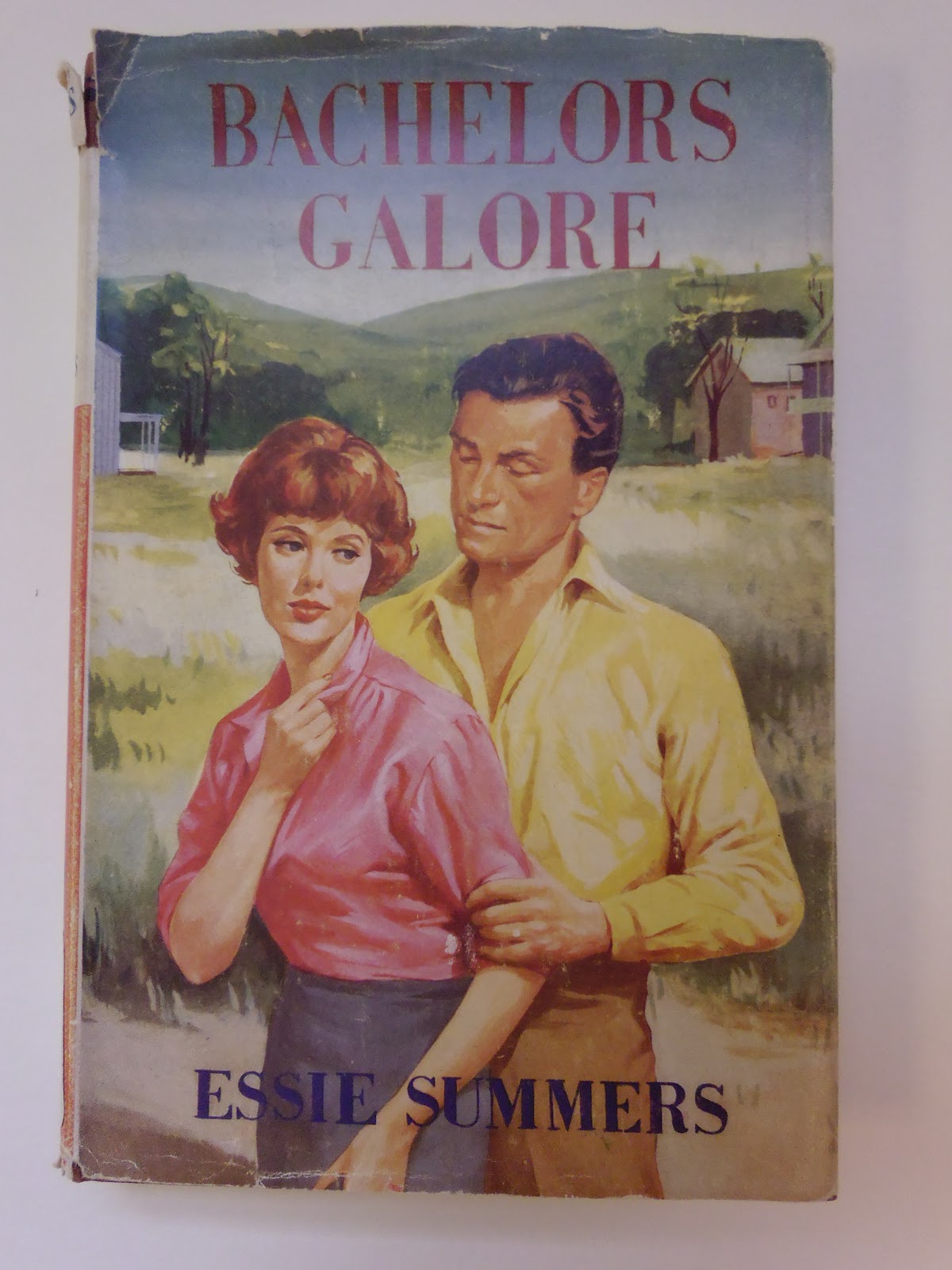
This wonderful image is a photograph of the ship Maheno, which served at Gallipoli as well as elsewhere in the Mediterranean during the First World War. Along with sister hospital ship Marama, it transported over 47,000 wounded soldiers to safety. For the winter months of 2012 the Hocken Library is using this image to promote the current exhibition – Ship Shape – an exhibition based on the idea of “portraits” of ships.
 |
| Maheno in her building berth, 1905, Cameron Family Papers MS-1046/422 |
Maheno was built by William Denny and Brothers at Dumbarton, Scotland but Dunedin was its home. Joining the Union Steam Ship Company’s fleet in 1905, the Maheno was the first turbine-powered ship to work the Trans-Tasman route. The vessel had a strong link with the University of Otago as well since the Ministry of Defence offered the institution surplus money from the Hospital Ships’ Fund to build a hall for the military training of medical students in 1919. Maheno and Marama Hall (as it was originally called) was completed in 1923 and is now occupied by the Department of Music. A roll of honour in the foyer lists medical staff who served on the ships.
Maheno’s elegant profile was much admired, as were its comfortable and beautiful interiors. Original photographs of the ship from the Hocken Archives Collection are currently on show as part of the exhibition:
For more information about the exhibition, follow this link Ship Shape
Blog post prepared by Assistant Curator of Photographs, Anna Petersen, with David Murray, Acting Arrangement and Description Archivist.
“Don’t wait till the spirit moves. While there are times when inspiration and thought outrace your pen, you’ll never get to the top if you wait on this.”
“Choose the magazine you are going to submit to most carefully … Not a bit of use submitting an article on colour bar or flying saucers to a periodical catering solely for young mothers or fashion trends.”
“Make sure of your facts, whatever you are writing … Don’t even let your characters eat whitebait out of season … unless it’s tinned.”
“Never be set back with rejections. I could have papered a room with mine.”
 |
| MS-3854/021, from the Charles and Louise Croot papers |
These are some of the tips Essie Summers gave in 1960 to young people interested in free-lance journalism. A copy of her advice, which runs to ten closely-typed pages, is in the papers of Dunedin teacher, broadcaster and writer Charles Croot. Perhaps Croot had invited Summers, a local Presbyterian minister’s wife, to talk to one of his English classes at Kaikorai Valley High School.
Essie Summers was well qualified to give advice to budding writers. She had published poems and stories in magazines, and for six years wrote a popular column in the Timaru Herald. She was also well on the way to becoming one of New Zealand’s most popular novelists. By 1960 she had written eight romances, published in England by Mills & Boon. They would eventually publish 52 of her books, which were translated into 17 languages and sold millions of copies. Many of her books were set in Otago and Canterbury, particularly in the high country, and her lyrical descriptions of the landscapes she loved inspired numerous overseas readers to visit New Zealand.
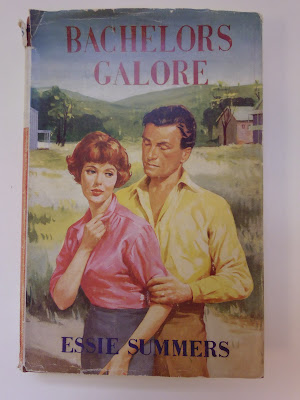 |
| Bachelors Galore by Essie Summers, published by Mills and Boon, London in 1958. The Hocken has most of Summers’ novels, which are collectors’ items today |
As well as giving a wealth of practical advice on formatting, inspiration, subject matter and editing, Summers revealed her own joy in writing: “One may as well admit that it is a great thrill to see one’s name in print and to know that some editor is so convinced of its merit that he is willing to identify himself with your views or imaginings and to pay cold cash for it.” Summers, who was renowned for her charm and kindness, signed off with some encouragement to her audience: “Wishing you all the best and some resultant and desirable little thin envelopes with acceptance slips and cheques.”
Blog post prepared by Ali Clarke, Reference Assistant
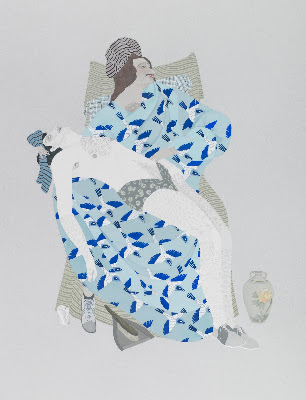 |
| Kushana Bush, Pieta (detail), 2011, gouache and pencil on paper |
In an unprecedented move, the University of Otago’s Hocken Library will take works by 2012 Frances Hodgkins Fellow Kushana Bush on a national tour that will include the Pah Homestead TSB Wallace Arts Centre in Auckland. The Exhibition,All Things to All Men: Kushana Bush continues at the Hocken Gallery until 14 April before opening at the Pah Homestead TSB Wallace Arts Centre, Auckland, on 23 April.
The exhibition, Bush’s first solo (single-artist) exhibition at a public gallery, comprises thirty-one delicate gouaches, all created last year during her tenure as the 2011 Frances Hodgkins Fellow at the University of Otago. This is an amazing feat considering the very time consuming method of applying gouache requires a high degree of precision.
Drawing on the passage in the Bible – To the weak became I as weak, that I might gain the weak: I am made all things to all men, that I might by all means save some (1 Corinthians 9:22) – the title of the exhibition puts forward a utopian notion that art can service the needs of everyone who views it. Often captured in deliberately awkward or sexually intimate poses, her ordinary folk reveal a wealth of human sensibilities and spiritualties. These intricate gouaches suggest proximity between everyday life and the spiritual realm, a feature she shares with the British artist Stanley Spencer, whose work she admires. The everyday activities that Bush’s figures perform invariably take on a ritual-like aspect.
Inhabited by a multi-cultural cast of actors, Bush’s cosmopolitan images are rich mosaics of cultural difference that unsettle Eurocentric art histories. Her satirical and often disarmingly intimate gouaches bring together constituent elements from all over the world. Many portray domestic scenes or characters engaged in daily activities including bathing, gardening and worshiping.
Bush paints exclusively with gouache (pronounced ‘gwash’), a medium first used in the 13th century in illuminated manuscripts and Persian miniature art. It is a water-based paint which has either an extremely high level of pigmentation or a chalk-like substance suspended in it. Gouache has an opaque character and, depending on the colour used, can appear very vibrant.
Read the ODT feature by Charmian Smith online:
Blog post prepared by Natalie Poland, Curator of Pictorical Collections
Among the treasures in a box of odd bits and pieces discovered during one of the Hocken’s building manoeuvres is this 1919 blueprint of the TSS Waimana, showing “accommodation for Australian families”. We don’t know the provenance of this plan, but a little research on the wonderful Papers Past website revealed its link to an event labelled by newspapers “the Waimana scandal”.
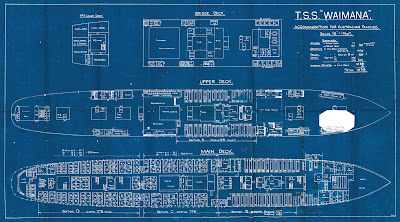 |
| The blueprint, MS-3755 |
The Waimana, a twin-screw ship, was built in Belfast in 1911 for Shaw, Savill and Albion, to carry immigrants and cargo on the New Zealand run. In 1914 the Waimana took on a new role as troopship, for which she was “altered out of recognition”. She was one of the largest of the steamers that departed New Zealand in October 1914 with the main body of New Zealand Expeditionary Force troops. After a rapid conversion, the Waimana could carry around 1500 men, 62 officers and 500 horses. Through the war, the ship returned to its more usual duties, transporting cargo to and from Britain, but in 1919 troopships were again needed. In June 1919 the Waimana arrived in Auckland with 1675 returning soldiers, whose “behaviour during the voyage was excellent”.
Troopships were not renowned for their comfort, but soldiers generally tolerated some degree of privation without too much complaint. When it came to their wives and children, though, they had higher expectations. In October 1919 the Waimana was fitted out, as per our blueprint, to carry a group of 500 or so returning Australian servicemen from London, together with 400 women and 100 children under three. As soon as the passengers arrived, complaints began about overcrowding and inadequate facilities and supplies. The final straw for some may have come when one of the many babies aboard had its toe bitten by one of the ship’s large complement of rats. The military hierarchy agreed that the complaints were justified and the passengers disembarked while better transport was sorted out.
The origins of the blueprint remain a mystery – perhaps somebody kept it as an example of how not to fit out a steamer for families on long haul voyages.
Blog post prepared by Ali Clarke, Reference Assistant
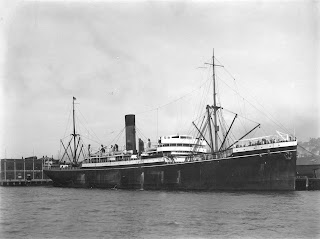 |
| Waimana at the Cross Wharf, Dunedin, 1922. Otago Harbour Board collection, S04-167a |
A very short post this time, you might like to listen to a podcast of Hocken Librarian, Sharon Dell, talking about the Hocken Collections with Emma Smith on Radio NZ Summernights. Here is the link.
http://www.radionz.co.nz/national/programmes/summernights/20120105
And here’s a picture of Sharon.
Less well known than the Hocken’s New Zealand and Pacific material are our collections relating to Antarctica. We recently catalogued a letter with interesting links to Victorian Antarctic exploration and one of history’s most famous palaeontologists. Robert McCormick (1800-1890) was a surgeon and naturalist serving in the British Navy. After recovering from yellow fever contracted in the West Indies he evidently decided that tropical climates did not suit him, obtaining postings to cooler climes when he could. In 1827 he travelled to the Arctic under William Edward Parry on the Hecla, studying the natural history of Spitsbergen. After unhappy spells in the West Indies and Brazil, and several years back in Britain, in 1839 he travelled to the Antarctic as naturalist and surgeon aboard the Terror, commanded by James Clark Ross. In 1852 he returned to the Arctic regions on the North Star, mapping part of the Wellington Channel. In 1884 McCormick’s two-volume autobiography appeared, bearing the impressive title Voyages of Discovery in the Arctic and Antarctic Seas, and Round the World; Being Personal Narratives of Attempts to Reach the North and South Poles; and of an Open-boat Expedition up the Wellington Channel in Search of Sir John Franklin and Her Majesty’s Ships ‘Erebus’ and ‘Terror,’ in Her Majesty’s Boat ‘Forlorn Hope,’ Under the Command of the Author.
Our copies of the two volumes of this book bear the inscription “To Sir Richard Owen K.C.B. F.R.S. &c &c &c With the Author’s kind regards & best wishes. Jany 29th 1884.” Owen (1804-1892) was one of the major figures of Victorian science, best known for his contributions to anatomy, his disagreements with Charles Darwin, and as founding director of England’s Natural History Museum. These books are part of Dr Hocken’s original collection and bear his signature, along with the pencil marks “2/12/6 2 vols 30/- net”, suggesting he obtained them from a book dealer some years after Owen’s death. The books include a few annotations by Owen and at the back of the second volume he notes the pages which include references to himself. In a section where McCormick describes a reindeer-shooting excursion, he marked the passage “Eleven deer altogether were killed by the party, four of them shot by myself” and noted “what did you do with ‘em?”
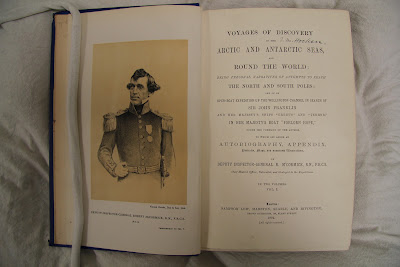 |
| Title page of McCormick’s book, along with his portrait in naval uniform
|
We recently came across a stray letter from McCormick to Owen dated 14 January 1884, which seems likely to have come into Hocken’s collection together with McCormick’s book. McCormick thanks Owen for his “kind & friendly letter” with “its good wishes, for the success of my book.” He asks if Owen would “permit me, to wind up my book with it as the last addenda to this record of my life”. McCormick had presumably left it far too late to add more to his book: Owen’s copy he signed just two weeks later. The appendix does include, however, an 1865 letter from Owen to General Sabine, President of the Royal Society, testifying to McCormick’s ability as a naval surgeon and naturalist.
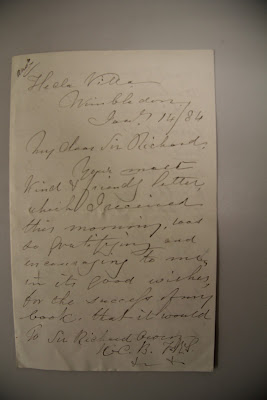 |
| McCormick’s letter to Owen [Misc-MS-2133]. |
Blog post prepared by Ali Clarke, Reference Assistant
‘I am going to be shifted from Somes Island in a few weeks. I don’t like to go away from the old place. I enjoy the sea and watching ships steaming pass [sic] the island. Although it is rather windy and unhealthy, its scenery soothes our weary hearts to some extent.’
(excerpt from a letter by Bira Kalayasiri to Mr Gerald Francis Shiel, dated 19 December 1942)
So wrote Bira Kalayasiri, a Thai national, to his New Zealand guardian Gerald Shiel from the Somes Island Internment Camp in Wellington Harbour. This letter is the final item of correspondence we have between the two. Within a year, Kalayasiri would be dead, one of the victims of an undisclosed accident that took place during his forced repatriation to Thailand in 1943.
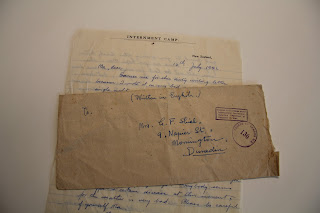 |
| Letter to the Shiels from the internment camp |
Kalayasiri and two of his compatriots, Aun Apibalsree and Yuwan Saraniyama, arrived in Dunedin to start study at the Otago School of Mines late in 1940. The trio appear to have received financial support from the Thai government and the firm Kampong Toh Tin Ltd. Patrick Shiel, the Singapore-based brother of Gerald, was connected with this company, and asked his Dunedin brother to take an interest in the students. A close association between Gerald, his wife Ina, and the Thai students developed; to the extent that the students suggested Gerald assume the role of their New Zealand guardian.
The folder of correspondence mostly holds letters written by Kalayasiri, Apibalsree and Saraniyama to Mr or Mrs Shiel (referred to by them as ‘Ma’) from their time spent carrying out work experience for their studies at the Wallsend Mine, near Greymouth, through to their internment at Somes Island. Although Kalayasiri tends to voice their experiences and predicament most vividly, all three initially express gratitude and affection to the Shiels for their goodness in Dunedin, and describe some of their working conditions and impressions of their workmates. As time progresses, the trio’s letters refer increasingly to the war underway and how they feel about it, and eventually move into expressions of frustration, conflicted emotion, and despair.
‘[…] although my country is against you but I still remain the same to you as before. Your generosity and kindness towards me are still impressing in my heart. I will never forget until the end of my life. So please consider me individually. What happens in my country should not be mixed.’
(excerpt from a letter to ‘Ma’ Shiel from Kalayasiri, December 1941)
‘Regarding my home in Thailand, I wonder whether I lost my father and mother or not. They stay in the fighting zone. I have lost my country. I do not know what will happen in future. I have lost my future. I have lost everything. Only thing I have now is only my poor humble soul waiting for the time when death calls upon me. I have to struggle for my life to see the future misery. I think what will happen in future will be worse than it is now. When I think of this I want to do something which will end my life.
I want to join the army here, but I do not expect to get it because I am an alien.’
(excerpts from a letter from Kalayasiri to Mr Shiel, December 1941)
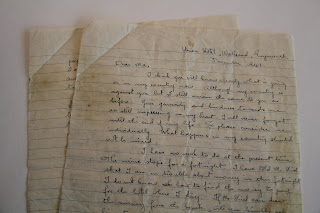 |
| Letter to ‘Ma’ in Dunedin from Greymouth |
Each of the group expresses a desire to join the New Zealand Army early on, and Saraniyama in particular made a concerted effort to enlist with the allied forces. All endeavours to sign up were futile, due to their status as enemy aliens. Their frustrations were amplified in their attempts to establish contact with groups that may have been able to provide them with advice or assistance, such as the recently established Free Thai Movement. Any ventures into overseas communication were thwarted by misinformation, lack of reply, and eventually censorship.
Few of the conditions of their internment are revealed, no doubt partially due to the censorship of letters written by those held in the camp. All three express boredom and frustration with their situation, but are able to continue with their studies, and financial support from the Thai government still reaches them, albeit with increasing delays. It is unclear exactly when in 1942 their internment commenced, or the point in 1943 that their fateful repatriation took place.
The Shiels, too, must have been aggravated with the situation the trio faced, and equally exasperated by the limited official information they eventually received after the youths lost their lives. A letter from the Minister of Defence to Mr Shiel states that ‘an accident occurred while in transit, as a result of which they died,’ and that ‘it is not desired that publicity be given to this matter and it would therefore be appreciated if you would treat this information as confidential.’ Compounding this tragedy, Gerald Shiel’s brother Patrick went missing, allegedly having met his death in an accident while fleeing Singapore in 1942; but the family had still not received any confirmation of his death by 1945.
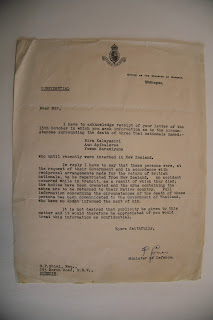 |
| Official notification of the trio’s deaths |
Information regarding the internment and death of the Thai trio sits in Ministry of Defence files held at Archives New Zealand. The files are restricted to preserve the personal privacy of those concerned, however, researcher may make application to the Chief Archivist for permission to view the files.
Kari Wilson-Allan
Assistant Archivist
Sources: AG-870/015 Correspondence relating to and with Bira Kalayasiri, Aun Apibalsree, and Yuwan Saraniyama and AG-870/016 Correspondence relating to the disappearance of Patrick Ormond Shiel, (Singapore 1945)
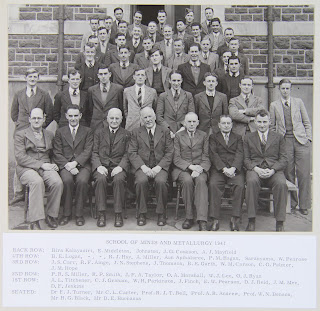 |
| 1941 School of Mines photo, Bira, Aun and Yuwan are in the back rows |
What do Sir Peter Buck, Chris Laidlaw, Vic Cavanagh and Greg McGee have in common? Yes – rubgy for one but you’ll have to visit the Hocken Library find out the full answer!
In collaboration with Hidden Dunedin, and the University’s Design Studies Department the Hocken has put on a display that examines the contributions made by Otago people to the development of rugby by showcasing a sample of this rich history. Drawn from the Hocken’s own collections, the show features rugby memorabilia, early rugby publications, official team photographs and personal scrapbooks. A version of the display will also be installed from 17 September in The Link next to the Central Library of the University.
Highlights of the display at the Hocken include:
Tom Ellison’s The Art of Rugby Football (1902). Ellison is known as one of the game’s great innovators and was introduced to rugby by his Taiaroa cousins at Otakou around 1881. He was a prominent member of the New Zealand Native Football Team, which toured Great Britain and Australia in 1888 and captained the 1893 New Zealand team on their tour of Australia. It was his suggestion that the New Zealand team should adopt Native team uniform of the black jerseys with a silver ferns. The 2-3-2 scrum formation that he developed for his Poneke club team in Wellington became the dominant style of All Black play until the 1930s.
Billy Stead had an enduring influence on Maori and All Black rugby. Stead was a member of the first official New Zealand tour of Britain and France in 1905-06. He was the team’s vice-captain and chief tactician. He wrote regular columns for the Southland Times and at the end of the tour, combined with captain David Gallaher to write one of the earliest rugby classics, The Complete Rugby Footballer. He played 32 games for the All Blacks, 12 as captain, he was part of the first Maori team and was later a referee, coach and manager. On display are a photo of the team, victory telegrams, and a copy of his book.
Ned Parata, from Puketeraki, Karitane, is widely regarded as the father of Maori rugby. The parallel development of Māori rugby was one of the defining characteristics of New Zealand rugby. Wiremu Teihoka (Ned) Parata organised the first Māori team in 1910 and persuaded Billy Stead to come out of retirement to play for it. Parata, who underwrote the cost of touring from the profits of his motor car business, continued to organise Māori rugby for the next 20 years, climaxing in the 40-match tour of Europe and Canada over the summer of 1926-27. An visual display features a selection of images from his scrapbook; it contains photographs, letters and newspaper clippings relating to the tour.
J W Stewart’s album features the celebrated Maori rugby tour of France, Britain and Canada led by Ned Parata and contains photographs, newspaper clippings and ephemera relating to the New Zealand Maori rugby tour of Great Britain, France and Canada, 1926-1927. It also has photographs of Palmerston, North Otago and South Island Maori teams. J. Stewart appears in many of these photographs and has been attributed as the creator of the album.
Still wondering the answer to the question at the start of this post? A hint is that the display contains a selection of team photos from the Otago University Rugby Football teams over the years.
To hear Dunedin sports historian Ron Palenski on Otago and the ruck listen to this interview with Jim Moira.
To see some of the display content and hear yours truely on my favourite items watch this clip from Channel 9.
The exhibition team comprised Dr. Noel Waite, Senior Lecturer; Michael Findlay, Professional Practice Fellow; Ryan Gallagher and Jon Thom, students, all of the Department of Applied Sciences and Sharon Dell, Hocken Librarian, working with Mark Sharma, Studio 3, Dunedin and Ron Palenski, external advisor, NZ Sports Hall of Fame, Dunedin.
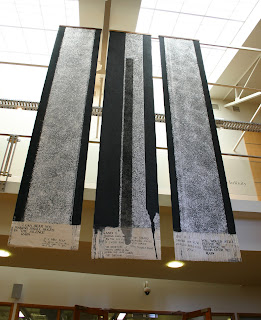 Ralph Hotere’s imposing artwork Rain (1979) will be familiar to a generation of University of Otago humanities students because it was commissioned by the university in 1979, and, once adorned the foyer of the original Hocken Library building (now known as the Richardson building). The work’s title references a poem written by the much loved New Zealand poet – the late Hone Tuwhare. Excerpts from Tuwhare’s poem ‘Rain’ are stamped and scrawled across the bottom reaches of the artwork’s three, unprimed canvas lengths.
The evocative five-metre high banners were removed from their original site in 2007 after concerns over their deteriorating condition. The building’s windy foyer and sunny aspect had led to major degradation of the thin paint pigment deployed by Hotere. The first stage of restoration work, carried out by Auckland paintings conservator Lydia Gutierrez, was completed in July and the banners have now been installed in the foyer of the current Hocken Library building at 90 Anzac Ave, Dunedin. Further paint consolidation will be carried out early next year.
The Hocken’s mezzanine floor enables visitors to experience this work ‘up close and personal’ and from a range of different aspects. Before Rain could be hung a special steel rigging had to be engineered and erected across existing roof trusses. While the three banners are lightweight, the perspex backing panels erected to support the fragile work weigh some 70 kilograms.
Next time you enter the Hocken Library look skyward and be entranced by the beauty of Rain! Read what the Otago Daily Times published about the rehung banners here.
Natalie Poland, Curator of Pictorial Collections
A regular visitor to the Hocken is Geoff Adams, formerly the Editor of the Otago Daily Times. Geoff is the author of the recently published book Judge Ward which explores the lives of three Victorian colonists to New Zealand – Dudley Ward, a Supreme Court Judge; Ward’s first wife Anne, first national president of the Women’s Christian Temperance Union; and his mistress Thorpe Talbot, who he married late in life. Geoff writes:
“Many thanks to the Hocken Collections. It allowed me to get the bulk of copious research done in Dunedin: perusing many decades of files of the Otago Daily Times and Otago Witness, not to mention sorties into other early newspapers, Lloyds’ registers, ships’ passenger lists, street directories, searches of New Zealand births, marriages and deaths, parliamentary reports, Hansard and other tools were all fruitful too. Some loose ends finally took me as a researcher to some other places in New Zealand and to London.
Hocken excelled in my hunting Talbot, a prize-winning novelist, as well as journalist, short story writer and poet. Not only do the collections have rare copies of her major books, but there is an archive (02-034/001) on Frances Ellen Talbot (her birth name in Yorkshire) presented in 1991 by Dr George Griffiths . This consists of some interesting fragments of personal letters and writing, as well as the only known photographs of Talbot, her birth certificate and the 1902 marriage certificate to Judge Ward. The archive is restricted, requiring George’s permission to peruse. Fortunately he is an old friend and knew my interest in all of the life and contacts of Judge Ward. And I live in the Maori Hill house where the Judge and Talbot were married!
I finally traced at the National Library, Wellington, the “missing” novel of Talbot — a long epic poem “Guinevere in the South” found in a copy of the obscure Geraldine County Chronicle newspaper. It was chasing clues concerning Timaru from the back of a cutting in George’s fragments that finally led to that discovery!”
We are glad to have helped Geoff with his research and very pleased to see the book published.