Experimental and Speculative Philosophy in Kant’s Age
Alberto Vanzo writes…
We saw in earlier posts that experimental-speculative distinction was widely present within early modern philosophy, including eighteenth century Germany. The distinction was clearly drawn in Tetens’ essay from 1775, six years before Kant published the first Critique. With that work, another distinction entered the scene. It was the distinction between empiricism and rationalism. The rationalism-empiricism distinction, developed and popularized in widespread works by Reinhold, Tennemann, and later Kuno Fischer, would eventually become the standard way of classifying early modern philosophers. The experimental-speculative distinction would fall into the almost total oblivion in which it lies today.
How did this process take place? It would be surprising if, with the publication of Kant’s first Critique in 1781, philosophers suddenly dropped the distinction between experimental and speculative philosophy altogether.
In fact, the lively debates surrounding the emergence of Critical philosophy in the late 1780s and 1790s were still framed, at least at times, in terms of the speculative-experimental distinction. In this post, I will present some evidence for this claim.
J.G.H. Feder published one of the first attacks on the first Critique in 1787, claiming that it was full “of the most abstract speculations of logic and metaphysics” (italics, here and below, are mostly mine). In Feder’s view, Kant was “too much a friend of the most abstract and profound speculations in Scholastic form”. One year earlier, Christoph Meiners criticized Kant’s “transcendentish [sic] speculations”, “independent from any experience” in the preface to a successful book.
Why did Feder and Meiners attack Kant? Because, in Feder’s words, Kant humiliated
- empirical philosophy, that is, the philosophy which is based only on observations and on the agreement of all of most human experiences, and on inferences based on the analogy between them, and fully renounces [to employ] demonstration[s] based on concepts in the study of nature […]
In other words, the philosophy that Kant allegedly humiliated was the same experimental (or as the Germans preferred to call it, observational) philosophy that Tetens had described in his essay of 1775. Feder and Meiners defended observational philosophy. By associating Kant’s name with speculation, they were categorizing Kant as an example of a speculative philosopher.
Kant’s followers accepted the classification of their philosophy as speculative. Replying to Feder in 1789, the Kantian J.C.G. Schaumann had no hesitation in calling Kant’s disciples “friends of speculation and critique”. In the same year, Reinhold opened his New Theory of the Human Capacity for Representation by claiming, against observational philosophers: “neither common understanding [scil. common sense], nor healthy understanding, but only reason guided by principles and trained through speculation could succeed in the study of experience”.
These quotes show that the experimental-speculative distinction was very much alive in Germany during the first reception of Kant’s Critical philosophy. The experimental-speculative distinction contributed to the self-understanding of the parties involved in the dispute.
The dichotomy of experiment and speculation was not the only way of categorizing the debates between Kant and experimental philosophers. A gifted Kant scholar, C.C.E. Schmid, published in 1788 “Some Remarks on Empiricism and Purism in Philosophy” to defend Kant from the criticisms of an experimental philosopher, C.G. Selle. The debate continued, with the term “empiricism” being often used to designate Kant’s opponents. The term that Schmid used to refer to Kant’s philosophy was the rather unusual term “purism”. Kant, instead, was classifying his philosophy as a form of rationalism in those very years. Clearly, the terminology was still rather fluid.
We all know who won the confrontation between anti-Kantian experimental philosophy on the one hand, Kantian and post-Kantian speculation on the other. The terms “speculation” and “speculative” soon acquired a new range of connotations in the philosophies of Schelling and Hegel. Observative or experimental philosophy lost popularity and its name was replaced by “empiricism”. Christian Garve was referring to the early stages of this process, when he wrote in 1796:
- it seems that in our time observation, which was formerly regarded as one of the first accomplishments of the philosophical spirit and the foundation of our scientific cognitions, since its object has been designated with the name of empirical, has fallen in discredit with some people.
Garve’s adjective “empirical” refers to the new term “empiricism”. “With some people” is clearly an understatement, reflecting Garve’s preference for the observational approach over Kantianism. While the historical notion of experimental or observational philosophy was falling into discredit, the historiographical dichotomy of empiricism and rationalism was on the rise. I will discuss this process in one of the next posts.
Next Monday, we’ll go back to Newton with a new post by Kirsten. Stay tuned!
Turnbull’s Treatise on Ancient Painting and the Experimental/Speculative Distinction
Juan Gomez writes…
In my previous post on David Fordyce’s thoughts on education, I showed how his speech to students on the commencement of the studies embodies the commitment to the method of the experimental philosophy. This is hardly surprising given that his teacher at Marischal, George Turnbull, expressed the same commitment a year before Fordyce’s speech in his Observations upon Liberal Education (1742). In this post I want to focus on an earlier text, his Treatise on Ancient Painting (1740). In addition to trying to find out “wherein the Excellence of Painting consists,” he wants to show the usefulness of this art and its essential role in education.
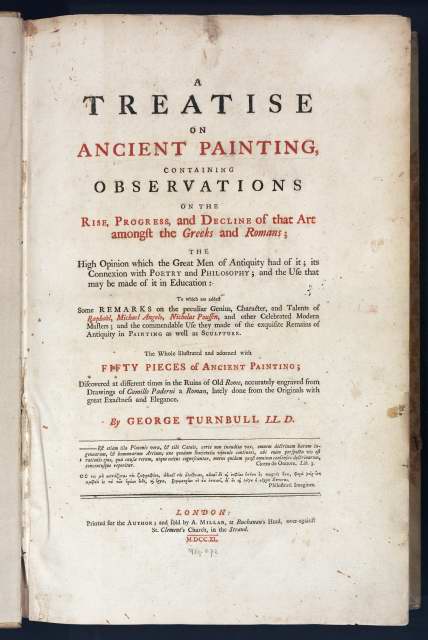
Relying heavily on texts by ancient authors, Turnbull claims that painting, and the arts in general, have always been (and should always be) connected to the study of nature. In this sense, pictures or paintings, when they reflect and are created in accordance to the laws of nature, can serve as proper samples for the study of nature. By analogy, moral paintings (which showcase the true excellence of art: Virtue) work as proper samples and ‘experiments’ for the study of human nature. (But the topic of ‘experiments’ in moral philosophy will have to wait a couple of posts, since I’m focusing strictly on the education issue first.)
The ESP distinction can be seen at work in the passages where Turnbull commends the experimental method and rejects speculation. Like he did in his Principles of Moral Philosophy, Turnbull expresses antipathy towards hypotheses and praises an emphasis on experiments and observation as the only true method for acquiring knowledge. When discussing one of the main purposes of travelling (since the Treatise on Ancient Painting was supposed to serve as a guide for young British travelers) he tells us the following:
- The Ancients travelled to see different Countries, and to have thereby Opportunities of making solid Reflexions upon various Governments, Laws, Customs and Policies, and their Effects and Consequences with regard to the Happiness or misery of States, in order to import with them into their own Country, Knowledge founded on Fact and Observation, from which, as from a Treasure of Things new and old, sure and solid Rules and Maxims might be brought forth for their Country’s Benefit on every Emergency. For this is certain, that the real Knowledge of Mankind can no more be acquired by abstract Speculation without studying human Nature itself in its many various Forms and Appearances, than the real Knowledge of the material World by framing imaginary Hypotheses and Theories, without looking into nature itself: And no less variety of Observations is necessary to infer or establish general Rules and Maxims in the one than in the other Philosophy. (Emphasis added)
In the final chapters of the book Turnbull again reminds us about the ‘true philosophy,’ this time leaning on Socrates, Bacon, and Newton for support. Arguing for the unity of natural and moral philosophy in education, Turnbull discusses the pleasure derived from the study of nature:
- Socrates long ago found fault with those pretended Enquirers into Nature, who amused themselves with unmeaning Words, and thought they were more knowing in Nature, because they could give high sounding Names to its various Effects; and did not inquire after the wise and good general Laws of Nature, and the excellent Purposes to which these steadily and unerringly work. My Lord Verulam tells us, that true Philosophy consists in gathering the Knowledge of Nature’s Laws from Experience and Observation. And Sir Isaac Newton hath indeed carried that true Science of Nature to a great height of Perfection… I shall only observe farther on this Head, that if this be the right method of improving and pursuing natural Philosophy, it must necessarily follow, that the Knowledge of the moral World ought likewise to be cultivated in the same manner, and can only be attain’d to by the like Method of enquiry: By investigating the general Laws to which, if there is any order in the moral World, or if it can be the Object of Knowledge, its Effects and Appearances must in like manner be reducible, as those in the corporeal World to theirs […]
As we can see, the works of George Turnbull and David Fordyce show evidence of the use of the ESP distinction in fields outside of natural philosophy. Beyond this, they show that the moral philosophy taught by these gentlemen in Aberdeen in the first half of the eighteenth century was driven by the characteristic attitude of the experimental method, shedding light on the development and roots of the ‘science of man’ in the eighteenth century.
Two Forms of Natural History
Peter Anstey writes…
There were two forms of natural history in the early modern period: traditional natural history and Baconian natural history. The distinction between them becomes clear in the light of the development of the experimental philosophy in the mid-17th century. Unfortunately, however, this distinction is almost always elided in the secondary literature on natural history.
Traditional natural history, deriving from Pliny the Elder and Dioscorides, had flourished in the late Renaissance. It involved the mapping of nature through the classification of plants and animals and the assembling of information about their uses and habits. This traditional natural history continued throughout the 17th century and reached its zenith in the 18th century in the work of the likes of Carl Linnaeus. But this was neither the only form of natural history, nor, for that matter, was it the most important form for the experimental philosophers. Let me explain.
The experimental philosophy of the seventeenth century developed as a method of knowledge acquisition in natural philosophy. However, unlike the division between science and philosophy today, in the early modern period natural philosophy and philosophy were not regarded as discrete disciplinary domains. Natural philosophy was thought to be the philosophy of nature, rather than, say, the philosophy of morality or metaphysics. Thus Descartes’ Principles of Philosophy are principles of natural philosophy and this work presents his mature natural philosophical system.
Robert Boyle's General History of the Air
The experimental philosophy was initially developed and applied in the study of nature and only later was it applied more broadly to the other parts of philosophy. The first ‘version’ of the experimental philosophy was the Baconian method of natural history. This was inspired by Francis Bacon’s grand scheme for the renovation of knowledge of nature and in particular his novel approach to natural history.
The Baconian method involved the assembling of vast amounts of data about particular substances, qualities or states of bodies. In this way it was far broader in its scope than traditional natural history. To be sure, it included facts about generations––that is animal, plant and insect species-–but it included much more, such as histories of cold, of the air, of electrostatic phenomena and of fluidity and solidity, etc. According to the Baconian method, once all of the facts were collected they were to be ordered and structured in such a way as to facilitate theoretical, or speculative, reflection upon the phenomenon at hand. Thus, once all the facts about, say, human blood or the air, were gathered, then the natural philosopher would be in a position to develop a true and accurate philosophy of the blood or air.
It was this method that was developed in a detailed and sophisticated way by the early Royal Society and which became popular across Europe in the second half of the 17th century. This Baconian natural history encompassed traditional natural history and as a result traditional natural history flourished under its aegis. But, the Baconian form of natural history was short-lived: it was in serious decline in the 1690s and all but disappeared in the first decades of the 18th century. All the while traditional natural history was going from strength to strength and was soon to become one of the most important branches of 18th century science.
The reasons for the decline of Baconian natural history need not detain us here, but the reason for the eliding of the distinction between it and traditional natural history is of great importance. I contend that scholars have failed to distinguish between the two because of their failure to appreciate the nature and significance of the experimental philosophy in general. When we view early modern natural history through the lens of the experimental philosophy the distinction between the two forms of natural history becomes clear. This is another reason why, as I claimed in an earlier post, ESP is best!
Newton’s ‘Crucial Experiment’
Kirsten Walsh writes…
In his first optical paper, Newton claims that he has performed an Experimentum Crucis, which proves that refrangibility is an original property of the light, not an effect of the prism:
- …the true cause of the length of that Image was detected to be no other, then that Light consists of Rays differently refrangible, which, without any respect to a difference in their incidence, were, according to their degrees of refrangibility, transmitted towards divers parts of the wall.
This experiment and its role in Newton’s theory of colours raises some questions that I’m not really sure how to answer. I hope you can help me.
Firstly, let’s have a closer look at this Experimentum Crucis:

Newton's Experimentum Crucis
White light travels from the Sun (S), through the first aperture (F), through the first prism (ABC), where it is refracted for the first time, producing an image on the first board (DE). A small amount of light passes through the second aperture (G), producing an image on the second board (de). A small amount of light passes through the third aperture (g), through the prism (abc), where it is refracted for the second time, producing an image on the screen (MN). Newton “took the first Prisme in [his] hand, and turned it to and fro slowly about its Axis”, so that different parts of the refracted image could pass through the apertures to the second prism. He took careful note of where each image appeared on the board MN.
Newton finds that each time a particular ray passes through a prism it refracts to precisely the same degree. For example, light that refracts to 50 degrees at the first prism refracts to 50 degrees at the second prism as well. Newton argues that this shows that refrangibility is an original and constant property of light.
Newton’s Experimentum Crucis was heavily criticised by his contemporaries. Hooke, for example, argued that this experiment is not a crucial experiment, because it does not prove that colour is an original property of light. Hooke believes that light becomes coloured as it passes through the prism, and Newton’s experiment does not convince him otherwise.
While colour is conspicuously absent from Newton’s discussion of this experiment, this line of criticism is extremely common. For example, Newton’s contemporaries, Hooke, Huygens and Pardies, and more recently, writers such as Sabra and Bechler have all made criticisms along these lines. As I have previously discussed, Newton used mathematics and measurement in order to achieve absolute certainty. So it is no accident that Newton only discusses refrangibility and not colour in this experiment.
Newton concludes that white light is composed of rays of every colour in equal amounts, but he argues for this in two steps:
1) Light is a “Heterogeneous mixture of differently refrangible Rays”; and
2) There is a one-to-one correspondence between refrangibility and colour.
So, while the Experimentum Crucis only supports step (1), it is often mistaken as an argument for Newton’s conclusion. Newton takes a great deal of care to establish (1) experimentally, but he seems to take little care at all to establish (2), and hence, the conclusion. In his first optical paper he simply asserts it as proposition 2; in his reply to Huygens he asserts it as a note to his definitions.
This raises two questions. Why did Newton take so little care over step (2)? How did Newton’s main opponents miss this lack of care?
Kant, Empiricism, and Historiographical Biases
Alberto Vanzo writes…
Many scholars have criticized histories of early modern philosophy based on the dichotomy of empiricism and rationalism. Among the reasons for their criticism are:
- the epistemological bias: histories of philosophy which give pride of place to the rationalism-empiricism distinction overestimate the importance of epistemological issues for early modern philosophers.
- the Kantian bias: histories of early modern philosophy that embrace the empiricism-rationalism distinction are often biased in favour of Immanuel Kant’s philosophy. They portray Kant as the first author who uncovered the limits of rationalism and empiricism, rejected their mistakes, and incorporated their correct insights within his Critical philosophy.
Since the introduction of the empiricism-rationalism distinction within philosophical historiography is due to Kant, scholars have charged him with both the historiographical and the Kantian biases. For instance, according to Anik Waldow, “Kant is impermissibly reductive in his attempt to present empiricism as a purely epistemological position”. For Hans-Jürgen Engfer, “Kant […] distinguishes both currents of empiricism and rationalism […] and want to reconcile and go beyond them with a third [position].”
I do not think that Kant should be charged with making the empiricism-rationalism distinction a merely epistemological one, or of placing his philosophy beyond and above the two currents of empiricism and rationalism.
To see why Kant does not have the epistemological bias or the Kantian bias, let us consider his two characterizations of empiricism in the Critique of Pure Reason.
I will start with the second characterization. It is contained in a section entitled The History of Pure Reason (A854/B882). Empiricists such as Aristotle claim that pure cognitions of reason “are derived from experience”. Noologists (elsewhere called rationalists) such as Plato claim that, “independent from [experience], [pure cognitions of reason] have their source in reason”.
The cognitions that Kant is referring to are concepts and judgements. As for concepts, empiricists “take all concepts of the understanding from experience” (Ak. 29:763). As for the judgements, empiricists claim that there are no synthetic judgements that can have an a priori justification. Kant’s proof that such judgements exist makes empiricism “completely untenable” (Ak. 20:275).
These characterizations of empiricism are cast in epistemological terms – especially if one takes epistemology to be concerned not only with what justifies beliefs, but also with issues concerning the origin of concepts.
Does Kant reject the epistemological views of empiricism and rationalism? The History of Pure Reason does not make this clear. However, elsewhere Kant places himself in the rationalist camp. For instance, in the second Critique he endorses the “rationalism of power of judgement” with regard to practical concepts (Ak. 5:71). In a metaphysics lecture from the 1790s, Kant qualifies his view that we have some non-empirical concepts (the categories) as a rationalist view.
Let us now look at Kant’s first characterization of empiricism in the Critique of Pure Reason. It is contained in the discussion of the antinomies. There, Kant does not characterize empiricism in epistemological terms, but in ontological terms. Empiricists are those natural philosophers who refuse to postulate entities whose existence, and phenomena whose occurrence, cannot be confirmed by sensory experience (B496-497): for instance, simple beings without extension or parts, a supernatural creator which caused the existence of the world, or contra-causal free actions that are undetermined by previous natural events. Empiricists adopt two attitudes toward those entities and phenomena:
- Modest empiricists acknowledge their ignorance as to their existence.
- Dogmatic or dogmatising empiricists deny their existence.
Kant rejects immodest or dogmatic empiricism because it “says more than it knows” (A472/B500). Interestingly, however, he endorses the attitude of modest empiricists in his solution of the antinomies.
What conclusions can we draw from this survey of Kant’s texts?
First, Kant operates with multiple notions of empiricism. The empiricism described in the History of Pure Reason is epistemological. The modest empiricism in the antinomies chapter, instead, is an ontological view concerning the existence of certain items. Immodest empiricism claims ignorance of their existence, modest empiricism claims knowledge of their non-existence. Hence, pace Anik Waldow and others, Kant does not consistently describe empiricism as “a purely epistemological position”.
Second, Kant does not consistently portray his position as an alternative to empiricism and rationalism. He sides with modest empiricists in the antinomies and with rationalists in other texts. He may have sown the seeds for a narrative of early modern philosophy based on the Critical Aufhebung of empiricism and rationalism. However, he can hardly be regarded as the first author to consistently develop such a narrative.
Speculative and Experimental Philosophy in Universities: (Post-)Cartesianism
This is the second post in Dr Gerhard Wiesenfeldt‘s series on speculative and experimental philosophy in early modern universities.
Gerhard Wiesenfeldt writes…
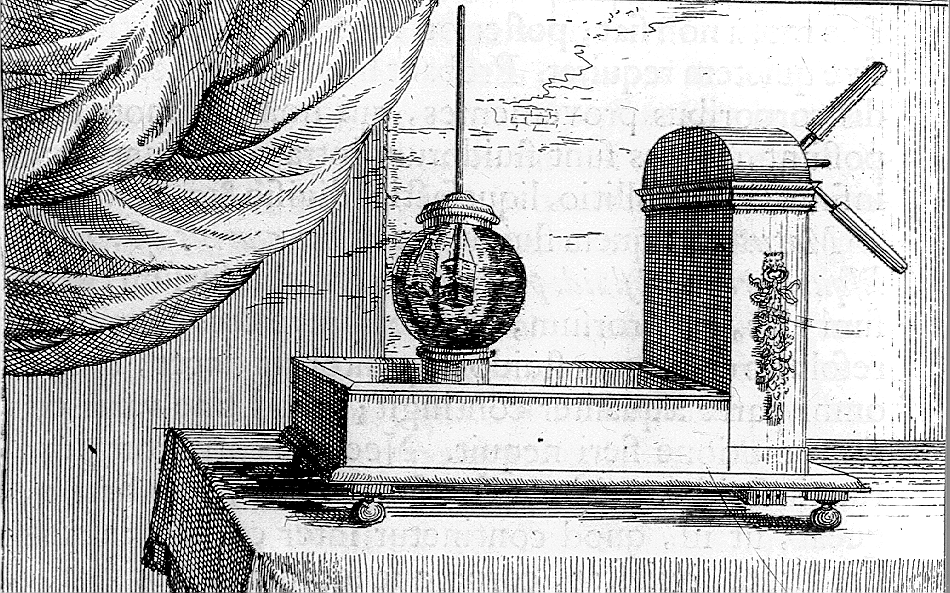
In my last post, I wrote about Johann Christoph Sturm’s experimental philosophy and his eclectic approach to speculative philosophy. A very different route to natural philosophy was taken by his colleague and friend, Burchard de Volder. De Volder was professor of philosophy at Leiden University and in 1675 became the first university lecturer to be officially charged with teaching ‘physica experimentalis’. While hardly known today, he was considered an important natural philosopher during his lifetime, he also was a correspondent of Newton, Leibniz and Huygens (who considered him to be the only other Dutchman to have understood Newton’s Principia). When he started teaching at Leiden, he was a clear-cut Cartesian with little inclination for experimental philosophy. He took up experimental philosophy only after the controversies on Cartesian philosophy at Leiden had reached such a level that the university (and in particular the faculty of philosophy) was seriously disrupted in its working. His decision to introduce experimental philosophy was probably motivated both by political considerations (the Cartesians at the university were under serious pressure and de Volder had reasons to fear being expelled) and by the urge to find ways of teaching philosophy that would not lead to conflict and even physical violence. In this he was supported by his conservative anti-Cartesian colleague Wolferd Senguerd, who started teaching experimental philosophy shortly after de Volder had began his lectures.
De Volder's airpump as illustrated by his colleague Wolferd Senguerd
While de Volder’s experimental lectures were largely based on Boyle’s New Experiments Physico-Mechanicall with some mathematical splashes from Stevin, he continued to teach speculative philosophy based solely on Descartes’ Principles of Philosophy. De Volder explicitly rejected Sturm’s eclectic approach and argued that speculative philosophy needed to be based on certain, universal principles, such as the Cartesian principle of clear and distinct ideas, in order to create a comprehensive philosophical system. Experimental and speculative philosophy had thus different foundations and remained largely unrelated. Occasionally, there were even contradictions between the two, when De Volder pointed out errors in Cartesian philosophy in his experimental lectures. Still, he maintained that natural philosophy needed to be developed in a systematic way, and that the Cartesian system was the best available.
Yet, over time, his judgment on this matter changed. In the 1690s he argued that Cartesian methodology worked only in the res cogitans, i.e. in mathematics and metaphysics, but not in natural philosophy, as there was no way to establish clear and distinct ideas on the physical world with certainty. While de Volder rejected Cartesian natural philosophy, he did not take up any of the other systems. He remained reluctant about Newton’s Principia and was not persuaded by Leibniz’s attempts to win him over. Instead, he ended up with a methodology not too far from Sturm’s, in stating that one needed to divide the physical world into parts on which certain hypotheses could be developed. He did not elaborate whether this still left room for speculative natural philosophy, but it is hard to see how such a science could have been maintained under these principles.
One of the contentions of these entries on university philosophy relates to the debate in this blog on the experimental/speculative versus rationalist/empiricist distinction. In terms of early 18th century university philosophy these distinctions are on an essentially different level. The distinction between rationalism and empiricism pertains to understanding philosophy as being divided into different schools (or sects). While one might describe rationalism and empiricism as the two biggest philosophical schools (or groups of schools), they were by no means the only ones – one philosopher at Helmstedt University counted no less than 26 different philosophical schools in 1735. The distinction between experimental and speculative philosophy, however, referred to different manners to practise philosophy independent of a particular school. Sturm and de Volder practised both experimental and speculative philosophy, but maintained that they were different enterprises, as did their students Wolff, ’s Gravesande and van Musschenbroek later on. At the same time experimental philosophy transcended philosophical schools, practised by Cartesians, Newtonians, Aristotelians, and Wolffians alike.
Speculative and Experimental Philosophy in Universities: Eclecticism
This is the first of two guest posts by Dr Gerhard Wiesenfeldt on speculative and experimental philosophy in late 17th century universities. Gerhard has published on early modern Dutch science, the visual culture of experiments, science in popular movies, biographies of ‘fameless’ scientists and romantic self-experiments. He is currently working on the different local cultures of science in the 17th and 18th centuries and their mutual interactions.
Gerhard Wiesenfeldt writes…
In late 17th century universities, experimental philosophy played a significant role, yet in a different manner to the role it played in the Royal Society. One of the traditional roles of universities had been to evaluate new knowledge and new knowledge systems and relate them to the existing sciences. In this context, the relation between experimental and traditional natural philosophy had to be addressed. Here, I want to discuss one of the various ways in which this relation was maintained, a way that became influential for the development of experimental philosophy in German speaking countries.
Johann Christoph Sturm, professor of mathematics and philosophy at the University of Altdorf in central Germany, was probably the leading university-based German natural philosopher of the late 17th century: he wrote the most widely read textbooks and many of his students went on to teach natural philosophy at other universities. He first taught a full course on experimental philosophy in 1672 and published its contents under the title Collegium experimentale sive curiosum in 1676. As the title suggests, the book presents a style of experimental philosophy similar to the experimental natural history of the early Royal Society. It is divided into a series of ‘tentamina’, which describe either one experiment, or a series of experiments, or an instrument. What is of particular interest, however, is Sturm’s concern with the way speculative natural philosophy ought to be taught.
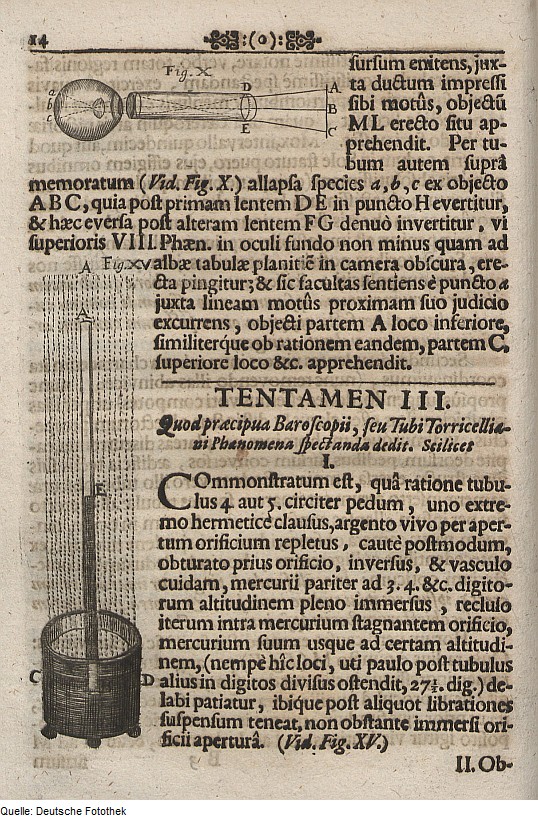
Sturm's description of the Torricellian apparatus
He wrote three different books on this subject, which show a development of the manner that he related speculative philosophy to experimentation: the Physica conciliatrix (1684), the Physica electiva sive hypothetica (1697) and finally the Physicae modernae sanioris compendium (1704). In the Physica conciliatrix, Sturm argues for philosophical eclecticism: given the variety of philosophical schools, it was improbable that one was correct in all cases, so speculative philosophy should not be based on one particular school (whether Aristotelian, Cartesian or atomistic), but take all existing hypotheses into account. While experiments would give some guidance in the matter, they could not solve the issue, because experimentation could not explain the causes of the observed phenomena (his earlier discussion of Henry More’s hylarchic spirit in Collegium experimentale exemplifies this issue for him).
The Physica electiva (later re-edited by Christian Wolff) follows on from that position, the search for causes remains the domain of speculative philosophy and cannot be based on one school, precisely because all schools have been shown to be incomplete in their explanations. The eclecticism he develops in this book is one of methodological diversity. Just as mathematics has developed different and unrelated methods that can be applied to different mathematical problems, speculative philosophy needs a variety of methods that provide a way to choose from a range of hypotheses put forward to explain a particular phenomenon.
To achieve this it was necessary to establish the principles on which these methods can be derived and justified, something that had already been established in mathematics. Philosophical analysis had to start with an account of the phenomena in question that was precise and true, but also included all circumstances. Then, all existing hypotheses explaining the phenomena had to be taken into account and analysed. Accounting for all phenomena was to be considered an argument for the truth of the hypothesis, contradiction by a single phenomenon refutes the hypothesis. Yet, even false hypotheses should be discussed further, as their refutation would lead to improved knowledge of the subject matter (see Michael Albrecht’s Eklektik for details on these principles).
While the Physicae modernae compendium was intended as a textbook that would work out this form of natural philosophy, it contains an important methodological development. Whereas the Physica electiva presents the notion of a complete speculative natural philosophy, i.e. a discussion of all known phenomena and the selection of the most probable hypotheses for each phenomenon, the preface of the Physicae modernae compendium restricts the content of ‘textbook natural philosophy’ to those phenomena that can be predicted with certainty.
Not all university philosophers went the route of eclecticism. In my next post, I will discuss the radically different approach that was developed by someone who was acquainted with Sturm from their common student days at Leiden University and later became one of his critics, Burchard de Volder.
David Fordyce’s advice to students
Juan Gomez writes…
I have mentioned the name ‘David Fordyce’ a couple of times in my previous posts. The influence this thinker had in the second half of the eighteenth century (Benjamin Franklin was impresed by his works, though he mistakenly credited them to Hutcheson) usually goes unnoticed, despite the success of his main works. He is also a very good example of the adoption of the rhetoric and methodology of experimental philosophy in the field of moral philosophy.
Fordyce (1711-1751) studied at Marischal College, Aberdeen, in the 1720s (the same decade George Turnbull was a regent there). He came back to his alma mater in 1742 to become a regent himself. During this period he taught, as most regents did, “all the Sciences, Logics, Metaphysics, Pneumatics, Ethics strictly so called & the Principles of the Law of Nature and Nations with natural and experimental Philosophy.” (David Fordyce to Philip Doddridge, 6 June 1743. Quoted in the Liberty Fund edition of his Elements of Moral Philosophy). This was also the period when he published his main works, the Dialogues Concerning Education (1745) and The Elements of Moral Philosophy (1748). The latter was first published as section nine of Robert Dodsley’s The Preceptor (1748), anonymously, and then published posthumously in 1754. The essay had such a good reception that it was used as the text book for moral philosophy lectures in North American universities, and it was used almost in full (only the conclusion was ommitted) for the entry on moral philosophy of the Encyclopaedia Britannica from its first edition until well into the nineteenth century.
A recent edition of the Elements also includes a speech he gave to his students at the start of the year of lectures on moral philosophy, which is the text I want to focus on. The speech is entitled A brief Account of the Nature, Progress, and Origin of Philosophy delivered by the late Mr. David Fordyce, P. P. Marish. Col: Abdn to his Scholars, before they begun their Philosophical course. Besides the explicit use of the terminology of the experimental method in his Elements (induction, hypotheses, deduction of rules from observation, etc.), his speech shows the traits that characterize the methodology of the experimental philosophy. For example:
- “It is evident that setting aside sovreign instruction, true knowledge must be acquired by slow degrees from experience & observation, & that it will always be proportionate to the largeness & extent of our Experience.”
- “The knowledge then of the nature, laws & connections of things is, as has been observed, Philosophy; and they who apply to the study of these, & from thence deduce rules for the conduct & improvement of human life, are Philosophers. They who consider things as they are or as they exist, & draw right conclusions from thence, are true Philosophers. But they who without regard to fact or nature indulge themselves in framing systems to which they afterwards reduce all appearances, are, notwithstanding their ingenuity & subtilty, to be reckoned only the corrupters & enemies of true learning.”
- “Now there is a natural & proper method of attaining to true knowledge as well as any other accomplishment, which if neglected must occasion error & contradiction. It cannot be too often repeated, that there is no real knowledge, nor any that can answer a valuable End, but what is gathered or Copyed from nature or from things themselves. That the knowledge of Nature is nothing else than the knowledge of facts or realities & their established connections. That no Rules or Precepts of life Can be given or any Scheme of Conduct prescribed, but what must suppose a settled Course of things conducted in a regular uniform manner. That in order to denominate those Rules just, & to render those Schemes successful, the Course of things must be understood & observed. & that all Philosophy, even the most didactic & practical parts of it, must be drawn from the Observation of things or at least resolved into it; Or which is the same thing, that the knowledge of truth is the knowledge of Fact, & whatever Speculations are not reduceable to the one or the other of these are Chimerical, Vague & uncertain.”
The previous are just the most telling quotes, but the whole overview Fordyce gives of the history of philosophy embodies the anti-Aristotelian, anti-hypothetical attitude of the experimental philosophy. Such was the message Fordyce delivered as a regent to his students in the 1740s, highlighting the relevance of the experimental/ speculative distinction, with the former being the only appropriate method for the progress of knowledge.
That’s it for now, but stay tuned to our blog. Pretty soon we will have a guest post by Dr. Gerhard Wiesenfeldt on a topic closely related to Fordyce’s speech: early modern universities and experimental philosophy.
On the Proliferation of Empiricisms
Peter Anstey writes…
One sign that a historiographical category no longer earns its keep is that it needs to be redefined in each new context of use. Another is that it leads to a proliferation of taxonomies of meaning. Such is the case with the term ’empiricism’. I have commented in a previous post that this term is becoming increasingly difficult to pin down: that Don Garrett gives us 5 empiricisms; Michael Ayers gives us 2; Jonathan Lowe gives us 3 and so on. In his recent post on the New APPS Blog Eric Schliesser gives us 4 and refers us to a recent article by Charles Wolfe which provides 3. If we throw into the mix Feyerabend’s 3 and Ernan McMullin’s 2 forms of ‘classical empiricism’ and allow for overlap, we have around 15 different forms of empiricism! And this is only a sampling of the field. It’s a field that is too crowded for anyone’s liking and provides one of the main arguments for letting go of the whole Kantian/post-Kantian historiographical category and for exploring the experimental/speculative distinction as a positive alternative.
The claim here is not that each of these 15 or so empiricisms is without value in so far as they might give us some insight into a particular thinker or trend within early modern thought. It is rather that the term ’empiricism’ is being called upon to do too much work to the point that its semantic domain is too fluid for it to have a determinate meaning. It is simply bad history to flog a term this hard.
This is where the experimental/speculative distinction can help. The fact that it is a historical distinction, that is easy to locate in early modern natural philosophers and philosophers alike, makes it easy to track. Restricting ourselves to Anglophone works, searches in EEBO and ECCO for ’empiricism’ (in any of the 15 senses) and ‘Rationalism’ yield very meagre results, but similar searches using ‘experimental’, ‘experimental philosophy’, ‘speculative’, ‘speculative philosophy’ and their cognates (e.g. ‘speculation’) are enormously fruitful.
What we claim is that it is now time to work through early modern thought using these terms and this distinction and to determine what the results are. We do not claim that ‘experimental philosophy’ has one determinate meaning (see my last post on Baconian vs Newtonian Experimental Philosophy). So it’s not as if we ourselves might never face a proliferation problem (though so far it seems to us that the usage of the terms is relatively consistent). It’s rather that the heuristic value of such a research program is enormous, whereas the rationalism/empiricism distinction is nearing its ‘use-by date’. We are not in competition with those who hang on to rationalism and empiricism. Rather we have a complementary and, in our view, far more promising research program.
Newton on Certainty
Kirsten Walsh writes…
A few weeks ago, I said that in Newton’s early optical papers:
- Newton claims that his doctrine of colours is a theory, not a hypothesis, for three reasons:
1. It is certainly true, because it is supported by (or deduced from) experiment;
2. It concerns the physical properties of light, rather than the nature of light; and
3. It has testable consequences.
From this set of criteria, we can see that early-Newton’s strong anti-hypothetical stance is closely related to his goal of generating theories that are certainly true. Students from Florida have pointed out that Newton’s criterion of certainty seems to set the bar quite high. Indeed it does. So today I will explain early-Newton’s goal of absolute certainty and why he thought it was achievable.
For Newton, absolute certainty is closely related to mathematics – he wants to achieve certainty in the science of colours by making it mathematical. In his first letter to the Royal Society, he says:
- A naturalist would scearce expect to see ye science of those become mathematicall, & yet I dare affirm that there is as much certainty in it as in any other part of Opticks. For what I shall tell concerning them is not an hypothesis but most rigid consequence, not conjectured by barely inferring ’tis thus because not otherwise or because it satisfies all Phænomena (the Philosophers universall Topick,) but evinced by ye mediation of experiments concluding directly & without any suspicion of doubt.
In a letter to Hooke, Newton says, ideally the science of colours will be “Mathematicall & as certain as any part of Optiques”. However, absolute certainty is difficult to achieve because the science of colours
- depend[s] as well on Physicall Principles as on Mathematicall Demonstrations: And the absolute certainty of a Science cannot exceed the certainty of its Principles.
Thus, Newton thinks that absolute certainty is also closely related to experiment. It is no accident that, in his first paper, Newton attempts to establish the physical principles of colour experimentally by focussing on refrangibility rather than colour of light. It would have been difficult to measure precisely changes in colour, but Newton was able precisely to measure degrees of refraction and lengths of refracted images. He hardly even mentions colour until he believes he has established that white light is a mixture of differently refrangible rays. When he is ready to reveal his theory of colour, he does so by first asserting that there is a one-to-one correspondence between refrangibility and colour of light rays. Newton claims that he has established the physical principles of colour with absolute certainty.
When he reveals his theory of colour, he does so in a quasi-mathematical style. In a letter to Oldenburg, Newton says:
- I drew up a series of such Expts on designe to reduce ye Theory of colours to Propositions & prove each Proposition from one or more of those Expts by the assistance of common notions set down in the form of Definitions & Axioms in imitation of the Method by which Mathematicians are wont to prove their doctrines.
This quasi-mathematical ‘proof’ of his theory of colours is set out in his reply to Huygens.
To summarise, Newton’s mathematical method and his experimental method are linked by his notion of absolute certainty. Newton claims his theory of colours is certainly true, because (1) his physical principles are established experimentally and are certainty true, and (2) he can use these physical principles as the basis of his mathematical proof. That a lengthy and sometimes heated debate followed Newton’s original paper, shows that his opponents weren’t as convinced by his careful demonstration as he was.
