
Monthly Update
Hello, readers!
In our monthly updates, we look back at what happened on the blog in the past few weeks and we highlight recent posts, conferences, and upcoming deadlines on early modern experimental philosophy.
Since the last monthly update, we wrote on Wolff’s criticism of Newton‘s hypothesis non fingo, on whether Newton actually feigns any hypotheses and on Tetens’ distinction between experimental and speculative philosophy. We also continued our discussion with Eric Schliesser on experimental vs speculative philosophy. Peter responded to Eric’s first review of our project by distinguishing Baconian and non-Baconian forms of experimental philosophy. Eric expanded on his views on the history of experimental philosophy on the New APPS blog. Then Juan and Eric debated on Newtonianism and anti-Newtonianism in early modern moral philosophy. Many thanks to Eric Schliesser for his stimulating inputs and to Zsolt Almási and Gerhard Wiesenfeldt for their comments on the blog. They are much appreciated.
Juan and Kirsten are giving two papers at the upcoming conference of the New Zealand division of the Australasian Association of Philosophy. The conference is hosted this year by the University of Waikato in Hamilton, and it will run from the 5th to the 9th of December. Both Kirsten and Juan will be talking about topics related to their PhD research. Kirsten’s paper investigates Newton’s first optical paper, and Juan will be talking about Turnbull and the theory of association of ideas. Here are the abstracts:
Hypotheses and Newton’s First Optical Papers (by Kirsten Walsh)
Newton’s famous pronouncement, Hypotheses non fingo, is controversial. Some writers, such as Sabre and Dear, argue that Newton is merely ‘paying lip-service’ to the dominant methodological tradition. Others, such as Janiak, argue that Newton’s anti-hypotheticalism is a polemical device, designed specifically to oppose his Cartesian and Leibnizian critics. I argue that we should take Newton’s pronouncement as a genuine account of his methodology.
I take a fresh look at Newton’s anti-hypothetical stance in light of the role of hypotheses in the Baconian-experimental tradition in which Newton’s early research was conducted. I examine Newton’s earliest publications: his first papers on optics. I argue that Newton is working with a rough but genuine distinction between hypothesis and theory. This distinction is consistent with both the Baconian-experimental method and with his later anti-hypothetical pronouncements.
The Association of Ideas in Hobbes, Locke, and Turnbull (by Juan Gomez)
John Locke added a chapter titled ‘Of the Association of Ideas’ to the fourth edition (1700) of his Essay concerning Human Understanding, which most scholars regard as just an afterthought. However, it has been argued that the theory of association explained in this chapter had a remarkable influence on most thinkers of the Scottish enlightenment, including Hutcheson, Hume, and Hartley, just to name a few. In his inquiry into the development of the theory of association in eighteenth-century Britain, Martin Kallich argues that Locke was not the first thinker in the early modern period to come up with such a theory, since Hobbes had already proposed a similar doctrine in Leviathan. Kallich also thinks that Locke’s originality consists in examining the association of ideas as a “hindrance to right thinking.” Hobbes, on the other hand, has a ‘positive’ representation of the theory. If we accept Kallich’s interpretation, George Turnbull’s description of the theory of association stands as an interesting case; he mentions Locke as one of his main sources, but gives a particularly ‘positive’ version of the association of ideas. In this paper I examine the theory of association in Hobbes, Locke and Turnbull, and argue for two claims: 1.) Kallich’s interpretation is not quite accurate, since Hobbes’ version of the theory of association is not as closely related to Locke’s version as he thinks; in fact, it can’t even be regarded as a proper theory of association 2.) Turnbull’s commitment to the experimental method led him to construct a version of the association of ideas that was the opposite of what Locke meant by ’association’. I will support my claims by showing the similarities and differences in the three versions of the theory, focusing on the difference between ‘natural association’, ‘associated ideas’, and ‘trains of thought’.
Early Modern experimental philosophy on the net:
- The New York Times interviewed Bill Newman on Newton’s alchemical research.
- Ian Hopkinson at SomeBeans has written a review of Thomas Sprat’s History of the Royal Society d a post on the early reports of the Royal Society, and a review of John Henry’s The Scientific Revolution and the Origins of Modern Science.
- There is a stunning set of images from early modern scientific texts at Renaissance Mathematicus. Additionally, Newton devotees can enjoy some images from Newton’s own copy of the Opticks on Internet Archive News. Not to speak of the blog carnival on visuals and representations in science hosted by Jai Virdi at From the Hands of Quack. What a feast!
- The Renaissance Mathematicus has also published a review of Rebekah Higgitt’s book Recreating Newton.
- The Philosophical Transactions and Notes and Records of the Royal Society are available online free of charge until 30th November. De Gruyter journals (including the Archiv für Geschichte der Philosophie) are available online free of charge until the end of the year.
Upcoming deadlines:
- New York City Workshop in Early Modern Philosophy, 25-27 February 2011. Deadline for submissions: 15 November.
- Conference: Passionate Minds: Knowledge and the Emotions in Intellectual History, Bucharest, 26-28 May 2011. Deadline for panel proposals: 15 November. Deadline for paper abstracts: 15 December.
- Workshop: Editing Medieval and Early Modern Texts. Principles and Practice, Dunedin (NZ), 7-8 February 2011, following the annual conference of the Australian and New Zealand Association of Medieval and Early Modern Studies.
- Singer Prize of the British Society for the History of Science (young scholar, unpublished essay). Deadline: 15 December 2010.
- Reading Conference in Early Modern Studies, 18-20 July 2011. Deadline: 31 January 2011.
- You have time until the 15th November to submit your favourite blog posts for the next edition of the Giants’ Shoulders blog carnival.
That’s it for this time. Have we missed some event, call for paper, or interesting reading? Would you like us to include your writings or events in the next monthly update? Do let us know! Also, you can subscribe to our mailing list or RSS feed if you would like to be notified of new posts. For more frequent updates, follow us on Twitter. You can “like” us on Facebook by pressing the buttons at the bottom of each post and on our Facebook page if you want. But most of all, thanks for reading and feel free to send us your comments, suggestions, and criticisms.
This coming Monday Kirsten will publish a post on Newton’s views on certainty in natural science. Stay tuned!
Tetens on Experimental vs Speculative Philosophy
Alberto Vanzo writes…
A couple of weeks ago, I introduced Christian Wolff as an example of knowledge of experimental philosophy in Germany during the first half of the eighteenth century. Wolff knew, among others, Boyle’s, Hooke’s, and Locke’s works and he criticized Newton’s rejection of hypotheses in the field of natural philosophy.
However, the fact that Wolff knew leading experimental philosophers does not mean that he regarded them all as exponents of one and same the movement of experimental philosophy. Did eighteenth century German philosophers identify a continuous tradition of experimental philosophy? If so, what did they regard as the distinctive features of that tradition? What authors did they regard as its representatives?
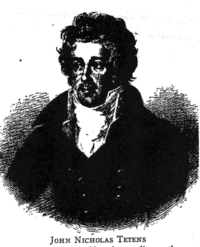
Johann Nicolaus Tetens
Today I am going to sketch the answers that Johann Nicolaus Tetens gave to these questions. Tetens was one of the brightest minds in Germany in the second half of the eighteenth century. The essay on which I am going to focus was published in 1775, six years before Kant’s first Critique. It is entitled On General Speculative Philosophy. It contrasts speculative philosophy [speculativische Philosophie] with observational philosophy [beobachtende Philosophie].
Observational philosophy is a philosophy which relies on observation. Observation, in the relevant sense, is a form of introspection. It takes place when we disregard the relation of our mental representations with the objects they are about and we regard our mental representations as “something subjective, modifications of ourselves”. Observation enables us to discover truths about God, the human soul, and the world, to which we have access
- without previous general speculations on substance, space and time, etc. […] Reid, Home, Beattie, Oswald, and also several German philosophers have proven this beyond doubt with their reasonings and with the proofs that they have put forward.
This passage makes clear that Tetens’ observational philosophy is actually Scottish common sense philosophy – a movement that had a great influence in Germany in the 1770s. Scottish common sense philosophy was an incarnation of experimental philosophy. Tetens’ contrast between observational and speculative philosophy is a version of the experimental-speculative distinction.
According to Tetens, common sense and introspection provide us with a stock of hypotheses and intuitions. These form “the terrain that one must cultivate when doing speculative philosophy.” Speculative philosophers must reformulate those intuitions in well-defined terms, look for systematic links between them, assess their truth, seek for reasons to believe them to be true, and so on. The philosophy that Tetens advocates in 1775 combines an initial observational stage with a later speculative stage.
According to Tetens, this means combining the virtues of British and German philosophy. Tetens regards observational philosophy as a distinctively British movement (with French and German followers) and speculative philosophy as a distinctively German tradition:
- British philosophers could be our models in observing; but they should not be our models in speculative philosophy. … New [British] philosophy was first shaped by Bacon and later by Locke. […] Bacon’s [New] Organon, regarded as a set of directions to perform observations and to extend empirical knowledge, is a masterwork … Locke’s books on the human understanding contain an excellent model for employing that method in the knowledge of our soul and its operations. Yet both of their logics are insufficient on the other side [scil. the speculative side] … British philosophy was nearly only an observational philosophy, an empirical physics of man.
Tetens identifies a continuous tradition of experimental (or in his terms, observational) philosophers stretching from Bacon to Reid, through Locke, Hume, and Condillac. This shows that the existence of a tradition of experimental philosophy and its opposition with speculative philosophy (ESP) were known to Kant’s contemporaries in the mid-1770s.
Over the following two decades, Kant adumbrated a new distinction between empiricism and rationalism. His followers (Reinhold, Tennemann) chose to privilege it over the ESP that they could find in Tetens’ text from 1775 (and elsewhere). Given their knowledge of the ESP, their choice to privilege the new distinction between empiricism and rationalism must have been a deliberate one. What reasons motivated that choice? Do let me know your thoughts in the comments!
Anti-Newtonianism in moral philosophy?
Juan Gomez writes…
Peter Anstey recently posted a reply to Eric Schliesser’s criticisms of the experimental/speculative distinction we are proposing. Eric posted some comments on this topic in the New APPS: Art, Politics, Philosophy, Science blog, where he expanded his criticisms by presenting a four-fold problem for our distinction. I quote the fourth point of criticism from Eric’s post:
- Fourth, and most important to the history of philosophy, when the “experimental” philosophy was introduced into moral areas (Turnbull, Hume, etc.) it was decidedly Baconian in character, and often quite hostile to Newton (but that story must await more detail later).
I am going to pitch in my reply before Eric gives us more details on this hostility to Newton. In my previous post on the ‘spirit’ of experimental philosophy, I attached a document with some quotes from Turnbull’s Principles of Moral Philosophy that illustrate the opposite of Eric’s claim. The following are just the three most explicit quotes (you can check this document for more of them):
- Account for MORAL, as the great Newton has taught us to explain for NATURAL Appearances, (that is, by reducing them to good general laws) (Epistle dedicatory, i)
- The great Master [Newton], to whose truly marvelous (I had almost said more than human) sagacity and accuracy, we are indebted for all the greater improvements that have been made in Natural Philosophy, after pointing out in the clearest manner, the only way by which we can acquire real knowledge of any part of nature, corporeal or moral, plainly declares, that he looked upon the enlargement Moral Philosophy must needs receive, so soon as Natural Philosophy, in its full extent, being pursued in that only proper method of advancing it, should be brought to any considerable degree of perfection, to be the principal advantage mankind and human society would then reap from such science. (Preface, iii)
- It was by this important, comprehensive hint [Newton’s], I was led long ago to apply myself to the study of the human mind in the same way as to that of the human body, or any other part of Natural Philosophy: that is, to try whether due enquiry into moral nature would not soon enable us to account for moral, as the best of Philosophers teaches us to explain natural phenomena. (Preface, iii)
One last thought, and a preview of a post in the near future, regarding Eric’s comments: David Fordyce, regent at Marischal College for 10 years (1741-1751), studied in the same college in the 1720’s when Turnbull was a regent. His posthumous publication The Elements of Moral Philosophy might fall under Eric’s description of being ‘Baconian in character,’ but there is certainly no hostility to Newton, and it fits in nicely with our description of experimental philosophy. I leave you with a passage from Fordyce’s book. It is interesting to mention here that parts of Fordyce’s book were used by William Smellie’s for the entry on moral philosophy of his first edition of the Encyclopaedia Britannica, and were maintained in the following editions for decades.
- Moral Philosophy has this in common with Natural Philosophy, that it appeals to Nature or Fact; depends on Observation, and builds its Reasonings on plain uncontroverted Experiments, or upon the fullest Induction of Particulars of which the Subject will admit. We must observe, in both these Sciences, Quid faciat & ferat Natura; how Nature is affected, and what her Conduct is in such and such Circumstances. Or in other words, we must collect the Phaenomena, or Appearances of Nature in any given Instance; trace these to some General Principles, or Laws of Operation; and then apply these Principles or Laws to the explaining of other Phaenomena. (The Elements of moral Philosophy, 1754, p. 7-8)
Baconian versus Newtonian experimental philosophy
Peter Anstey writes…
Eric Schliesser’s comments about the utility of the experimental/speculative distinction, provide an opportunity for me to lay out a distinction that is absolutely central to our project. But let’s hear from Eric first: I quote from his blog post on It’s Only a Theory:
- It ignores at least one other group of philosophers, namely those that believed in (mathematical) theory mediated measurement. I am thinking of Galileo, Huygens, and Newton, among the best known. These are not best described as experimental, although all were accomplished experimentalists (and Newton’s Optics is often assimilated to experimental traditions), but their work has very different character from say, Bacon or Boyle. (They are also not best described as speculative, because all three practiced a self-restraint on published speculation.) Certainly after the Principia this approach created standing challenge to all other forms of philosophizing. So the Otago framework will run into big trouble in 18th century.
We’ve already shown that, in fact, the terminology of the experimental philosophy is very prevalent in the 18th century and, moreover, that the experimental philosophy was extended beyond natural philosophy into moral philosophy and even aesthetics. See, for example, the works of George Turnbull which are a good example of experimental moral philosophy.
But the important issue Eric raises has to do with those who practised ‘theory mediated measurement’ such as Galileo, Huygens and Newton. What our research has shown is that the experimental philosophy was practised in two quite different ways. Up until the 1690s, Boyle, Hooke and the early Royal Society practised experimental philosophy according to the method of Baconian natural history. However, from the last decade of the seventeenth century Newton’s new mathematical natural philosophical method came to be seen as the preferred method of experimental philosophy. The Baconian natural history program started to run out of steam in the 1690s and it soon came to be replaced by the Newtonian method. This is, in fact, the explanation of Newton’s common refrain ‘Natural philosophy is not natural history’. And Newton himself had a large hand in the demise of the Baconian approach to experimental philosophy both through criticism and through his own positive alternative. Far from providing an exception to our framework, Newton, the self-confessed experimental philosopher, is one of the central players!
Does Newton feign an hypothesis?
Kirsten Walsh writes…
Newton’s famous pronouncement, Hypotheses non fingo, first appeared in 1713, but Newton’s anti-hypothetical stance is present as early as 1672, in his first papers on optics. In his first publication, he introduces his notion of certainty, and insists that his doctine of colours is a theory; not an hypothesis:
- For what I shall tell concerning [colours] is not an Hypothesis but most rigid consequence… evinced by ye mediation of experiments concluding directly & without any suspicion of doubt.
Despite these clear anti-hypothetical themes, a corpuscular hypothesis lies beneath Newton’s theory of light and colours. What are we to make of this? Is Newton guilty of feigning an hypothesis? Is Wolff correct when he says that Newton “indulges in hypotheses in those very areas in which they think he abstained from employing them“?
To begin, what does Newton mean by Hypotheses non fingo? ‘Fingo’ has been variously translated as ‘frame’, ‘make’, ‘imagine’ and ‘devise’. Experts argue that ‘feign’ is the most appropriate translation. While it has a variety of meanings, such as to form, to invent, to forge, or to suppose erroneously, the word ‘feign’ also carries the nuance of pretence, counterfeit, or sham. Thus, they argue that while Newton indeed conceived or framed hypotheses, he did not attach any special epistemic status to them. He maintained a clear demarcation between theories that were supported by experimental results and hypotheses that were merely unsupported speculations.
Now let’s take a closer look at Newton’s early optical papers. Newton claims that his doctrine of colours is a theory, not an hypothesis, for three reasons:
- It is certainly true, because it is supported by (or deduced from) experiment;
- It concerns the physical properties of light, rather than the nature of light; and
- It has testable consequences.
These are the three key aspects of Newton’s early methodology. He refers to them again and again throughout the debate that followed the publication of his first optical paper.
Newton explicates his corpuscularian view in his first optical paper and describes light rays as substantial bodies. But when his opponents accuse him of hypothesising, Newton argues that he is not guilty. Firstly he argues that this hypothesis is not necessary for his explanation of colours. Secondly he argues that he attaches no special epistemic merit to his hypothesis because:
- It is not supported by experiment;
- It concerns the nature of light; and
- It has no testable consequences.
While Newton never gives up his corpuscularian view, he attempts to explicate and promote his theory without referring to it. He argues that he doesn’t need to provide any hypothesis on the nature of light – his theory on the properties of light is sufficient on its own.
I claim that Newton isn’t guilty of violating his anti-hypothetical stance. He demonstrates that he can distinguish between theory and hypothesis, giving the former higher epistemic status than the latter. He does not pretend to have empirical support for his corpuscular hypothesis, nor does he try to ‘prop it up’ on other grounds. Perhaps he regrets having ever opened the proverbial can of worms, for the next time he explicates his theory of light and colours, he does so without any reference to the corpuscular hypothesis or the nature of light.
That Newton can tell the difference between good scientific explanations and speculations is further supported by his use of queries in these early optical papers, but more on this next time. To conclude, I think Newton is not guilty of feigning an hypothesis. What do you think?
Experiment and Hypothesis, Theory and Observation: Wolff vs Newton
Alberto Vanzo writes…
Looking for sources for knowledge of experimental philosophy in eighteenth century Germany, I found some interesting texts by relatively unknown authors (at least beyond the circle of specialists). Christian Wolff is one of them. He was the most famous German philosopher in the first half of the eighteenth century. His philosophy was taught in many universities and his works were very popular. For instance, his German Logic knew no less than 14 editions during Wolff’s life.
Wolff knew several British experimental philosophers. He cited works by Robert Boyle and Robert Hooke, he was the Locke reviewer for an important journal (the Acta eruditorum), and he polemized with the Newtonian John Keill on the existence of the vacuum. He is a good example of the fact that German thinkers were acquainted with the works and the methodological views of British experimental philosophers in the first half of the eighteenth century.
A number of Wolff’s statements might make us think that he was himself an adherent to the early modern version of x-phi. Like British experimental philosophers, Wolff criticizes Descartes’ attempt to explain a great variety of natural phenomena in the light of few general principles that he established a priori. Like Hume and Hutcheson, Wolff is eager to extend the dominion of experimental philosophy beyond the boundaries of physics. He projects the disciplines of experimental cosmology, experimental teleology, experimental theology, experimental politics, and even experimental ontology. For his philosophical system as a whole, he chooses the name of “universal experimental philosophy” (philosophia experimentalis universalis). How could Wolff have been a more enthusiastic adherent to the program of experimental philosophy?
Yet contrary to the appearances, Wolff’s views were quite different from those of his British counterparts. This can be seen by comparing him with Newton. Newton, like virtually every other early modern experimental philosopher, claimed that he did not feign any hypothesis (his famous hypotheses non fingo). Wolff rebuts that Newton
- indulges in hypotheses in those very areas in which they think he abstained from employing them […] In fact, what else is universal attraction or gravity, which is represented by a measure of attraction, if not a hypothesis which is assumed because of certain phenomena and then is extended to all matter?
According to Wolff, not only did Newton feign hypotheses, but he did well to do so. This is because natural philosophers must proceed like astronomers:
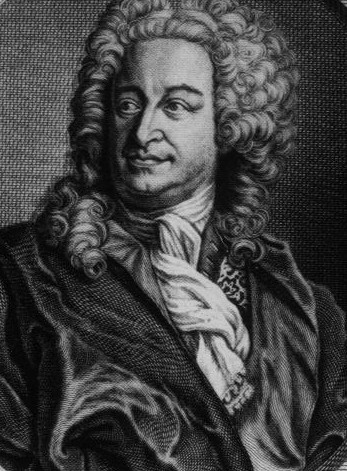
Christian Wolff
From some present events, they infer what they have to assume, in order for [the events] to follow [from it], and they posit that their hypothesis applies to all [similar] events […] To determine whether they did well to assume the hypothesis, they infer what follows from it on the basis of a correct reasoning, in order to compare it with the remaining events that they have either observed, or that they derive from observations. [They do this] in order to see whether what has been observed agrees with the hypothesis. If they find that [observations and hypothesis] are in contrast with one another, then they improve the hypothesis, and in this way they constantly move closer to the truth.
Wolff holds that there is a circular relationship between observation or experiment on the one hand, and theory on the other hand. He stresses
- how much theory owes to observations and how much, on the other hand, observations owe to theory, since observations perfect theory and theory in turn continuously perfects observations. He who is ignorant of any theory and does not have much ability to use the faculty of knowing will only discover obvious and mostly imprecise [truths] on the basis of observations. There would not be much progress, unless one could presuppose some theory; and the more [a theory] is developed, the more discoveries one will make by means of observation[s].
Unlike Newton, Wolff was no great scientist. However, the quotes above suggest that his methodology of science is worth a serious reading. His acknowledgments of the interaction between theory and observation sound modern. They sketch a version of the hypothetico-deductive method that might provide an interesting alternative to Newton’s strict inductivism.
In summary, Wolff is a good example of the Germans’ knowledge of British experimental philosophy in the first half of the eighteenth century. His views are also interesting in their own right. So are Johann Nicolaus Tetens’ comments on observational vs speculative philosophy or Johann Heinrich Lambert’s distinction between theory-testing experiments and experiments that have a life of their own – two hundred years before Ian Hacking. More on this another time.
In the next post, Kirsten will discuss Newton’s method, in particular his rejection of hypotheses and his use of queries. See you next Monday!
Monthly Update: Events, CFPs, and Readings
Hello, readers!
Below is a list of upcoming events, call for papers, recent posts and a journal article of some relevance to early modern experimental philosophy.
Upcoming Events:
- 29th Symposium of the Scientific Instruments Commission. Florence, 4-9 October.
- Third Annual North Sea Early Modern Philosophy Workshop. Antwerp (Belgium), 12-13 October.
Calls for Papers with deadlines in October-November:
- Annual Conference of the New Zealand Division of the Australasian Association of Philosophy. University of Waikato (New Zealand), 5-9 December 2010. Deadline: 29 October.
- Hume after 300 Years: The 38th International Hume Society Conference. Edinburgh, 18-23 July 2011. Deadline: 1 November.
- New York City Workshop in Early Modern Philosophy. New York, 25-27 February 2011. Deadline: 15 November.
Readings
Brett Fulkerson-Smith discusses Kant’s “experiment of pure reason” in the last issue of the Kantian Review.
Two reviews relating to the early Royal Society have recently been published: a review of John Gribbin’s book The Fellowship at Some Beans and a review of an exposition on John Aubrey and the roots of the Royal Society in the Times Online.
Here on our blog, we introduced ourselves and our project. We wrote about our research on Newton’s mathematical method and on the experimental method in British moral philosophy, in particular in George Turnbull. We discussed the difference between contemporary and early modern experimental philosophy. We argued that it is better to interpret the history of early modern philosophy in the light of the distinction between experimental vs speculative philosophy, rather than rationalism vs empiricism. In the comments, Neil Rickert, Benny Goldberg and Gary Banham provided valuable suggestions. Thanks!
We did not quite manage to fully convince Eric Schliesser. He discussed our ideas over at It’s Only A Theory.
Have we missed some event, call for paper, or reading? Would you like us to include your writings or events in the next monthly update? Do let us know! Also, you can subscribe to our mailing list or RSS feed if you would like to be notified of new posts. For more frequent updates, follow us on Twitter.
See you next Monday with a post on Christian Wolff vs Isaac Newton on the experimental method.
Turnbull and the ‘spirit’ of the experimental method
Juan Gomez writes…
You will probably recognize the following phrase: ‘An attempt to introduce the experimental Method of Reasoning into moral Subjects.’ It is the subtitle of David Hume’s Treatise of Human Nature of 1739-40, and the first explicit mention of the application of the experimental method in moral topics. Many scholars have pointed to it, and claimed that Hume was the first one to go forward with this attempt. However, others (Tom Beauchamp, Alexander Broadie) have also noticed that this idea did not originate with Hume. I will show here that the ‘spirit’ of the experimental method was very much alive at least 20 years before the publication of Hume’s Treatise. In fact, contrary to the most commonly held view, Hume should not be the reference point when studying the emergence of the “science of man”. Rather, we should look at the Aberdeen philosophers, in particular at George Turnbull and his lectures at Marischal College in the 1720’s.
I will make a prima facie case for this claim with only a few quotes (available in this document), but please do contact me if you are interested in the topic, since there is more than enough evidence that I would be happy to discuss with you.
To begin with, Hume was not the first to allude to the application of the experimental method in moral philosophy. Francis Hutcheson had already done this in his 1725 Inquiry. The subtitle of this work explains that it contains the following:
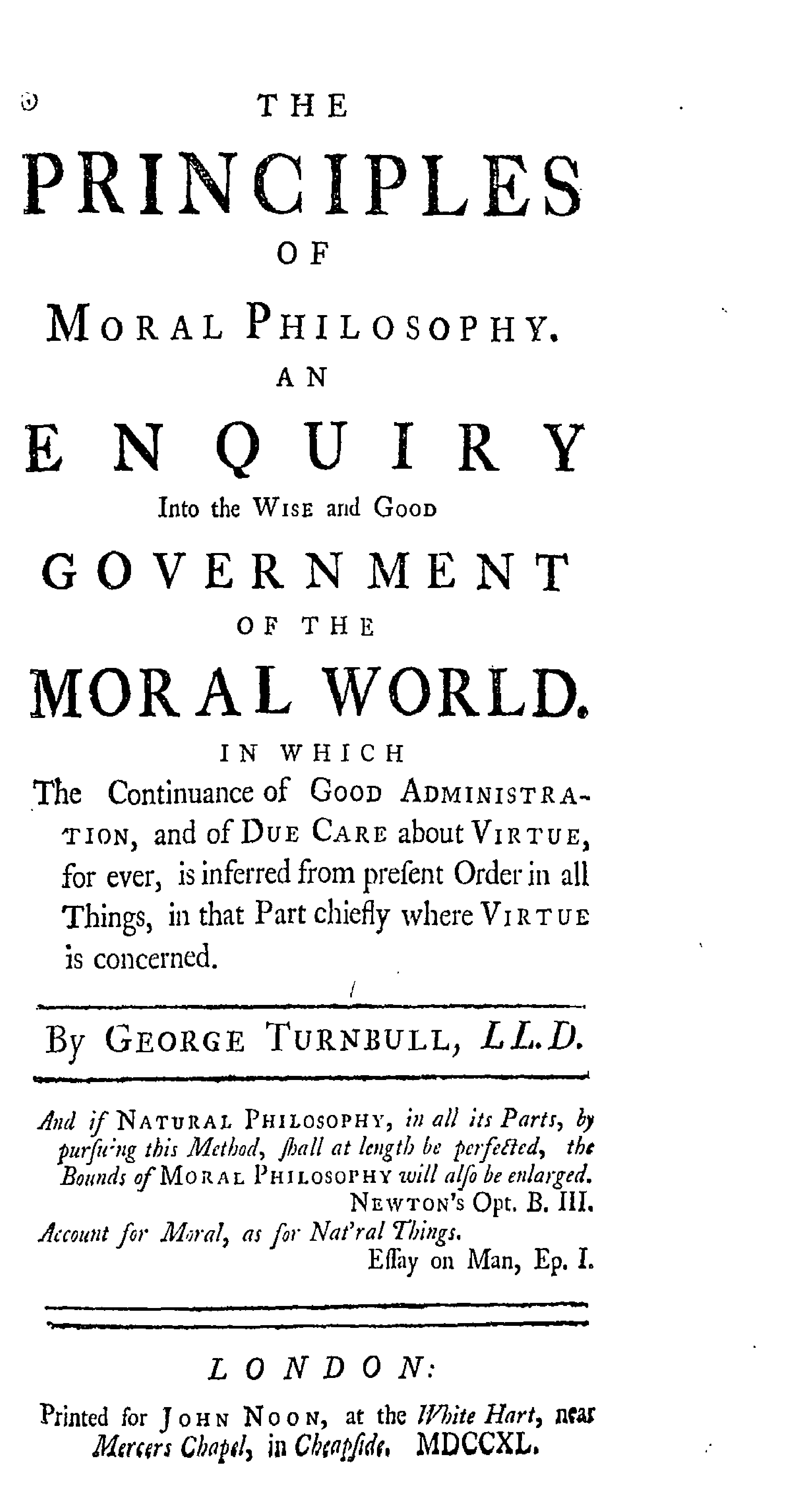
Turnbull's Principles of Moral Philosophy(1740)
- the Principles of the late Earl of Shaftesbury are explained and defended against the Fable of the Bees; and the Ideas of Moral Good and Evil are established, according to the Sentiments of the Ancient Moralists, with an attempt to introduce a Mathematical Calculation on subjects of Morality. (emphasis added)
Hutcheson doesn’t use the words ‘experimental method’, but saying that he will give a ‘mathematical calculation on subjects of morality’ is perfectly in line with the spirit of the experimental method (specifically with the Newtonian method). To be fair to Hume, he does recognize Hutcheson as one of the philosophers who has “begun to put the science of man on a new footing.” (Treatise (1739), Introduction, p. 6-7) So Hume might have recognized that he was not the first, but a number of modern scholars have not.
Moving on to George Turnbull, whom I believe is mistakenly underrated as a figure of the Scottish Enlightenment, published his Principles of Moral Philosophy in 1740, the same year Hume published the third volume of his Treatise, which is on Morals. This would at least lead us to think that both Hume and Turnbull were working on the application of the experimental method in morality at the same time. But as Turnbull mentions in the introduction to his Principles, his book is based on the lectures he gave at Marischal College between 1721 and 1726, around the time when Hume was a student at the University of Edinburgh. Besides the numerous remarks in the Principles that show Turnbull’s devotion to the experimental method, there is a key document that shows that he was teaching the young Aberdeen students the moral philosophy he explains in the book he published 17 years later. The document is the 1723 graduation thesis, which the graduating students (Thomas Reid among them) had to defend, titled De scientiae naturalis cum philosophia morali conjunctione (On the unity of natural science and moral philosophy).
I am currently working on the 1723 thesis, and at this moment I can let you know that it is strengthening my belief in the importance of Turnbull in the development of the ‘science of man.’ For now I’ll leave you with enough quotes from the Principles that show that if we want to study the development of the science of morals, we should start focusing more on Turnbull and Aberdeen, and less on Hume and Edinburgh.
From Experimental Philosophy to Empiricism
Alberto Vanzo writes…
As those of you who’ve been following us since our first post will know well by now, we claim that the most common and important distinction in early modern philosophy is the distinction between experimental and speculative philosophy (ESP). Among others, Bacon, Boyle, Locke, Newton, Turnbull, Hutcheson, Hume, and Reid all employ the ESP. They see themselves as belonging to the tradition of experimental philosophy. They contributed in various ways to the shaping and the evolving of this tradition.
However, if you open any history of philosophy which has been written in the last 150 years or so (say, Kuno Fischer’s, Frederick Copleston’s, or my high school manual), you will find the claim that another distinction was central to the development of early modern philosophy. This is the distinction between empiricism and rationalism.
The ESP and the empiricism-rationalism distinction are far from equivalent. In fact, ESP is best. While the ESP is absent from the histories of philosophy, the rationalism-empiricism distinction is absent from the writings of early modern philosophers – the so-called empiricists and rationalists. The rationalism-empiricism distinction was first adumbrated in Kant’s first Critique (B882). It was later developed in the late eighteenth century and nineteenth century in the histories of philosophy of several authors influenced by Kant (Reinhold and Tennemann are two examples).
This fact raises some questions:
- Did Kant or his followers intentionally obliterate the ESP?
- Did they introduce the historiographical distinction between empiricism and rationalism as a replacement for the historical distinction between experimental and speculative philosophy?
- Did they know the ESP in the first place?
To answer these questions, I started studying the influence of British experimental philosophers in Germany between the beginning of the eighteenth century and the publication of Kant’s first Critique in 1781.
I then want to follow the development of the empiricism-rationalism distinction in the histories of philosophy which were written in Germany from 1781 to the mid-nineteenth century. That’s the period in which some of the basic narratives that we still read today in many histories of philosophy first took shape. The way late eighteenth century and nineteenth century authors articulated and developed the empiricism-rationalism distinction is hardly agenda-free. It reflects their philosophical views and assumptions. I’m curious to learn more about that.
So far, I’ve discovered some interesting texts, especially those by Christian Wolff (1679-1754) and Johann Nicolaus Tetens (1736-1807). Next time I’ll tell you about Wolff’s criticism of Newton’s hypotheses non fingo. Next Monday Juan will tell us about Turnbull’s explicit rejection of hypotheses and his endorsement of the application of the experimental method beyond natural philosophy.
I’d love to hear what you think about my research plans.
ESP is best
Peter Anstey writes…
There are two ways to carve up 17th and 18th century philosophy: the traditional way is to divide it into rationalist versus empiricist philosophy (REP); a new way is to divide it into experimental versus speculative philosophy (ESP). We argue that the ESP way is far better than the traditional terms of reference.
Let’s start the comparison by pointing out the fact that the ESP distinction provided the actual historical terms of reference that many philosophers and natural philosophers used from the 1660s until late into the 18th century. There are literally scores of books from the period that use these terms and deploy this distinction (They are used by Boyle, Hooke, Sprat, Glanvill, Cavendish, Locke and Newton). By contrast, the terms ‘Rationalism’ and ‘Empiricism’ (and their non-English cognates) were introduced by Kant and his followers in the late 18th century. One can find very occasional uses of the terms in the earlier period, but they have completely different meanings. For example, ‘empiricism’ in Johnson’s Dictionary (1768) means ‘Dependence on experience without knowledge or art; quackery’.
Second, on the standard view, REP is largely about epistemology, that is the origins of ideas and sources of knowledge. The REP view has it that rationalists claimed that there are innate ideas and that these are the foundations of knowledge: the empiricists claimed that all ideas originate in the senses and that knowledge is built upon experience and not innate ideas or principles. By contrast, ESP is largely about methodology, about how to proceed in acquiring knowledge, especially knowledge of nature. It includes questions about the sources of knowledge and ideas, but it also includes views on the nature of hypotheses, principles, theory, mathematics, experiment and natural history.
So ESP has more explanatory range than REP and allows a more nuanced understanding of individual philosophical positions and debates. One important example is Newton’s rejection of hypotheses. This is very nicely explained by ESP, but is largely irrelevant to REP and has therefore posed a problem for scholars who approach Newton from the REP framework.
Third, you’ll notice that I highlighted ‘standard view’ above. This is because nowadays it is pretty difficult to settle on exactly what ‘Empiricism’ and ‘Rationalism’ mean. The Hume scholar Don Garrett reckons that there are 5 types of Empiricism. The Locke scholars Jonathan Lowe and Michael Ayers give us 3 and 2 types respectively. Paul Feyerabend reckoned that there were 3 types and Ernan McMullin has a few more. This proliferation of empiricisms is an indicator that the term no longer earns its keep.
By contrast, the term ‘experimental philosophy’, while it admits of some latitude of application, its widespread use by the philosophers themselves means that it’s pretty easy to work out whether someone is an experimental philosopher or not and whether they are sympathetic to it.
Fourth and finally, there’s the issue of demarcation. According to REP the leading empiricists are normally thought to be Locke, Berkeley and Hume and the leading rationalists are Descartes, Leibniz and Spinoza. But even this is often contested: Des Clarke has Descartes as an empiricist; Richard Aaron had Locke as a rationalist; Nicholas Rescher has Leibniz as an empiricist! And where does Robert Boyle, the archetypal experimental philosopher sit? He promoted observation by the senses, but he was partial to innate ideas. ESP provides a far more natural line of demarcation and one that explains this vacillation on the part of modern scholars.
All in all ESP is better. So what should we do with the Rationalism and Empiricism distinction? Are there any good reasons to retain it?
