Newton on Experiment and Mathematics
Kirsten Walsh writes…
In my last post, I discussed our 20 revised theses and why I altered thesis 5. In this post, I’ll discuss why I replaced thesis 8.
In 2011, I claimed that:
- 8. The development of Newton’s method from 1672 to 1687 appears to display a shift in emphasis from experiment to mathematics.
But at the start of this year, I replaced this thesis with a new thesis 8:
- 8. In his early work, Newton’s use of the terms ‘hypothesis’ and ‘query’ are Baconian. However, as Newton’s distinctive methodology develops, these terms take on different meanings.
Since my new thesis is a replacement of the original thesis, rather than a modification, two explanations are required. So in today’s post, I’ll tell you why I decided to remove my original thesis 8, and in my next post, I’ll tell you about my new thesis 8.
I originally included thesis 8 because there are some obvious differences in the styles of Newton’s early work on optics and his Principia. In Newton’s first paper on optics (1672), there is a strong emphasis on experiment. Experiment drives his research and guides his rejection of various possible explanations of the phenomena under consideration. Ultimately, he presents an Experimentum Crucis as proof for the certainty of his proposition that white light is heterogeneous. In contrast, the Principia (1687) displays a strong emphasis on mathematics. The full title of the work, the Author’s Preface to the Reader, and the fact that Book I opens with 11 lemmas outlining the mathematical framework of the work are just a few features that make it clear that Principia is primarily a mathematical treatise.
I now think that my original thesis 8 is misleading.
Firstly, as I have emphasised on this blog, Newton’s early work had a mathematical style that made it unique among his contemporaries. While they recognised him as an experimental philosopher, his claims of obtaining certainty via geometrical proofs set him apart from the Baconian-experimental philosophers. Moreover, his methodological statements show evidence of a tension between experiment and mathematical certainty. For example, he says that the science of colours,
- “depend[s] as well on Physicall Principles as on Mathematicall Demonstrations: And the absolute certainty of a Science cannot exceed the certainty of its Principles. Now the evidence by wch I asserted the Propositions of colours is in the next words expressed to be from Experiments & so but Physicall: Whence the Propositions themselves can be esteemed no more then Physicall Principles of a Science.”
Secondly, Newton continued to identify as an experimental philosopher until the end of his life. For example, in the General Scholium at the end of Principia, he says:
- “and hypotheses, whether metaphysical or physical, or based on occult qualities, or mechanical, have no place in experimental philosophy.”
This resembles Newton’s earlier emphasis on grounding propositions on empirical evidence, rather than on speculative conjectures.
Thirdly, in Principia, Newton appears to be negotiating a similar tension between experiment and mathematical certainty that we saw in his early work. For example, in the Scholium to the Laws of Motion he asserts the certainty of his Laws, while at the same time, acknowledging their experimental basis:
- “The principles I have set forth are accepted by mathematicians and confirmed by experiments of many kinds.”
And:
- “By these examples [i.e. the experiments mentioned above] I wished only to show the wide range and the certainty of the third law of motion.”
From these three points, we can see that the methodological differences between Newton’s early papers and Principia aren’t as great as they first appear. But I did not remove my original thesis 8 because I think that the methodology of the 1672 paper is precisely the same as the methodology displayed in Principia. Rather, I don’t think my original thesis 8 captures what is important about these differences.
As I have explained here, my project is to distinguish between those features of Newton’s methodology that changed, and those that stayed the same. Some aspects of Newton’s methodology developed over time. For example, he came to value geometrical synthesis over algebraic analysis. Other aspects of his methodology varied according to context. For example, in Opticks, he employs ‘experiments’ and ‘observations’, but in Principia, he employs ‘phenomena’. But this triumvirate of methodological ideas – experiment, mathematics and certainty – should be considered an enduring feature of Newton’s methodology.
Geminiano Montanari on Natural History and Explanations
Alberto Vanzo writes…
A while ago, I wrote a post on the late seventeenth-century Italian natural philosopher, Geminiano Montanari. I argued that his stints of speculative reasoning were, after all, compatible with his allegiance to the experimental philosophy. In this post, I will focus on another aspect of Montanari’s experimentalism that appears to clash with his natural-philosophical practice: his view that, before even attempting to explain natural phenomena, we should compile a universal natural history.
The problem: disagreements and errors in natural philosophy
Montanari sees the compilation of a universal natural history as way of overcoming disagreements among philosophers. Having noted the many competing views on what “the first principles of natural things” may be, Montanari explains that this variety is due to the excessive self-confidence of “nearly all great minds”. Instead of jumping to first principles,
- It was necessary to start philosophy from particular things, examining the whole of nature one piece after another, and to amass a rich capital of experiences so as to prepare the historical matter on whose basis one should later speculate about the reasons [of those experiences].
The solution: building a universal natural history
We can avoid errors and reach agreement on the principles of things by following Francis Bacon’s suggestion of building a natural history including “all experiences and other certain information that one could get from faithful sources”.
How much information should be gathered before we can discover the first principles of natural things?
- [I]n order to find what the true, first and most universal principles of all things may be, it is not sufficient to make an induction from few terms, but it is necessary first to cognize all natural effects, so that one can later find a common reason which satisfies all experiences. But who can already boast to possess such an universal information?
Montanari’s answer is: nobody. It is still too early to make an induction from the observation of everything to its first cause. We must postpone the task of explaining the whole of nature and focus our strengths on the task of compiling natural histories.
Did Montanari do what he says?
He certainly collected many experiments and observations on manifold phenomena, from the capillary behaviour of liquids to the comets and celestial bodies. But he did not refrain from developing explanations of those phenomena, even though he was aware that his experiences were limited and many phenomena had not yet been observed. It is tempting to conclude that Montanari did not do what he says, that his allegiance to the Baconian view that a comprehensive data collection must precede natural-philosophical explanations was merely verbal, and that he was merely paying lip-service to the Baconian fashion of the time.
I do not think that this is the case. Montanari claims that completing a universal natural history is necessary to establish the “true, first and most universal principles of all things”. However, he does not claim that completing a universal natural history is necessary to explain specific natural phenomena, nor does he think that we must first establish the first principles of all things in order to explain specific phenomena. On the contrary, Montanari thinks that, upon completing a universal natural history, we will have to to advance piecemeal toward the first principles, by formulating explanations of specific phenomena and proceeding to increasingly higher levels of generality.
Montanari’s two-part discussions of specific phenomena follow, on a small scale, his favoured Baconian method that for establishing first principles. Regardless of whether he is discussing the capillary action, the behaviour of hot spheres of glass in water, or the position of a comet, Montanari starts by providing a natural history of the phenomenon at hand in the form of a list of observations and experiments. He then proceeds from the “historical matter” to its “reasons”, that is, he provides natural-philosophical explanations of the phenomena.
These explanations are fallible. Natural histories are inescapably incomplete and it is always possible that future experiments or observations invalidate his explanations. However, Montanari holds that it is possible to “deduce” explanations “with physico-mathematical evidence” from a suitable, even if limited, natural-historical basis. What warrants his explanations is the fact that they “explain all the other effects we have observed.”
In conclusion, Montanari does not violate his claim that we should build a universal natural history before identifying the very first principles of the whole nature. The magnitude of the task suggests that this may be only a regulative ideal and may even warrant a certain scepticism on whether we will ever be able to discover the first principles. However, discovering these principles is not necessary to do science for Montanari. What drives Montanari’s natural philosophy is the fact that he allows for fallible natural-philosophical explanations which are based on small-scale, necessarily incomplete, subject-specific natural histories.
Joseph Butler and Method in Moral Philosophy and Religion
Juan Gomez writes…
One of the features that we have explored in our project is the application of the experimental method in areas other than natural philosophy. I have focused on the work of George Turnbull to illustrate how the method was applied in moral philosophy and religion. In my next series of posts I want to focus on the work of Joseph Butler (who was arguably one of the figures that most influenced Turnbull) and explore his ideas on method in moral and religious inquiries.
As an introductory post to this series I will focus on the preface that appeared in the 1788 edition of Butler’s Analogy of Religion (first edition 1736) by Samuel Halifax, Bishop of Gloucester. In this preface Halifax gives an account of Butler’s ‘moral and religious systems’ that serves as a summary of Butler’s main ideas.
Halifax tells us that Butler’s moral system can be found mainly in the first three of his collection of Sermons, which are on human nature. Halifax highlights the way Butler proceeds to determine human nature:
What the inward frame and constitution of man is, is a question of fact; to be determined, as other facts are, from experience, from our internal feelings and external senses, and from the testimony of others…From contemplating the bodily senses, and the organs or instruments adapted to them, we learn that the eye was given to see with, the ear to hear with. In like manner, from considering our inward perceptions and the final causes of them, we collect that the feeling of shame, for instance, was given to prevent the doing of things shameful; compassion, to carry us to relieve others in distress; anger, to resist sudden violence offered to ourselves.
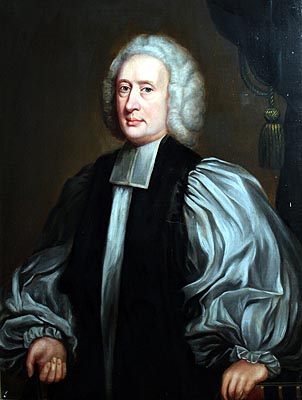
The method for acquiring knowledge of our moral system must be the same we employ to discover external facts. Halifax contrasts this method that Butler adhered himself to with the one used by Samuel Clarke. Halifax and Butler both see the two methods not as opposed to each other but rather as complementary:
The reader will observe, that this way of treating the subject of morals, by an appeal to facts, does not at all interfere with that other way, adopted by Dr. Samuel Clarke and others, which begins inquiring into the relations and fitness of things, but rather illustrates and confirms it.
It is interesting that Clarke is portrayed as following an a priori method in his moral inquiries, and I will leave the analysis of this and its relation to Butler’s method for a future post where we will examine the correspondence between Butler and Clarke regarding this issue. Since this is just an introductory post, I want to finish by showing Halifax’s rendering of Butler’s method in his religious work.
Butler’s main philosophical text was his Analogy, where he deals with natural and revealed religion and argues that the former is confirmed in the latter, both giving us evidence for the divine government of the world. The way Butler proceeds in this text is by arguing by analogy from the natural to the moral realm:
This way of arguing from what is acknowledged to what is disputed, from things known to other things that resemble them, from that part of the divine establishment which is exposed to our view to that more important one which lies beyond it, is all on hands confessed to be just. By this method Sir Isaac Newton has unfolded the system of nature; by the same method Bishop Butler has explained the system of grace; and thus, to use the words of a writer, whom I quote with pleasure, has ‘formed and concluded a happy alliance between faith and philosophy.’
One of the advantages of this method of analogy is that (as we will see in my next post where we examine Butler’s Analogy in a bit more detail) it does not lead to a claim of certain knowledge about the doctrines of religion, but it rather leads to a high degree of credibility in them. This feature allows Butler to get rid of a number of objections. Further, if the analogy Butler argues for is a strong one, then all objections made against revealed religion will also count as objections to natural religion, which is a consequence the objectors will not want to admit.
As we have seen in this brief account of Halifax’s preface, it appears that a striking feature of Butler’s work in morality and religion is the methodology he applies in both areas, one that argues from facts and experience instead of hypotheses and speculations:
Instead of indulging to idle speculations, how the world might possibly have been better than it is; or, forgetful of the difference between hypothesis and fact, attempting to explain the divine economy with respect to intelligent creatures, from preconceived notions of his own; he [Butler] first inquires what the constitution of nature, as made known to us in the way of experiment, actually is; and from this, now seen and acknowledged, he endeavours to form a judgment of that larger constitution, which religion discovers to us.
In my next post we will examine Butler’s application of this method in his Analogy and his defense of probable knowledge.
Teaching Experimental Philosophy III: the case of Francis Hauksbee the Elder
Peter Anstey writes …
In two previous posts I examined an early teacher of experimental philosophy, John Theophilus Desaguliers and a later one, George Adams. In this post I turn to a third teacher of experimental philosophy, Francis Hauksbee the Elder (1660–1713). (He was called ‘the Elder’ to differentiate him from his nephew of the same name who also taught experimental philosophy.) Hauksbee was one of the two most important first-generation pedagogues. (We will examine the other, John Keill, in my next post.)
He was a gifted instrument maker who not only developed a new much improved design of Robert Boyle’s air-pump, but also conducted a series of very important new experiments using this instrument. Many of these were published in the Philosophical Transactions. As a result of his proficiency with experimental apparatus he became a kind of de facto curator of experiments at the Royal Society in c. 1704 after Robert Hooke’s death. In addition he seconded James Hodgson FRS to carry out public lectures on experimental philosophy in London while he acted as the demonstrator.
By 1709 he himself was lecturing on experimental philosophy and continued this until his death in 1713. In 1709 he published a compilation volume of his air-pump experiments entitled Physico-Mechanical Experiments … touching Light and Electricity. This volume, in many ways, mimicked Boyle’s ground-breaking New Experiments Physico-mechanical touching the Spring of the Air (1660). (Even the titles are similar.) Hauksbee clearly saw himself as working in a tradition of experimental natural philosophy that extended back to Boyle.
The work gives us an interesting insight into how he viewed natural philosophy. He begins by telling us that:
The Learned World is now almost generally convinc’d, that instead of amusing themselves with Vain Hypotheses, which seem to differ little from Romances, there’s no other way of Improving Natural Philosophy, but by Demonstrations and Conclusions founded upon Experiments judiciously and accurately made. (Preface)
By now our readers should recognize the standard tropes of the experimental philosopher: the decrying of hypotheses; the likening of them to romances; the appeal to the necessity of experiment for the improving of natural philosophy.
Hauksbee goes on in the Preface to mention ‘The Honourable and most Excellent Mr. Boyle’ and ‘the … Incomparable Sir Isaac Newton’ implying that he himself is engaged in the same natural philosophical project. It is interesting to note, however, that there is no mention of the method of natural history as practised and promoted by Boyle in the Preface or in Hauksbee’s work. Hauksbee’s experimental practice was a natural extension of Boyle’s work, but at the same time methodologically discontinuous with it.
Hauksbee was also much quicker than Boyle to draw natural philosophical conclusions from his experiments. He did not, however, apply mathematics to his discoveries and he was later criticized by Desaguliers in his Course of Experimental Philosophy (1734) in so far as his experiments
were only shewn and explain’d as so many curious Phaenomena, and not made Use of as Mediums to prove a Series of philosophical Propositions in a mathematical Order, they laid no such Foundation for true Philosophy. (vol. 1, Preface)
Hauksbee may not have had developed views on the methodology of natural philosophy or much aptitude in mathematics, but he was a gifted experimenter and a keen promoter of experimental philosophy.
Newton and the ESD
Kirsten Walsh writes…
We rang in 2013 by reconsidering our set of 20 core theses on the emergence and fate of early modern experimental philosophy. While our general theses regarding the distinction between experimental and speculative philosophy (ESD) were unchanged, I altered several of the specific claims about Newton’s methodology. In this post, I’ll focus on thesis 5 and why I changed it.
In 2011, I claimed that:
5. The ESD is operative in Newton’s early optical papers.
By ‘operative’, I mean that Newton appears to frame his methodology in terms of the ESD and aligns himself with the experimental philosophers of the Royal Society. While Newton’s methodology differed from his contemporaries in important ways (for example, unlike his contemporaries, Newton emphasised quasi-mathematical reasoning), it nevertheless reflects some of the key ideas and preferences of the Royal Society. Previously, I have discussed Newton’s early anti-hypothetical stance and Newton’s early use of queries as evidence of this his preference for the experimental philosophy of the Royal Society.
I now have enough evidence to broaden the scope of thesis 5. The ESD is operative in all of Newton’s scientific work; not just his early work:
5. The ESD is operative in Newton’s work, from his early work on optics in the 1670s to the final editions of Opticks and Principia published in the 1720s.
Let’s start with Newton’s Opticks. This book is widely recognised as a work of experimental philosophy. Newton’s experimental focus is made explicit by the opening sentence (which appears in every edition):
- “My Design in this Book is not to explain the Properties of Light by Hypotheses, but to propose and prove them by Reason and Experiments…”
Moreover, the presence of queries and the absence of hypotheses reflect the epistemic commitments of the experimental philosophy.
Commentators often notice that, in later editions of Opticks, Newton’s queries become increasingly speculative. This suggests that, despite his use of ESD-jargon, Newton was not following the experimental philosophy after all. In response to this kind of objection, I have argued that these later queries perform a role that is distinct to that of hypotheses, and that this role is consistent with Newton’s methodology. Moreover, the general features of Newton’s methodology reflect his commitment to experimental philosophy in opposition to speculative philosophy. In short, the ESD is operative in every edition of the Opticks.
Now consider Newton’s Principia. This book is often seen as less a work of experimental philosophy and more a work of mathematics. However, I have argued that the methodological passages in the first edition of Principia, though sparse, make it clear that experiment is an important theme of this work. Moreover, in the ‘General Scholium’, which was introduced in the 2nd edition in 1713, Newton makes his commitment to the experimental philosophy explicit.
Commentators often notice that Newton’s use of hypotheses in Principia, and their changing roles between the three editions, suggest that his methodology changes over time. However, I have argued that, in all three editions, Newton’s use of hypotheses is consistent with his experimental method. Moreover, the late introduction of Rule 4 in 1726 demonstrates that this commitment to experimental philosophy, in opposition to speculative philosophy, is long-lasting. In short, the ESD is operative in every edition of the Principia.
To summarise, the notions of experiment, queries and a decrying of speculative hypotheses that are enduring themes in Newton’s work, from the 1670s to his death in 1727, support my broader thesis 5. Commentators often see Newton’s use of these notions as rhetorical and argue that he failed to follow his own methodology. However, I argue that Newton’s methodology is internally consistent. Moreover, these methodological statements are more than ‘mere’ rhetoric. Rather, to some extent they track his epistemic and ontological commitments.
Do you think my argument is convincing? I’d love to hear what you think about my conclusion.
Empiricism and innate ideas
Alberto Vanzo writes…
The empiricism/rationalism distinction (RED) is still often characterized, at least in part, in terms of the rejection or endorsement of innate ideas. Empiricists like Locke, Berkeley and Hume are said to deny that we have innate ideas, whereas rationalists are said to have endorsed innatism. Empiricists are also said to have rejected, and rationalists to have endorsed, substantive a priori truths. However, I will only focus on innate ideas in this post. Is it plausible to distinguish early modern empiricists from early modern rationalists on the basis of their attitude toward innate ideas? Here are five reasons to doubt that this is plausible.
1. Spinoza. As Luis Loeb noted, “Spinoza is completely silent on the subject of innateness”. He never claimed that we have innate ideas. However, he famously denied that mind and body interact. This may be taken to imply that our ideas, rather than deriving from sense experience, are innate.
2. Berkeley. In his most famous writings, Berkeley did not claim that all of our ideas have sensory origin, nor did he reject innate ideas. He only rejected abstract ideas. But the greatest difficulties for enrolling the “empiricist” Berkeley among the enemies of innatism come from his personal notes. Not only did he write that Locke was “tedious about innate ideas” (Luce/Jessop, 9:153), but he also wrote in his Notebooks (649) that “[t]here are innate ideas i.e. Ideas created with us.” (1, 2).
3. Malebranche. The “rationalist” Malebranche attacked, rather than endorsed, innate ideas. As Nicholas Jolley noted, Malebranche’s rejection of innatism derives from his anti-psychologism. Ideas, “according to Malebranche, are not in the mind at all; indeed, they are not the sort of entities which could be in a mind. So if there are, and could be, no ideas in a mind at any time, a fortiori there are no innate ideas.”
Descartes can reply that ideas are only innate in us in
- the same sense as that in which we say that generosity is “innate” in certain families, or that certain diseases such as gout or stones are innate in others: it is not so much that the babies of such families suffer from these diseases in their mother’s womb, but simply that they are born with a certain “faculty” or tendency to contract them. (Comments on a Certain Broadsheet)
Malebranche rebuts that this form of innatism is trivial and vacuous. Saying that our ideas are innate because our mind has the capacity to form or bring them to consciousness under appropriate circumstances is like saying that we fall asleep because we have a dormitive virtue. What we need to know are the categorical, non-dispositional properties that ground these dispositions.
4. Leibniz. Leibniz was aware of Malebranche’s criticism. When he defends the doctrine of innate ideas (most notably, in the New Essays), he is fighting a battle on two fronts. On the one hand, he counters Locke’s rejection of innatism in the first book of the Essay. On the other hand, he responds to Malebranche, because he too endorses the dispositional account of innate ideas attacked by Malebranche: “This is how ideas and truths are innate in us – as inclinations, dispositions, tendencies, or natural potentialities and not as actions”. So, the standard account of Leibniz’s innatism as a rationalist reply to Locke’s concept-empiricism is too simplistic. Leibniz is opposing the “rationalist” Malebranche as well as the “empiricist” Locke. (As Nicholas Jolley explains in The Light of the Soul, Leibniz replies to Malebranche by identifying the categorical basis of the relevant dispositions with unconscious petites perceptiones).
5. Boyle and the Cimento. Things become even more complicated if we consider less-known authors like Robert Boyle or the Italian natural philosophers who were associated with the Accademia del Cimento. They are usually regarded as empiricists. Yet Boyle mentions “inbred notions” or endorses innatism in various passages (e.g. The Christian Virtuoso, in The Works of Robert Boyle, eds. Hunter/Davis, 11:300-301). The opening of the Cimento’s Saggi di naturali esperienze mentions innate notizie that God has planted in our soul and that we recollect in the course of experience. Passages like these are hard to reconcile with the tendency to take the endorsement or rejection of innate ideas as a criterion to distinguish between early modern empiricists and rationalists.
I agree with Loeb that the empiricism/rationalism distinction is broken-backed. However, if one still wants to use it, one cannot appeal to the endorsement or rejection of innate ideas as scholars have often done. Do you think that this conclusion is convincing? I would love to hear your views in the comments.
CFP: Special issue on Early Modern Baconians
Early Modern Baconians: Science, Politics and Philosophy
This special issue of SOCIETY AND POLITICS aims to gather together articles dealing with the formation, evolution and influence of Francis Bacon’s thought. We are particularly interested in articles exploring the influence of Francis Bacon’s ideas upon seventeenth and eighteenth century European thought: from science to politics, and from religion to the evolution of literary forms and genres. Our purpose is to accommodate a diversity of approaches, coming from different fields. We welcome articles on experiment and experimental science, natural history, medicine of the mind, the Baconian ‘method’, the advancement of learning, religion and theology, politics and the reformation of law, fables and projects for ‘scientific’ or ‘esoteric’ societies (inspired by Francis Bacon’s writings). SOCIETY AND POLITICS welcomes research coming from different fields and strongly encourages cross-disciplinary approaches.
SOCIETY AND POLITICS is a peer-reviewed scholarly journal published by “Vasile Goldiș” Western University of Arad, Romania. Papers no longer than 8,000 words and book reviews no longer than 800 words should be submitted by email to Dana Jalobeanu and Oana Matei by the 10th of February 2013. Guidelines for authors here.
—
Dr Dana Jalobeanu
University of Bucharest
Faculty of Philosophy
Splaiul Independentei 204
Bucuresti
Feijoo and his ‘Magisterio de la experiencia’ (lessons of experience), Part III
Juan Gomez writes…
In my last two posts I commented on an essay by Benito Feijoo. First we examined how he pictures the history of philosophy as the contest between two ladies —Solidína (experience) and Idearia (imagination) — to conquer the world. He sides with experience, and we also examined some of the arguments he gives to support the adoption of the experimental method and the rejection of mere speculation. In today’s post I want to follow Feijoo further, examining in particular his thought that just as we must abandon speculation when it is unaided by experience, we must also be cautious and keep in mind that experience without reasoning can also lead us astray in our quest for knowledge.
After spending most of his essay showing (through examples) that the proper path to knowledge is to follow the experimental method, Feijoo concludes with 3 capital errors that frequently take place in our experimental observations:
- We shall conclude this discourse, by pointing out three capital errors, which stem from lack of reflection in experimental observations. The first is that of taking for the effect that which is cause, and for cause that which is effect. The second is to take for cause something that only happens accidentally and has no influence at all. The third is, between two effects of the same cause, to take one as the cause of the other. I shall show examples of these three errors in observations pertaining to Medicine.
Of the first type of mistake Feijoo gives us a case where someone drinks water excessively to quench an overwhelming thirst. A few hours later such person suffers a fever, and it is commonly thought that the cause of the fever is the excessive consumption of water. However this is a false conclusion due to the lack of reflection when observing. If we reason, we can see that the sickness is the cause of the thirst that leads to the excessive consumption of water.
Feijoo warns us that this kind of mistake is very dangerous in medicine, since the lack of reflection and reasoning leads the physician to err in his diagnosis and prevent him from curing the disease.
The second kind of mistake takes place when we assign as the cause something that only happens accidentally. Feijoo tells us that this mistake is committed frequently by ‘superstitious souls’ that constantly assign to their diseases causes that have nothing to do with it. The most common mistaken cause in these cases is the weather. Patients frequently blame their disease on the weather: If during summer the weather is hot, the disease is taken to be caused by the excessive heat, but if summer is not hot enough, then this is also taken to be the cause of the disease.
Finally, the third kind of mistake happens when between two effects of the same cause we take one to be the cause of the other. Feijoo’s example is that of a man that performs an intense physical exercise or activity, then drinks alcohol in excess, and later suffers a fever. While most men would take the excessive drinking to be the cause of the fever, the truth is that intense exercise is more likely to cause a fever than excessive drinking.
This account of capital errors in experimental observation concludes Feijoo’s essay. So what are we to make of his thoughts on the ‘Lessons of Experience’? Well I believe that in Feijoo we have a clear example of the dispersion of the experimental method across the Iberian Peninsula in the first half of the eighteenth century. Feijoo might be the most influential figure of this period in Spain, but he certainly was not alone in the adoption and promotion of the experimental method: Andres Piquer, Manuel Martinez, Juan de Cabriada, and the circles of doctors in Seville and Valencia all shared the beliefs Feijoo expresses in his text. As we have seen in Feijoo’s work, the novatores believed that the correct path towards knowledge was the one taken by Bacon, Boyle, and Newton.
Revisiting our 20 theses
Peter Anstey writes …
In March 2011 we posted 20 core theses about the emergence and fate of early modern experimental philosophy. After two years of further research we have found that a number of them needed updating. We take this as a sign of progress and want to thank our readers for their hand in developing our thinking. Here is the revised set.
General
1. The distinction between experimental and speculative philosophy (ESD) provided the most widespread terms of reference for philosophy from the 1660s until Kant.
2. The ESD emerged in England in the late 1650s, and while a practical/speculative distinction in philosophy can be traced back to Aristotle, the ESD cannot be found in the late Renaissance or the early seventeenth century.
3. The main way in which the experimental philosophy was practised from the 1660s until the 1690s was according to the Baconian method of natural history.
4. The Baconian method of natural history fell into serious decline in the 1690s and is all but absent in the eighteenth century. The Baconian method of natural history was superseded by an approach to natural philosophy that emulated Newton’s mathematical experimental philosophy.
Newton
5. The ESD is operative in Newton’s work, from his early work on optics in the 1670s to the final editions of Opticks and Principia published in the 1720s.
6. In his optical work, Newton’s use of queries represents both a Baconian influence and (conversely) a break with Baconian experimental philosophy.
7. While Newton’s anti-hypothetical stance was typical of Fellows of the early Royal Society and consistent with their methodology, his mathematization of optics and claims to certainty were not.
8. In his early work, Newton’s use of the terms ‘hypothesis’ and ‘query’ are Baconian. However, as Newton’s distinctive methodology develops, these terms take on different meanings.
Scotland
9. Unlike natural philosophy, where a Baconian methodology was supplanted by a Newtonian one, moral philosophers borrowed their methods from both traditions. This is revealed in the range of different approaches to moral philosophy in the Scottish Enlightenment, approaches that were all unified under the banner of experimental philosophy.
10. Two distinctive features of the texts on moral philosophy in the Scottish Enlightenment are: first, the appeal to the experimental method; and second, the explicit rejection of conjectures and unfounded hypotheses.
11. Experimental philosophy provided learned societies (like the Aberdeen Philosophical Society and the Philosophical Society of Edinburgh) with an approach to knowledge that placed an emphasis on the practical outcomes of science.
France
12. The ESD is evident in the methodological writings of the French philosophes associated with Diderot’s Encyclopédie project, including the writings of Condillac, d’Alembert, Helvétius and Diderot himself.
Germany
13. German philosophers in the first decades of the eighteenth century knew the main works of British experimental philosophers, including Boyle, Hooke, other members of the Royal Society, Locke, Newton, and the Newtonians.
14. Christian Wolff emphasized the importance of experiments and placed limitations on the use of hypotheses. Yet unlike British experimental philosophers, Wolff held that data collection and theory building are simultaneous and interdependent and he stressed the importance of a priori principles for natural philosophy.
15. Most German philosophers between 1770 and 1790 regarded themselves as experimental philosophers (in their terms, “observational philosophers”). They regarded experimental philosophy as a tradition initiated by Bacon, extended to the study of the mind by Locke, and developed by Hume and Reid.
16. Friends and foes of Kantian and post-Kantian philosophies in the 1780s and early 1790s saw them as examples of speculative philosophy, in competition with the experimental tradition.
From Experimental Philosophy to Empiricism
17. Kant coined the now-standard epistemological definitions of empiricism and rationalism, but he did not regard them as purely epistemological positions. He saw them as comprehensive philosophical options, with a core rooted in epistemology and philosophy of mind and consequences for natural philosophy, metaphysics, and ethics.
18. Karl Leonhard Reinhold was the first philosopher to outline a schema for the interpretation of early modern philosophy based (a) on the opposition between Lockean empiricism (leading to Humean scepticism) and Leibnizian rationalism, and (b) Kant’s Critical synthesis of empiricism and rationalism.
19. Johann Gottlieb Buhle and Wilhelm Gottlieb Tennemann were the first historians to craft a detailed, historically accurate, and methodologically sophisticated history of early modern philosophy based on Reinhold’s schema.
20. Tennemann’s direct and indirect influence is partially responsible for the popularity of the standard narratives of early modern philosophy based on the conflict between empiricism and rationalism.
Any comments on or tweaks to these 20 theses would be most welcome.
An Update…
Kirsten Walsh writes …
Hello, Readers!
As 2012 draws to a close, we’d like to announce some minor changes to our blog. While our Marsden funding has ended and we are gradually moving onto other new projects, our interest in early modern experimental philosophy continues and so will this blog.
Peter Anstey has moved to the University of Sydney, where he is about to begin a project on ‘The nature and status of principles in early modern philosophy’. His book John Locke and Natural Philosophy has recently been awarded the Journal of the History of Philosophy Book Prize for the best book on the history of Western philosophy published in 2011.
And Alberto Vanzo has moved to the University of Birmingham, where he is a Marie Curie research fellow. He is working on developments in the history of the rationalism and empiricism distinction.
We still have much to study and to blog about – so we will all continue to make regular posts on this blog, along with the occasional guest-blogger. But in the New Year, we will post fortnightly instead of weekly. We value your interest in our blog, and we hope you will continue reading, commenting and criticizing and contributing to our research next year. Our first post of 2013 will appear on 7 January.
We at Early Modern Experimental Philosophy wish you a happy festive season and look forward to hearing from you in 2013!
On a final note, since tomorrow marks 370 years since Newton was born*, I couldn’t resist adding this picture. My apologies to those of you with historically-sensitive eyes!
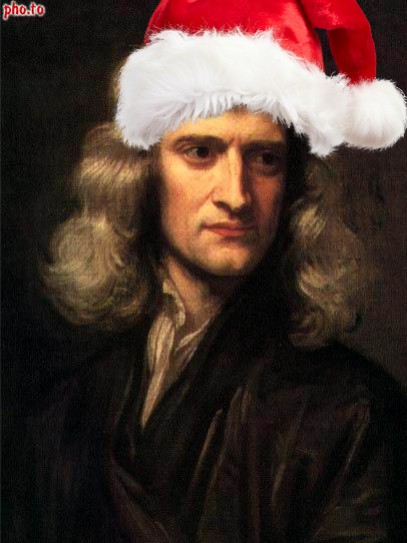
*Actually, Newton was born on 25 December 1642 on the Julian (‘Old Style’) calendar, which adjusts to 4 January 1643 on the Gregorian (‘New Style’) calendar.
