Newton’s ‘Phenomena’ continued…
Kirsten Walsh writes…
In my last post, I considered the phenomena in book 3 of Newton’s Principia. Newton’s decision to label these propositions ‘phenomena’ is puzzling, as they do not seem to fit any standard definition of the term. In this post, I’ll consider Bogen & Woodward’s (1988) distinction between data, phenomena and theories, and suggest that it sheds light both on Newton’s use of ‘phenomena’ and on the connection between his methodology in Opticks and Principia.
Bogen & Woodward (B&W) have argued for a 3-level picture of scientific theories in which:
- ‘Data’ are records produced by measurement and experiment that serve as evidence or features of phenomena. E.g. bubble chamber photographs, and patterns of discharge in electronic particle detectors.
- ‘Phenomena’ are features of the world that in principle could recur under different contexts or conditions. E.g. weak neutral currents, and the decay of a proton.
- ‘Theories’ are explanations of the phenomena.
B&W argue that theories explain phenomena, but not data. Data usually reflect many causal influences besides the explanatory target, while phenomena typically reflect single, or small, manageable numbers of causal influences. For example, General Relativity explains the phenomenon of bending light, but doesn’t explain the workings of the cameras, optical telescopes, etc. that causally influence the data.
Can we characterise Newton’s phenomena in terms of these three levels of theory? Let’s consider phenomenon 1:
- “The circumjovial planets, by radii drawn to the centre of Jupiter, describe areas proportional to the times, and their periodic times – the fixed stars being at rest – are as the 3/2 powers of their distances from that centre.”
In his discussion of this phenomenon Newton explained, “This is established from astronomical observations.” He provided the following table:
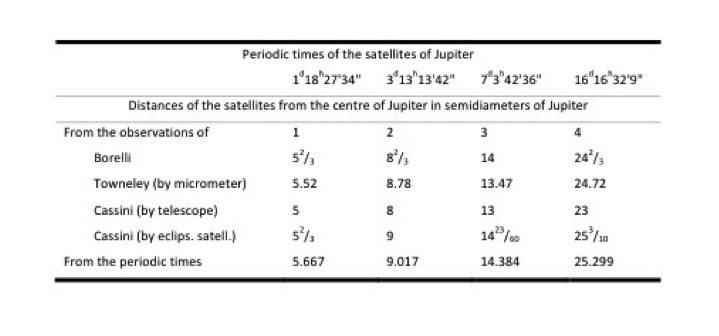 These observations are not data in the ‘pure’ sense that B&W discuss. Rather, they are generalisations: average distances and calculated periods of orbit. Moreover, the bottom row contains the average distances calculated from the period and the Harmonic rule (that the periods are as the 3/2 power of the semidiameters of their orbits). These calculations illustrate the ‘fit’ between the expected distance and the observed distance. Nevertheless, they provide a good example of how we might get from a set of data to a phenomenon. So perhaps we can think of them as ‘data’ in a methodological sense: they are records from which phenomenal patterns can be drawn.
I have another reason for considering these calculations ‘data’ in B&W’s sense of the term. In his discussion of phenomenon 1, Newton indicated that these calculations reflect a number of causal influences besides gravity. For instance, he explained that the length of the telescope affected the measurement of Jupiter’s diameter, because
- “the light of Jupiter is somewhat dilated by its nonuniform refrangibility, and this dilation has a smaller ratio to the diameter of Jupiter in longer and more perfect telescopes than in shorter and less perfect ones.”
This is a nice illustration of B&W’s notion of the shift from data to phenomena. By attending to his theory about telescopes, Newton was able to manipulate the data to control for distortion.
Now let’s consider the role of phenomenon 1 in Principia. Phenomenon 1 is employed (in conjunction with proposition 2 or 3, book 1, and corollary 6 to proposition 4, book 1) to support proposition 1, theorem 1, book 3:
- “The forces by which the circumjovial planets are continually drawn away from rectilinear motions and are maintained in their respective orbits are directed to the centre of Jupiter and are inversely as the squares of the distances of their places from that centre.”
This theorem doesn’t contain any information about the sizes or positions of the satellites of Jupiter, or about the workings of telescopes. So, while it explains the phenomenon, it gives no direct explanation of the data. This suggests that, in the Principia, data and phenomena are methodologically distinct.
B&W’s distinction between ‘data’ and ‘phenomena’ reveals two methodological features of Newton’s phenomena:
Firstly, Newton’s phenomena are explananda, but not appearances. Traditionally, ‘phenomenon’ seems to have been synonymous with both ‘appearance’ and ‘explanandum’. For example, the ancient Greeks were concerned to construct a system that explained and preserved the motions of the celestial bodies as they appeared to terrestrial observers. 2000 years later, Galileo and Cardinal Bellarmine argued over which system, heliocentric or geocentric, provided a better fit and explanation of these appearances. This suggests that, traditionally, there was no real difference between phenomena and data. For Newton, however, these come apart. The six phenomena of Principia describe the motions of celestial bodies, but not as they appear to terrestrial observers. In this sense, they are not appearances, but they do require an explanation.
Secondly, this reveals a continuity in Newton’s methodology. The point of Newton’s articulation of ‘phenomena’ in Principia is the same as his experiments in Opticks. Both identify and isolate a pattern or regularity. In the Opticks, Newton isolated his explanatory targets by making observations under controlled, experimental conditions. In Principia, Newton isolated his explanatory targets mathematically: from astronomical data, he calculated the motions of bodies with respect to a central focus. Viewed in this way, Newton’s phenomena and experiments are different ways of achieving the same thing: isolating explananda.
These considerations are admittedly speculative, so I’m keen to hear what our readers think. Does this look like a good way of characterising Newton’s phenomena?
Newton’s ‘Phenomena’
Kirsten Walsh writes…
On this blog, I have often argued that Newton’s Principia should be characterised as a work of experimental philosophy (for example, here, here and here). To support this argument, I have tended to emphasise similarities between Newton’s work in optics and mechanics. Recently, however, I have noted that some aspects of Newton’s methodology varied according to context. For example, in the Opticks, Newton employed ‘experiments’, but in the Principia, he employed ‘phenomena’. Given that experimental philosophy emphasises observation- and experiment-based knowledge, it is important for my project that I understand Newton’s use of phenomena, and its relationship to observation. In this post, I’ll discuss the phenomena in Principia, and in my next, I’ll discuss the relationship between phenomena and experiments in more detail.
Firstly, let’s consider the origin of the phenomena of Principia. In the first edition of Principia (1687), book 3 contained nine hypotheses. But in the second edition (1713), Newton re-structured book 3 so that it contained only two hypotheses. Five of the old hypotheses were re-labelled ‘phenomena’, and he added one more (phenomenon 2), to bring the total to six:
Phenomenon 1: The circumjovial planets, by radii drawn to the centre of Jupiter, describe areas proportional to the times, and their periodic times – the fixed stars being at rest – are as the 3/2 powers of their distances from that centre.
Phenomenon 2: The circumsaturnian planets, by radii drawn to the centre of Saturn, describe areas proportional to the times, and their periodic times – the fixed stars being at rest – are as the 3/2 powers of their distances from that centre.
Phenomenon 3: The orbits of the five primary planets – Mercury, Venus, Mars, Jupiter, and Saturn – encircle the sun.
Phenomenon 4: The periodic times of the five primary planets and of either the sun about the earth or the earth about the sun – the fixed stars being at rest – are as the 3/2 powers of their mean distances from the sun.
Phenomenon 5: The primary planets, by radii drawn to the earth, describe areas in no way proportional to the times but, by radii drawn to the sun, traverse areas proportional to the times.
Phenomenon 6: The moon, by a radius drawn to the centre of the earth, describes areas proportional to the times.
There are several things to notice about these phenomena. Firstly, they are distinct from data, in that they describe general patterns of motion, rather than measurements of the positions of planetary bodies at particular times. So, while the phenomena are detected and supported by astronomical observations, they are not observed or perceived directly.
Secondly, they are distinct from noumena (or the nature or essence of things), in that they are facts inferred from the observable, measurable properties of the world. They describe the motions, sizes and locations of bodies, but not the substance or causes of these properties of bodies.
Thirdly, they describe relative motions of bodies. That is, in each case, the orbit is described around a fixed point. For example, phenomenon 1 describes the motions of the satellites of Jupiter around Jupiter, which is taken as a stationary body for the purposes of this proposition. In phenomena 4 and 5, the motion of Jupiter is described around the sun, which is taken as stationary.
Fourthly, these phenomena do not prioritise the observer. Rather, each motion is described from the ideal standpoint of the centre of the relevant system: the satellites of Jupiter and Saturn are described from the standpoints of Jupiter and Saturn respectively, the primary planets are described from the standpoint of the sun, and the moon is described from the standpoint of the Earth. And because Newton doesn’t prioritise the observer, effects such the phases and retrograde motions of the planets are not phenomena but only evidence of phenomena.
The re-labelling of these propositions as ‘phenomena’ is somewhat puzzling. The term ‘phenomenon’ has a variety of uses, such as:*
- A particular (kind of) fact, occurrence, or change, which is perceived or observed, the cause or explanation of which is in question;
- An immediate object of sensation or perception (often as distinguished from a real thing or substance); or
- An exceptional or unaccountable thing, fact or occurrence.
But, as we’ve seen, Newton’s ‘phenomena’ don’t properly fit any of these definitions. Can any reader shed light on what Newton really meant by the term?
* Definitions (a) and (c) feature in both C18th and C21st dictionaries, but in the C21st, definition (b) has become more prominent, particularly in philosophy.
UPDATE: I have written a follow-up post.
René Réaumur and Charles Dufay on Experimental Natural Philosophy
A guest post by Michael Bycroft, a PhD Student at Cambridge.
Michael Bycroft writes…

René Réaumur
In a recent post Peter Anstey asked: “When did the French embrace experimental philosophy?” In this post I want to do two things. One is to draw attention to two Frenchmen who practised experimental natural philosophy (ENP) well before Jean-Antoine Nollet began teaching this method in the mid-late 1730s. These men were René Réaumur and Charles Dufay. My other task is to try to explain why these men, who did so much to practice ENP, did so little to explicitly define or defend their practice.
René Réaumur (1683-1757) was arguably the most active and influential member of the Académie des Sciences in the first half of the eighteenth century. Nowadays he is known for his research on insects, steel-making, and thermometry, but his interests were truly encyclopaedic. Charles Dufay (1698-1739) is known to historians of physics as a student of electricity, but his research interests were nearly as broad as those of Réaumur, his patron and collaborator.
There is no doubt that these two men practiced ENP. It is true that they were Cartesians, in the sense that their chief theoretical resources were vortices and subtle fluids. But they wore their theory lightly, and they saw themselves primarily as experimenters rather than as system-builders. This pair was at least as committed to ENP, and in some cases more so, than their French colleague Nollet or their English counterparts Francis Hauksbee the Elder and John Desaguliers.
Yet it is hard to find clear, succinct, accessible endorsements of the key tenets of ENP in the writings of Dufay and Réaumur. Such endorsements do exist, but they are invariably buried in the middle of one or other of the many papers they published in the Académie’s journal, the Mémoires de l’Académie Royale des Sciences. Here is an example from one of Réaumur’s first papers, on the growth of shells, published in the 1709 volume of the Mémoires:
- But conjectures such as these [ie. the ones Réaumur had just advanced in the first part his paper] are not enough in true natural philosophy. Experiments performed on the matters at hand are the only sound basis for our reasoning…It is to experiments that I shall turn to decide whether I have correctly described the manner in which nature behaves, or whether [instead] everything I have said is merely a trick of the imagination.
- Mais de pareilles conjectures ne suffisent point en bonne Physique. Les seules expériences faites sur les choses dont il est question, y doivent servir de bases à nos raisonnemens. … C’est aux experiences que je vais rapporter à faire voir, si j’ai véritablement décrit la maniere dont la Nature agit, ou si l’on doit regarder tout ce qu’on vient d’avancer comme un simple jeu d’imagination.
Charles Dufay
This statement is clearly in the spirit of ENP, and similar statements can be found elsewhere in Réaumur’s papers, and in Dufay’s. But they are fleeting asides rather than stand-alone manifestos. Why were these men so reticent?
An important part of the answer is that the stand-alone manifestos of Nollet, Hauksbee and Desaguliers appear in the prefaces of their natural philosophy textbooks, and Dufay and Réaumur did not write textbooks. They did not need to. They were independently wealthy, drew sizeable pensions from the Academy, and were well-rewarded by the state for their research on French industries such as steel and textiles.
Perhaps it is also relevant that Bernard le Bovier de Fontenelle, the Perpetual Secretary of the Academy, did much to define and defend the Academy’s activities on behalf of its members.
Another factor may be that Dufay and Réaumur were more concerned to defend the application of natural philosophy to industry (against skeptical artisans and ministers) than they were to defend the application of experiment to natural philosophy (against speculative philosophers). At any rate, the former concern dominated the preface to Réaumur’s first book, L’art de convertir le fer en acier (1722).
Finally, as we have seen, Dufay and Réaumur dispensed methodological advice in the course of the papers they published in the Academy. Perhaps they considered this the best forum for expressing their views on ENP, even though this choice makes their views harder for the historian to identify than if they had written textbooks or dictionary entries instead.
This is not to say that Dufay and Réaumur had no connections with earlier and later textbook writers on ENP in France. On the contrary. They both learned much of their physics from Jacques Rohault’s Traité de physique, and in their turn they taught Nollet much of what he knew about experimentation (Nollet assisted both Dufay and Réaumur in their laboratories in the early 1730s). These connections reinforce the broader lesson of this post, which is that the leading practitioners of ENP were not always its most explicit promoters.
Defining Early Modern Experimental Philosophy (2)
Alberto Vanzo writes…
In my last post, I raised the question as to whether there is any methodological view that was shared by all or most early modern experimental philosophers. To paraphrase Bas Van Fraassen, is there any statement E+ such that
- To endorse the method of (early modern) experimental philosophy = to believe that E+ (the experimentalists’ methodical dogma)?
As those of you who have followed this blog for a while will know, early modern experimental natural philosophers claimed that we should reject hypotheses and speculations (that is, roughly, natural-philosophical claims and theories) and rely instead on experiments and observations. In this post, I will discuss whether this claim, suitably understood, is the experimentalists’ methodical dogma. What does their rejection of hypotheses amount to?
The statement that we should reject hypotheses does not mean that we should avoid learning natural-philosophical claims and theories. On the contrary, according to Robert Hooke, learning hypotheses is beneficial because it helps us to devise new explanations and raise questions:
- the Mind will be somewhat more ready at guessing at the Solution of many Phenomena almost at first Sight, and thereby be much more prompt at making Queries, and at tracing the Subtilty of Nature, and in discovering and searching into the true Reason of things […]
Experimental philosophers also allow us to entertain claims and theories for the sake of testing them. Robert Boyle states in a letter to Oldenburg that natural histories should include “Circumstances” such that their “tryal or Observation” is “necessary or sufficient to prove or to invalidate this or that particular Hypothesis or Conjecture”.
Boyle’s statement makes clear that he allows for the acceptance of a natural-philosophical claims that are proven by “tryal [experiment] or Observation”. The claims in question must be those that are expressed by substantive or – in Kantian terms – synthetic a posteriori statements. Experiments and observations cannot prove analytic a priori statements. These are hardly the kind of statements that concerned experimental philosophers. Assuming that the analytic/synthetic distinction is tenable, accepting analytic a priori statements as true seems to be a harmless move anyway.
In the light of this, we may be tempted to paraphrase the rejection of hypotheses as follows:
- [A] Only commit to those substantive (as opposed to analytic) claims and theories that are warranted by experiments or observations.
[A] is in line with experimental philosophers’ rejection of arguments from authority, epitomized by the motto of the Royal Society: “nullius in verba“, which can be loosely translated as “take no man’s word for it”. [A] entails the rejection not only of arguments from authority, but also any kind of a priori arguments for substantive natural-philosophical claims – for instance, the arguments that Descartes used in the Principles of Philosophy to establish that material objects are made up of corpuscles. [A] has the welcome effect of classifying Descartes where, in my view, he belongs: outside of the movement of experimental philosophy, even though he too gathered natural-philosophical observations and performed some experiments.
However, [A] is inconsistent with the fact that many experimental philosophers were committed to substantive claims, like the corpuscularian and mechanist hypotheses, that were hardly warranted by the then extant empirical evidence. Boyle or Montanari did not seem to be concerned to provide detailed empirical arguments for corpuscularism or mechanism. However, they did not regard their acceptance of these views as being inconsistent with their commitment to experimentalism.
In view of this, I suggest replacing [A] with [B]:
- [B] Only firmly commit to those substantive claims and theories that are warranted by experiments and observations
and claiming that experimental philosophers like Boyle and Montanari did not firmly commit to corpuscularism and mechanism. They only weakly, tentatively, provisionally commit to these views, even though they were confident that future discoveries would dispel any doubt on their truth.
Is it correct to say that experimental philosophers’ commitments to mechanism and corpuscularism was typically weak, provisional, tentative? Are there other claims on the natural world that experimental philosophers firmly endorsed, even though the then available empirical evidence did not warrant them? Can a clear distinction between weak, provisional, tentative and strong, definitive, firm commitments be drawn, and if so, how? If you have any suggestions on how these questions should be answered, please let me know in the comments or get in touch. Answering these questions is important to establish if my suggestion that [B] represents a suitable candidate for the experimentalists’ methodical dogma is persuasive.
Samuel Clarke on arguing a priori
Juan Gomez writes…
In my two previous posts I explored Butler’s preferred methodology in the Analogy and the Sermons. We first looked at bishop Halifax’s description of Butler’s work and then we reviewed the latter’s own methodological statements. Both Butler and Halifax describe two methods used in arguing for the existence and attributes of God: a posteriori and a priori. They identify the latter of these methods with the work of Samuel Clarke. Since we have already discussed at some length Butler’s methodology, I want to spend this post analysing the comments Clarke (one of the leading Newtonians of the first decades of the eighteenth century) makes regarding his use of the a priori method.
Clarke was sympathetic to the experimental method as practised by Newton and he was especially interested in the application of mathematics to metaphysics, which is the project carried out in his Boyle lectures, A Demonstration of the being and attributes of God (1704) and A discourse concerning the unchangeable obligations of natural religion (1705). In the text of the lectures themselves there is not much regarding methodology, other than Clarke stating that his method is “as near to Mathematical as the nature of such a Discourse would allow.” However, subsequent editions of the discourse included Clarke’s replies to objections where in his answers to the sixth and seventh letters he explains in more detail his use of the a priori method. In the former he briefly explains why he prefers it by contrasting it with the a posteriori method:
- The Proof a posteriori is level to All Mens Capacities: Because there is an endless gradation of wise and useful phænomena of Nature, from the most obvious to the most abstruse; which afford (at least moral and reasonable) Proof of the Being of God, to the several Capacities of All unprejudiced Men… The Proof a priori, is (I fully believe) strictly demonstrative; but (like numberless Mathematical Demonstrations,) capable of being understood by only a few attentive Minds; because ’tis of Use, only against Learned and Metaphysical Difficulties…
So on one hand the a posteriori proof is accessible to more people, but it provides only reasonable (not demonstrable) proof; on the other, the a priori way of arguing provides demonstrative proof, but it is only reserved for a few minds engaged in metaphysical disputations. Clarke prefers the a priori method in this case (i.e. in natural theology) because it can provide him with demonstrative proof of the attributes of God. However, this method is not meant to be in direct opposition to the a posteriori method, but rather complement it. This is what Clarke mentions in his preface to the Discourse:
- The Honourable Robert Boyle, Esq; was a Person no less zealously solicitous for the propagation of true Religion, and the practice of Piety and Virtue; than diligent and successful in improving Experimental Philosophy, and in inlarging our Knowledge of Nature. And it was his settled Opinion, that the advancement and increase of Natural Knowledge, would always be of Service to the Cause and Interest of true Religion, in opposition to Atheists and Unbelievers of all sorts… In pursuance of which End I endeavoured, in my former Discourse [the Demonstration], to strengthen and confirm the Arguments which prove to us the Being and Attributes of God, partly by metaphysical Reasoning, and partly from the Discoveries (principally those that have been late made) in Natural Philosophy.
Clarke believes that both ways of arguing complement each other and both prove the attributes of God. In his Answer to the Seventh Letter Clarke justifies in more detail his use of the a priori method. Clarke believes that an a priori argument is necessary to carry further what the a posteriori argument proves. He recognizes that the latter “ought always to be distinctly insisted upon,” but the a priori argument is useful to answer objections against the attributes of God at a metaphysical level. Further, Clarke explains that the a posteriori argument by itself cannot prove the eternity, infinity and unity of God:
- The Temporary phænomena of nature, prove indeed demonstrably a posteriori, that there is, and has been from the beginning of those phænomena, a Being of Power and Wisdom sufficient to produce and preserve those phænomena. But that This First Cause has existed from Eternity, and shall exist to Eternity, cannot be proved from those Temporary phænomena; but must be demonstrated from the intrinsick Nature of Necessary-Existence.
In a similar vein, Clarke comments that from the observation of the phænomena of nature we can only prove that there is a Being with sufficient power and wisdom, but not that such being is absolutely infinite and universal. What I want to point out here is that the two methods in consideration should be interpreted as complementary and not as opposed to each other. However, Clarke’s a priori arguments regarding the attributes of God were widely criticized, even from those who shared his Newtonianism and admired the mathematical method that Newton successfully applied in his natural philosophy. One of these critics is Joseph Butler, and in my next post I will examine the discussion between this two figures regarding the attribute of infinity.
Experimental philosophy in France
Peter Anstey writes…
When did the French embrace experimental philosophy? There is no doubt that the early Académie des Sciences was committed to the use of experimental methods in natural philosophy from its inception in 1666. But there is little evidence of French natural philosophers self-identifying as experimental philosophers, of the teaching of experimental philosophy or of institutional recognition of experimental philosophy before the 1730s.
In 1735 Abbé Nollet offered the first course in experimental philosophy in France and two years later he published Programme ou idée générale d’un cours de physique expérimentale which was strongly influenced by John Theophilus Desaguliers whom he had met in England around 1734. By the late 1730s, however, it is not hard to find explicit endorsements of experimental philosophy and the deployment of the experimental/speculative distinction. The reviewer of Abbé Pluche’s Spectacle de la Nature in 1739 claims that Pluche rightly prefers experimental natural philosophy to speculative (Physique spéculative à laquelle il préfére avec raison la Physique) and that experimental philosophy is ‘so à la mode today’ (qui est aujourd’hui si à la mode).
By the early 1750s experimental philosophy is part and parcel of French natural philosophy. We have discussed this before on this blog in relation to Denis Diderot, but the following nice, clear, anonymous dictionary entry reinforces the point. In the Dictionnaire philosophique ou Introduction à la connoisance de l’homme, London (?), 1751 we find the following entry under ‘Physique’:
Natural philosophy is the knowledge of causes and effects of nature. It is experimental or conjectural. Experimental natural philosophy is certain knowledge; conjectural natural philosophy is often only ingenious. The one leads us to the truth, the other leads to error.
La Physique est la connoissance des causes & des effets de la nature: elle est expérimentale, or conjecturale. La Physique expérimentale est une connoissance certaine; la Physique conjecturale n’est souvent qu’ingénieuse: l’une nous conduit à la vérité, & l’autre nous mene à l’erreur.
The parallels with our oft-cited passage from John Dunton’s student manual in 1692 are striking:
Philosophy may be consider’d under these two Heads, Natural and Moral: The first of which, by Reason of the strange Alterations that have been made in it; may be again Subdivided into Speculative and Experimental.
… we must consider, the distinction we have made of Speculative and Experimental, and, as much as possible, Exclude the first, for an indefatigable and laborious Search into Natural Experiments, they being only the Certain, Sure Method to gather a true Body of Philosophy, for the Antient Way of clapping up an entire building of Sciences, upon pure Contemplation, may make indeed an Admirable Fabrick, but the Materials are such as can promise no lasting one.
(The Young-Students-Library, London, 1692, vi–vii)
And yet the two passages are six decades apart. Why did it take so long for the French to take up experimental philosophy? Why is it, for example, that the first chair in experimental philosophy in England was the Cambridge Plumian Chair in Experimental Philosophy and Astronomy founded in 1708 and first held by Roger Cotes, whereas the first chair of experimental philosophy in France was held by Abbé Nollet who was appointed as Professeur Royal de Physique Expérimentale au College de Navarre in 1753?
Any light that our readers can shed on these questions would be most welcome.
Borrowed Terms and Innovative Concepts in Newton’s Natural Philosophy
Kirsten Walsh writes…
In my last two posts, I have discussed my alterations to the 20 theses of our project. In this post, I’ll continue to discuss thesis 8.
In 2011, I claimed that:
- 8. The development of Newton’s method from 1672 to 1687 appears to display a shift in emphasis from experiment to mathematics.
But at the start of this year, I replaced this thesis with a new thesis 8:
- 8. In his early work, Newton’s use of the terms ‘hypothesis’ and ‘query’ are Baconian. However, as Newton’s distinctive methodology develops, these terms take on different meanings.
In my last post, I told you that I decided to remove my original thesis 8 because the methodological differences between Newton’s early papers and Principia aren’t as great as I initially thought. This isn’t to say that I now think that the methodology of the 1672 paper is precisely the same as the methodology displayed in Principia. Rather, I don’t think my original thesis 8 captures what is important about these differences.
In today’s post, I’ll tell you about my new thesis 8.
On this blog, we have argued that the early members of the Royal Society adopted the new experimental philosophy in a Baconian form. Newton initially encountered the experimental philosophy in the early- to mid-1660s through his reading of Boyle, Hooke and the Philosophical Transactions. While he never adopted the Baconian method of natural history, other features of his early methodology resemble the Baconian approach. For example, in Newton’s 1672 paper and the debate that followed, his use of experiment and queries, and his anti-hypothetical stance, were recognised and accepted by the Baconian experimental philosophers. Moreover, his 1675 paper, in which he explored his hypothesis of the nature of light, was recognised by his contemporaries as an acceptable use of a hypothesis.
In Newton’s later work, however, hypotheses and queries look quite different.
Firstly, consider Newton’s Opticks. When the Opticks was published in 1704, it contained no hypotheses, and the introduction explicitly stated that:
- “My Design in this Book is not to explain the Properties of Light by Hypotheses, but to propose and prove them by Reason and Experiments.”
Book III ended with a series of queries, which provided directions for further research, in the style of Baconian queries. E.g.:
- “Query 2. Do not the Rays which differ in Refrangibility differ also in Flexibility…?”
However, in the 1706 and 1718 editions, Newton introduced new queries, which explore the nature of light. E.g.:
- “Qu. 29. Are not the Rays of Light very small Bodies emitted from shining Substances?”
Like the earlier queries, these ones set out a new research program. But they are much more speculative than was acceptable according to the Baconian method.
Now consider Newton’s Principia. There are hypotheses in every edition of Principia, but they look nothing like Newton’s 1675 hypothesis. In particular, they do not explore the nature of things. For example:
- “Hypothesis 1. The centre of the system of the world is at rest.”
I have argued that the hypotheses in Principia provide a specific supportive role to theories. These propositions are temporarily assumed in order to draw out the observational consequences of Newton’s theory of gravitation. They are simplifying assumptions; not assumptions about the nature of gravity.
Previously, I have argued that Newton’s methodology should be seen as a three-way epistemic distinction between theories, hypotheses and queries. I call this an ‘epistemic triad’. I claim that Newton took these, already familiar, terms and massaged them to fit his own three-way epistemic distinction. It is important to recognise, therefore, that the triad is a three-way epistemic division, rather than the juxtaposition of three terms of reference. The terms ‘theory’, ‘hypothesis’ and ‘query’ are simply labels for these epistemic categories.
In fact, this is a feature of many of Newton’s innovative concepts. He borrowed familiar terms and massaged them to fit his own needs. I have shown that he did this with his key methodological terms: ‘theory’, ‘hypothesis’ and ‘query’. Steffen Ducheyne has argued that Newton did this in other aspects of his methodology, such as his dual-methods of analysis and synthesis. This suggests that Newton’s labeling and naming of things was very much post hoc. It seems that, when discussing Newton’s methodology, we should emphasize divisions and functions over definitions.
Defining early modern experimental philosophy (1)
Alberto Vanzo writes…
At the recent Bucharest conference on experiments in early modern philosophy, Mordechai Feingold warned against the attempt to characterize experimental philosophy in atemporal terms. The risk is losing sight of the different ways in which experimental philosophy was practised and understood in the course of time and ending up with a characterization which only applies to some experimental philosophers, or is too general to be helpful. To borrow an expression from Bas Van Fraassen’s book The Empirical Stance, Feingold (as I understood him) warned us not to claim that
- To be an (early modern) experimental philosopher = to believe that E+ (the experimentalist’s dogma).
I agree that being an early modern experimental philosopher did not simply amount to endorsing a certain philosophical claim. I tend to think of early modern experimental philosophy as a movement. We can identify the members of this movement based on at least three features which do not involve the commitment to specific philosophical claims:
1. Self-descriptions: experimental philosophers typically called themselves such. At the very least, they professed their sympathy towards experimental philosophy.
2. Friends and foes: experimental philosophers saw themselves as part of a tradition whose patriarch was Bacon, whose prominent members included Boyle, Locke, later Newton and Hume, and whose opponents were Aristotle and the Scholastics, later Descartes, even later (at least in some quarters) Leibniz.
3. Rhetoric: like the members of many movements, experimental philosophers endorsed a distinctive rhetoric. They praised experiments and observations and they criticized hypotheses and speculations (or certain uses and forms thereof). They called them fictions, romances, or castles in the air.
By conceiving of early modern experimental philosophy as a movement, we can accommodate Feingold’s invitation to take its evolution into account. The identity of movements can evolve in the course of time. This happened to experimental philosophy too. It broadened its scope from the study of nature and medicine to ethics and aesthetics (Hume, for instance, advocated the “application of experimental philosophy to moral subjects”). Its list of friends and foes were progressively extended. Its seventeenth-century members regarded the construction of Baconian natural histories as being central to the success of experimental philosophers. Its eighteenth-century exponents no longer took this to be an important or even useful endeavour.
However, experimental philosophers were also, crucially, committed to a certain method. This is why they placed so much emphasis on experiments and observations, while attacking hypotheses and speculations. They believed that the key to success in the study of the natural world (and, later, of ethics and aesthetics) was the endorsement of a method that involved reliance on experiments and observation and rejection of (certain forms of) hypotheses and speculations.
Of course, I am happy to grant that there were differences among the methods adopted by experimental philosophers. Newton’s method differed in several respects from those of Boyle and other experimental philosophers. However, it would be interesting if we could identify a specific methodological view that was shared by all or most experimental philosophers. To paraphrase Van Fraassen once again, it would interesting if we could state that
- To endorse the method of (early modern) experimental philosophy = to believe that E+ (the experimentalists’ methodical dogma).
But how should we define “E+”? Is there a single statement that we can identify “E+” with and that applies to all or most experimental philosophers? If so, then there still is an “atemporal” component of the commitment to experimental philosophy (in the early modern sense). Otherwise, we might be better off claiming, to quote again Van Fraassen, that the method of experimental philosophy is best seen as a “a stance (attitude, commitment, approach, a cluster of such […])” that, albeit related to belief in propositions like E+ (whatever that may be), will involve “a good deal more, will not be identifiable through the beliefs involved, and can persist through changes of belief”.
What should we identify E+, the the experimentalists’ methodical dogma, with? I will address this question in my next post. In the meanwhile, I would love to hear your thoughts and suggestions. Please leave a comment or send me an email.
Probable knowledge in Butler’s Analogy
Juan Gomez writes…
In my previous post I presented Bishop Halifax’s preface to Joseph Butler’s Analogy of Religion, Natural and Revealed. I focused on the discussion regarding the method applied by Butler both in the Analogy and in his Sermons which is described as an a posteriori method that deduces all knowledge from facts and observations. In this post I examine Butler’s own description of his method in the Analogy where he justifies the usefulness of probable knowledge.
Butler spends the entire introduction to the Analogy explaining and justifying his methodology. He begins by distinguishing probable from demonstrative evidence: the former “admits of degrees; and of all variety of them, from the highest moral certainty, to the very lowest presumption.” Probable knowledge arises from our observation of facts and generates conclusions that though imperfect and not certain are suitable for imperfect beings like us; “probability is the very guide of life.” As an example of the way probable knowledge is a matter of degree he refers to an example Locke gives in the Essay (IV. xv. 5): while someone from a warm climate will not believe that water can become hard, arguing by analogy from his previous observations of water always being liquid, an Englishman will, also from analogy: (a) suppose that there may be frost in England any given day next January, (b) find it probable that there will be frost at least one day of that month, and (c) have moral certainty that there will be frost some day during winter.
The last and higher degree of probable knowledge is the one Butler tries to obtain in the Analogy. He insists that even though it provides imperfect knowledge, when it comes to human actions it is the best guide we have. For example, if there are two ways for me to get home, one of which there are rumours that it is unsafe, the other is known for its safety, it would be foolish of me to take the unsafe road even though the probability of being harmed was low. After this confirmation of the usefulness of probable knowledge Butler further specifies that this is the way arguing by analogy works: we argue from known facts to the unknown; from what reason shows to what we may know through revelation:
- …if there be an analogy or likeness between that system of things and dispensation of Providence, which revelation informs us of, and that system of things and dispensation of Providence, which experience together with reason informs us of, i.e. the known course of nature; this is a presumption, that they have both the same author and cause; at least so far as to answer objections against the former’s being from God, drawn from any thing which is analogical or similar to what is in the latter, which is acknowledged to be from him; for an Author of nature is here supposed.
This is a nice summary of Butler’s purpose in the Analogy: he wants to show that natural and revealed religion coincide, and that arguing by analogy we can confirm the wisdom and perfection of God through both. Further, he believes that this method is just because it is based on facts and observation and not on hypotheses. Butler contrasts his method with the one followed by Descartes:
- Forming our notions of the world upon reasoning without foundation for the principles which we assume, whether from the attributes of God, or any thing else, is building a world upon hypothesis, like Descartes. Forming our notions upon principles which are certain, but applied to cases to which we have no ground to apply them, (like those who explain the structure of the human body, and the nature of diseases and medicine from mere mathematics without sufficient data,) is an error much akin to the former: since what is assumed in order to make the reasoning applicable, is hypothesis. But it must be allowed just, to join abstract reasoning with the observation of facts, and argue from such facts as are known, to others that are like them; from that part of the divine government over intelligent creatures which comes under our view, to the larger and more general government over them which is beyond it; and from what is present, to collect what is likely, credible, or not incredible, will be hereafter.
Notice that Butler is not trying to claim that his method will provide certainty, but rather that his conclusions will be more credible than those derived from mere hypotheses. One of the central issues in the Analogy is the nature and existence of a future state. Butler argues that from what we know of our present stage in life through the observation of nature it is not unlikely that there is a future state. This is an interesting feature of the application of the experimental method in religion. Facts and observations are still the only sources for acquiring knowledge, but instead of the certainty they provide in natural philosophy they give us, at best, highly probable knowledge about the government of God and the future life. Butler’s discussion in this introduction is of special interest for us since he explicitly rejects the use of hypotheses and mere speculation:
- As there are some, who, instead of thus attending to what is in fact the constitution of nature, form their notions of God’s government upon hypothesis: so there are others, who indulge themselves in vain and idle speculations, how the world might possibly have been framed otherwise than it is… Let us then, instead of that idle and not very innocent employment of forming imaginary models of a world, and schemes of governing it, turn our thoughts to what we experience to be the conduct of nature with respect to intelligent creatures; which may be resolved into general laws or rules of administration, in the same way as many of the laws of nature respecting inanimate matter may be collected from experiments.
We can see then that the rejection of hypotheses and mere speculation was also present in discussions about religion, even when those who sided with the experimental method like Butler and Turnbull admit that all we can conclude about the future state is, at best, highly probable and hence imperfect knowledge. This was not a problem from them, since they were still arguing from things we know, and since it is suitable to the nature of human beings that we only acquire probable knowledge of the future, more perfect state. However, this was not the only way figures sympathetic to the experimental method argued about the government of God. As we mentioned in the previous post Butler’s a posteriori method is contrasted with Samuel Clarke’s a priori method, but I leave this discussion for my next post.
Teaching Experimental Philosophy IV: the case of John Keill
Peter Anstey writes …
In my last post we met the instrument maker and promoter of experimental philosophy Francis Hauksbee the Elder. Hauksbee, however, wasn’t the first lecturer to give public lectures in England on the exciting new developments in natural philosophy. That honour rests with a Scotsman called John Keill.
John Keill (1671–1721) came under the tutelage of the first Newtonian David Gregory in Edinburgh. He followed Gregory to Oxford in 1691 and by 1699 was giving lectures. Around 1704/95, according to his student John Theophilus Desaguliers, Keill became ‘the fi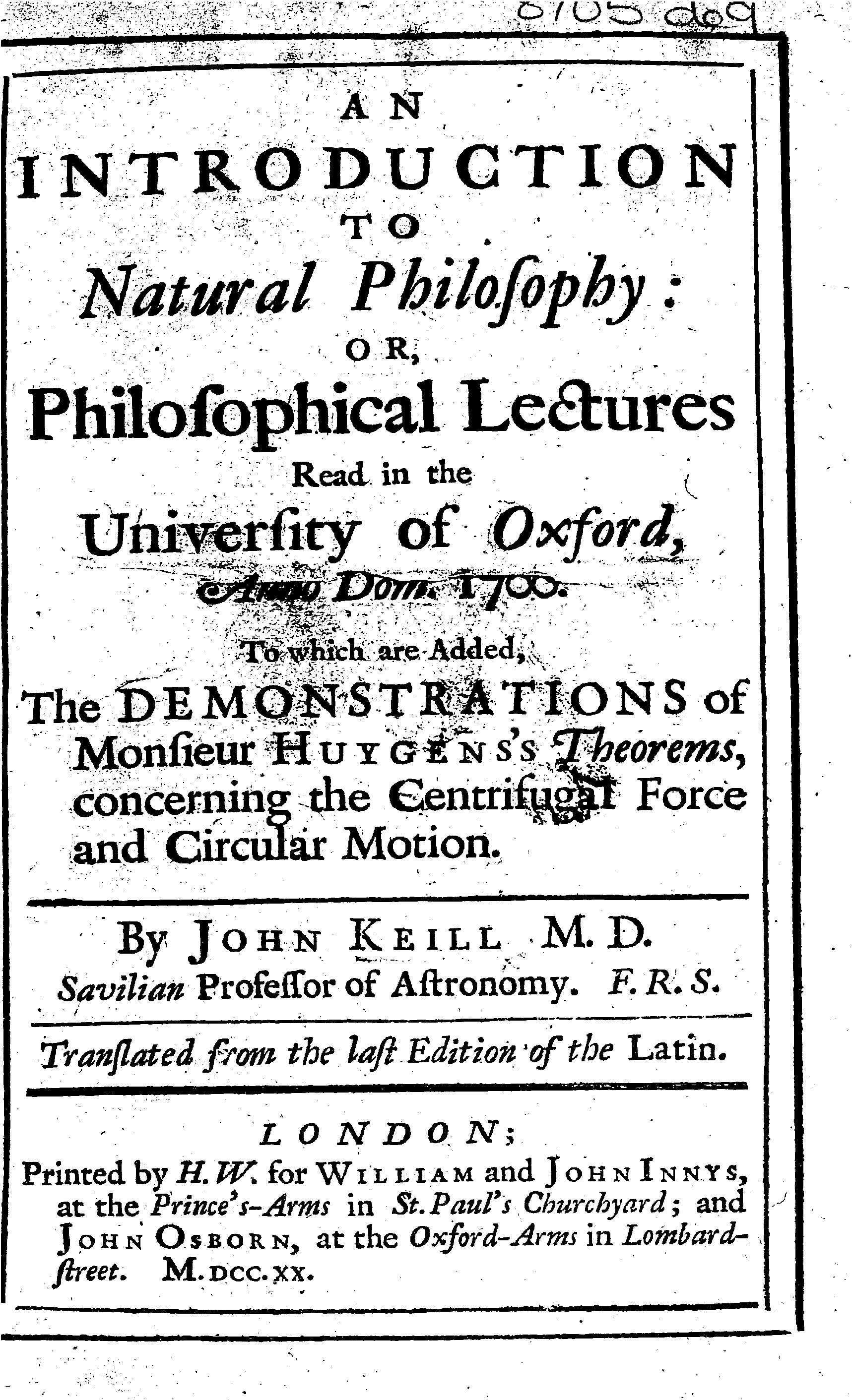 rst who publickly taught Natural Philosophy by Experiments in a mathematical Manner’ (A Course of Experimental Philosophy, Volume 1, 1734, Preface). His lectures were published in Latin in 1702 and in English translation in 1720 under the title of An Introduction to Natural Philosophy: or, Philosophical Lectures read in the University of Oxford Anno Dom. 1700.
It is not clear, however, that Keill saw himself as teaching experimental philosophy. Some scholars have claimed that Keill was appointed as a lecturer in experimental philosophy at Oxford in 1704 and that he was the first to teach experimental philosophy there. Indeed, in 1707 The Oxford Intelligencer advertised his ‘Course of Mechanical and Experimental Philosophy’. Moreover, in the preface to his Introduction to Natural Philosophy he does express his opposition to speculative natural philosophy, particularly Cartesianism, singling out the Cartesian theory of gravity for particularly harsh treatment (pp. iv–vii).
Hence, one might naturally assume that he is a straightforward advocate of experimental philosophy, and yet this is not the case. For, in the first lecture Keill proceeds to distinguish four ‘Sects of Philosophers’: the Pythagoreans and Platonists; the Peripatetics; those who ‘proceed upon Experiments; and the Mechanical’ (pp. 1–3). He then informs the reader that ‘Amongst these various ways of Philosophizing, there is no particular one, wherein we do intirely acquiesce’ (p. 3). In fact, Keill saw himself as pursuing, not the new experimental philosophy, but what he calls ‘Mathematical Philosophy’ inspired by Newton and characterized by ‘applying Geometry to Natural Philosophy’.
As for experimental philosophy, Keill warns that:
- many of the Experiments that the third Sect of Philosophers [experimental philosophers] have delivered down to us, must be made use of: tho this ought not to be done without great Caution; for we are well apprised how fond these Gentlemen are of their Theories, how willing they are that they should be true, and how easily they deceive both others and themselves, in trying their Experiments (p. 7).
It is clear from this passage that Keill’s conception of what constitutes an experimental philosopher differs from that of Boyle and others, for Keill finds them too fond of their theories, whereas what characterises the experimental philosophers throughout the latter decades of the seventeenth century is their extreme caution in making any theoretical commitments until the observational and experimental data is assembled. Keill’s experimental philosopher would be foreign to most who aligned themselves with the movement.
The method that Keill follows instead is that of ‘The great Philosopher of this age, the most Ingenious and Incomparable Mr. Newton’ who ‘by his great and deep skill in Geometry’ was able to show the inconsistencies of Descartes’ vortex theory. Keill’s opponents in natural philosophy were not the speculative philosophers but ‘our ungeometrical Philosophers’ (p. 24). Thus Keill is representative of the first generation of those, like John Arbuthnot and John Harris who, inspired by Newton, adopted a straightforwardly mathematical approach to natural philosophy. Surprisingly, Keill’s reservations about experimental philosophy were completely ignored by the likes of Hauksbee the Elder and Desaguliers who preferred to see their efforts in promoting experimental philosophy as following Keill’s example and, in Desaguliers’ case, even recycling some of his lectures.
