

A Different Light : First Photographs of Aotearoa – closing 7 Feb 2026
Hocken Collections Māori Archivist Rauhina Kohuwai-Banks (RKB) sat down with Curator of Photography, Anna Petersen (AP), to kōrero about A Different Light: First Photographs of Aotearoa, an exhibition showcasing the history of photography in Aotearoa, now in its last week at the Hocken Gallery.
RKB Tēnā koe Anna, thank you for sitting down to talk with me about A Different Light: First Photographs of Aotearoa, an exhibition which you co-curated alongside Shaun Higgins (from Tāmaki Paenga Hira) and Natalie Marshall (from the Alexander Turnbull Library).
You also contributed to an illustrated publication of the same name, edited by Catherine Hammond and Shaun Higgins.
How did you get involved in co-curating the exhibition and what was the hope for this collaboration?
AP Well it fell naturally, because I’m Curator of Photographs at the Hocken, and the show was curated by the photography curators at the three participating institutions.
I think the hope, the initial hope for the collaboration – because it did evolve from a memorandum of understanding between the University of Otago and the Auckland Museum – kind of changed a bit.
It was first envisaged that the exhibition would accompany a conference held by the Centre for Research on Colonial Culture, and a corresponding production of a book edited by University of Otago academics – but then the conference didn’t eventuate. Although Angela Wanhalla was invited to write the introduction, in the end, the main body of the book was the work of library and museum staff.
… It was determined that it would be a show of early New Zealand photography, and it both set out to demonstrate the evolution – the technological evolution of photography from 1850 to 1900 – at the same time, exploring how photography became embedded in the whole cultural, social, political, economic development of the colony.
RKB It’s very wide-reaching, and the exhibition has toured Auckland, Wellington, and finally Ōtepoti Dunedin, and each iteration of the exhibition has had its own distinct flavour – for example, you decided to showcase some original photographs held by the Hocken in the Dunedin iteration. What did you pick, and why?
AP It was partly the differences in the gallery spaces allocated for the show, and design decisions that gave that different ‘flavour’ in the two other venues. They didn’t add any more early original photographs like we did, but because our space is larger – and I also actually wanted to highlight more the particular aesthetic of early photography, which I felt had been somewhat overridden by a museological insistence on a storyline.
With the consent of the other two curators, I added a whole wall of early photographs of Dunedin for our local audience. Then I also augmented each of the five sections with some more photographs that just complemented what was already chosen. So I didn’t feel that I actually changed the whole nature of the show, but it does have a bit more of a look that I would have liked it to have had all along (laughs)…
RKB I’m sure locals from Ōtepoti appreciate what you augmented the show with!
Taking a bit of a turn… this week we will be commemorating 186 years since the signing of Te Tiriti o Waitangi by northern rangatira in 1840, and A Different Light doesn’t shy away from the fact that the development of photography coincided with the ‘time of turbulent social change’ that was the colonisation of Aotearoa New Zealand.
I wonder if you would like to share any insights you’ve had, in co-curating this exhibition, on the connections between photography and how mana whenua and early Pākehā settlers viewed themselves and each other during this period?
AP From the start, we had three very large collections of photographs to draw on, but… we could only do our best with those. So, for example, we couldn’t show the earliest known photograph in New Zealand. And by the same token, we knew, for example, that Māori increasingly were hanging photographs of their tīpuna in wharenui, but we didn’t have any original examples of interiors of wharenui that showed that, so that’s a limitation.
Examples of how early Pākehā were relating to Māori … one area in the exhibition is showing how some early Pākehā photographers took advantage of Māori sitters for commercial gain, and to satisfy the worldwide appetite for photographs of people of different ethnicities.
And this was very often done without – well, we don’t actually know, but we presume that the sitters probably didn’t know quite what was going to be done with the photographs. But also that the photographers didn’t note their names.
Having said that, we do have also examples where the names were noted on the back, or in the albums. And these have proven to be incredibly precious, and continue to be so, for Māori now, to discover. The Eccles album, which is included in the show, has proven to be a particularly important example of that.
And then we also have another aspect of Māori agency in the show, including two portraits of King Tāwhiao, who embraced photography in order to promote his presence.
There are also photographs of Māori who had been displaced in the Wellington region.
So we have tried to bring some of those issues out.
RKB Kia ora, thank you for sharing that… So, though the exhibition is closing this Saturday, the legacy lives on in the accompanying publication of the same name. Your chapter, ‘The Give and Take of Photographs’, takes a look at early photographs of Dunedin and Otago. Can you tell me more about early photographers and photographs in this area? Do you have any favourite examples?
AP Sure, well the development of Dunedin in the 1860s, 70s and 80s seem to have been particularly well documented by national standards, and even international standards. And that’s partly because of the discovery of gold – so the money that was generated, and the influx of immigrants, attracted a lot of photographers to the city. And some of those photographers were very gifted and dedicated, like William Meluish and Joseph Perry, and some, like the famous Burton Brothers, were very adept at marketing their photographs.
This period also coincided with the development of the wet-plate collodion method and albumen prints, which were a stable, inexpensive way of producing photographs. And photographs of Dunedin, as well as photographs that were taken around Otago – photographing the scenery, the resources, the development of infrastructure, for example, were used to promote the whole province – both in New Zealand and overseas.
I was particularly interested in photographs by Joseph Perry, because they hadn’t been really thoroughly researched. It was a great thrill to uncover new archival material about those – how they came about.
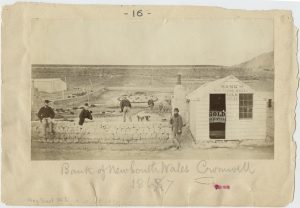
AP One of my favourites is that one of people outside the bank in Cromwell in 1867, which I just find incredibly beautiful – I think it’s just really beautifully balanced. I said that to somebody and he said it was interesting I should feel that way about the photograph because really that photograph could have been taken anywhere in the world, it’s not distinctively New Zealand.
How about you, Rauhina – are there any that stay with you?
RKB (laughs) … I’m not sure I’m prepared to have this question turned back on me!
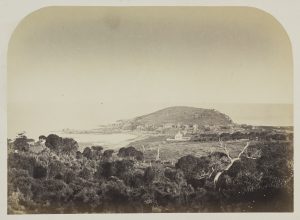
As I was walking around the exhibition there were so many moments of “Oh, I didn’t know that!” … there’s so much I don’t know about photography, so being walked through how this actually relates to us in Aotearoa, depicting both Māori and Pākehā, and others, and the visceral feeling of actually seeing places [I know]… like the picture of the kāik at Moeraki, … knowing that place myself, being able to step back in time, seeing it up on the wall, that was really special to me.
AP Yes, that’s one of the ones we added to the exhibition, that whole wall.
RKB The exhibition is truly an amazing achievement, and it’s opened my eyes, as I was saying, to the history of photography in Aotearoa – a history that will surely continue to evolve. Are there any other whakaaro you’d like to share?
AP Just, I suppose I’d like to say what a wonderful, exciting project it was to work on, and how much I’ve learned in the process, but also, it really has enhanced collaboration between Hocken and the Auckland Museum and the Alexander Turnbull staff, which is wonderful. And it’s been a great joy to read the visitor comments, and to see how much fun visitors had with the interactive – to create their own 19th Century style portrait.
RKB Kā mihi nunui, Anna – thank you so much for sharing your expertise and insights with me – and everyone – today. And I encourage everyone to go to the exhibition this Saturday!
Anna Petersen is Photographs Curator at the Hocken Collections Uare Taoka o Hākena, and co-curator of A Different Light: First Photographs of Aotearoa.
Rauhina Kohuwai-Banks (Kāi Tahu – Kāi Te Ruahikihiki, Kāti Māmoe) is the Māori Archivist at the Hocken Collections Uare Taoka o Hākena. Their work focuses on digitisation, description, access and advocacy.
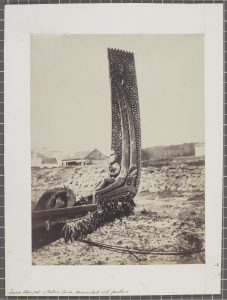
A Different Light: First Photographs of Aotearoa will be open for its final day this Saturday 7 February 2026, closing at 5pm, at the Hocken Gallery, Level 1, 90 Anzac Avenue, Dunedin.
The Hocken will be closed on Friday 6th February for Te Rā o Waitangi / Waitangi Day.