

Dum-de-do! Cookie Bear’s story
Post researched and written by David Murray, Archivist
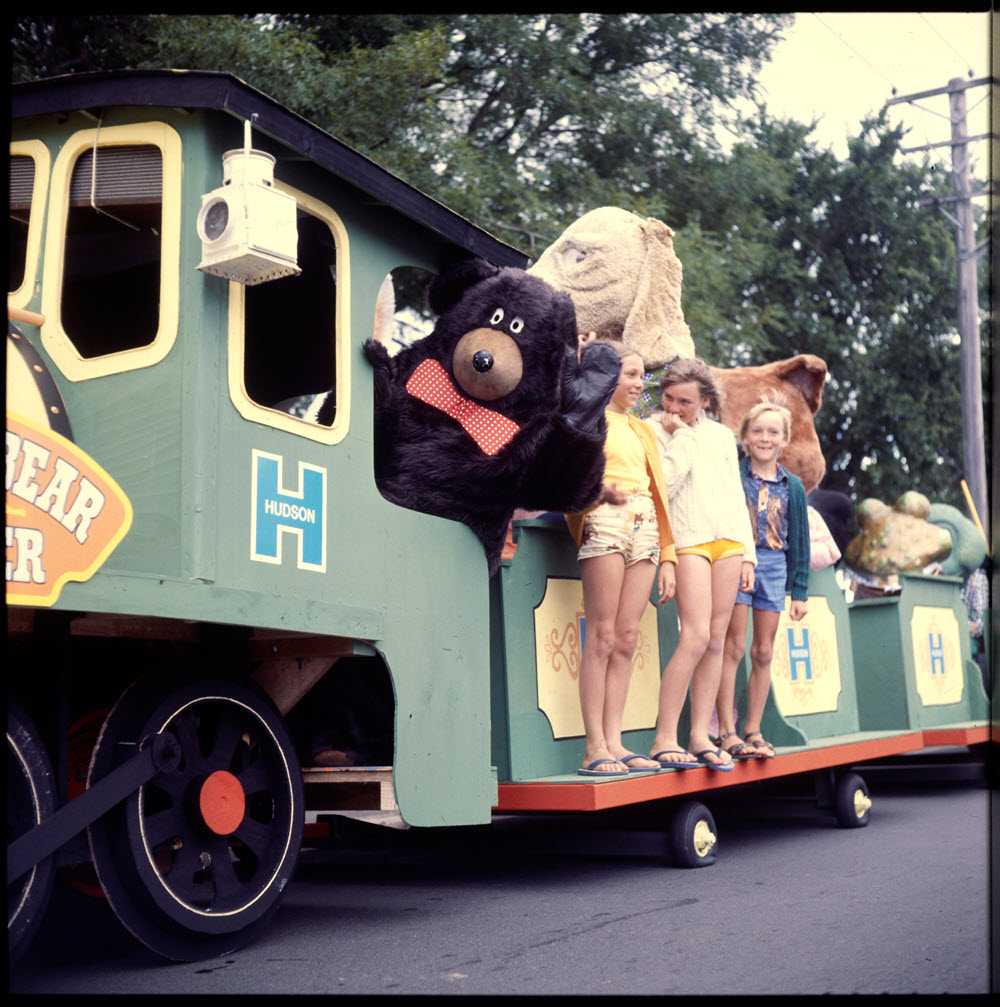
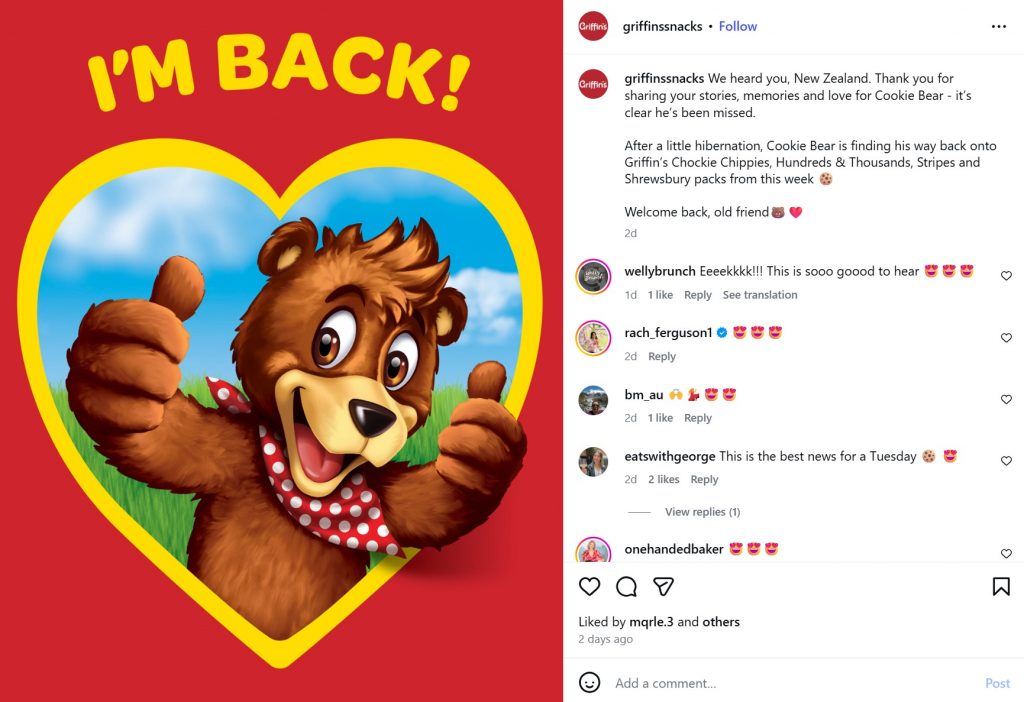
Cookie Bear is back! Many were disappointed when, in April last year, Griffin’s announced he would no longer feature on Chockie Chippie and Hundreds & Thousands biscuit wrappers. Last week the company posted on social media: ‘We heard you, New Zealand. Thank you for sharing your stories, memories and love for Cookie Bear – it’s clear he’s been missed.’ In coming weeks he will once again be seen on full-size biscuit packets.
Cookie Bear started out with the Hudsons brand, owned by Cadbury Fry Hudson Ltd. At Hocken, we recently catalogued papers from the Dunedin Cadbury factory, so we thought we would share some of what we have learned about Cookie Bear’s story.
In the 1970s, Hudsons and Griffin’s were the biggest players in the New Zealand biscuit industry. Griffin’s (then owned by Nabisco) had the largest share of the overall biscuit market, but Hudsons had the biggest share for chocolate biscuits. Hudsons made more than 50 different biscuit varieties, with the most popular including Chocolate Chippies (introduced in 1955), and the jam-filled Shrewsbury (introduced in 1959). The company was always looking to improve its advertising campaigns in a highly competitive market.
Some recent media reports have dated the origin of Cookie Bear 1968, but he in fact made his first appearance in 1971. He was included in television advertisements recorded late that year and broadcast on television by January 1972. Early commercials included the catchphrase ‘Dum de do’, which at first was also followed by ‘dum de day’.
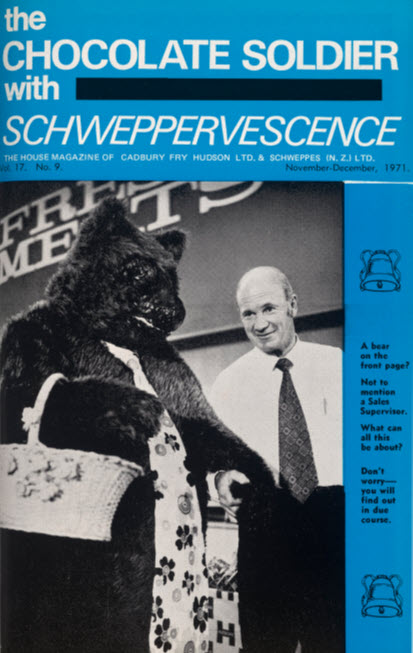
There is some disagreement about who came up with the idea. Ted Barringer, Cadbury Fry Hudson General Manager, later described Jim Hinkley (1943-2020) as having ‘fathered’ Cookie Bear. Hinkley joined the company’s display department in 1968. In the 1980s he wrote: ‘I built and created Cookie Bear (admittedly right after Andy Williams did) but I did give him some character of his own’.
Andy Williams was the star and host of the The Andy Williams Show, a US television variety show that ran from 1962 to 1971. The Cookie Bear character, played in full costume by Janos Prohaska, first appeared in 1969. The running gag was that he asked for Cookies but never got any.
The other person who claimed to have come up with Cookie Bear was Don Donovan (1933-2014). He was Deputy Managing Director of the ostentatiously named Carlton-Carruthers du Chateau advertising agency of Wellington, which was responsible for recording the commercials. Three years after the event, Donovan wrote that Cookie Bear was: ‘first used tactically as an appropriate vehicle to support a special “cookie drive” by Hudsons in 1971. He was derived shamelessly from Andy Williams’ bear.’ In 2002 Donovan wrote: ‘When my grandchildren ask me: “What did you do in the Great War of Life, Grand-dad?” I modestly claim to have invented Cookie Bear’.
It’s likely concept and design evolved somewhat separately, in which case Hinkley and Donovan can rightly share credit. When Donovan confirmed his copyright clearance in 1974, he noted: ‘copyright is normally held by the original artist. However, this symbol has been drawn by numerous people and we believe that in Law it probably would be regarded as the property of this Advertising Agency’.
The bear that appeared in the first television advertisements looked very much like the Andy Williams Show bear, right down to the long colourful tie he wore. He had a more naturalistic look than later versions. Some might say terrifying, especially in the black and white broadcasting of the day.
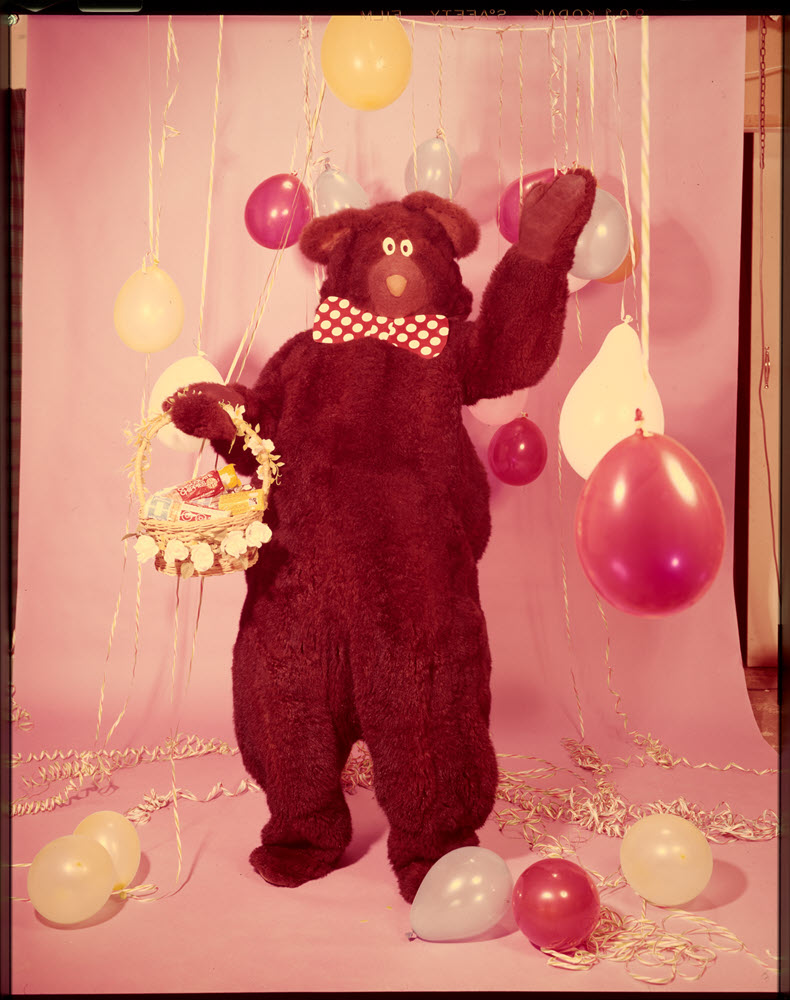
1974 was a big year for Cookie Bear. Cadbury Schweppes Hudson (as the company was renamed in 1973) decided to increase his profile and use him on a more permanent basis. He was given a major makeover. His snout became much shorter, his eyes became whiter, and he adopted what became his trademark red with white polka dot bow tie. He looked less realistic and more like a friendly children’s character. The change also lent him to a cartoon-style of drawing, ideal for print advertising. If Hinkley’s role is not entirely clear, designing the most iconic version of the bear is attributable to him. Donovan was still involved and wrote the description, ‘C.B. should be seen as a friendly, large, warm, cuddly personality’.
A Cookie Bear’s Club for children was established. From October 1974 it had a monthly page in the New Zealand Woman’s Weekly and by the end of November over 100,000 applications had been received. Most used the form from the magazine. By June 1976 there were over 150,000 members and membership appears to have peaked later that year at nearly 200,000, representing more than one fifth of all of the eligible children in the country. The club was staffed by a Mrs Watson, who at one point had four part-time assistants.
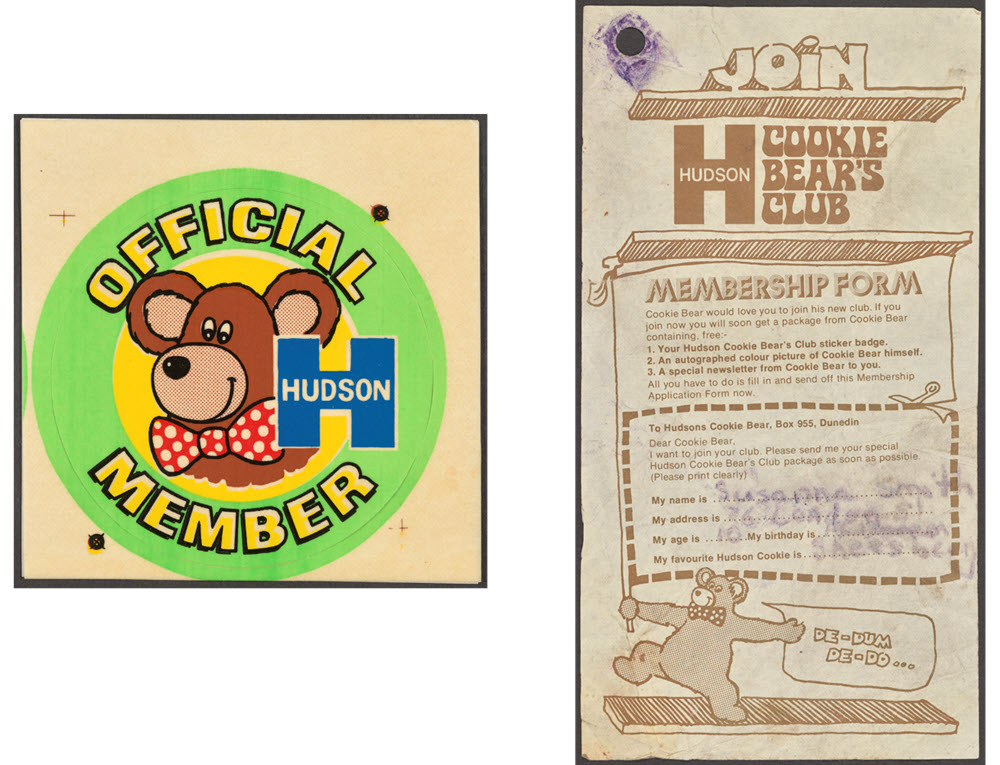
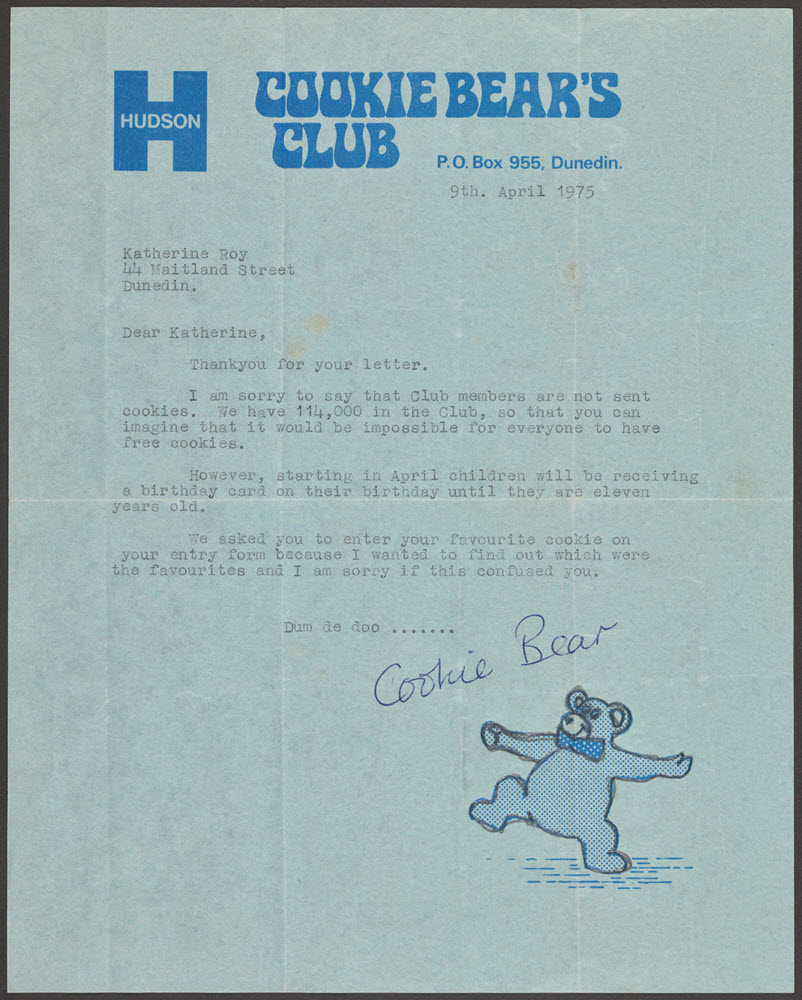
Members were sent cards on their birthdays. Merchandise included posters, stickers, games, and badges. A soft toy developed by the North Shore Toy Company and Bing Harris Sargood sold over 8,500 units. A hardcover book, The Adventures of Cookie Bear (1975), was written by John Berry and illustrated by Virginia Austin.
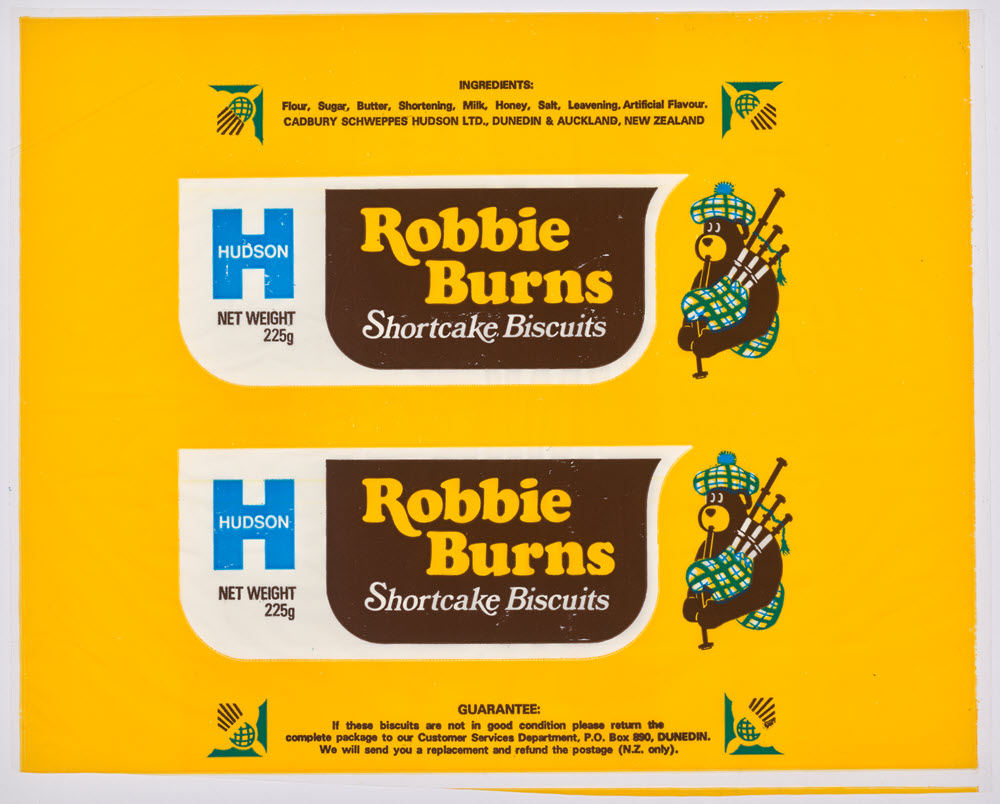
Cookie Bear did not appear on biscuit wrappers until January 1976, when a redesign saw him added across almost the entire range. On several he said ‘Dum de do!’, on Toffee Pops he picked flowers, on Coconut Ruffles he peered from behind palm leaves, on Chocolate Toppers he wore a top hat, and on Robbie Burns shortcake he played the bagpipes.
Ken Williams dressed as Cookie Bear and other characters for in-store promotions. In 1978 he said, ‘Cookie Bear seems to get the worst bashing … It’s not that they don’t like him: they usually just want to see how much padding he has got and the only way they can figure this out is to give him a good hard thump’.
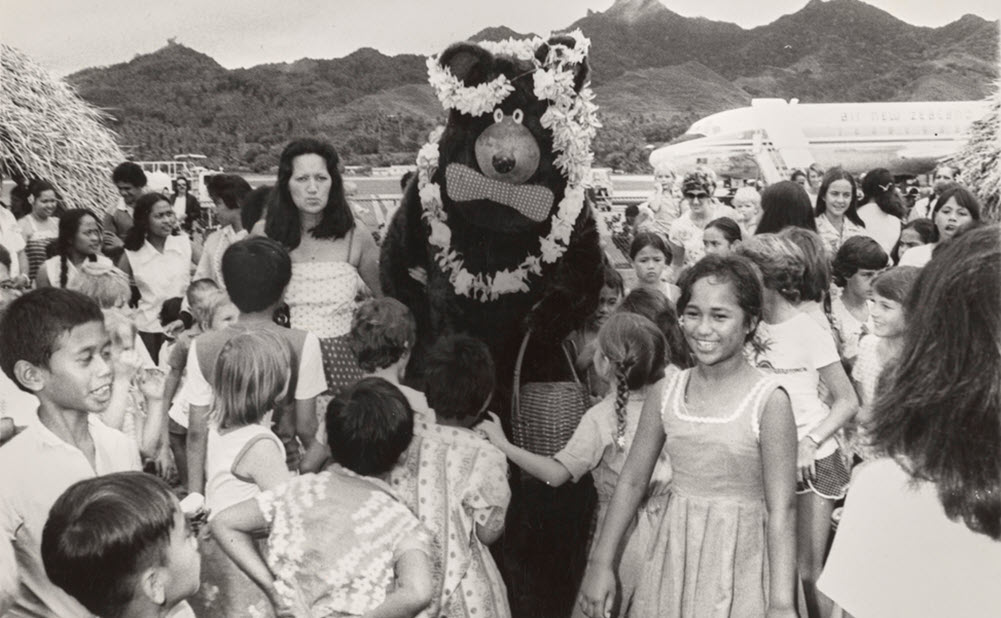
In 1978, a young fan asked if he would visit Rarotonga, and he did. He met with an enthusiastic crowd.
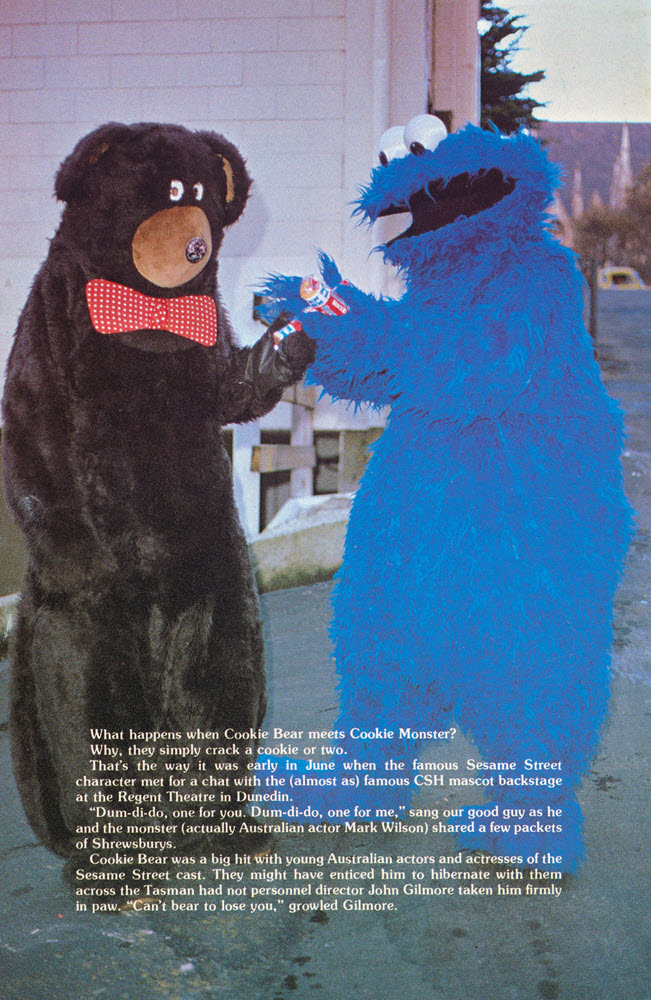
Television One wanted to use him in their comedy series Koro and Joe. In their proposal, the character Rangi gets a job walking around a supermarket dressed as Cookie Bear. He misbehaves in various ways, and finally clouds of smoke billow out from the head of the costume, after Rangi forgets to put out his cigarette. Cadbury Fry Hudson turned down the request. Although preliminary arrangements suggest he appeared on the Max Cryer Show.
One his career highlights might have been when he played tennis with Björn Borg and Chris Lewis, when they visited New Zealand.
Sales were good. In the early 1980s Cadbury Schweppes Hudson had more than 30% of the market share for cookies and approaching 50% of the market share for fully chocolate coated biscuits. Nevertheless, the company decided to pull back on its use of Cookie Bear. From 1982 he no longer featured on wrappers, and in 1983 Cookie Bear’s Club closed. Although the club was still popular a sharp increase in postal charges had made it significantly more expensive to run. Cookie Bear did not disappear though. He continued to used be for in-store displays, promotions, and television advertising.
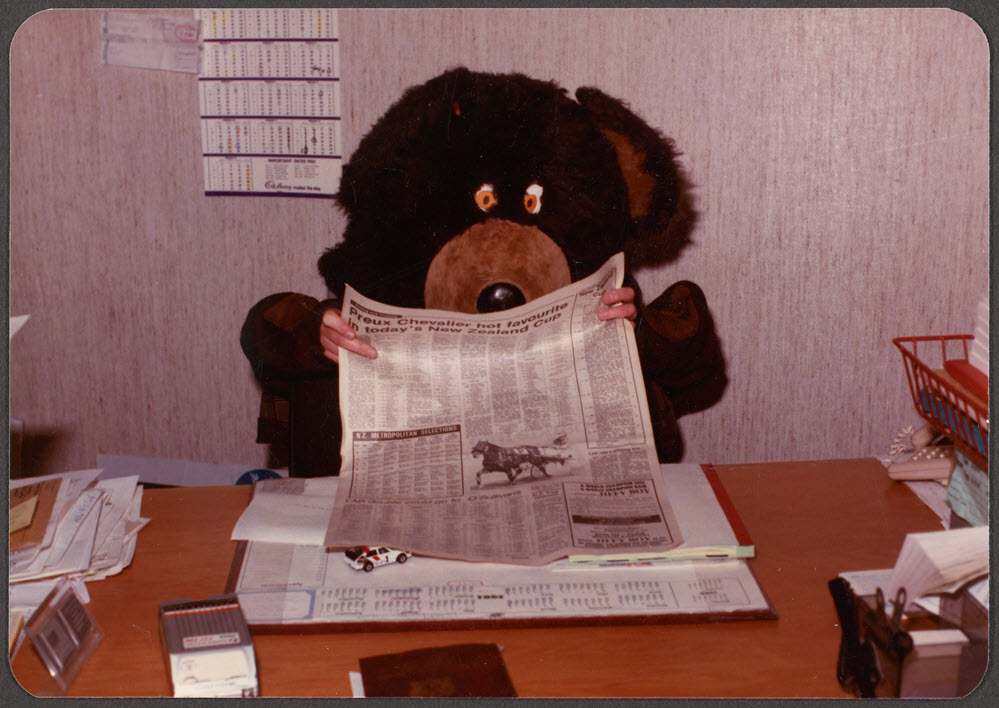
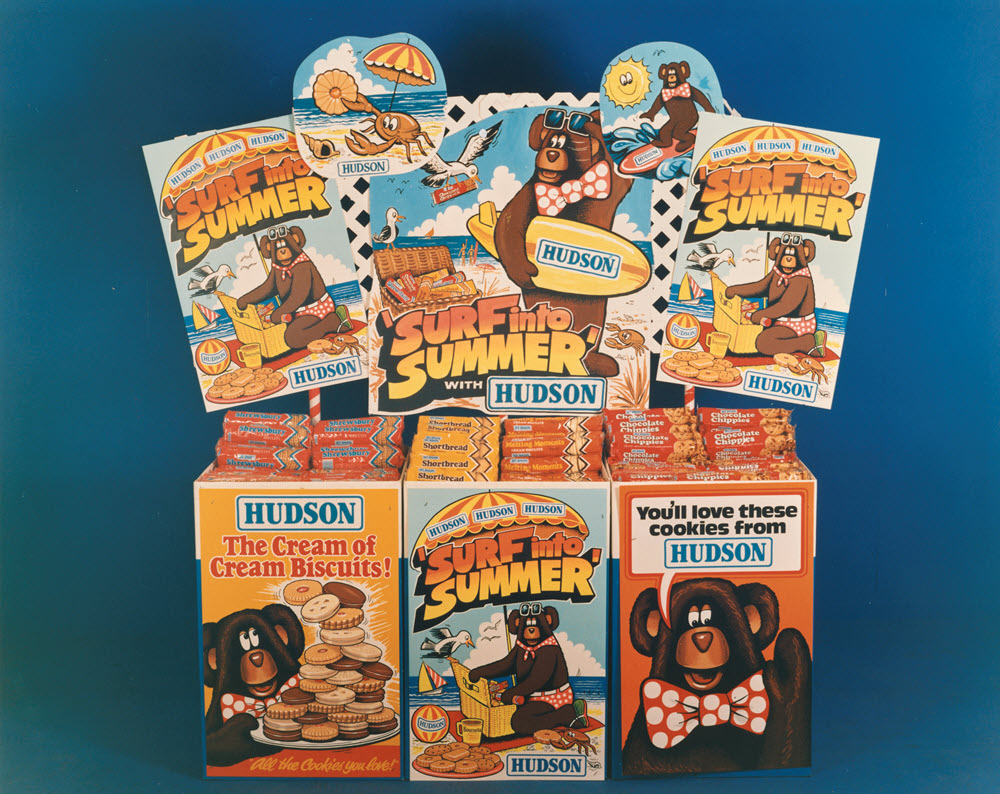
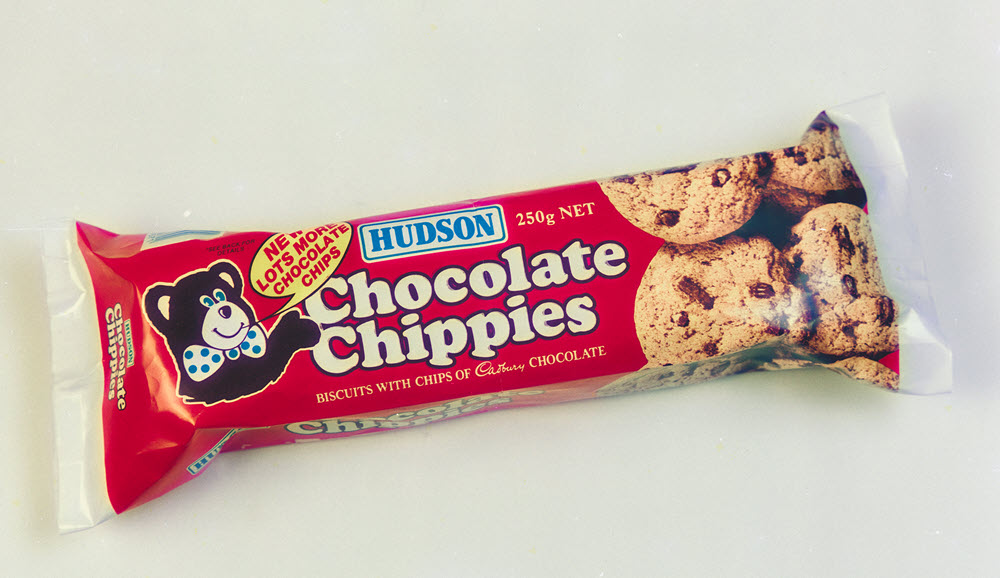
One of the suited television versions displeased Jim Hinkley. In April 1988, no longer employed by Cadbury Schweppes Hudson, he wrote to the company: ‘You have ruined my Bruin!!’ Hinkley said it would have been kinder to have had him put down, and added: ‘I expect by return mail, the good news that this animal has been donated to a moths home and the original “Stewart” returned to his rightful place in front of the cameras’.
1988 saw the revival of Cookie Bear Club. The uptake was not on the scale of the 1970s, but 15,000 members joined in 1989. A new soft toy was produced and the bear’s and face once more appeared on packets of Chocolate Chippies, Shrewsburys, and Shortbread.
The costume Hinkley dislikes seems not to have lasted. The in-house Chocolate Soldier magazine announced a facelift in September 1989, when the new Cookie Bear made his debut with broadcaster Paul Holmes and others in the Octagon for the launch of the expanded Dunedin City Council. Changes were made to his eyes and ears, and his fur became shorter.
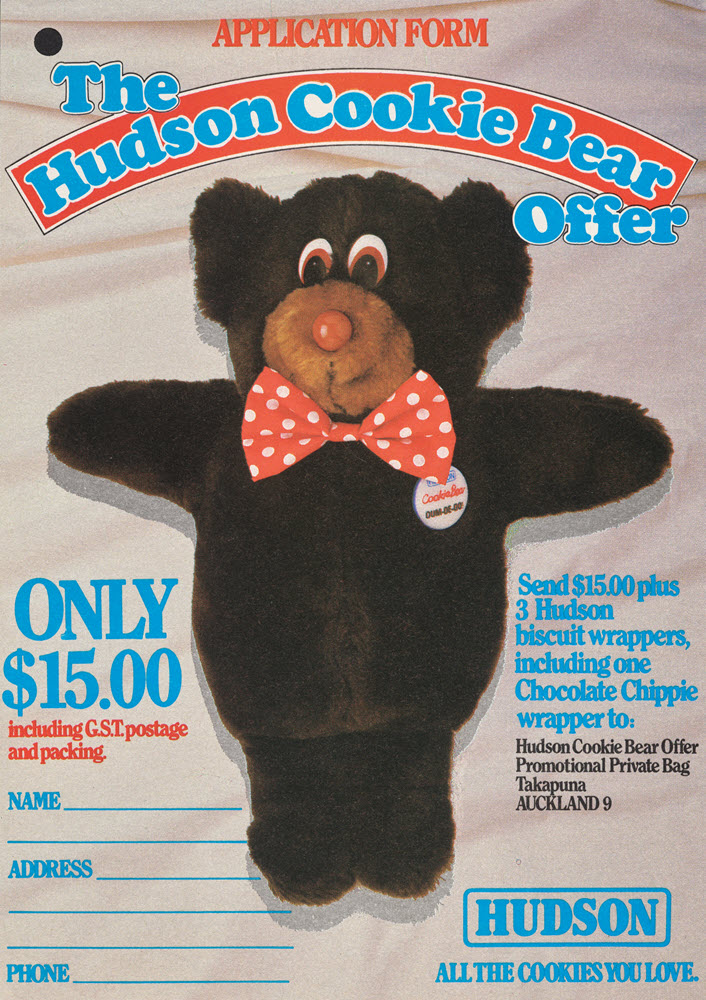
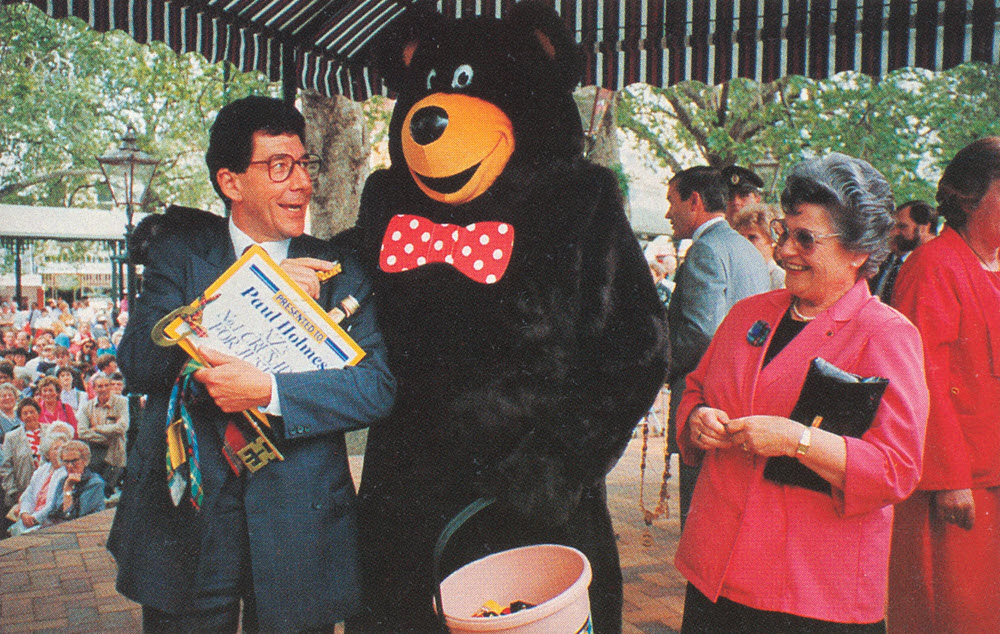
CHS had four new suits made, and prepared a ‘Code of Behaviour for Hudson Cookie Bear’, with rules including
- When walking, walk with a cheeky Hudson Cookie Bear skip
- Hudson Cookie Bear doesn’t speak, except to say ‘Dum de do!’
- Never frighten children, e.g. by going up behind them when they are unaware.
In 1990 Cookie Bear introduced Hudson’s last great biscuit – the Squiggle Top. By the end of that year, however, he was under new management. The new owners of Griffin’s, Britannia Brands, came to an agreement where Cadbury Schweppes Hudson transferred its biscuit rights and its Papakura factory to Griffin’s, while Griffin’s transferred its confectionery rights and its Avondale factory to CSH, which was renamed Cadbury Confectionery Limited. The Dunedin bakehouse was closed. As part of the deal, Cadbury was required to give up all Hudson branding, so it branded its newly acquired confectionery range under one of its longstanding brand names, Pascall.
With Hudson, Griffin’s acquired Cookie Bear. The Hudson brand name was phased out about 1994, but Cookie Bear remained. He remained on some wrappers, including Chocolate Chippies, which he became most strongly associated with. Hundreds and Thousands Biscuits, one of Griffin’s own original lines, also came to feature him.
Cookie Bear gradually came to look less like the classic, avuncular version, taking on a more slimmed down appearance. In August 2004 his bow tie was swapped out for a bandana, although it was still red with white polka dots. A further refresh in 2020 radically changed his appearance again. He now looked still more cubbish, and sported a quiff. To older fans he might look more like a Cookie Bear Junior.
For most of the past year Cookie Bear has been on something of a holiday, appearing only on the Cookie Bear Mini Bears and Mini Snack Packs. He will reappear shortly, on Chockie Chippies, Hundreds & Thousands, Stripes, and Shrewsbury biscuits.
Selected references:
‘Papers relating of the history of Cookie Bear’. MS-5414/034. Cadbury Limited records. Hocken Collections – Uare Taoka o Hākena.
Barringer, E.E. Sweet success: The story of Cadbury & Hudson in New Zealand (Dunedin: Cadbury Confectionery Limited, 2000).
‘The “bear facts”: the making of a commercial’ in Chocolate Soldier vol. 17 no. 10 (Jan/Feb 1972).
‘Hudsons biscuits new look wrappers’ in Chocolate Soldier vol. 22 no. 8 (Sep/Oct 1982).
‘Cookie Bear calls it a day’ in Chocolate Soldier vol. 22 no. 14 (Nov/Dec 1983).
‘Cooke Bear’s return’ in Grocers’ Review vol. 68 no. 4 (Apr 1989).
‘Cooke Bear gets a facelift’ in Chocolate Soldier vol. 26 no. 3 (Sep/Oct 1989).
‘Dum de doo… Cookie Bear provides growth in Kids category’ in Grocers’ Review vol. 84 no. 3 (April 2005).
Donovan, Don. ‘I admit it, I am Cookie Bear’s father’ in Donovan’s World blog (28 August 2009). Retrieved from https://don-donovan.blogspot.com/2009/08/i-admit-it-i-am-cookie-bears-father.html
Quinn, Rowan. ‘Cookie Bear – a threatened species?’. RNZ news (26 April 2016). Retrieved from https://www.rnz.co.nz/news/national/302356/cookie-bear-a-threatened-species