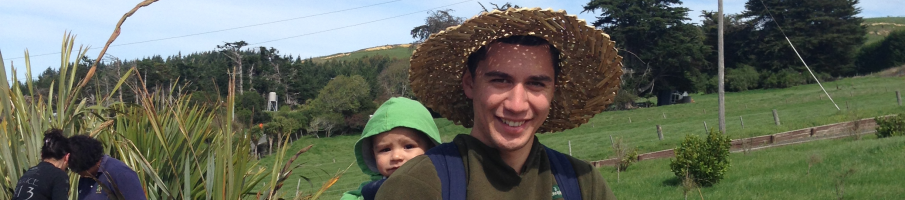
Ngā Pae o te Māramatanga Summer Internships
Are you a Māori pre-doctoral student who is interested in advancing your skills and capacity in Indigenous research, and wanting some paid work over summer? Or do you know someone who may be interested? Ngā Pae o te Māramatanga have 27 Summer Internships on offer. Closes 10 October.
**** CLICK HERE TO FIND OUT MORE ****
Employment Opportunities for Māori and Pacific PhD graduates.
The following has been received from AUT, with employment opportunities for new Māori and Pasifika PhD graduates.
———————
Recruiting Now – Māori and Pacific Early Career Academic Programme
- Permanent Lecturer appointments available for Māori and/or Pacific scholars
- Utilise your PhD and begin your academic career
- Variety of disciplines sought across three outstanding facultie
Auckland University of Technology (AUT) aspires to be the University of opportunity for Māori and Pacific people and is proactively engaged in growing the number of our Māori and Pacific academics. AUT is dedicated to increasing the participation and success of Māori and Pacific peoples across all academic disciplines. We are a young university with an innovative, student centric academic environment with a strong focus on research-led teaching
The 2019 Māori and Pacific Early Career Academic Programme offers Māori and/or Pacific scholars’ permanent, full-time appointments as research-active lecturers.
- Click HERE visit our dedicated programme page on the AUT Careers site. Watch videos of some of our current early career academics speak, access individual job links for further information and make an application!
We are currently recruiting the following subject areas:
- Lecturer in Management (Business School)
- Lecturer in Public Relations (School of Communication Studies)
- Lecturer in Digital Media (School of Communication Studies)
- Lecturer in Communication Design (School of Art & Design)
- Lecturer in Digital Design (School of Art & Design)
- Lecturer in Māori Studies and New Zealand History (Te Ara Poutama)
A full programme information pack for the programme is also attached to each job advert. For an initial confidential chat, just contact Mike Wood, Executive Recruitment Partner on +64 9 921-9185 or mike.wood@aut.ac.nz.
Professional development and networks
In all roles you can expect to be surrounded by an extensive support programme designed to develop your teaching skills, extend research capability and advance your professional skills in supervision and graduate mentoring. This includes a dedicated development programme and cultural support network, access to approved expenditure on research, a commitment from the school to your personal professional development, as well as ongoing support from your line manager, a dedicated senior academic mentor and a member of the University’s Strategic Leadership Team in your development as an academic.
Important programme eligibility criteria:
- This must be your first full-time, permanent academic teaching position in either a university or other tertiary education provider. You will also have no more than 5 years fixed-term contract academic teaching experience (in total) in a university or other tertiary education provider.
- You must have a completed PhD within 3 years of application to this programme, or will have submitted your completed thesis for examination by 22 February 2019
- Programme is open to applicants of Māori or Pacific genealogical descent
- You must be able to start before 25 February 2019
AUT already has over 30,000 adventurous, energised, innovative educators, researchers and students that have been drawn to test boundaries, challenge established theories, break new ground and discover what is possible… Join us!
Please Note:
- Closing date for applications is Sunday, 30 September 2018
- Interviews will take place throughout October 2018
The Maraea Project: Indigenous Health Solutions
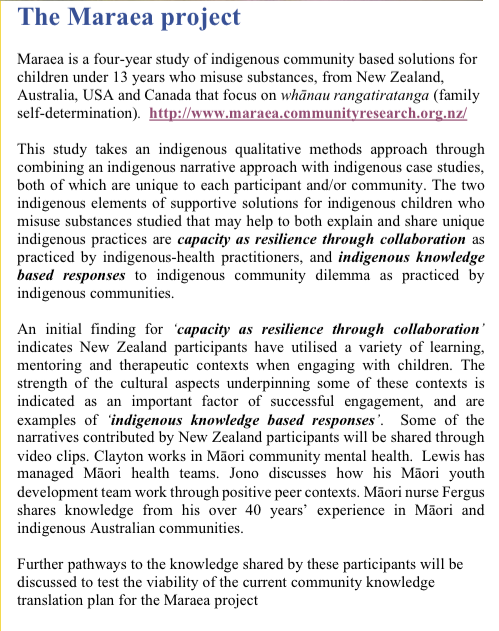
Dr Lisa Chant (Ngāti Whātua, Senior Fellow at Taupua Waiora Centre for Māori Health Research) is our guest presenter at the next Te Tumu Seminar, speaking on the Maraea Project and Indigenous-based health solutions. The seminar will be in Te Iringa Kōrero [3rd floor] of Te Tumu, 3pm on Friday 21 September. Everyone is welcome.
10 questions with . . . Jenny Bryant-Tolalau
Last week we featured Lyn Carter’s new book on Indigenous Pacific responses to Climate Change and her 10-question interview with the Association of Social Anthropologists of Aotearoa/New Zealand. Jenny Bryant-Tokalau has researched collaboratively with Lyn, and until her recent retirement, was a member of Te Tumu’s Pacific Islands Studies programme. Jenny has published Indigenous Pacific Approaches to Climate Change, as a companion volume to Lyn’s as part of the Palgrave Studies in Disaster Anthropology series. Click here to download Jenny’s book. ASAA/NZ also asked Jenny the 10 questions. Click here to see.
10 questions with . . . Lyn Carter.
The Association of Social Anthropologists of Aotearoa/New Zealand recently conducted a ’10 questions with’ session with Te Tumu’s Lyn Carter about her newly released book Indigenous Pacific Approaches to Climate Change: Aotearoa/New Zealand on their blogsite. Click here to read all about it.
Latest Masters of Indigenous Studies Graduate
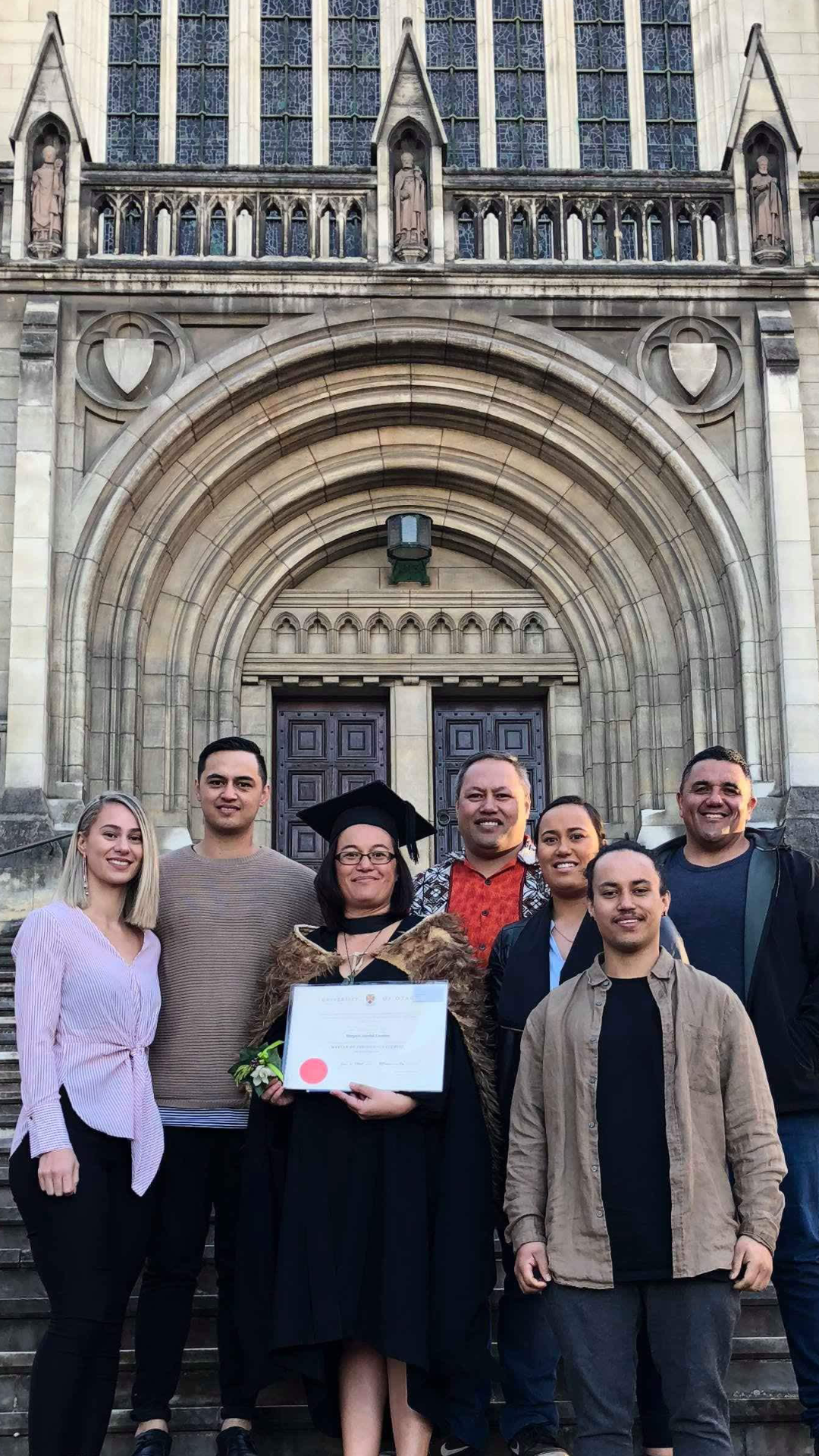
Margaret Courtney and her whānau. (Click to enlarge)
Graduation is always the culmination of a lot of hard work. At last week’s graduation, we had our latest graduate, Margaret Courtney, walk across the staff to collect her hard-earned Masters of Indigenous Studies degree certificate. Margaret, of Te Arawa (Tūhourangi,
Ngāti Whakaue, and Tapuika), also holds an LLB from Waikato University, and works as a Regional Advisor for Te Puni Kōkiri. I asked her to send me a short account of her studies, and the abstract of her research dissertation. Koia kei a koe, Margaret!
“My journey to complete my Masters qualification was a journey of personal growth, perseverance and enlightenment. Combining my experience of Whenua Māori, the Native Land Court system and integrating it with the history of our tūpuna and iwi has helped to fill knowledge gaps for my whānau. Given our ‘nuclear family’ upbringing my research emphasised the importance of Whenua Māori as a connection to our tūpuna but also strengthens our Whānau Mātauranga. It is this knowledge that we can pass onto our tamariki and mokopuna.
“The Master of Indigenous Studies programme at Te Tumu was the best option for me given I live and work in Rotorua. It provided a part time online option which complimented by mahi and lifestyle. The paper offerings provided choice and completing the dissertation cemented my learnings. I enjoyed the mixed forms of delivery and assessments.
“I am thankful for the support and patience of my supervisor Dr Paerau Warbrick. He provided good advice, steered me on track when needed, and helped me to extend my knowledge and research skills. Ka nui te mihi ki a koe, e whānaunga! To my whānau, your continued support is unwavering!”
Abstract
This research supports the view that whenua Māori is important in today’s global environment and remains a vital connection to our tūpuna, our iwi and our whānau history.
This is illustrated through an exploration of the author’s connection to Tūhourangi, an iwi of Te Arawa, the impact that the Native land legislation had on Tūhourangi and specifically the whenua, Rotomahana Parekārangi in the nineteenth century. The research explores the path of Rotomahana Parekārangi through the Native Land Court regime. The research concludes with an example of how the author’s whānau are making attempts to transmit their collective whānau mātauranga to the younger members of their whānau. This is in order to provide the whānau with experiences of the whenua, of their iwi and to understand the importance of their connection to the whenua derived from their tūpuna. It is important that the younger generation are cognisant of these connections and whānau mātauranga as, in time, they will become the kaitiaki of the whenua, and will need to pass this knowledge onto their mokopuna.
New book: Indigenous Pacific Approaches to Climate Change
 Climate Change is an issue for the Pacific. We are delighted to announce the lastest book by a Te Tumu scholar, Dr Lyn Carter, Indigenous Pacific Approaches to Climate Change, published as part of Palgrave’s Studies in Disaster Anthropology Series.
Dr Carter, a Ngāi Tahu scholar, is a member of Te Tumu’s Indigenous Development programme, and teaches the popular INDV301 course, Māori and Indigenous Development Ethics and Government.
From the publisher: “Situating Māori Ecological Knowledge (MEK) within traditional environmental knowledge (TEK) frameworks, this book recognizes that indigenous ecological knowledge contributes to our understanding of how we live in our world (our world views), and in turn, how we adapt to climate change.

Dr Lyn Carter
“As an industrialized nation, Aotearoa/New Zealand (A/NZ) has responsibilities and obligations to other Pacific dwellers, including its indigenous populations. In this context, Lyn Carter discusses how A/NZ can benefit from the wider Pacific strategies already in place; how to meet its global obligations to reducing greenhouse gases; and how A/NZ can utilize MEK to achieve substantial inroads into long-term adaptation strategies and sustainable practices. Carter demonstrates that in all respects Māori tribal groups are well-placed to be key players: adaptation strategies, policies, and practices are integrated throughout Māori/Iwi traditional knowledge.”
Click here to access this new book.
Sudesh Mishra seminar

Professor Sudesh Mishra
Te Tumu is honoured to be hosting Professor Sudesh Mishra from the University of the South Pacific, Fiji, who is in Dunedin for the next six weeks on the Ratu Sir Kamisese Mara Fellowship. He is a noted poet and literary critic, but his research is now taking new directions, in particular looking at Indigenous responses to modern ecological crises, such as climate change.
He will be giving a lecture in the Te Tumu Seminar Series at 3pm on 24 August on the Ground Floor of Te Tumu, entitled “On Seeing a Bull’s Skull in a Bicycle Seat: Innovative Archaisms in Oceania.” More details in the poster below. Please feel free to come along, and circulate this blog post to anyone who might be interested.
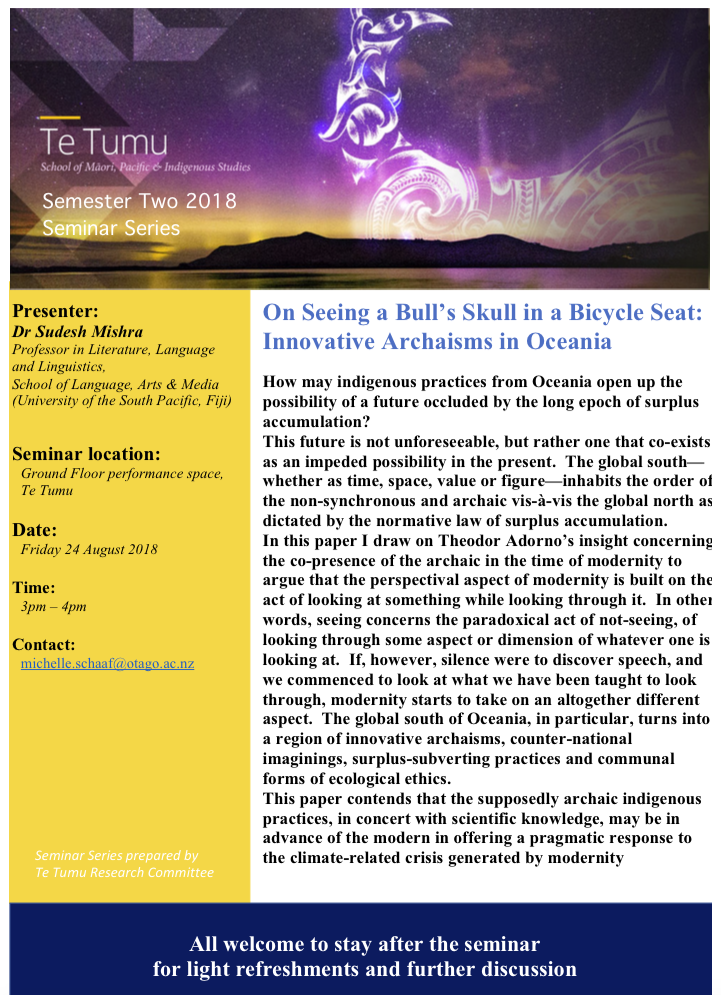
Click on image to enlarge.
Talitali fiefia, to our new Pasifika lecturer
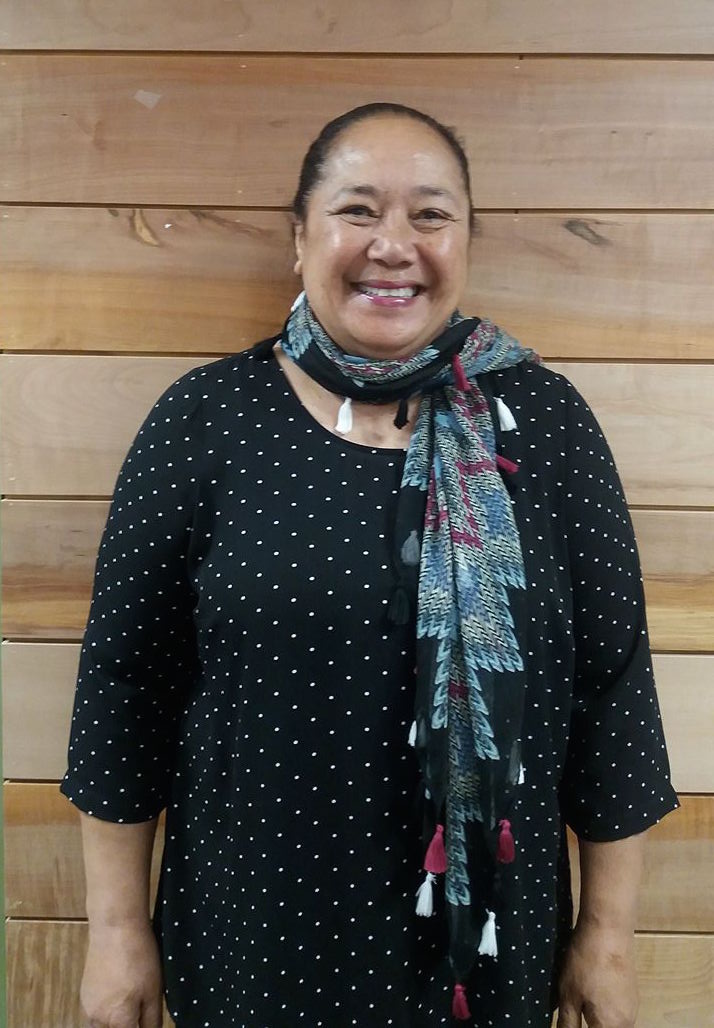
Dr. Telesia Kalavite
Mālō e lelei. Te Tumu is very pleased to introduce our new lecturer, Dr. Telesia Kalavite, who has just joined our staff. Telesia will be teaching in the Pacific Islands Studies programme, as well as in the Indigenous Development programme.
Dr Kalavite is a professional Tongan educator who has taught in Tonga, Fiji, New Zealand and Australia at primary, secondary and tertiary institutions for many years. Her tertiary education working experiences were at Tonga Institute of Education, Waikato Institute of Technology, The University of Waikato, The University of Southern Queensland and now The University of Otago. Her qualifications include: Teachers’ Certificates (TC), a Diploma in Education (DipEd), a Bachelor of Arts (BA), a Postgraduate Certificate in Education (PGCertEd), a Master of Education (MEd), a Postgraduate Diploma in Educational Leadership (PGDipEDL), and a Doctor of Philosophy (PhD). Whilst in the teaching profession Telesia worked for the development of her own Tongan people as well as Pacific peoples’ communities. She is a passionate community person who actively participated in many youth, church, university, community groups and non-government organisations.
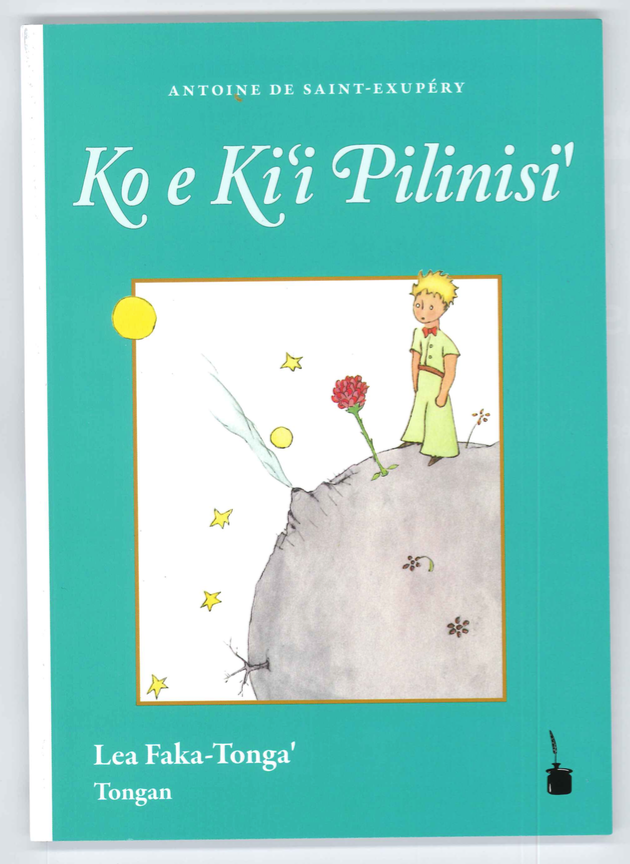
Ko e Ki’i Pilinisi’ (2018). Dr Kalavite’s translation of Le Petit Prince.
She believes in grassroots development to alleviate the harsh conditions of disadvantage. Her passion and research interest are in Pacific and indigenous educational development worldwide in particular New Zealand, Australia and the Pacific region.
Dr Kalavite is also a noted translator of works between the English and Tongan languages. One of her most recent works is Ko e Ki’i Pilinisi’, a translation of Antoine de Saint-Exupery’s famous novella, Le Petit Prince (The Little Prince). We are excited that she will be offering an introductory Tongan language paper in Summer School next year.
We are delighted to welcome Telesia, and her husband Sione, to Te Tumu, and to Dunedin.
Te Kōparapara Book Launch
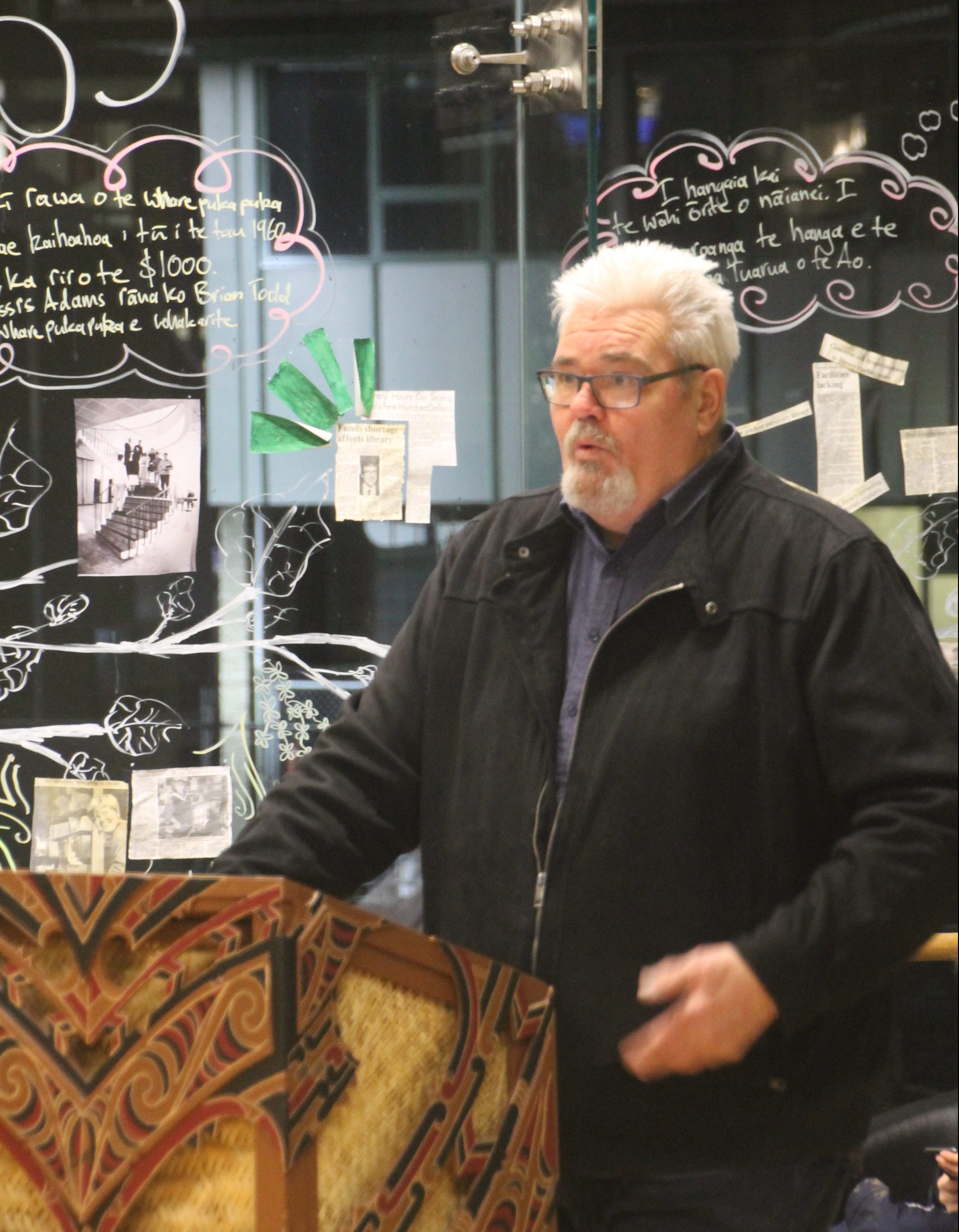
Ōtākou Rūnaka Representative, Tahu Pōtiki
Te Tumu enjoyed a great launch last night of its new book, Te Kōparapara: An Introduction to the Māori World. Published by Auckland University Press [click here to order online] , this book will be used by Māori Studies staff in their teaching, particularly for the MAOR102 Māori Society paper.
The event was MC’d by Professor Poia Rewi, the Dean of Te Tumu, then launched by local Ōtākou Rūnaka Representative, Tahu Pōtiki, who reminisced about his own time as a student at Otago, and how there was a gap in local Ngāi Tahu presence in Māori Studies at that time, something that this new book goes some way in filling. Lead editor Professor Michael Reilly spoke on the processes of wrangling such a large number of authors and editors, and of the exemplary work of Ginny Sullivan, AUP’s copy editor who sadly passed away. AUP Director, Sam Elworthy also spoke, singing the praises of the scholarly work being produced by Te Tumu.
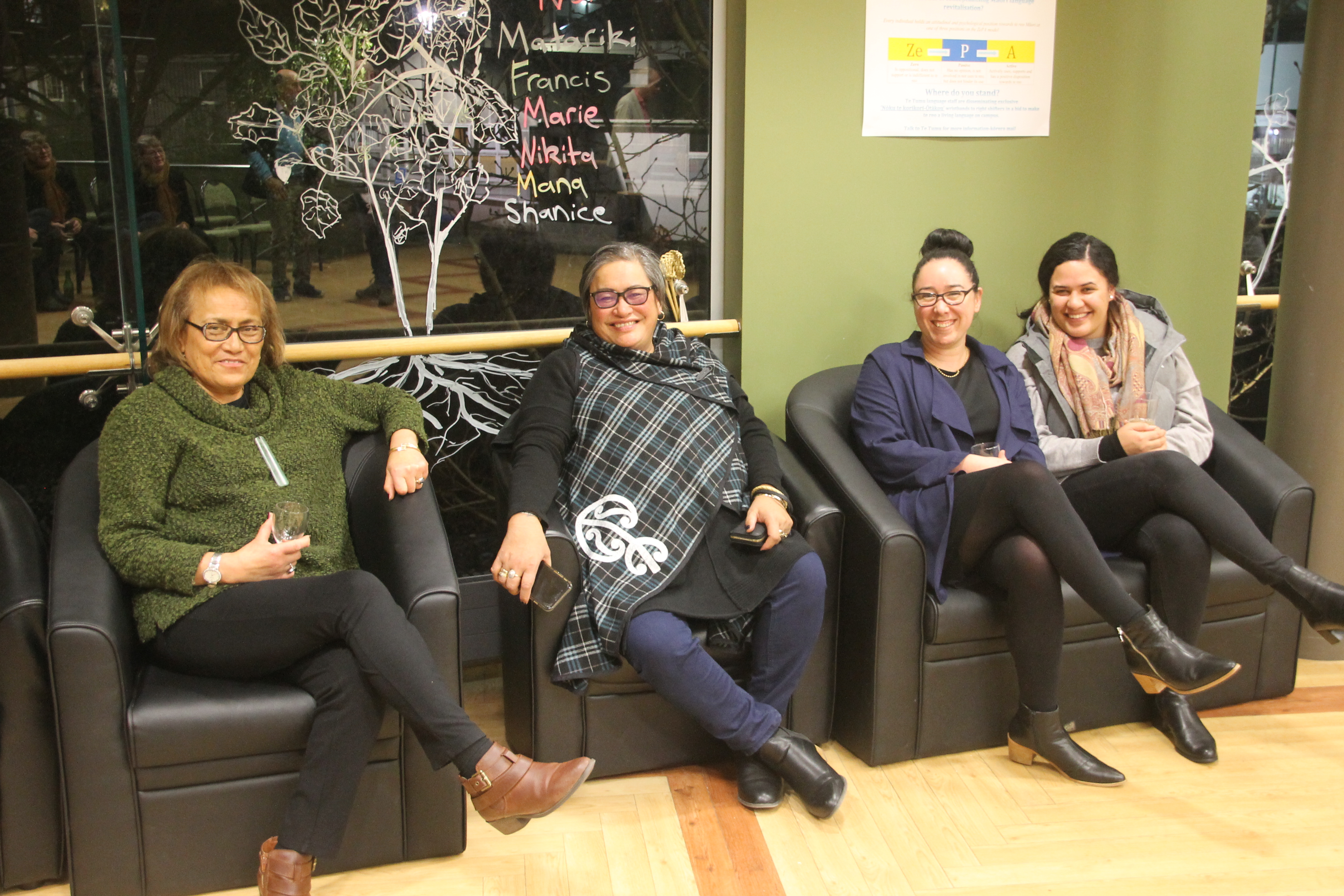
Pearl, Tangiwai, Tawini and Nadine. Click to enlarge.

A beaming Sam Elworthy, from Auckland University Press.

Good friends of Te Tumu
