Seminar on the Samoan Elections
Te Tumu Seminar Series
Talofa lava. Come along to:
“The 2016 Samoan Elections: A Comparative Analysis of Elections in the Pacific Islands Region” (Roundtable Discussion)
Dr. Iati Iati, Senior Lecturer, Department of Politics & Dr. Alumita Durutalo, Lecturer, Te Tumu/Maori, Pacific & Indigenous Studies
Friday 11th March, 2016. 2.00pm – 3.00pm
RS8, Level 2, Te Papakori, Te Tumu/Richardson South Building.
The Ngāruawāhia Tūrangawaewae Regatta

Tangiwai Rewi
This Wednesday Tangiwai Rewi will be giving a seminar, “The Ngāruawāhia Tūrangawaewae Regatta: Today’s Reflections on the Past”, based on her on-going research on intergenerational knowlege transfer relating to Kīngitanga practices.
For more details, see the Abstract
The seminar will be in Te Iringa Kōrero (R3S10, 3rd floor, Te Tumu), 2.30-3.30, Wednesday 25 November, and is open to all.
Seminar on Fijian Politics
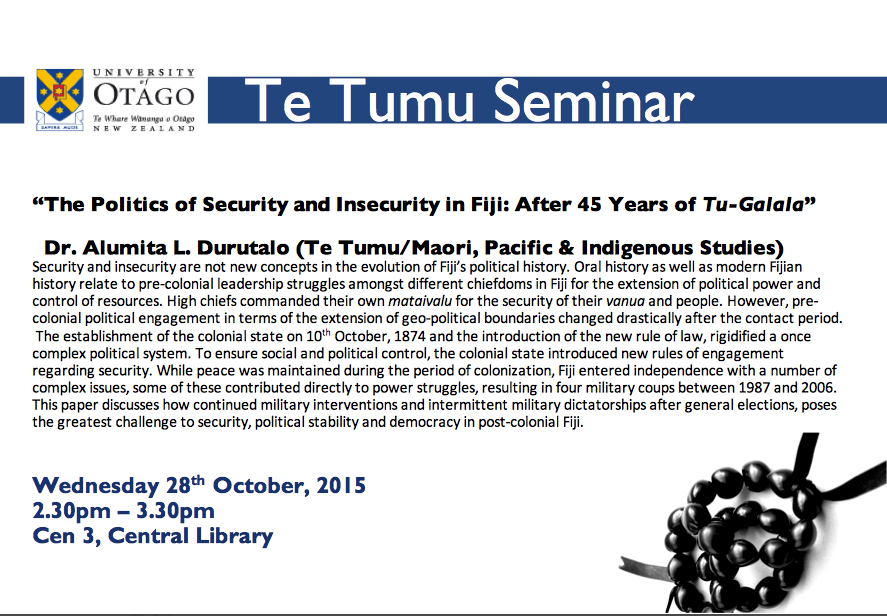
Click to enlarge.
Dr Alumita Durutalo’s seminar on “The Politics of Security and Insecurity in Fiji” has been rescheduled. This will now be held 2.30pm, 28 October, in CEN3, in the Central Library.
Te Tumu Seminar
Dr. Victoria Mason (School of Politics and International Relations, ANU) will be giving the next Te Tumu seminar on 3pm, Wednesday 9 September in R3S10 (Te Iringa Kōrero, Te Tumu)
Title: ‘Planned misery’: Oslo, aid, and the human rights industry in Palestine
An afternoon tea will follow the seminar.
Abstract: Despite a plethora of human rights initiatives, conflict resolution attempts, and considerable international humanitarian and development funding, the international community has not only been unable to bring about meaningful resolution of the Palestinian question, but has, ironically, compounded the situation facing Palestinians. This paper posits that these failures result from the international community dealing with Palestinian rights in a ritualistic and perfunctory way.
Presenter biography: Dr. Victoria Mason is a Lecturer in the School of Politics and International Relations at the Australian National University in Canberra. Her research focuses on human rights issues and peace and conflict studies. Within these fields she works on a number of areas including Palestinian human rights, the wider Israel-Palestine conflict, human rights in peace processes, refugees in the Middle East and Islamophobia.
Matani Schaaf Seminar
Matani Schaaf, who has just submitted his PhD thesis, will be presenting the next Te Tumu seminar on “What Was/Is the Participation Motivation of Elite Pasifiki Rugby Players?”
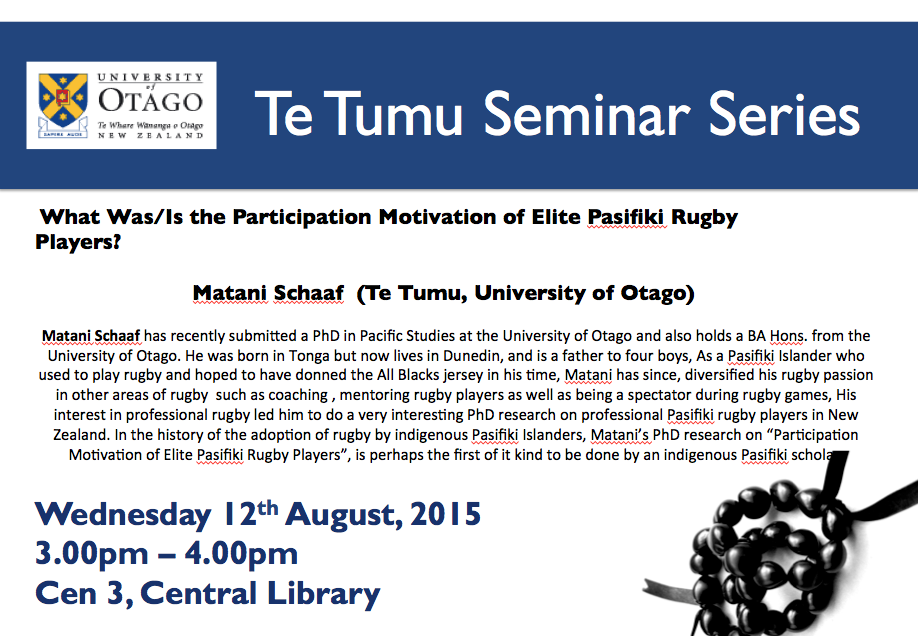
Click to enlarge.
This will be held in CEN3, (Central Library) at 3pm, Wednesday 12 August. All interested people are welcome. Click on the image below for more details.
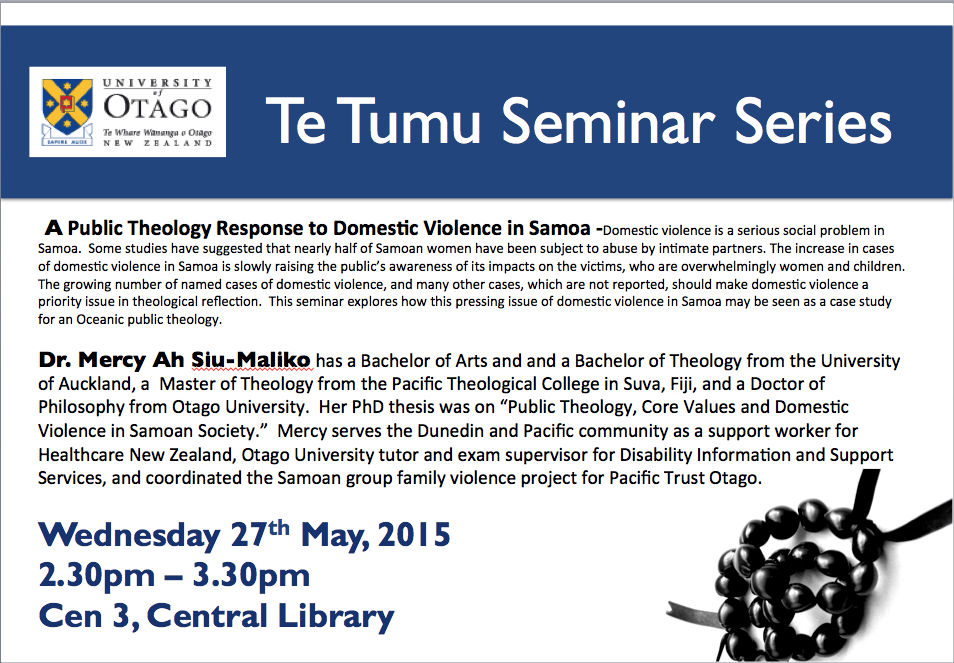
A Public Theology Response to Domestic Violence in Samoa
Dr Mercy Ah Siu-Maliko will be giving the next Te Tumu seminar: “A Public Theology Response to Domestic Violence in Samoa”. All interested people are welcome.
Vicki Grieves Seminar
Dr Victoria Grieves (University of Sydney) will be giving the next Te Tumu seminar on “Working against nature: the plough as symbol of western progress and icon of Northern domination”.
This will be held in Cen3 (Central Library), on Wednesday 15 April 2015, 2.30pm – 3.30pm. Everyone is welcome.
Abstract: This paper argues that while the idea of the plough and of ploughing is embedded in western theory and discourse as an inherently good concept, the introduction of the plough and the beginnings of agriculture as we know it today is likely to be the beginning of the epoch now known as the Anthropocene. While the plough embodies all of the values of hard work, of thought and creativity, of respectability and of progress in western thought, as a tool of progress it has been used as a means of colonising and securing lands. The impact of this has been devastation to indigenous people and also to the natural world. Ploughing has had the effect of creating borders, of delineating colonised lands and enslaving men and animals to pull the blades through the soil. When recognised as such, the ploughs themselves have figured prominently in various ways in poor white and Indigenous dissent. Thus the plough works against nature rather than with nature. It has been convincingly theorised as an object of death and destruction of the natural world (Serres) and its impact on the collective issues that comprise climate change and the Anthropocene is profound.
Upcoming Te Tumu Seminar
By Professor Chris Andersen (Faculty of Native Studies, University of Alberta).
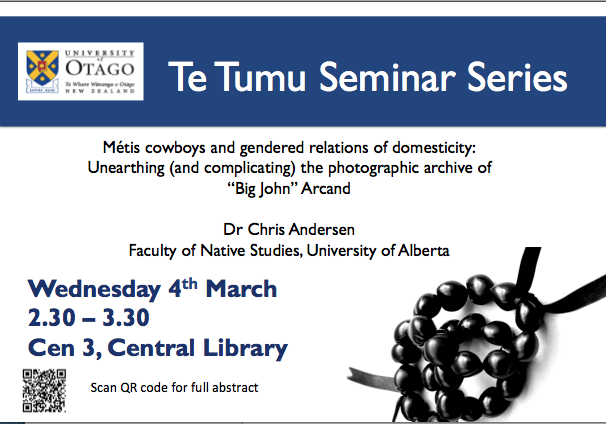
Click to enlarge
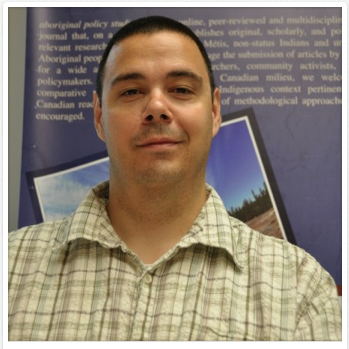
Chris Andersen, University of Alberta.
This seminar will be followed by tea and coffee on Level 1, Te Tumu.
Public Lecture: “Scots and Indigenous Peoples in the Australian Colonies”
This might be of interest to some: Professor Ann Curthoys, a leading Australian historian who specialises in indigenous-settler interactions and relations, is giving a free public lecture entitled “Scots and Indigenous Peoples in the Australian Colonies” on Monday 24 November in Castle Lecture Theatre 1 at 3.30pm. Click here for full abstract and details.
Te Tumu Seminar: Guardianship in Early Colonial Fiji
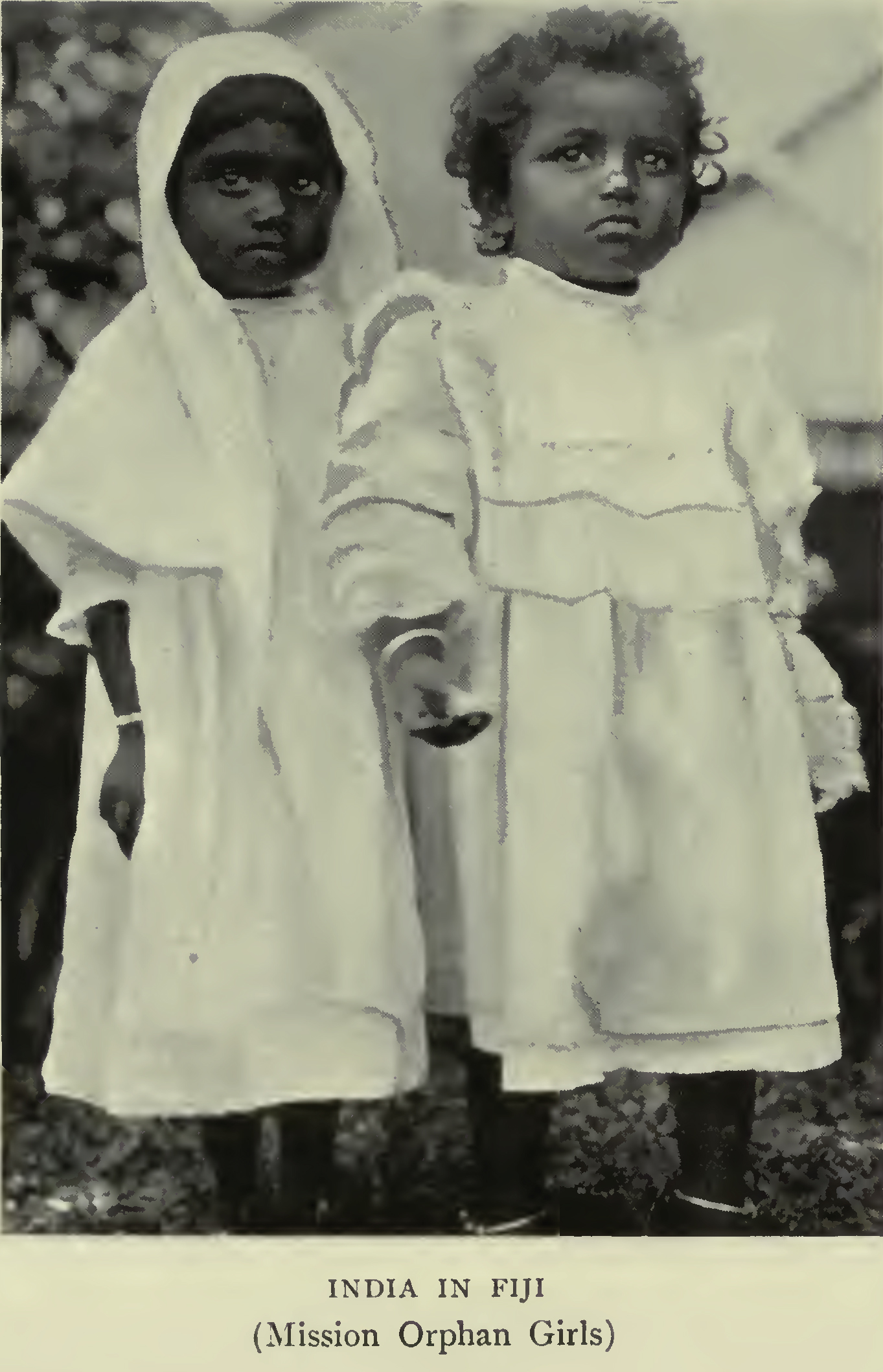
Image from: Burton, J.W. (1910). Fiji of To-Day. London: Charles H. Kelly
Te Tumu PhD student Erica Newman will be presenting the research presentation, Guardianship in Early Colonial Fiji, on 12 November. Please note that the venue and time have changed to previously advertised. It will now be 3.30-4.30 pm in R3S10 (3rd floor, Te Tumu building).
Abstract: Fiji became a British Colony in 1874 and within five years the Indian Indentured Labour Scheme was introduced to provide workers for the European owned plantations. Care of any orphaned children from these plantations was the responsibility of Colonial Office bureaucrats who applied the western systems of guardianship and adoption that they used throughout the Empire.This seminar will examine five examples of Colonial Office correspondence negotiating the approval of guardianship of children, between the years of 1889 to 1900. A study of these files reveals the circumstances of the child, those who were approved guardianship, and why they sought to become a guardian.
