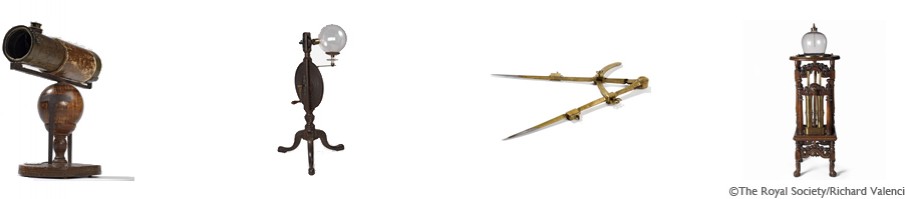
Newton’s Mathematical Method
Kirsten Walsh writes…
My PhD is on Isaac Newton. Working within the experimental/speculative framework of our project, I am taking a fresh look the development of Newton’s method of natural philosophy. I am addressing the following research questions:
- What does Newton’s method amount to?
- What were the key innovations in Newton’s method of natural philosophy?
- To what extent was Newton’s method influenced by the Baconian method of natural history?
- Where does Newton’s method fit in the experimental/speculative framework?
I am developing a clearer account of the ‘mathematical revolution’ in natural philosophy that began with Newton.

Newton, Opticks, 4th edition. Experiment demonstrating the separation of rays of different 'refrangibility'.
At the moment I am examining Newton’s famous first optical paper, read to the Royal Society in February 1672. Newton’s new theory of light and colours sparked controversy. He had to defend his views against the objections of some important natural philosophers: Hooke, Pardies and Huygens. The debate forced Newton to clarify his views on scientific method. I hope that closer analysis of this controversy will give us a clearer idea of Newton’s early views on method, hypotheses, queries, and experiment.
My work is at an early stage, and I’d love to hear your comments.
Experimental Method in Moral Philosophy
Juan Gomez writes…
This is just a quick summary of the project I’m working on, so you can get a grasp of it, hopefully get interested, and discuss related issues with us. Our Marsden project as a whole revolves around the experimental/speculative distinction in the early modern period (see project description). My interest is to trace and study such distinction within the moral philosophers and the texts produced by them. I’m trying to find answers to the following questions:
- Was the experimental method actually being applied in moral philosophy, or did they use it just as a rhetorical tool?
- Can introspection amount to more than just speculation?
These are just two of the questions that have come up in my research. I should point out here that I’m focusing only on British philosophers in the Eighteenth century, since it seems to be the most fertile ground for my interests. There is enough evidence to show that the British philosophers (Hutcheson, Turnbull, Hume, Reid, Fordyce) were using the language of experimental philosophy in their moral treatises, but this is a different thing from actually following the guidelines of the experimental method of natural philosophy and applying it in moral topics. And even when they were following such guidelines, the most important tool for acquiring knowledge of the “science of man” was introspection, and it is just not clear how different this is from plain speculation.
It seems that most of the eighteenth-century British philosophers (especially Turnbull and Hume) dealing with moral topics tried to fulfill the following ‘prediction’ made by Newton:
- if Natural Philosophy, in all its Parts, by pursuing this [experimental] Method, shall at length be perfected, the Bounds of Moral Philosophy will also be enlarged.” (Newton’s Optics. Book 3, Query 31).
We are trying to find how far they succeeded in making moral philosophy a ‘moral science’ by following the experimental method.
At the moment I’m studying George Turnbull’s Principles of Moral Philosophy (1749), and I’ve come across many interesting findings, which make me realize how important this philosopher and teacher was for the Scottish Enlightenment, and how he has been overlooked and underrated. In future posts I will tell you more about Turnbull’s philosophy, and why I believe he is of extreme importance for understanding philosophy in the Scottish Enlightenment. For the time being I leave you with this quick description of my research, and welcome any comments or questions you have.
Is x-phi old hat?
Peter Anstey writes…
The term ‘experimental philosophy’ has been around for a very long time. It began to appear in the titles of books in English in the early 1660s!
Early modern x-phi is not the same as contemporary x-phi, but we think that there are important and interesting connections between the two.

Steve Stich, a contemporary experimental philosopher
Early modern x-phi began as an approach to the study of nature that emphasised observation and experiment as the primary source of knowledge about the world and opposed the use of speculation from first principles and the use of hypotheses. It was a broad movement in natural philosophy (the science of nature) that soon spread to medicine, the study of the understanding, and, in the eighteenth century, to moral philosophy and aesthetics. (It is to be differentiated from the post-Kantian category of Empiricism. We’ll publish a post on this soon.)
Contemporary x-phi is a philosophical methodology that applies both scientific experiments and the tools of analytic philosophy to philosophical problems. Its main domains of application are the philosophy of mind, the philosophy of perception, and moral philosophy.
Early modern x-phi and contemporary x-phi have at least one very important thing in common. The early modern experimental philosophers were fed up with speculations and theories about the world that were based on untested or untreatable principles: contemporary experimental philosophers are also tired of philosophical arguments about, say perception, that are based on premises on people’s intuitions that are either untested or in some cases have been shown to be false by scientific experiments.
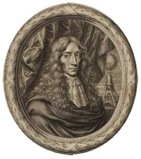
One of the first experimental philosophers, Robert Boyle
But there are also important differences between the two. For instance, early modern x-phi was an all-encompassing approach to the study of nature, a scientific method if you will, whereas contemporary x-phi is more modest in its aspirations (though some see it as supplanting traditional philosophy).
Furthermore, early modern x-phi went through various incarnations because key methodological notions such as hypothesis, experiment and confirmation were stilly being clarified. For example, for its first four decades the early moderns thought that experimental philosophy should be done using the method of Baconian natural history. The success of Newton’s Principia changed all that. By contrast, contemporary x-phi has a sophisticated and robust set of methodological practices and principles on which to proceed.
We are no experts in the new experimental philosophy, but as we explore aspects of its old incarnation in the next posts, we’d be delighted to hear your views on how it relates to its new homonym.
Conference: The Rise of Empiricism
Sydney, 6-7 September 2010
Darlington Centre, Institute Building boardroom
From the conference website:
Empiricism is often regarded as the characterising feature of modern scientific method, and, in those approaches to psychology and the social and economic sciences that seek to model themselves on successful scientific practice in the physical and life sciences, it often acts as a model of good practice. Yet what is advocated is a very simplified model in which a rarefied notion of method as value-free inquiry is presented as the essence of empiricism. The failings of such a conception have long been evident, but the motivations behind the various forms of empiricism have remained obscure. The conference will explore new avenues to the original form of empiricism and show how it was able to directly engage questions of value in a novel and revealing way, and how its connection with ‘hard’ sciences was not merely to provide a methodological gloss on these, but went to the core of what scientific explanation consisted in.
Speakers:
- Peter Anstey (Otago University)
- Millicent Churcher (Sydney University)
- Stephen Gaukroger (Sydney University)
- Peter Kail (Oxford University)
- Rhodri Lewis (Oxford University)
- David Macarthur (Sydney University)
- Liam Semler (Sydney University)
- Dejan Simko (Sydney University)
- Alberto Vanzo (Otago University)
- Anik Waldow (Sydney University)
- Charles Wolfe (Sydney University)
Organiser:
Dr. Anik Waldow
Lecturer
Department of Philosophy, SOPHI
University of Sydney, NSW 2006, Australia
Telephone: +61 2 91141245
Fax: +61 2 9351 3918
Email: anik.waldow[at]sydney.edu.au
Experimental Philosophy and the Origins of Empiricism
Philosophers from the early modern period (from Descartes to Hume) are normally divided into Rationalists and Empiricists. Yet this distinction was developed by post-Kantian philosophers from the late 18th century. In this research project we are exploring the hypothesis that there is a far better way of approaching early modern philosophers.
Our central thesis is that the most common and the most important distinction in early modern philosophy is that between Experimental and Speculative Philosophy. This is a distinction that many of the actors actually used, and, we claim, it can explain all that the traditional distinction can explain and more besides.
Here is how John Dunton describes philosophy in his The Young-Students-Library (1692):
- Philosophy may be consider’d under these two Heads, Natural and Moral: The first of which, by Reason of the strange Alterations that have been made in it; may be again Subdivided into
Speculative
- and
Experimental
- .
- We must consider, the distinction we have made of
Speculative
- and
Experimental
- , and, as much as possible, Exclude the first, for an indefatigable and laborious Search into Natural Experiments, they being only the Certain, Sure Method to gather a true Body of Philosophy, for the Antient Way of clapping up an entire building of Sciences, upon pure Contemplation, may make indeed an
Admirable Fabrick
- , but the Materials are such as can promise no lasting one.
Dunton’s comment in a student text reflects the fact that this distinction was very widespread within natural philosophy. Indeed it is to be found in the writings of almost all of the leading British philosophers in the late seventeenth century, including Locke, Boyle and Newton, and many continental philosophers as well. Moreover, by the mid-18th century this distinction between experimental and speculative philosophy had found its way into other branches of philosophy, such as moral philosophy, aesthetics and the study of the understanding. The experimental-speculative distinction thus provided the fundamental terms of reference within which some of the most important developments of early modern philosophy took shape.
Welcome!
We are Peter Anstey, Juan Manuel Gomez, Alberto Vanzo and Kirsten Walsh. We are four students of early modern philosophy based at the Department of Philosophy of the University of Otago in New Zealand. This is the blog of our research project which is entitled “Experimental Philosophy and the Origins of Empiricism”. You can read a description of our project here.
In this blog, we would like to share and discuss our ideas and research with you. We’ll also let you know about forthcoming events and recent publications which are relevant to our research. Whether you are a philosopher, an intellectual historian, a historian of philosophy or science, or you just have an interest for figures such as Boyle, Locke, Newton or Kant, we hope you’ll find these pages interesting.
We would love to hear from you if you have any feedback, comment, or suggestion. Feel free to leave a comment on these pages or to drop us an email. Also, you can subscribe to the mailing list or to our RSS feed or follow us on Twitter if you’d like us to let you know when we publish new posts.
Thanks for stopping by, and happy browsing!
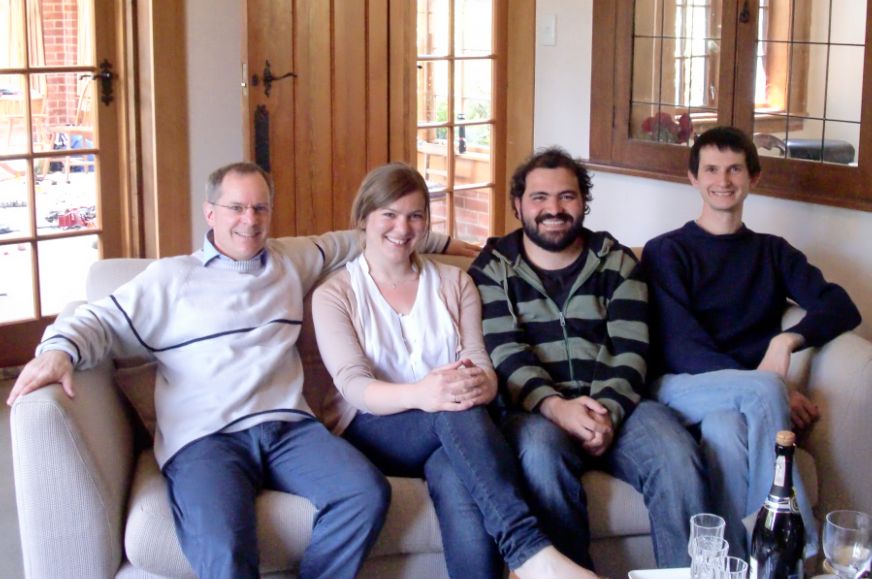
From left to right: Peter, Kirsten, Juan, and Alberto
