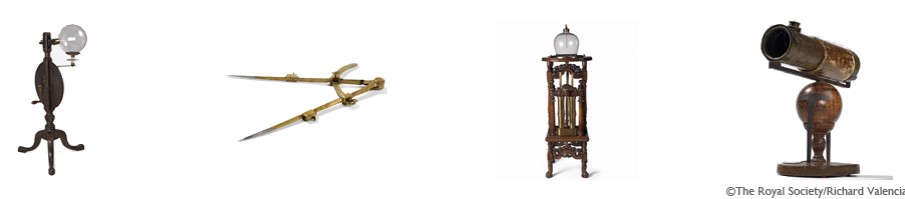
Teaching experimental philosophy: the case of George Adams Jr
Peter Anstey writes…
Around 100 works were published in the eighteenth century that bore the term ‘Experimental Philosophy’ in their title. Of these more than 80 were works designed for the teaching of experimental philosophy. In my last post I examined one of the earliest of these course books, J. T. Desaguliers’ Lectures of Experimental Philosophy of 1719. In this post we turn to one of the last of the course books published in the century, namely George Adams Junior’s 5 volume Lectures on Natural and Experimental Philososphy, first published in 1794.
Before turning to the contents of this work, however, it is worth noting that 48 of the 100 works, that is nearly half of them, were published in the last 15 years of the century. So Adams’ volumes were very much part of a publishing trend and they can only be properly understood by a comparison with the spate of other publications around them.
Nevertheless, these volumes contain some interesting surprises. The first thing to note is that Adams takes a decidedly historical approach to his subject, describing the origins of, say, experiments on air pressure with Torricelli and Pascal and tracing them through Boyle and others. These historical surveys serve to highlight just how important developments in seventeenth-century experimental philosophy were to those writing toward the end of the following century.
The second thing to note is the surprisingly high profile of Francis Bacon and Robert Boyle. The many references to Boyle and the esteem in which Adams clearly held him is perhaps explained in part by the fact that Adams’ work has a theological agenda similar that of some of Boyle’s natural philosophical output. The subtitle to Adams’ book is ‘Describing, in a familiar and easy manner, the Principal Phenomena of Nature; and Shewing, that they all co-operate in Displaying the Goodness, Wisdom, and Power of God’. However, it’s a little over the top when Adams says of Boyle,
- He seems to have been a heavenly spirit in a human form descending from above, to survey the wonders of this lower frame … (vol. 1, p. 10)
This sort of praise is more often associated with Newton in the eighteenth century. Interestingly, Adams seems not to have acquiesced in the over-exuberant praise of Newton. In fact, his view of Newton is far more measured. He does regard Newton as the greatest practitioner of Bacon’s experimental philosophy
- Among those who have pursued the path pointed out in the
Novum Organum
- , Sir Isaac Newton holds the first rank (vol. 2, p. 133)
But when earlier warning against overdependence upon authority he criticizes those who have ‘an implicit faith in the opinions they have adopted’ (vol. 2, p. 104) providing the example of someone who had claimed ‘Newton … is henceforth to be considered as our only sure guide and instructor’.
Thirdly, and most interestingly, Adams includes a 40-page chapter on ‘On the method of reasoning in natural philosophy’ and here we find an enthusiastic endorsement of Bacon’s method of natural philosophy as developed in his Novum organum of 1620. It contains, among other things, a full exposition of the idols of the mind, though Adams shows no interest in Baconian natural history, alluding to it only once and then in passing (vol. 2, p. 136). It is interesting to note, in conclusion, his allusion to Bacon’s comments on the ‘empirical philosophers’. They are,
- those, who labour with great diligence and accuracy, in a few experiments; and then venture to deduce theories and build up systems, strangely wresting every thing else to these experiments. … the opinions produced by these are more deformed and monstrous than those of the sophistical kind.
There is no evidence of the post-Kantian rationalism–empiricism distinction here!
Conflating the Experimental and Mechanical Philosophies
Kirsten Walsh writes…
Recently I read Alan Shapiro’s paper, ‘Newton’s “Experimental Philosophy”’, in which he argues that
- the apparent continuity between Newton’s usage [of the term ‘experimental philosophy’] and that of the early Royal Society is, however, largely an illusion.
To support this claim, Shapiro argues that, whereas ‘experimental philosophy’ was used as a synonym for ‘mechanical philosophy’ by the early Royal Society, for Newton, the two terms had different meanings. This is demonstrated by the fact that Newton adopted the experimental philosophy, but not the mechanical philosophy.
Shapiro explains that the mechanical philosophy is characterised by adherence to some or all of the following theses:
- the world and its components behave like a machine; or, more strongly, the world can be described solely by the mathematical laws of mechanics; all causation is by contact action so that the immaterial, spiritual agents are banished; matter is composed of invisible corpuscles; and hypotheses about the properties and motions of these invisible corpuscles may be formulated to explain visible effects.
Here Shapiro is conflating mechanism and corpuscularianism. However, Peter Anstey explains in his recent book, John Locke and Natural Philosophy, that these are distinct (but related) philosophies. The leading idea of the mechanical philosophy is that natural phenomena should be explained by analogy with the functioning of machines. The corpuscularian philosophy is primarily a philosophy about the underlying nature of matter, whereby explanations of natural phenomena are constrained by appeal to the invisible corpuscles which constitute all material bodies. Thus, the former is a theory of explanation; the latter, a theory of matter. There is a significant amount of overlap between the mechanical and corpuscularian philosophies, for example the focus on shape, size, motion and texture. But, they are not interchangeable. For example, Anstey points out that it wasn’t the case that everyone who held a corpuscularian theory of matter was a mechanical philosopher.
In contrast, the experimental philosophy emphasises that we can only acquire knowledge of nature by first accumulating observations and experiments and then turning to theory and hypotheses. Thus, the experimental philosophy is a theory of method, which can be viewed as placing epistemic constraints on philosophical endeavours, as opposed to the explanatory constraints of the mechanical philosophy, or the ontological constraints of the corpuscularian philosophy. So, at least notionally, these are three distinct philosophical positions.
Shapiro argues that, in practice, the early Royal Society didn’t distinguish between these philosophical positions. As evidence, he cites a passage from the preface to Robert Hooke’s Micrographia in which Hooke runs together “the real, the mechanical, the experimental philosophy”. But if we look at Hooke’s other work for uses of the term ‘mechanical’, we find that he can and does distinguish the mechanical from the experimental.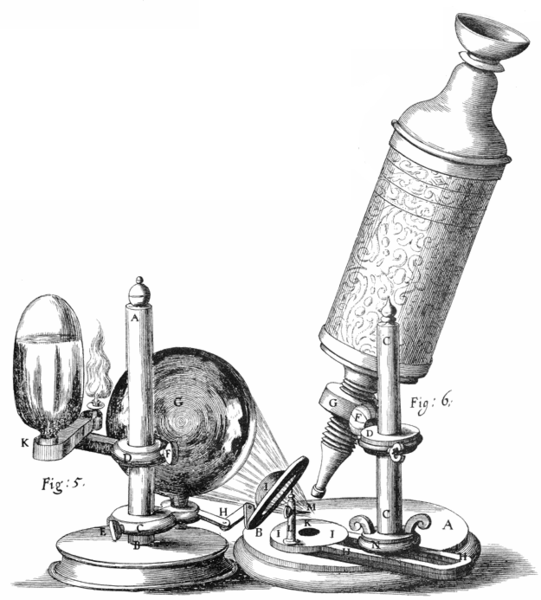
When Hooke explicitly discusses experimental philosophy, he emphasises the importance of constructing natural histories. For example, in his ‘General Scheme’, where he sets out his “Method of Improving Natural Philosophy”, Hooke explains that the best way to proceed is according to the Baconian method of natural history. He says there are three “ways of discovering the Properties and Powers [of bodies]”:
- I. By the Help of the Naked Senses.
- II. By the Senses assisted with Instruments, and arm’d with Engines.
- III. By Induction, or comparing the collected Observations, by the two preceding Helps, and ratiocinating from them.
When he discusses III, Hooke explains that an understanding of mathematics and mechanics “will most assist the Mind in making, examining, and ratiocinating from Experiments”:
- Mechanicks also being partly Physical, and partly Mathematical, do bring the Mind more closely to the business it designs, and shews it a Pattern of Demonstration, in Physical Operations, manifests the possible Ways, how Powers may act in the moving resisting Bodies: Gives a Scheme of the Laws and Rules of Motion, and as it were enters the Mind into a Method of accurate and demonstrative Inquiry and Examination of Physical Operations. For though the Operations of Nature are more secret and abstruse; and hid from our discerning, or discovering of them, than those more gross and obvious ones of Engines, yet it seems most probable, by the Effects and Circumstances; that most of them may be as capable of Demonstration and Reduction to a certain Rule, as the Operations of Mechanicks or Arts.
Later in the same discussion, Hooke enumerates the different kinds of observations one should make when constructing natural histories:
- 25ly, To enquire and try how many Mechanical Ways there may be of working on, or altering the Proprieties of several Bodies; such as hammering, pounding, grinding, rowling, steeping, soaking, dissolving, heating, burning, freezing, melting, &c.
Hooke is using the term ‘mechanical’ in (at least) two different senses. In the first sense, the term describes the processes of machines; in the second sense, the term describes manual work. But he conflates neither of these with the experimental philosophy. They are distinct, albeit related, philosophies.
Previously on this blog we have claimed that some features of Newton’s early methodology, for example his early use of queries, suggest that he was influenced by the new experimental philosophy of the early Royal Society. I do not claim that Newton’s experimental philosophy is continuous with the experimental philosophy of the early Royal Society, so I do not take issue with Shapiro’s main claim. But I do take issue with his claim that the ‘mechanical philosophy’ and ‘experimental philosophy’ were considered by the early Royal Society to be synonymous.
CFP: Early Modern Medicine and Natural Philosophy
Center for the Philosophy of Science, University of Pittsburgh
2-4 November 2012
The aim of the conference is to bring to the fore the medical context of the ‘Scientific Revolution’ and to explore the complex connections between medicine and natural philosophy in Renaissance and Early Modern Europe. Medicine and natural philosophy interacted on many levels, from the practical imperative to restore and maintain the health of human bodies to theoretical issues on the nature of living matter and the powers of the soul to methodological concerns about the appropriate way to gain knowledge of natural things. And issues of life, generation, ageing, medicine, and vital activity were important topics of investigation for canonical actors of the Scientific Revolution, from Boyle, Hooke and Locke to Descartes and Leibniz. Recent efforts to recover the medical content and contexts of their projects have already begun to reshape our understanding of these key natural philosophers. Putting medical interests in the foreground also reveals connections with a wide variety of less canonical but historically important scientists, physicians, and philosophers, such as Petrus Severinus, Fabricius ab Aquapendente, Lodovico Settala, William Harvey, Richard Lower, Thomas Willis, Louis de la Forge, and Georg Ernst Stahl. This interdisciplinary conference will bring together scholars of Renaissance and Early Modern science, medicine and philosophy to examine the projects of more and less canonical figures and trace perhaps unexpected interactions between medicine and other approaches to studying and understanding the natural world.
Submission of extended abstracts for individual paper presentations (limit 30 minutes) are invited. More information is available here.
Confirmed speakers include:
Domenico Bertoloni Meli (Indiana University)
Antonio Clericuzio (University of Cassino)
Dennis Des Chene (Washington University)
Patricia Easton (Claremont Graduate University)
Cynthia Klestinec (Miami University, Ohio)
Gideon Manning (Caltech)
Jole Shackelford (University of Minnesota)
Justin E. H. Smith (Concordia University, Montreal)
Degérando’s Experimental History of Philosophy
Alberto Vanzo writes...
So far, on this blog, we have focused on a philosophical movement and a historiographical tradition. Of course, the movement was experimental philosophy. The historiographical tradition was based on the dichotomy of empiricism and rationalism and was first developed by Kantian and post-Kantian authors, like Reinhold and Tennemann, who did not belong to the movement of experimental philosophy. This post is on a historian who was an adherent of experimental philosophy and who endeavoured to employ its methodology in his history of philosophy. He is Joseph-Marie Degérando, who published a Comparative History of the Philosophical Systems, relatively to the Principles of Human Knowledge in 1804. Interestingly, this text is also influenced by the new post-Kantian historiography based on the rationalism-empiricism distinction.
Degérando intends to apply the method of natural history to the history of philosophy. Natural histories were large structured collections of facts about natural phenomena and they were to form the basis for the identification of theories and principles. Degérando’s history of philosophy is a structured collection of facts about past philosophies which will help us identify which philosophical outlook is the best.
Before starting to collect the facts, we must determine the organizing principles of the collection. Philosophers should
- imitate naturalists, who, before entering into the vast regions of natural history, give us regular and simple nomenclatures and they seek the principle of these nomenclatures in the essential characters of each production.
The “nomenclatures” that form the basis for Degérando’s natural history of past philosophers are three dichotomies: scepticism vs dogmatism, empiricism (or sensualism) vs rational (or speculative or contemplative) philosophy; and materialism vs idealism.
Armed with these nomenclatures, historians of philosophy should free themselves of all prejudices and collect historical facts in an unbiased way. Only after having completed this task should historians start philosophizing. Degérando claims to have ascertained “facts as if” he were “foreign to every opinion” and he has “later established an opinion on the basis of the sole testimony of facts”.
In doing this, Degérando does not aim to write a “simple narrative history, to use Bacon’s expression”, but an “inductive or comparative history that converts the facts into “experiences in the path of human spirit.”
- […] the work that we set out to do can be considered as the essay of a treatise of philosophy, […] a treatise conceived of according to the most cautious, albeit most neglected method, the method of experiences. Hence, we dare to offer this essay as an essay of experimental philosophy.
Degérando is strongly influenced by the post-Kantian historiography of Tennemann and other German historians. Like Tennemann, he focuses on epistemological issues concerning “the certainty of human cognitions”, “their origin” and their reality. Degérando uses the distinction between empiricism and rationalism. Like the Kantians, he criticizes them as two unilateral points of view that should be overcome by a higher philosophical standpoint. This is a form of experimental philosophy that is inspired by Bacon and Condillac and is superior to empiricism which as criticized by German historians. Empiricism stops at the facts. The philosophy of experience “transforms them” and identifies general laws.
- Empiricism does not see anything else than the exterior of the temple of nature; experience enters into its sanctuary. Empiricism is an instinct; experience is an art. Empiricism does not see anything else than phenomena, experience ascends from effects to causes. Empiricism is confined to the present; experience learns the future from the past. Empiricism obeys blindly, experience interrogates with method. Everything is mobile, fugitive for empiricism; experience discovers regular and constant combinations underneath the variable appearances. But what need is there to insist on this distinction? He who opens [a book by] Bacon will see it standing out in every page.
The philosophical upshot of Degérando’s experimental history of philosophy
- is spelled out by Bacon’s words, when he said in his preface to the Advancement of Learning: in this way we believe that we are combining, in a manner that is as stable as legitimate, the empirical and rational methods […]
According to Degérando, experimental philosophy, and not Kant’s Critical philosophy is the true, higher synthesis of empiricism and rationalism.
Defending the Scholastics
One of the features of Early Modern Experimental Philosophy was the rejection of the ‘old ways,’ the Scholastic system of philosophy in particular. We have shown in this blog ample evidence of the attack on the Scholastics by those who promoted Experimental Philosophy. We have been showing how the ESD plays an important role in the early modern period, but we have focused mainly on the work of experimental philosophers. In this post I want to present a text that defends the usefulness of the logic of the Scholastics (the use of syllogistic logic in particular). The text is by Edward Bentham (1707-1776), a teacher of divinity in Oxford for twenty years. In 1740 he published Reflections upon the nature and usefulnes of logick as it has been commonly taught in the schools.
In this text, Bentham does not explicitly attack the “new philosophy.” In fact, at some points he recognizes some of the flaws that the promoters of experimental philosophy found in the Scholastics. But his general claim is that those who reject Scholastic logic are making a huge mistake. In the first couple of pages Bentham tells us that most of the treatises in Logic were “wrote in abstruse Scholastic Language,” and these lead the “moderns” to reject “the dry Systematical method of delivering rules.” But these thinkers end up doing more damage by their rejection of Scholastic logic:
- They launch out into various disquisitions upon abstruse subjects; and often draw the illustration of their rules from the depth of other sciences. And by this means, while they seem to enrich the mind with new discoveries, and therefore entertain the Fancy, they perplex the Judgment; While they promise to give the understanding more activity and freedom, they really rob it of that balast, by which in prudence it should be kept steady, and be prevented from being hasty and precipitant in its determinations. Thus enquiries into the nature of our Souls, our Sensations, our Passions and Prejudices, with other springs of wring judgment, make a part of the natural History of Man, rather than a part of Logick, and are of too mixed a nature to fall under general rules.
Bentham seems to be arguing that Scholastic logic should be learnt before exploring any of the other sciences, but this is not to say that the former is all that is needed and the rest of the sciences are useless. On the contrary, they are at the same level: “At the same time that we admire the ingenuity and great learning of later Philosophers, let the exact method and accuracy of the Scholastick Systematical Logicians be entitled to our praise and imitation.” Bentham does admit that there are some flaws in the Scholastic system, but they have nothing to do with the logic. He goes over the different parts of Scholastic logic, and when discussing syllogisms he tells us:
- Now it must be own’d, that in discourse upon ordinary matters, we have no occasion, either to put ourselves to the trouble of continually applying a common standard, or to tie ourselves up to the strictness of Scholastick form, in order to perceive the agreement or disagreement above mentioned [Syllogisms]: Nor can it be any great edification to an inquisitive Student to be told in such variety of form, as sometimes he is in treatises of Scholastick Logick, that Man is Animal. But yet he may find his account in learning those general rules, which are applicable, as a test, to all reasoning, however varied or disguised by the advantage of witty turns and good Language.
Bentham considers Syllogisms to be of great use, and in the final pages of his text he confirms the importance of Scholastic Logic and attacks the moderns who reject it:
- Since the decline of Scholastick learning, though Science of every kind has received prodigious improvements by the labour and sagacity of exalted Genius’s, yet we find the common run of reasoners as bad as ever; –not more knowing, but much more conceited; –not so ambitious as to improve their knowledge, as to conceal their ignorance; –determining magisterially upon points, without knowing or considering the first principles, of what they are discoursing of; –taking themselves to be masters of every subject, upon which they can raise an objection…
In a previous post, Peter Anstey commented on the Straw Man problem for the ESD. But this text by Bentham shows that there was still some appreciation for Scholastic Logic, especially the use of syllogism. Despite all the criticisms of the Scholastic system made by the promoters of experimental philosophy Bentham defended their logic. As Kenneth Winkler points out in his chapter (Lockean logic) in The Philosophy of John Locke: New Perspectives, Bentham was one of the thinkers who attempted to adopt a kind of Lockean logic but without giving up syllogistic. Determining if Bentham was after all (beyond logic) a speculative philosopher requires a lot more than a blog post, but I will keep working on it and follow up on this issue in the near future.
Teaching Experimental Philosophy: Desaguliers and Boyle
Peter Anstey writes…
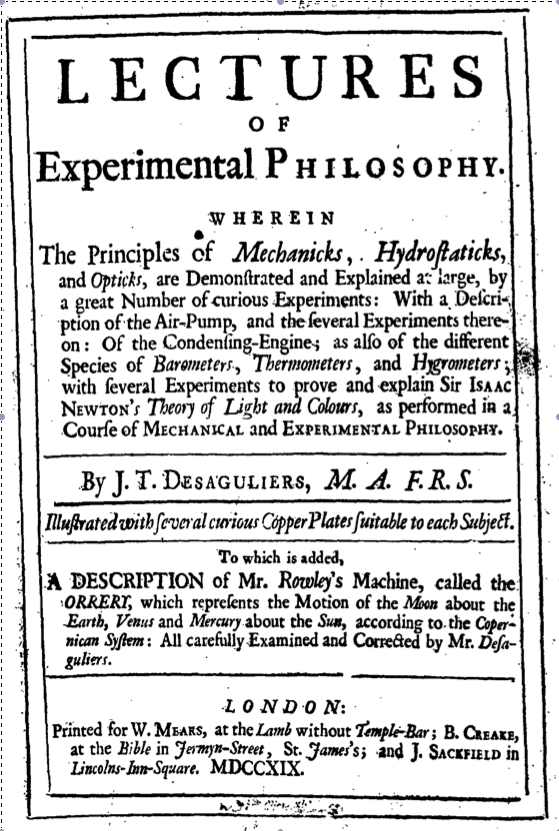 According to ECCO there were one hundred books published in the eighteenth century with the term ‘experimental philosophy’ in their title. What is surprising about these books is that the majority of them are courses in or lectures on experimental philosophy: they are pedagogical works rather than works in natural philosophy per se.
One of the earliest of these works was Lectures of Experimental Philosophy by John Theophilus Desaguliers published in 1719. This work gives the principles of mechanics, hydrostatics and optics, explaining them with descriptions of experiments that had recently been used in these disciplines.
The work is written in the spirit of the experimental philosophy and before Desaguliers launches into his exposition of mechanics, the first discipline that he discusses, he provides the reader with a sketch of the ‘principles’ of natural philosophy. What is interesting is that much of this derives without acknowledgment from Robert Boyle’s Origin of Forms and Qualities (1666/7). Thus, Desaguliers tells us that:
- 1. That the Matter of Natural Bodies is the same; namely, a Substance extended, divisible, and impenetrable. (p. 7)
In Forms and Qualities Boyle says,
- The Matter of all Natural Bodies is the Same, namely a Substance extended and impenetrable. (Works of Robert Boyle, eds Hunter & Davis, 5: 333)
If one were to quibble that Desaguliers has left out the word ‘divisible’, we need only to turn to an earlier passage in Forms and Qualities where Boyle says:
- there is one catholic or universal matter common to all bodies, by which I mean a substance extended, divisible, and impenetrable. (Works, 5: 305)
That Desaguliers read this passage is evident from his third claim:
- 3. That Local Motion is the chief Principle amongst second Causes, and the chief Agent of all that happens in Nature. (p. 8)
Boyle says in the very next paragraph,
- that Local Motion seems to be indeed the Principl amongst Second Causes, and the Grand Agent of all that happens in Nature. (Works, 5: 306)
There are other borrowings from Forms and Qualities, but space prevents me from listing them here. Two points are worth noting, however. First, it is very interesting to see concrete evidence of the influence of Boyle’s Forms and Qualities in the latter years of the second decade of the eighteenth century. Until now there has been little recognition of the impact of this specific work by Boyle, though few would doubt his enormous impact on British experimental philosophy in general.
Second, the text that Desaguliers lifts from Boyle appears in the speculative part of Forms and Qualities: it is speculative natural philosophy and is supported in the ‘historical part’ of that work by experimental observations. There is no sense of this division in Desaguliers’ treatment of these ‘principles’, though he does bring some experimental evidence to bear against the Cartesian materia subtilis. After dismissing various other speculative theories, such as Aristotelianism, Desaguliers simply introduces Boyle’s speculative theory with the following words:
- That Philosophy therefore is the most reasonable, which teaches …
Hypotheses and Newton’s Epistemic Triad
Kirsten Walsh writes…
Over the weekend, I participated in a conference on ‘Newton and his Reception’, at Ghent University. I presented a paper based on my idea that Newton is working with an ‘epistemic triad’. I had an excellent audience in Ghent, and received some very helpful feedback, but I’d like to hear what you think…
To begin, what is Newton’s ‘epistemic triad’?
In his published work, Newton often makes statements about his purported method in order to justify his scientific claims. In these methodological statements, he contrasts things that have strong epistemic credentials with things that lack those credentials. Consider, for example, these passages from his early papers on optics:
- For what I shall tell concerning them is not an Hypothesis but most rigid consequence, not conjectured by barely inferring ’tis thus because not otherwise or because it satisfies all Phænomena … but evinced by ye mediation of experiments concluding directly & wthout any suspicion of doubt. (6 February 1672)
- I shall not mingle conjectures with certainties… (6 February 1672)
- To determine by experiments these & such like Queries wch involve the propounded Theory seems the most proper & direct way to a conclusion. (3 April 1673)
What these passages tell us is that Newton is making a distinction between theories, which are certain and experimentally confirmed, hypotheses, which are uncertain and speculative, and queries, which are not certain, but provide the proper means to establish the certainty of theories. I call this three-way division Newton’s ‘epistemic triad’, and argue that this triad provides the framework for Newton’s methodology.
To support this argument, I defended the following three theses:
Endurance thesis. There are some general features of Newton’s methodology that don’t change. These are characterised by the framework of the epistemic triad.
Developmental thesis. There are some particular features of Newton’s methodology that change over time. These can be characterised as a development of the epistemic triad.
Contextual thesis. There are some particular features of Newton’s methodology that vary with respect to context (namely, mechanics versus optics). These can be characterised as an adaptation of the epistemic triad to particular contexts.
The developmental and contextual theses are not news to most Newton scholars. It is commonly accepted that Newton’s methodology changed in important ways over the course of his life, and that there are methodological differences between Principia and Opticks. The endurance thesis is more problematic, so I made a special effort to show that Newton’s use of hypotheses is more consistent than we think. I argued that:
- In Principia, Newton appears to be working with the same implicit definition of ‘hypothesis’ that he works with in his early optical papers; and
- Hypotheses perform similar methodological roles in all of Newton’s natural philosophical work.
I need to do some more work to properly explicate this methodological role. But, to state it very broadly, Newton temporarily assumes hypotheses, which act as ‘helping premises’ in his inferences from phenomena. The fact that a statement may appear in Newton’s writing as a hypothesis, and then reappear later in a query, rule of reasoning, or phenomenon, has convinced many Newton scholars that Newton is inconsistent in his use of hypotheses. Against this conviction, I argue that Newton applies the label ‘hypothesis’ to things that perform a particular function, rather than to a particular claim.
Edward Caird on the history of early modern philosophy
Alberto Vanzo writes…
By researching the history of early modern experimental philosophy, my fellow bloggers and I are attempting to provide an alternative to the standard narrative of early modern thought as a prolonged conflict between the empiricist school of Locke, Berkeley, and Hume and the rationalist school of Descartes, Spinoza, and Leibniz. Who was responsible for coining and popularizing that standard narrative?
Several scholars suggested that British Idealists in particular, played an important role in this process. I recently tested this suggestion by doing some research on Edward Caird, one of the main first-generation British Idealists.
Caird did not write any history of philosophy, but he provided extended accounts of early modern thought in his widely read Kant books. The quotes below are from the first volume of The Critical Philosophy of Immanuel Kant (1889).
Caird sees his own idealism as a completion of the philosophical revolution initiated by Kant. Kant’s Critical philosophy opened the doors to an “idealistic interpretation of the universe” (44) by synthesizing “the different tendencies of his time” and going “beyond their one-sidedness, and thereby lifted philosophical discussion to a new level” (44).
“How are we to describe” this “great change”, initiated by Kant? (46) “In general terms we may say that it was a change from division to reconciliation, from Individualism and Atomism to a renewed perception that the whole is prior to the parts, and that individual independence must rest on social unity” (46, see 70). Individualism is the guiding principle of the whole “history of [early] modern philosophy” (72).
“The history of modern thought begins with” Martin Luther’s “declaration of the spiritual independence of the individual, and the rejection of the principle of authority” (72). Along similar lines, modern science and “Bacon’s empiricism” placed a strong emphasis on individual, first-hand knowledge. Luther and Bacon attempted to go beyond mere subjectivity to achieve “the unity of thought with its object” (74). They failed, giving rise to the scepticism with which Descartes grappled at the beginning of the Meditations. Descartes overcame it by relying on God’s veracity. To Descartes, “our consciousness of God” is prior even to “our consciousness of ourselves” (76).
Malebranche and Spinoza developed Descartes’ theocentric approach to unify subject and object, but they failed and gave way to the individualist assumption that “we must see all things” not in God, but “in ourselves”, either “through the sensations which outward objects have produced in our minds, or through the ideas which spring directly out of our own consciousness, that we come to a knowledge of other things” (83). Locke’s and Hume’s empiricism explored the first alternative, Leibniz’s and Wolff’s rationalism the second. They all failed, leading “the progress of Individualism to its necessary consummation in Scepticism” (86). Only Kant managed to synthesize subject and object, mind and world by realizing that the latter is mind-dependent and placing “the idea of a self-determining subject” (85) at the centre of his philosophy. Thus ends Caird’s account of early modern thought.
How much of the standard narratives of early modern philosophy can we find in this account? The emphasis on the individualism of the Reformation may have struck a familiar chord. The account of Kant’s Critical philosophy as a synthesis of Lockean and Leibnizian ideas and an antidote to scepticism sounds familiar too. But these are precisely the elements of Caird’s account that are not distinctive of Idealist accounts of early modern thought, such as Schwegler‘s and Erdmann’s. Their distinctive traits are others, like the following:
- an emphasis on individualism as a distinctive feature of the entire early modern period,
- a theo-centric interpretation of Descartes, Malebranche and Spinoza (but not Leibniz) as members of a single school,
- the teleological reading of early modern thinkers as struggling to reach an adequate understanding of the unity of subject and object, mind and world — something that only Hegel would fully achieve.
Besides having these rather unfamiliar features, Idealist histories of early modern thought do not spell out the standard triumvirates. They sever the theocentric philosophies of Descartes, Malebranche, and Spinoza from Leibniz’s and Wolff’s philosophy. They read Berkeley as an idealist rather than an intermediate step in the progress from Locke to Hume. On the whole, then, Caird’s account of early modern thought is much less similar to standard histories of early modern philosophies than Tennemann’s earlier, Kant-inspired History of Philosophy. This leads me to doubt that British Idealism is key to understanding how the standard narrative of early modern thought came to the fore.
Experiments in Early Modern Moral Philosophy
Juan Gomez writes…
As we have constantly argued for in this blog, experimental philosophy went beyond the boundaries of natural philosophy and was adopted in a number of other areas (ethics, aesthetics, theology, etc.) We have seen that this is particularly true in the case of Scotland (Turnbull, Hume, Fordyce, Reid, Hutcheson, Smith etc.), but we are yet to discuss the suitability of the experimental method of natural philosophy for enquiries into moral philosophy. In particular, we have not examined in any detail what those thinkers we have discussed would count as ‘experiments’ in formulating their moral theories. This is the topic of today’s post.

In a previous post I commented on Turnbull’s description of paintings as suitable samples or experiments for moral philosophy. But that discussion considered Turnbull’s Treatise on Ancient Painting instead of his main moral text, The Principles of Moral Philosophy. In the latter there is no explicit statement of what experiments for moral philosophy would look like, but we can get a picture of what they would amount to. Turnbull constantly writes statements where he tells us that the only method we should apply in all inquiries is one founded on experiment and observation:
- …we set about such an inquiry [moral] in the fair impartial way of experiment, and of reasoning from experiment alone…
…the whole of true natural philosophy is not, for that reason, no more than a system of facts discovered by experiment and observation; but it is a mixture of experiments, with reasonings from experiments: so in the same manner, in moral philosophy…
In fine, the only thing in enquiries into any part of nature, moral or corporeal, is not to admit any hypothesis as the real solution of appearances, till it is found really to take place in nature, either by immediate experiment, or by necessary reasonings from effects, that unavoidably lead to it as their sole cause, law, or principle.
It is only in the way of experiment, that either the science of the human mind, or of any material system can be acquired.
From these statements and the argument Turnbull develops in his book, it seems that he is using ‘experiment’ in a sense that is closer to the meaning of ‘experience’. This usage of the term is not surprising, since the French word ‘experience’ can mean both ‘experiment’ and ‘experience,’ and even in English and in Spanish the word can be used with both senses (the verb ‘experimentar’ in Spanish is used both to refer to ‘experience’ and to ‘experiment’). So it seems that ‘experiments’ in moral philosophy lose one of the connotations the term has in natural philosophy, namely the active, manipulation of nature. When Turnbull insists that in moral philosophy we can only reason by way of experiments, he is talking about observing and experiencing the way human beings behave, and founding our conclusions on such observations. So far we would have to say that there are no experiments per se in moral philosophy, but rather just experience and observation.
However, there is an aspect that does have some sort of parallel with experiments in natural philosophy. As I commented in a previous post, introspection is one of the aspects that the Scottish experimental moral philosophers used in their investigations, and this is the experimenting factor in their method. If we are to follow the methodology of experimental philosophy, then we must found all our theories on experience and observation, and completely disregard any sort of hypotheses and speculation. But when the subject of our inquiries is the human mind, our observations are limited. Yes, we can observe how other human beings behave, and that can give us some knowledge, but we cannot observe their minds. The only way anyone can observe the human mind and its operations is by looking into and experiencing their own mind, by introspection. By looking into our own minds we can construct an explanation of our constitution and behaviour based on such observations, and then we can observe others and compare experiences in order to enrich our moral theories. This is why Turnbull is constantly asking the reader not to take his word for the claims he makes, but rather experiment and look into their own minds to confirm such claims. He wasn’t the only one taking this stand: Thomas Reid also appeals to introspection and even Locke as early as Draft B of the Essay (1671) takes introspection to be a form of experiment.
So it seems that the term ‘experiment’ was tweaked for its application in moral philosophy. It is closer to what we mean by ‘experience,’ but it keeps an aspect of ‘experimenting’ that is limited to the each individual’s own mind. The question remains, however, as to whether we can actually count introspection as a proper experiment or not. The Scottish experimental moral philosophers certainly counted it just as they would count any experiment in natural philosophy.
CFP: Creative Experiments
From the Zeta Books website:
The Journal of Early Modern Studies is seeking contributions for its second issue (Spring 2013). It will be a special issue, devoted to the theme:
Creative experiments:
Heuristic and Exploratory Experimentation in Early Modern Science
Editor: Dana Jalobeanu
The past decade has seen a renewed interest in multiple aspects of early modern experimentation: in the cognitive, psychological and social aspects of experiments, in their heuristic and exploratory value and in the complex inter-relations between experience, observation and experiment. Meanwhile, comparatively little has been done towards a more detailed, contextual and specific study of what might be described, a bit anachronistically, as the methodology of early modern experimentation, i.e. the ways in which philosophers, naturalists, promoters of mixed mathematics and artisans put experiments together and reflected on the capacity of experiments to extend, refine and test hypotheses, on the limits of experimental activity and on the heuristic power of experimentation. So far, the sustained interest in the role played by experiments in early modern science has usually centered on ‘evidence’- related problems. This line of investigation favored examination of the experimental results but neglected the “methodology” that brought about the results in the first place. It has also neglected the more creative and exploratory roles that experiments could and did play in the works of sixteenth and seventeenth century explorers of nature.
JEMS is an interdisciplinary, peer-reviewed journal of intellectual history, dedicated to the exploration of the interactions between philosophy, science and religion in Early Modern Europe. It is edited by the Research Centre “Foundations of Modern Thought”, University of Bucharest, and published and distributed by Zeta Books. For further information on JEMS, please visit http://www.zetabooks.com/journal-of-early-modern-studies.html.
We are seeking for articles no longer than 10,000 words, in English or French, with an abstract and key-words in English. Please send your contribution by the 1st of October 2012 to jems@zetabooks.com.
