
Buffon and the Experimental Philosophy
Peter Anstey writes …
The historiography of the Enlightenment over the last fifty years has focused heavily on the influence of the natural philosophy of Bacon and Newton and the philosophy of Locke on the French philosophes.
Surprisingly, however, the thought of Bacon, Locke and Newton has rarely been seen as part of the broader impact of the experimental philosophy movement: the focus has been on individuals and their thought and experimental philosophy has been regarded as an expression of the ‘empiricism’ of these thinkers. See for example, Jonathan Israel’s monumental Radical Enlightenment and Democratic Enlightenment, neither of which lists ‘experimental philosophy’ in its index and which tend to subordinate English experimental philosophy to empiricism. (The term gets a mere 4 entries in the index of his 983-page Enlightenment Contested.)
Now, one text that has been repeatedly cited as early evidence of the important impact of Newton is Buffon’s Translator’s Preface to his 1735 French translation of Stephen Hales’ Vegetable Staticks of 1727. But when we turn to the text itself it’s pretty clear that Newton is merely an exemplar of a broader phenomenon.
As we have argued many times on this blog, the experimental philosophy that emerged in England in the 1660s was characterized by an emphasis on observation and experiment, an aversion to theoretical systems and especially its decrying of hypotheses and principles. Let us look at Buffon’s Preface and see what he has to say about Hales’ book. He says:
- The novelty of the discoveries and the majority the ideas [of Hales’ book] will no doubt surprise natural philosophers. I know nothing better of its kind, and the genre itself is excellent, for it is only experiment and observation.
- … works founded on experiment, merit more than others. I can even say that in natural philosophy, one ought to search out experiments as much as one ought to be afraid of systems. I admit that there is nothing so good as to establish first a single principle, and then to explain the universe, and I am convinced that if one were so happy to divine it, all the pain that it takes to make experiments would be unnecessary. But sensible people see rather how much this idea is vain and chimerical: the system of nature probably depends upon several principles, principles that are unknown to us and their combination even less so.
- … It is by choice experiments, reasoned and followed, that one forces nature to reveal its secret. All the other methods have never succeeded.
- … Collections of experiments and observations are therefore the only books that can augment our understanding. Being a natural philosopher is not a matter of knowing what follows from this or that hypothesis, in supposing, for example, a subtle matter, vortices, an attractive force, etc. It is to know well that by which it comes and to understand that which is presented to our eyes. The understanding of effects will conduct us insensibly to that of their causes and will not trip us up into the absurdities that seem to characterize all systems.
- … It is this method that my author [Hales] has followed. It is that of the great Newton; that which Bacon, Galileo, Boyle, Stahl recommended and embraced; that which the Académie of Sciences has made it a law to adopt … (pp. iii–vi)
Notice the underlined words here: ‘experiment and observation’, ‘systems’, ‘vain and chimerical’, ‘hypothesis’. This passage bears all the hallmarks of an expression of the central doctrines of the experimental philosophy. This is reinforced by the gallery of greats that is listed: Bacon, Galileo, Boyle, Stahl.
The focus is not on individuals such as Newton at all, nor is it on empiricism. It is on the méthode of the experimental philosophy. This is what Voltaire had referred to just one year earlier in 1734 in his letter ‘On the Lord Bacon’ in his Letters concerning the English Nation, where he claimed that Bacon ‘is the Father of experimental philosophy’ and that ‘no one before the Lord Bacon was acquainted with experimental Philosophy’.
It is the experimental philosophy, and not Bacon or Newton, that Buffon is praising and advocating. The experimental philosophy, as discussed by Buffon, Voltaire, d’Alembert and Diderot, needs to become a central notion in our historiography of the Enlightenment.
Hypotheses versus Queries in Newton’s Opticks
Kirsten Walsh writes…
A while ago I argued that the queries in Newton’s early optical papers are not hypotheses. Rather, they are empirical questions that may be resolved by experiment. In Newton’s Opticks, however, his queries become increasingly speculative – especially the famous ‘Query 31’. What should we make of this? Did Newton abandon his early distinction between hypotheses and queries?
In his early optical papers, Newton explains that “the proper Method for inquiring after the properties of things is to deduce them from Experiments”. Having obtained a theory in this way, one should proceed as follows:
- specify queries that suggest experiments that will test the theory; and
- carry out those experiments.
He tells us that hypotheses have a role in this procedure. They may be useful for: (a) suggesting further experiments, as the first step toward specifying queries; and (b) ‘illustrating’ the theory to assist understanding.
The queries in Newton’s Opticks have been much talked about, and often Newton has been accused of slipping hypotheses into his work under the guise of the more-respectable query. To examine this claim, I looked at the draft manuscripts* of Newton’s Opticks; in particular, “The fourth book concerning the nature of light & ye power of bodies to refract & reflect it” (Add. 3970, 337-8).
The draft begins, as many of the other books of Opticks begin, with a list of observations, followed by numbered propositions. However, it contains little in the way of argument and virtually no discussion of experimental evidence. Shapiro points out that this is because this is a draft of an outline or plan of a book; not a draft of the book itself. The propositions are things that Newton hoped to prove. For example:
- Prop. 1. The refracting power of bodies in vacuo is proportional to their specific gravities.
Prop. 2. The refracting power of two contiguous bodies is the difference of their refracting powers in vacuo.
The draft contains a section entitled ‘The conclusion’, which contains five ‘hypotheses’. I am interested in ‘Hypothesis 2’:
- As all the great motions in the world depend upon a certain kind of force (wch in this earth we call gravity) whereby great bodies attract one another at great distances: so all the little motions in ye world depend upon certain kinds of forces whereby minute bodies attract or dispell one another at little distances.
- How the great bodies of ye earth Sun moon & Planets gravitate towards one another what are ye laws of & quantities of their gravitating forces at all distance from them & how all ye motions of those bodies are regulated by those their gravities I shewed in my Mathematical Principles of Philosophy to the satisfaction of my readers: And if Nature be most simple & fully consonant to her self she observes the same method in regulating the motions of smaller bodies wch she doth in regulating those of the greater… The truth of this Hypothesis I assert not because I cannot prove it. But I think it very probable because a great part of the phaenomena of nature do easily flow from it wch seem otherways inexplicable…
I. Bernard Cohen describes this as “a ‘whale’ of an hypothesis” – and he’s right! When Newton started writing out this statement, he intended for it to be ‘Proposition 18’. But at some point, he has scratched out ‘Prop 18’, and re-branded it as ‘Hypoth 2’. There is no real semantic difference between a proposition and a hypothesis, but, for Newton, there is an epistemic difference. Propositions are things that he is able to assert as true. Hypotheses are things that he is unable to assert, because he does not have the evidence. Newton clearly hoped to assert Proposition 18. But as he started to explicate it, he must have realised that he couldn’t prove it. Thus, he re-labelled it as a hypothesis.
When Newton abandoned the fourth book, and restructured the rest of his Opticks, this ‘Hypothesis 2’ appears to have been re-worked to become ‘Query 31’ in Opticks, 2nd edition (1717):
- Have not the small Particles of Bodies certain Powers, Virtues, or Forces, by which they act at a distance, not only upon the Rays of Light for reflecting, refracting, and inflecting them, but also upon one another for producing a great Part of the Phaenomena of Nature? For it’s well known, that Bodies act one upon another by the Attractions of Gravity, Magnetism, and Electricity; and these Instances shew the Tenor and Course of Nature, and make it not improbable but that there may be more attractive Powers than these. For Nature is very consonant and conformable to her self…
 Here, there is an obvious semantic shift between hypothesis and query: the query is stated as a question. Some scholars have argued that this is the only difference between hypotheses and queries: in the Opticks, queries are simply Newton’s way of getting around his self-imposed ban on hypotheses. I claim that there is more to the shift than this. Newton is using the semantic structure of the query to explore a possible future research program. The epistemic difference between the query and the hypothesis is similar to the epistemic difference between Popper’s falsifiable and unfalsifiable theories. The former is testable-in-principle, whereas the latter is not; and testability is a necessary condition of something becoming well-tested.
There is a difference between Newton’s early queries and his later queries: the former are part of the process of justification; but the latter are part of the process of discovery. In a previous post I noted that:
- While Newton’s [early] method of queries is experimental, it does not appear to be strictly Baconian. For the Baconian-experimental philosopher, queries serve “to provoke and stimulate further inquiry”. Thus, for the Baconian-experimental philosopher, queries are part of the process of discovery. However, for Newton, queries serve to test the theory and to answer criticisms. Thus, they are part of the process of justification.
The queries in Newton’s later work seem closer to the Baconian tradition that inspired him.
That the themes of Hypothesis 2 and Query 31 appear in Rule 3 of Principia, raises questions about the status of Newton’s ‘Rules of Philosophising’ and how we should interpret the re-branding of ‘hypotheses’ as ‘rules’ in later editions of Principia. I’d love to hear what you think!
* Recently, Cambridge University put Newton’s papers online, making it possible for those of us who live ‘down under’ to examine copies of many of Newton’s manuscripts!
Nullius in verba, Nihil in verbis, Sapere aude
Greg Dawes writes…
I was recently reading Peter Ackroyd’s short biography of Isaac Newton, when I was startled to come across the following sentence: “[The Royal Society] excluded all questions of politics and religion… Their motto became, Nullius in verba, ‘Nothing in words’, or nothing on authority.” As we shall see, “Nothing on authority” is a good rendering of the sense of the motto. But even with my modest knowledge of Latin I could see that Nullius in verba could not possibly be translated as “Nothing in words.” The latter phrase in Latin would be Nihil in verbis, but that was not the phrase chosen by the founders of the Royal Society.
Imagine my surprise, then, to find that “nothing in words” has become what Stephen Jay Gould once called the “canonical mistranslation” of this famous motto. Indeed while casually browsing the shelves of our public library I found another instance. In his popular book on the history of the Royal Society, John Gribbin offers the same combination of mistranslation with accurate paraphrase that appears in Ackroyd’s biography. “Nullius in Verba,” Gribbin writes, “translates literally as ‘nothing in words’ but should be taken as meaning ‘take no man’s word for it.” He’s right that it should be taken to mean “take no man’s word for it.” But he’s wrong to say that it “translates literally as ‘nothing in words.'”
A quick Web sea rch for the Latin phrase will reveal how common a mistranslation this is. You may not be surprised to find such a mistake in popular works. You may be even less surprised to find it on the Web, where (to borrow the words of Tacitus) “all things hideous and shameful from every part of the world find their home and become popular.” But Gould’s criticism was directed at no less a figure than the distinguished philosopher of science, Karl Popper.
Popper and a fellow author had written to Science regarding the use of the names “progenote” and “protogenote.” The details of this particular “dispute about words” need not detain us. The only fact to note here is that Popper and his fellow author ended their letter by saying,
We all may at times be seduced by the tempting ease of introducing new words. But then, we should always respect the forbidding difficulties facing those who toil to establish new facts. As the founders of the Royal Society of London put it in 1663: Nullius in verba — there is nothing in words. It is facts we seek.
Popper may well be right that disputes about words are particularly fruitless. And it is surely true that scientists seek to know “the facts.” The problem is that the motto of the Royal Society does not make a contrast between facts and “mere words.” Nullius is the genitive singular of nemo, the Latin for “no one.” In verba is a puzzling phrase, for reasons I shall examine in a moment. But it is best understood here as “on the word of.” So the whole phrase can be literally translated as “on the word of no one,” or (as Ackroyd and Gribbin rightly suggest) “take nothing on authority.”
Following Gould’s letter, the issue was discussed by Clive Sutton in the British Journal for the History of Science. Sutton points out that the members of the Royal Society were opposed to the idea that verbal argumentation alone could lead to new knowledge. So the common mistranslation of their motto does, perhaps, capture one aspect of their thinking. But it remains a mistranslation, which fails to express what the motto was intended to convey.
The Latin motto has its origins in a work by the Roman poet Horace. In the first of his Epistles, Horace writes that he is setting aside mere literary concerns in order to turn to philosophy. “In case you ask me who’s my master, what roof protects me,” he writes, “I’m not bound to swear by anyone’s precepts [nullius addictus iurare in verba magistri], I’m carried, a guest, wherever the storm-wind blows me.” It is this passage that explains the slightly odd phrase in verba, which makes more sense as the indirect object of iurare than when taken out of context. But the fellows of the Royal Society could read Latin almost as easily as English. They could assume that their contemporaries would recognize the allusion and read the motto as it was intended.
But how was it intended? In its original context, Horace is presumably not saying that he will take no notice of what the various schools of philosophy teach. What he is saying is that he is not going to consider himself bound to any one of them. He is free to pick and choose whatever opinion he judges best. This lends some support to a thesis recently put forward by Thomas Ahnert, that the motto of the Royal Society reflected its “anti-sectarian aims … rather than its concern with the definition of reliable testimony”. On this view, the motto supports an eclectic attitude, as opposed to dogmatic adherence to a particular school of natural philosophy.
While this anti-sectarian interpretation cannot be excluded, there is evidence that the fellows were advocating reliance on first-hand evidence rather than second-hand reports. Sutton notes that one of the other phrases that was considered (and rejected) was a biblical one, namely omnia probate or “test all things,” originally from 1 Thessalonians 5. This, too, can be understood in the sense of opposing uncritical reliance on authorities. Sutton also cites a remark made by one fellow when the Society met for elections on St Andrew’s Day 1663. Responding to a suggestion that in England St George’s Day would have been more appropriate, the fellow said, “I had rather it [had] been on St. Thomas’s Day, for he would not beleeve till he had seen and putt his fingers into the holes; according to the motto, Nullius in Verba.'”
St Thomas, who is remembered for doubting the reports of Jesus’ resurrection and for believing only when faced with “experimental” evidence, was apparently the patron saint of the Royal Society.
There is, incidentally, a fascinating anticipation of these ideas in a remark made by William Gilbert, some sixty years before the founding of the Royal Society. In the preface to his De magnete, Gilbert asks why he should make his ideas public, given the lamentable state of contemporary natural philosophy. “Why,” he writes, “should I submit … this noble … philosophy to the judgement of men who have taken oath to follow the opinions of others [iuratis in alienorum sententias].” Here, too, there is a contrast between merely following authorities — the attitude Gilbert is condemning — and seeing for oneself.
By way of contrast, Gilbert goes on to describe his intended audience as “true philosophers … who seek knowledge not only in books but in things themselves [non in libris solum sed ex rebus ipsis].” One might be tempted to read this as a contrast between words and facts, of the kind employed by Popper. But what Gilbert is criticizing are those who seek knowledge in books alone (in libris solum). (He presumably wants people to read his book.) As Shapin and Schaffer note in Leviathan and the Air Pump, words had an important role to play in early modern experimental philosophy: they were the means by which experimental results could be conveyed to those who were not among the original witnesses.
 Finally, it might be interesting to note a certain similarity between the motto of the Royal Society and that of my own university, sapere aude. This phrase also came from one of Horace’s Epistles, where it has the sense of “dare to be wise.” (“Who’s started has half finished: dare to be wise! Begin!”) This is the translation favoured by the university authorities. But Horace’s phrase is also cited by Immanuel Kant in his essay Was ist Aufklärung? (“What is Enlightenment?”). In that context he translates it as “have the courage to use your own understanding” (Habe Mut, dich deines eigenen Verstandes zu bedienen). Here, too, a contrast is being made between thinking for yourself and relying on authority. As Kant writes,
If I have a book to serve as my understanding, a pastor to serve as my conscience, a physician to determine my diet for me, and so on, I need not exert myself at all. I need not think, if only I can pay: others will readily undertake the irksome work for me.
But if I act in this way, I remain in a state of self-imposed tutelage, which is the very opposite of Enlightenment.
I have yet to convince the university authorities to replace their “Dare to be wise!” with “Have the courage to think for yourself!” This would, however, be closer to what Kant intended. It would also be consistent with the often mistranslated motto of the Royal Society.
Explicating Newton’s Natural Philosophical Methodology: Part II
This is the second part of Steffen Ducheyne’s presentation of his new book, “The main Business of Natural Philosophy:” Isaac Newton’s Natural-Philosophical Methodology. You can find the first part here.
Steffen Ducheyne writes …
In the Principia (1687), Newton developed a detailed picture of how one may deduce causes from phenomena (for the technical details I refer to Chapters 2 and 3). Newton’s expression ‘deductions from phenomena’ has oftentimes been considered as a rhetorical tool by which he sought to distance himself from his opponents. However, close scrutiny shows, I believe, that Newton’s ‘deductions from phenomena’ have profound methodological significance as well. I do not, however, endorse the view that Newton’s Principia-style methodology was therefore non-hypothetical. Rather, what makes it methodologically interesting is that it encompassed procedures to minimize speculation and inductive risk in the process of theory formation. What is distinctive of Newton’s Principia-style methodology is that he established bi-conditional dependencies between causes and their effects from the laws of motion. In other words, the causes which Newton would later infer in Book III were backed-up and constrained by the laws of motion. Given these dependencies, Newton was able to present his derivations of the centripetal forces acting in our solar system as deductions and, hence, as ‘deductions from phenomena’. I want to emphasize, however, that Newton’s proceeding from phenomena to theory, i.e. his presenting of certain inferences as deductions from phenomena, taken as such is not what makes his method essentially different from hypothetico-deductivism. Rather, proceeding from phenomena to theory is the by-product of what genuinely makes Newton’s method distinctive from hypothetico-deductivism: the establishment of systematic dependencies backed-up by the laws of motion. These systematic dependencies, in other words, mediate between experimental or astronomical results and the very causes which account for these phenomena.
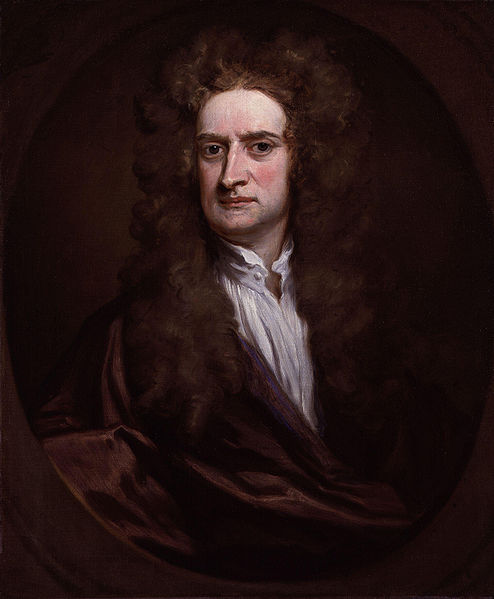
Portrait of Isaac Newton (1702)
Once he had finished the Principia, Newton returned to his optical studies, which would eventually lead to the publication of the Opticks in 1704. Could he now methodize optics according to the highly sophisticated standards which he had developed in the Principia? In my view, the answer is negative. For instance, I have argued that Newton’s argument for the heterogeneity of light rests on an argument of uniformity that cannot be licensed by Newton’s second rule of philosophizing. I have also paid considerable attention to the problem of transduction which Newton encountered in his optical studies. In mechanics, the affected entities, i.e. the explananda – bodies moving along specific trajectories, and their constituent elements, namely, the particles constituting these very bodies – all have a theoretically salient property in common, namely, mass. Because gravity is proportional to mass and because the latter is additive, gravity is likewise additive. This allowed Newton to show that a body’s overall force can be decomposed into the individual forces of each of the bodies constituting that body and vice versa. In optics, by contrast, we do not know – at least not without speculating on the matter – the constituting elements of the explananda. In the Opticks Newton could not establish ‘deductions from phenomena’ because, in contrast to the physico-mechanical theory of the Principia, a mixed science describes a given phenomenon mathematically without an accompanying explanatory story. In other words, in the Opticks the inference of causes could not be constrained by a set of laws which carry information about the proximate causes involved.
By way of outro and also as a teaser, I would like to conclude by devoting some words to the provisionalism that characterized Newton’s later methodological thought. Newton’s provisionalism pervades the third and especially the fourth regula philosophandi, which were added in the second (1713) and third (1726) edition of the Principia, respectively. The provisionalism which Newton envisioned did not apply to the ‘deductions from phenomena’, but rather to propositions ‘rendered general by induction’ – at least evidence from Newton’s manuscripts leads me to believe so. Based on a careful study of Newton’s manuscripts, I have also succeeded in clarifying what Newton understood by qualities which cannot be “intended and remitted” and, on the basis of this, I have concluded that the Cohen-Whitman translation of “intendi et remitti” as “increased and diminished” is incorrect. I could say much more about my book, but I hope that this will suffice to get you interested in reading it.
Explicating Newton’s Natural Philosophical Methodology: Part I
Steffen Ducheyne writes …
The research team at Otago has kindly invited me to discuss some of the central ideas of my recent monograph “The main Business of Natural Philosophy”: Isaac Newton’s Natural-Philosophical Methodology. My aim in this and next week’s guest post is not to give a complete overview of my book, but rather to bring some salient features of Newton’s methodology to the fore insofar as they are relevant for the speculative-experimental distinction.
Newton sought to separate hypotheses from demonstrations from within natural or experimental philosophy. This, in my view, adds an interesting dimension to the speculative-experimental distinction, for it shows how the distinction was transformed and introduced in the realm of natural philosophy. Newton’s preoccupation with methodological rigour and his distaste of hypotheses led him to explicate the conditions under which our conclusions about the physical world are to be considered as truthful. In this process, he would develop a highly sophisticated methodological position the kind of which had never been seen before.
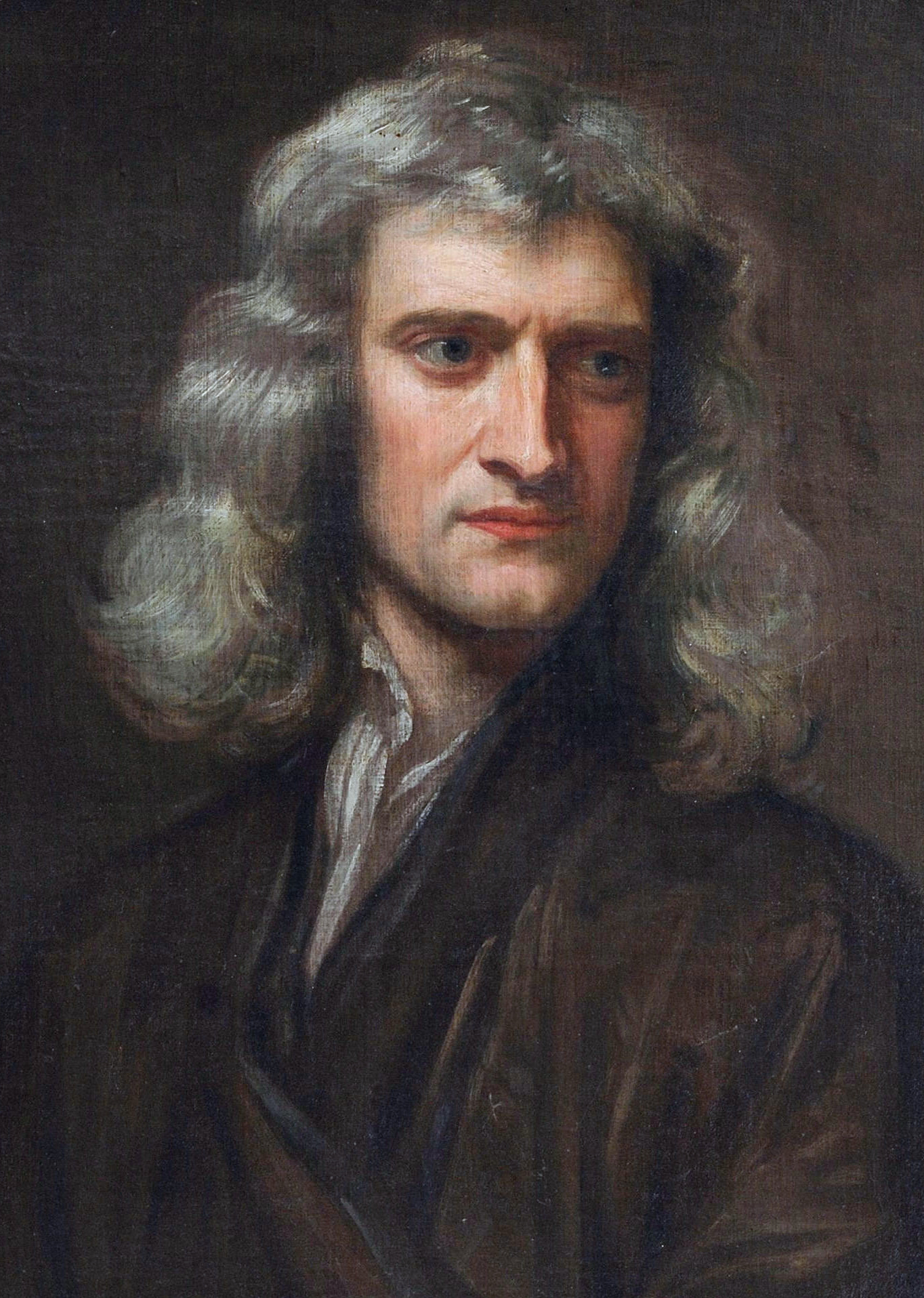
Portrait of Isaac Newton (1689)
Before turning to a discussion of Newton’s methodology proper, however, I would like to say something on how I have approached Newton’s methodology. Oftentimes, Newton’s methodology has been approached as if it was a stable given that remained fixed throughout his natural-philosophical career. In my book I have argued that Newton’s methodological views developed alongside with his natural-philosophical research. In Chapter 5, moreover, I distinguish between four distinct phases in the development of Newton’s methodological thought. Furthermore, although Newton clearly favoured his Principia-style methodology, which sets out to physico-mathematically ‘deduce’ causes from their effects, and considered it as the one to be followed ideally, Newton also relied on different methodologies. For instance, in the demonstrative parts of the Opticks he made use of a mixed mathematics treatment and in its speculative parts he proposed hypotheses to be investigated further. In my monograph I have called attention to important diachronic and synchronic differences in Newton’s methodological thought.
Newton’s first optical paper (1671/2) was not only a scientific debut, he also introduced a new methodological ideal on how knowledge about the empirical world is to be established. That ideal consisted in deducing causes from phenomena with demonstrative certainty. In the unedited version of his first optical paper, Newton stated the following on his theory of the heterogeneity of white light: “For what I shall tell concerning them [i.e. colours] is not a Hypothesis but most rigid consequence, not conjectured by barely inferring ’tis thus because not otherwise or because it satisfies all phænomena […] but evinced by ye mediation of experiments concluding directly & without any suspicion of doubt.” In the same period, he criticized the use of hypotheses in natural philosophy. At this point, important features of Newton’s methodological views were in place: his rejection of hypotheses, his ideal of deducing causes from phenomena, his conviction that by injecting mathematics into natural philosophy the latter could partake in the certainty of the former, his endeavour to draw conclusions from experiments, and his desire to treat of light ‘abstractly’, i.e. without making statements on the nature of light. Yet, as I argue in detail in Chapter 4, Newton’s methodological position was at that point still lacking elaboration and justification. That Newton did not provide much detail on how the heterogeneity of white light is derived from the experimentum crucis illustrates the lack of elaboration that characterized Newton’s early methodological views. In next week’s post I will summarize just how Newton’s methodological views developed from the publication of the first edition of the Principia in 1687.
Physics: from experimental philosophy to experimental science
Alberto Vanzo writes…
I have been wondering recently when German thinkers ceased considering physics as a part of philosophy and whether this may be related to the demise of experimental philosophy in late eighteenth-century Germany. I think that this may have well been the case. My hypothesis is that experimental philosophy declined as the result of the influence of Kantian and post-Kantian idealism and that the distinction between physics and philosophy gained foot in the 1830s and the 1840s as a reaction to post-Kantian idealism. In this post, I would like to expand on this suggestion and ask you for comments and pointers for further research.
As is well-known, physics was generally regarded as a part of philosophy in the early modern age. This is true for most early modern German writers, including several German experimental philosophers who, in the 1770s and 1780s, attempted to develop their systems on the basis of experiments and observations and eschewed hypotheses and a priori speculations. They held that the whole of philosophy relied on the same method as physics.
In the last two decades of the eighteenth century, Kantian and post-Kantian philosophies came to dominate the philosophical scene and eclipsed the German tradition of experimental philosophy. Kant vindicated a metaphysics based on a priori reasonings rather than observations and experiments. Kant held that we can discover some features of the natural world a priori. He distinguished this a priori, metaphysical study of nature from empirical, experimental physics, which he regarded as a part of philosophy too. However, at the end of the Critique of Pure Reason he introduced a narrow notion of philosophy that includes only a priori disciplines and excludes empirical physics from the domain of philosophy:
- Thus the metaphysics of nature as well as morals, but above all the preparatory (propaedeutic) critique of reason that dares to fly with its own wings, alone constitute that which we can call philosophy in a genuine sense. (A850/B878)
Early-day Kantians agreed with Kant that experimental physics was part of philosophy in the broad sense, but not of philosophy in the narrow sense. However, many of their pronouncements imply that physics (tacitly identified with experimental physics) is not part of philosophy (tacitly identified with Kant’s narrow notion of philosophy). For instance, the Kantian Johann Gottlieb Buhle wrote that, when seventeenth-century writers used the expression “Cartesian philosophy”, they were often thinking “about his physics and cosmogony rather than about his philosophy in the proper sense”. With statements like this, Kant and his disciplines promoted a division of labour between the a priori inquiries of philosophers and the a posteriori research of physicists.
Did German authors start distinguishing between physics and philosophy once the Neo-Kantians started spreading Kant’s outlook in the 1860s, as Richard Rorty claimed? I believe that several German authors started distinguishing physics from philosophy much earlier, in the 1830s or 1840s. One of the most important events in the German intellectual scene between Kant’s death in 1804 and the 1840s was the rise and decline of post-Kantian idealism. Post-Kantian idealists like Schelling and Hegel pursued an approach to the study of nature that was heavily influenced by their own philosophical speculations (Schelling, for instance, founded a Journal for Speculative Physics). I believe that the tendency to distinguish physics from philosophy spread as a reaction to the attitude of post-Kantian idealists towards physics. The entry “Physik” published in the Brockhaus Conversations-Lexicon in 1833, two years after Hegel’s death, states:
- philosophy, at least in Germany, has again attempted to gain influence on physics. However, after all attempts to found physics from this side [i.e. on philosophy] proved unfruitful, only very few physicists, and actually not the most thorough ones, still believe that they could replace the secure footing that mathematics made possible to give [to physics] with the still very shaky concepts of philosophy. Hence, even if the so-called dynamical conception of physics that is related to this philosophical point of view still survives in some speculations, nevertheless we must admit that now only the mechanical point of view is influential and valid in real-life physics [im Leben der Physik].
Although suggestive, this single quote is hardly sufficient to prove my hypothesis that German authors started distinguishing physics from philosophy as a reaction to the post-Kantian idealistic tendencies that had in turn eclipsed experimental philosophy. Do you think that this view is persuasive? Also, when did physics stop being regarded as a part of philosophy in Great Britain and France? I would be grateful for any comments and suggestions.
Aberdeen’s 1755 Plan of Education
Juan Gomez writes …
One of the topics we have covered in this blog is education. I have commented on David Fordyce’s ideas, and Gerhard Wiesenfeldt contributed to the blog with two very interesting posts on Speculative and Experimental Philosophy in Universities (Post-Cartesianism and Eclecticism). In this post I want to expand on this topic and tell you about Alexander Gerard‘s Plan of Education.
As we have mentioned throughout various posts in this blog, one of the features of those allied with experimental philosophy was their disdain for the scholastic school of thought and the rejection of mere speculation. This led the regents and teachers in Colleges and Universities to revolt against the scholastic teaching system and promote a change in the way education was structured. In Aberdeen, the first stages of this project of reformation started with the teachings of George Turnbull and Colin MacLaurin in the 1720’s, but we had to wait until the 1750’s for the reform of the curriculum. It was written by Alexander Gerard and published in 1755. It gives us a good overview of what the members of the faculty found wrong with the scholastic mode of thinking and the central role experimental philosophy (and the experimental method) should take in the colleges and universities.
Gerard begins by explaining why the faculty members at Marischal college have decided to reform the method of education. The method used in most European universities, Gerard tells us, was that of the Peripatetic Philosophy ‘espoused by the Scholastics’. This is his description:
- The chief business of that Philosophy, was, to express opinions in hard and unintelligible terms; the student needed a dictionary or nomenclature of the technical words and authorized distinctions; experiment was quite neglected, science was to be reasoned out from general principles, either taken for granted, or deduced by comparison of general ideas, or founded on very narrow and inadequate observation: Ontology, which explained these terms and distinctions, and laid down these principles, was therefore introduced immediately after logic. By these two, the student was sufficiently prepared for the verbal, or at best, ideal inquiries of the other parts.
Fortunately, the state of philosophy had changed:
- [Philosophy] is become an image, not of human phantasies and conceits, but of the reality of nature, and truth of things. The only basis of Philosophy is now acknowledged to be an accurate and extensive history of nature, exhibiting an exact view of the various Phenomena for which Philosophy is to account, and on which it is to found its reasonings.
This change in Philosophy posed a problem for a system that was based on Scholastic methods. If philosophy is founded on facts and observation, from which we then derive the terms or notions, the system of education was flawed by teaching first the notions and principles without any experience of the facts they refer to. The teachers at Marischal proposed to restructure the order in which the different subjects were taught. Instead of starting with Logic and Ontology, the students “after being instructed in languages and classical learning, be made acquainted with the Elements of History, Natural and Civil, of Geography and Chronology, accompanied with the Elements of Mathematics; that they should then proceed to Natural Philosophy, and, last of all, to Morals, Politics, Logic and Metaphysics.” This new curriculum was much better suited for the pursuit of knowledge and the aims and methods of the new philosophy.
Most of the pamphlet is an attack on the scholastic system that justifies the decision of the Masters of the college to leave the teaching of Logic to the final year. There are constant references made to the importance of facts, experiments, and observations as the sole foundation of knowledge. Any sort of purely speculative way of thinking was not to be included in education. But the promoters of this reform were not claiming that logic and metaphysics were of no use at all; what we need to understand is that they are entirely dependent on all the other sciences, and if they are to contribute in our search for knowledge, then they must come after all the other sciences. The attack of the promoters of the methods of the experimental philosophy was not against speculative subjects themselves, but against the scholastic methods of education that considered speculation to be more important than our knowledge of the natural world.
Experimental Philosophy and the Straw Man Problem
Peter Anstey writes …
One common objection against the experimental–speculative distinction (ESD) as an alternative historiographical framework for understanding early modern philosophy is the Straw Man Problem. Our interlocutors are prepared to admit the importance of the emergence of the experimental philosophy in Britain in the mid-seventeenth century and its subsequent uptake across the Continent. However, they object that, in spite of all the experimental philosophers’ rhetoric, there were few, if any, speculative philosophers. The speculative philosopher, in their view, is merely a straw man, a creation of the experimental philosophers who needed someone or something to define themselves against. The claim, then, is that there was not really any substantive experimental–speculative distinction because there were not really any speculative philosophers.
In my view this objection is based upon a superficial understanding of the ESD. Moreover, I believe that providing an adequate response to the Straw Man Problem is a good way to highlight what is at the core of the ESD framework.
A weakness of the Straw Man objection is the presumption of parity: it is assumed that if we have an actual distinction then we have practitioners of, more or less, equal number on both sides of the distinction. This presumption may derive from the Kantian rationalism–empiricism historiography with its two triumvirates of Descartes, Leibniz and Spinoza versus Locke, Berkeley and Hume. Be that as it may, it is certainly true that there were very few advocates of speculative philosophy after the 1660s. In Britain, Thomas Hobbes, Margaret Cavendish and John Sergeant were all opponents of the experimental philosophy and so might be classed as speculative philosophers, but it’s hard to name any others.
Nevertheless, this lack of parity does nothing to undermine the ESD. For, what is important is that it is the method, content and characteristics of speculative philosophy that were the focus of experimental philosophers’ attacks and disdain and not, on the whole, the practitioners themselves.
The ESD is, therefore, in the first instance a distinction that pertains to natural philosophical (and later philosophical) methodology and only secondarily to individuals. A nice analogue here is found in twentieth-century philosophy of mind. From the 1970s most philosophers were materialists or physicalists about the mind and it became hard to name any substance dualists. And yet physicalists about the mind defined their position, in large part, as being distinct from and opposed to dualism. Anyone who has done even the most cursory reading in the philosophy of mind knows that there is an historical explanation of this phenomenon. The Identity Theory emerged in the 1960s on the back of the attack on the ‘ghost in the machine’ by Gilbert Ryle and others. Early materialist theories of the mind were new and radical in so far as they defined themselves against dualism, even if within a few decades there were hardly any dualists to be found.
A similar situation is to be found with the emergence and growth of early modern experimental philosophy. There had been a long tradition in philosophy of distinguishing between speculative and operative philosophy, between speculative and operative knowledge and even speculative and operative intellects. Natural philosophy had almost invariably been classified as a speculative science. The conceit of the Fellows of the early Royal Society (among others) was to claim not only that natural philosophy could also be an operative (that is, experimental) science, but that the operative method of natural philosophy is far superior to the old speculative approach.
Thus, in order to explain the nature of the ESD, we shouldn’t look forward from the mid-seventeenth century for parity among practitioners from either side, rather we should look back to the origins of the distinction. In so doing it becomes clear that the speculative philosopher is no straw man.
Hypotheses and Newton’s Rings
Kirsten Walsh writes…
In Ian Lawson’s recent post, he mentioned Hooke’s work on colours in thin films. In this post, I’ll look at how Newton used his hypotheses on light to build on Hooke’s work in some interesting and important ways.
In his optical work of the early 1670s, while Newton prefers theories to hypotheses, he thinks that hypotheses are acceptable, even useful, for two purposes:
- To ‘illustrate’ (i.e. provide an intuitively plausible explanation of) the theory; and
- To ‘suggest’ experiments.
However, he insists that hypotheses should always be removed from the final version of the theory. Recall Newton’s claim from his 1672 paper: “I shall not mingle conjectures with certainties”.
In December 1675, Newton wrote his paper, “An hypothesis explaining the Properties of Light”. Here, he published his hypotheses on the nature of light for the first time. To summarise them briefly:
- There is an ‘aethereal medium’;
- Aether vibrates, carrying sounds, smells and light;
- Aether penetrates and passes through the pores of solid substances;
- Light is neither the aether itself, nor the vibrations, but a substance that is propagated from ‘lucid’ bodies and travels through the aether;
- Light warms the aether and the aether refracts the light; and
- The rays (or bodies) of which light consists differ from one another physically.
In this paper, Newton claims that he is only discussing these hypotheses for the purposes of ‘illuminating’ his theory. Moreover, he does not assert that these hypotheses are true, and emphatically does not use them to support his theory. For example, when he discusses hypothesis (4), Newton is careful not to push too forcefully for any particular account of light. He says one might suppose light to be “an aggregate of various peripatetic qualities”, or “unimaginably small and swift” corpuscles of various sizes, or “any other corporeal emanation or impulse or motion of any other medium diffused through the body of the aether”:
- Onely whatever Light be, I would suppose, it consists of Successive rayes differing from one another in contingent circumstances, as bignes, forme or vigour… And further I would suppose it divers from the vibrations of the aether.
In this paper, there is a notable emphasis on experiment. For example, when Newton discusses hypothesis (1), he gives an account of a new electrical experiment which seems to support his claim. And when he discusses hypothesis (3), he discusses the implications for Boyle’s tadpole experiments. But the most important experiments in this paper are his investigations on the colours that appear between two glass surfaces.
Alan Shapiro notes that Newton began these investigations while he was reading Hooke’s Micrographia. But his experiments and mathematical descriptions quickly developed into something well beyond the scope of Hooke’s investigations. Hooke described the colours that appear when two thin sheets of glass are placed one on top of the other. When he made the thin film of air between the two sheets thicker or thinner by pressing the two sheets together with greater or lesser force, the colours changed. He observed that different colours appeared at different thicknesses, but he was unable to quantify this observation as he was unable to measure accurately the thickness of the film at any given point. Newton had the idea of placing a convex lens on top of a flat sheet of glass. This enabled him to easily calculate the thickness of the film of air, and the colours appeared as a set of concentric coloured circles centred at the point of contact between the two surfaces. These concentric circles are now known as ‘Newton’s Rings’.
-

Opticks, Book 2, Figure 3
Next Newton considered his hypotheses. According to hypothesis (2) the vibrations of the aether vary in size, according to hypothesis (3) aether passes through the pores of solid substances, and according to hypothesis (6) rays of different colours will cause aethereal vibrations of different sizes. If these hypotheses were correct, he argued, then light of a particular colour would be reflected either when the length of the vibration, or some multiple of the length of the vibration, matched the thickness of the film, and transmitted otherwise. So he predicted that:
- if the Glasses in this posture be looked upon, there ought to appear at A [the centre], the contact of the Glasses, a black spott, & about that many concentric circles of light & darknesse, the squares of whose semidiameters are to sense in arithmetical progression.
Newton’s “Hypothesis” paper provides a good example of his method of hypotheses. He remains carefully detached from his own hypothesis, using it only to ‘illustrate’ his theory and to suggest further experiments. Newton was also careful to keep his hypotheses well separate from his theory; the paper ends with a series of ‘Observations’ that contain no reference to his hypotheses at all!
Workshop: Letters by Early Modern Philosophers
The workshop is part of the 13th International Conference of the International Society for the Study of European Ideas which will take place in Cyprus on 2-6 July 2012.
The workshop focuses on letters written in the seventeenth century on themes at the border between art, science, and philosophy. A presentation of the workshop topic can be found here.
Abstracts of up to 500 words should be sent to the workshop organiser, Filip Buyse, at filip.buyse1@telenet.be.
