First Te Tumu Seminar for 2020
Many people will remember Suzanne Duncan (Te Rarawa, Te Aupōuri), a former student, and lecturer at Te Tumu. She left a few years ago to return to her rohe ā-iwi, the Far North, where she works in Kaitaia as Principal Strategist for Te Hiku Media. Suz will be back in Dunedin next week with the General Manager, Peter-Lucas Jones (Ngāi Takoto, Te Rarawa, Te Aupōuri, Ngāti Kahu); they are presenting the first of Te Tumu’s seminars this year on the amazing work being done at Te Hiku [see abstract below].
Where: Te Paparewa (RGS2 – ground floor of Te Tumu).
When: 3.30pm, Wednesday 4 March.

Te Hiku Media
Abstract: Te Hiku Media is a not-for-profit charitable trust belonging to the five iwi of the Far North, Ngāti Kuri, Te Aupōuri, Ngāi Takoto, Ngāti Kahu and Te Rarawa. Founded as an iwi radio station in 1991, Te Hiku Media has grown as an iwi broadcaster to include regional news, the live streaming of nationally significant events, Māori language archiving and the development of natural language processing tools for the revitalisation of te reo Māori. This seminar will share the journey that has been led by their kaumātua and outline their recently awarded $13 million dollar data science project, Papa Reo.
Publishing award
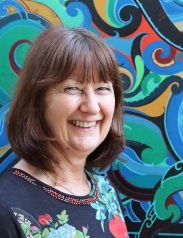 Congratulations to Lyn Carter, the coordinator of our Indigenous Development Programme, for her recent article co-written with Janet Stephenson (Centre for Sustainability) and Claire Freeman (Geography) from Otago, and others in the journal Society & Natural Resources.
The article won the S & NR best publication award for 2019. Click on the link to read it: Hybrid Neoliberalism Implications for Sustainable Development
PhD Celebration
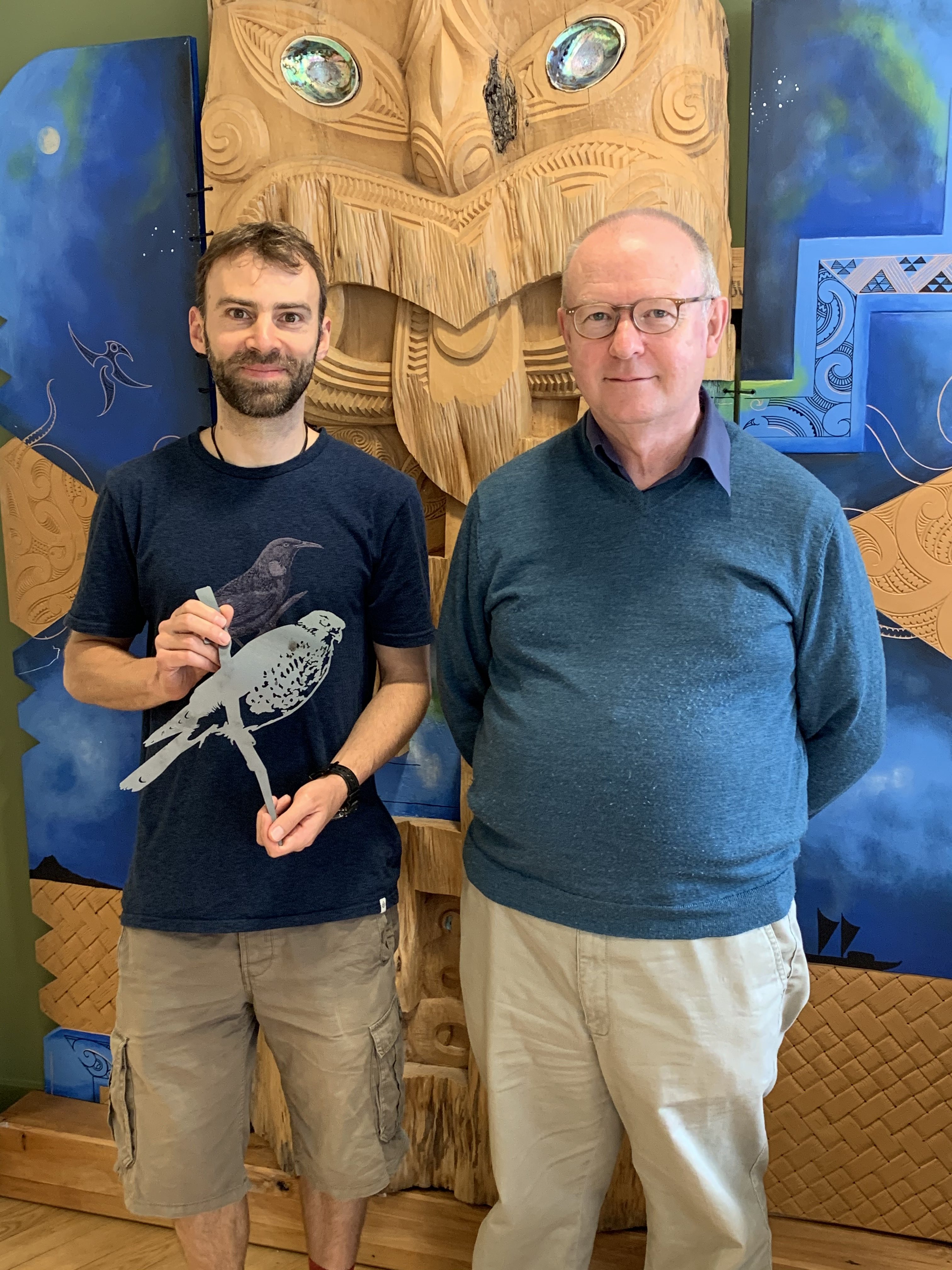
Raphael Richter-Gravier and his primary supervisor, Michael Reilly.
When possible, Te Tumu always likes to acknowledge our students’ completions of their PhDs with a morning or afternoon tea. Today was our opportunity to celebrate Raphael Richter-Gravier, who graduated last December. Given that his thesis investigated Polynesian bird narratives, it was fitting that Te Tumu gifted Raphael with a 2-dimensional metallic sculpture of a kārearea (NZ falcon). His supervisor, Professor Michael Reilly, spoke about what a wonderful doctoral student Raphael was, one whose writing was stimulating and thoughtful, and didn’t need too much revising. Raphael also noted that his friend, Manu Berry has created a number of woodcuts inspired by the bird narratives, which are currently on exhibition at PC Gallery in Port Chalmers. Raphael has been with Te Tumu for a number of years, as a student and tutor in Māori Studies. He seems to have a lot of activities on his plate at present (including teaching French), and we wish him well for the future.
He Kōrero Manu: Manu Narratives
This is perhaps the first time Te Tumu has featured in Spinoff, New Zealand’s pre-eminent online news service! Raphael Richter-Gravier recently completed a PhD thesis on bird narratives from Polynesia, that features in the article. Raphael was supervised by Professor Michael Reilly and Dr Michelle Schaaf from Te Tumu, and also by Professor Bruno Saura from the University of French Polynesia. Click here to access the Spinoff article on Raphael’s thesis. If you want to read the thesis, click here.
He whakamāori i te reo Kariki o neherā
Kia ora koutou.
For those of you into te reo Māori and translation, there is a plenary talk at the 2020 Annual Conference of the Australasian Society for Classical Studies on 31 January that might interest you. This is a public event!
Associate Professor Simon Perris: Te Iriata and the Iliad: On translating Homer into Māori.
Friday 31 January 2020, St David Lecture Theatre, 9am.
“This talk concerns a collaborative and creative research project being undertaken by myself and my colleague Dr Karena Kelly (Te Kawa a Māui, Victoria University of Wellington). This nascent project is intended to produce a translation of (some of) Homer’s Iliad into te reo Māori – into Te Iriata. As far as we know, this is the first-ever direct translation of a non-biblical ancient Greek text into Māori.
“In this talk, I will introduce the project, describe our working methods, survey some of the challenges Dr Kelly and I have encountered, and address some of the central methodological, linguistic, and other issues at stake; I will also share some specific sections of the work to date, and address more broadly the idea of a classical tradition in Māori translation.”
See ClassicsConferencePoster for all three public events from this conference.
Neigbourly success, on a Pacific theme.
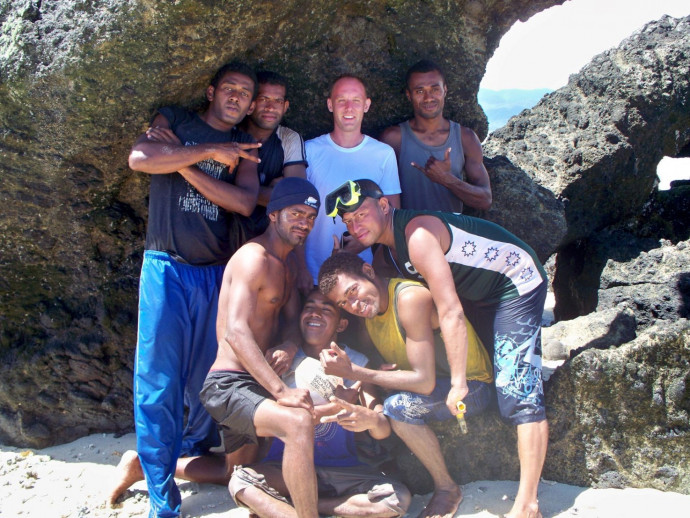
John Shaver of Religious Studies (centre, back) with friends in Fiji.
Earlier this year, due to move logistics within the Humanities Division, some Te Tumu staff had to shift rooms. This led to our Pacific Island Studies team sharing the fourth floor with academics from the Religious Studies programme. Te Tumu would like to congratulate one of our new neighbours, Dr John Shaver, for winning a Marsden Grant to undertake further research on religious practice in Fiji.
Click here to find out more about his project, “Investigating the impact of religion on cooperation and inequality in Fiji”. We look forward to finding out more as his project progresses.
Manu narratives of Polynesia

Raphael submitting his thesis in April.
Te Tumu would like to congratulate Raphael Richter-Gravier, one of our stellar postgraduate students, for having completed all the post-examination formalities for his PhD on “Manu narratives of Polynesia: a comparative study of birds in 300 traditional Polynesian stories“.
Raphael was supervised by Professor Michael Reilly and Dr Michelle Schaaf from Te Tumu, and through a co-tutelle arrangement, also by Professor Bruno Saura from the University of French Polynesia. Raphael’s research is comprehensive and in-depth, looking at a wide range of bird stories on a number of themes from all around Polynesia, including Aotearoa.
If you are interested in delving into some of the stories, or reading Raphael’s thesis in its entirity, it is now available online on the university’s OUR Archive. Click here to access it.
Raphael will be graduating in December, and is planning to publish from his research.
3 Summer Scholarships for Māori students
The Te Hau Kāinga team are looking for three Māori students (second year or higher in 2019) for some amazing research-based work over the 2019-2020 summer break. There are two main options. One is to develop a project in your home area to look at how the Second World War affected the whānau and communities there. The output can be a written report, a mōteatea, a video (or something else) that can be shared with your whānau. The other is to undertake archival research within an archive, such as the Hocken Collections, or Ngā Taonga Sound and Vision. If you are curious, or want to discuss an idea, or find out more, contact the project leaders. Click here for more information, or to apply.
Website now live for Te Hau Kāinga project
 The website for the Te Hau Kāinga project went live this week. Te Hau Kāinga is a Marsden-funded research project led by Angela Wanhalla (History) and Lachy Paterson (Te Tumu) investigating the impacts of World War Two on Māori who remained in New Zealand during the conflict, either in their home communities, or working away from home. Designed by local web design company, Myth, the website is fully bilingual. It features a photo gallery, and a “stories” section, as well as a page where interested people can upload their own whānau stories and photographs. Check it out – click here. As stories get added to this site, links to these will be posted to the project’s FaceBook and Twitter pages. Feel free to follow these to find out more as the project rolls out.
Te Hau Kāinga
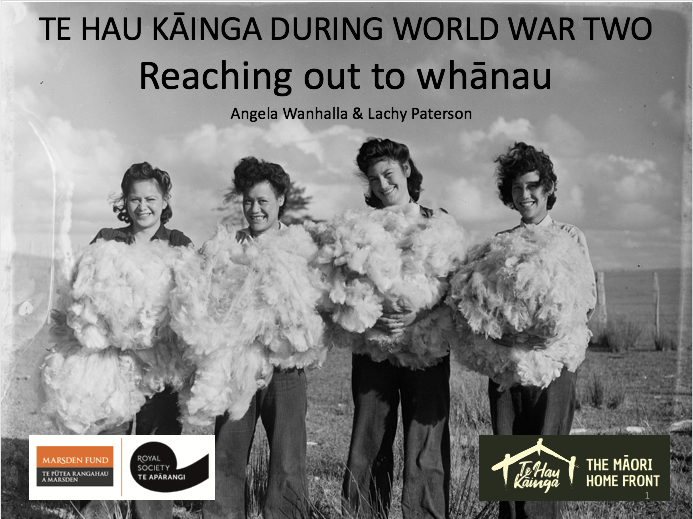 Angela Wanhalla (History) and Lachy Paterson (Te Tumu) will be giving a talk on what’s involved in their new Marsden-funded project, Te Hau Kāinga: Histories and Legacies of the Māori Home Front, 1939-1945 this evening.
This will be in the Seminar Room at the Hocken Collections at 5.30pm, 11 September. Yes – this evening.
In particular, they will be explaining how they intend to reach out to whānau to let them know about the project, and to give them the opportunity to share stories of how their kaumātua or tīpuna coped during the war period. Students who wish to return home and undertake some whānau research over the summer break should come along and learn about the summer scholarships on offer. Another highlight will be a sneak preview of the project’s website that will be launched very soon.
