Rapa Nui trip connects and inspires University delegation
Sitting in Rapa Nui, Te pito o te henua, it is difficult not to reflect on the many connections that have revealed themselves throughout this haerenga. Some have been immediately recognisable, while others have presented themselves more quietly through conversations, shared experiences, and the everyday interactions that come from living alongside people rather than simply visiting a place.
As a lecturer within Te Tumu, this experience has reinforced the value of learning through relationships. Throughout my time here, I have found myself recognising familiar linguistic features, cultural values, and ways of relating that speak to the shared foundations of our Polynesian heritage. These moments have prompted reflection on the enduring connections of Te Moana nui ā-Kiwa and the ways our histories continue to shape Indigenous communities and scholarship across the Pacific.
Rapa Nui is the eastern-most island that makes up te taimana o te Moana nui ā-Kiwa, or the Polynesian triangle, with Aotearoa being the western point of the triangle and Hawai’i the north. Experiencing the island and meeting the tāngata whenua firsthand has deepened my appreciation of the cultural and linguistic relationships that continue to connect Te Moana nui ā-Kiwa. Although Rapa Nui language and culture have developed in distinctive ways, there are clear connections with both Māori and Tongan language and cultural practices that will compliment and influence my current research trajectory. Observing these similarities in context has reignited my interest in comparative research, particularly in the areas of language revitalisation, intergenerational transmission of pūrākau, and the maintenance of cultural identity.
One of the many highlights of this haerenga has been being hosted by whānau in Rapa Nui. Staying in family homes has provided insights that could never be gained through formal study alone. The generosity with which we have been welcomed, fed, included in everyday living and cared for as part of the whānau reflects values that resonate strongly with Māori understandings of manaakitanga and whanaungatanga, all while navigating three, sometimes four languages. These experiences have reinforced the importance of building genuine relationships as the foundation for collaborative research and meaningful engagement with Indigenous communities.
Our delegation of eight tauira and four academic staff travelled to Rapa Nui to facilitate a series of community wānanga covering te reo Māori, education, hauora Māori, law and the environment, archaeology, sport and health. While we came intending to share knowledge from Aotearoa, the wānanga quickly became spaces of reciprocal learning. It was particularly rewarding to see our tauira confidently contribute their own experiences and perspectives, creating genuine kōrero and space to wānanga.
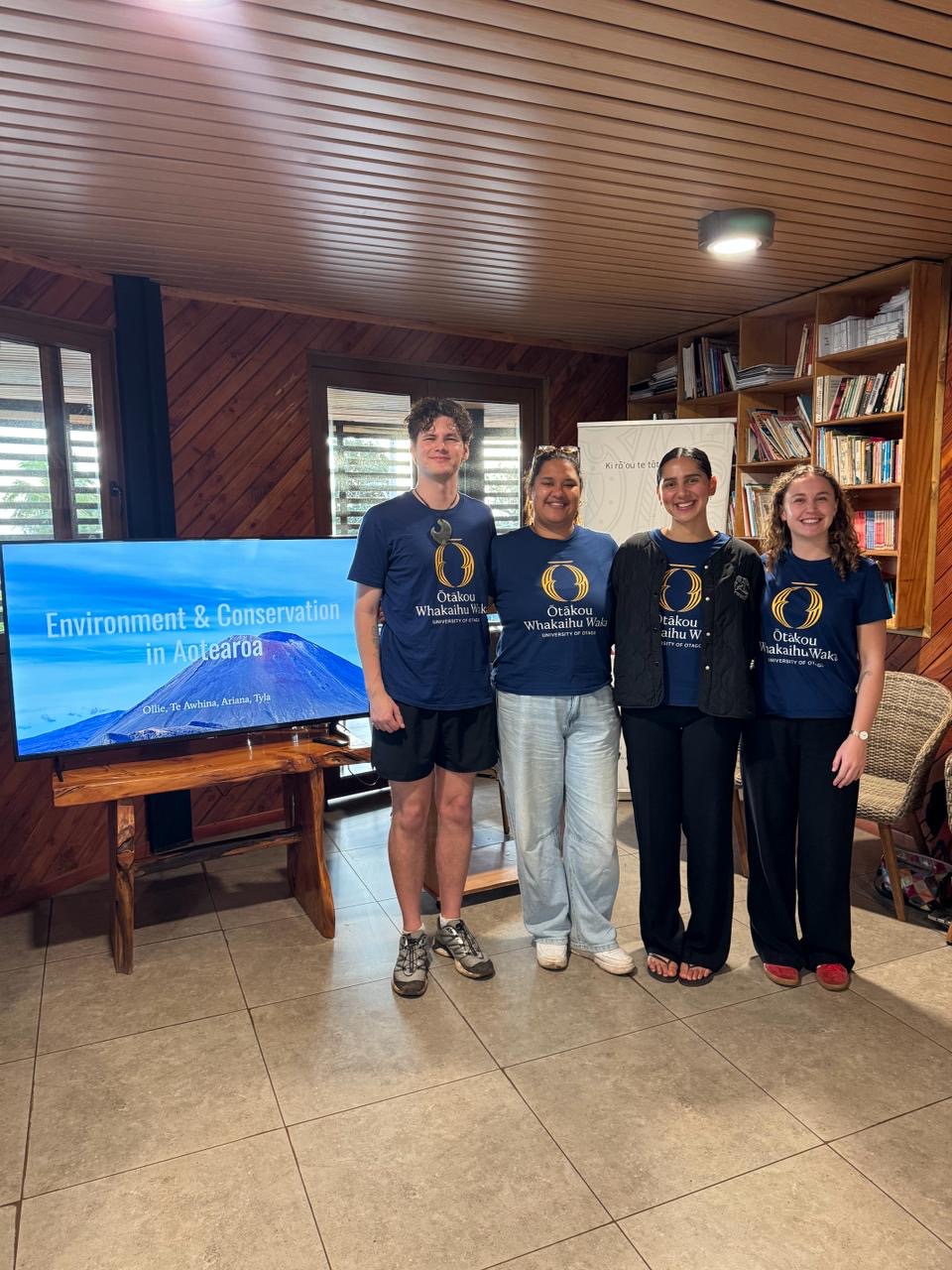
L-R Ollie Ihaka-Gudsell (Indigenous Studies and Law), Tyla Te Puawai Hill -Moana (PhD Candidate Genetics and Mātauranga Māori), Te Āwhina Brundell (Masters of Peace and Conflict), Ariana Davis (Indigenous studies and Law).
Ollie Ihaka-Gudsell, a Te Tumu and Law student described his experience as special, “Every rainy or sunny day, every experience, and every story and connection has been special. My experience has connected me to the people of Rapa Nui and to my own whakapapa”.
Te Āwhina Brundell, a tauira from Te Tumu, doing her masters with Te Ao o Rongomaraeroa comments, “This experience has expanded me in the most beautiful of ways. My favourite part has been the connection between our histories, our stories and our languages. It becomes impossible to deny our shared identity as one people”.
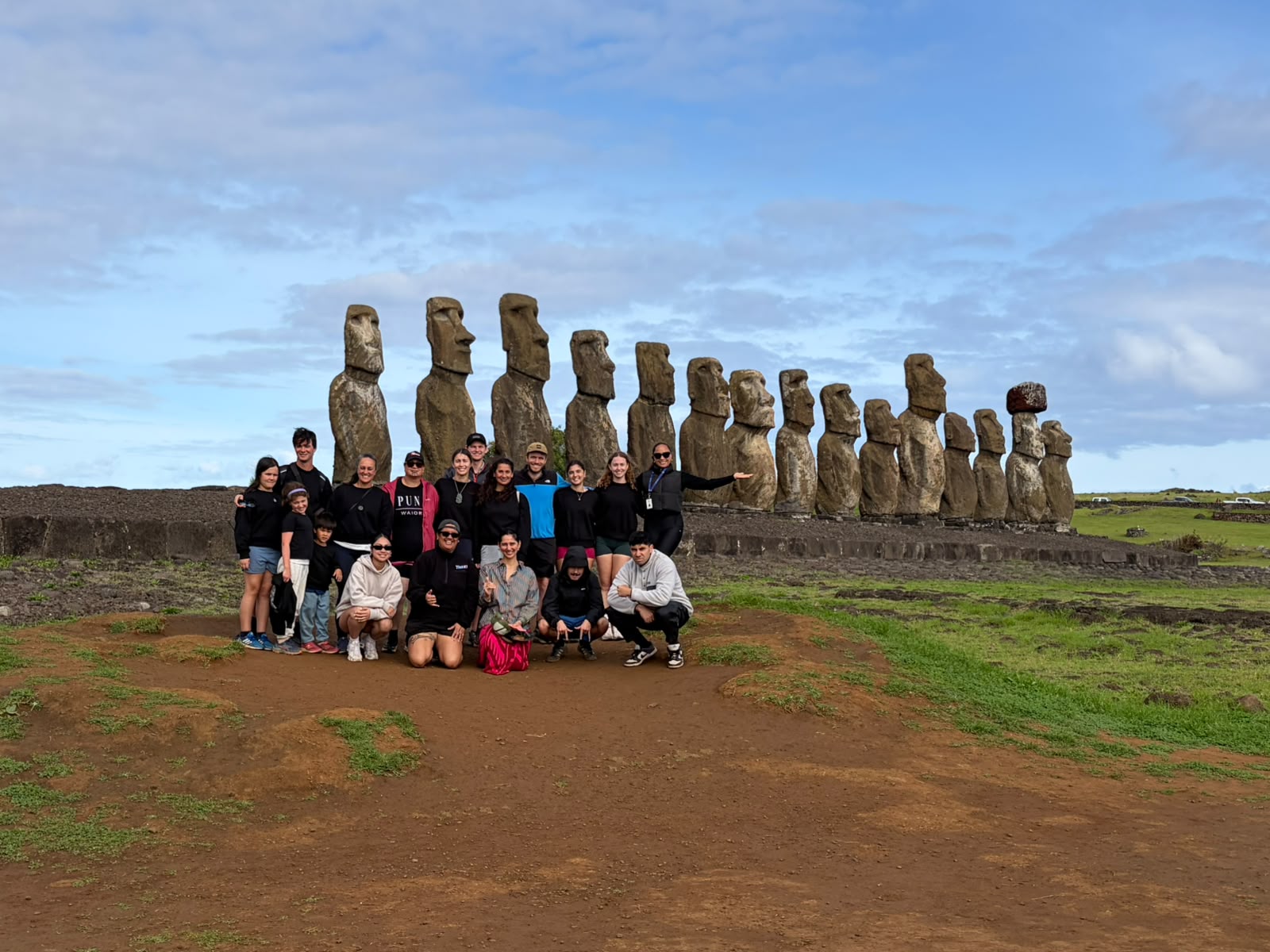
Prime Minister’s Scholarship Ōtākou Whakaihu Waka delegation at Tongariki, in Rapa Nui
It’s clear that this experience will have a lasting influence on all students and staff involved. The relationships established here have opened opportunities for future collaborations exploring Indigenous language maintenance, comparative Polynesian linguistics, and culturally grounded approaches to education…which will see many of the current delegation return. The experience of being on this haerenga will also enrich my teaching by enabling students to better understand te reo Māori within its wider Polynesian context and appreciate both the diversity and interconnectedness of Pacific languages and cultures.
As our time in Rapa Nui draws to a close, I sit with a deep sense of gratitude for the people who have welcomed us into their homes and communities. While the formal wānanga have been an important part of this visit, it is the everyday moments of sharing meals, navigating conversations in a mixture of Rapa Nui, Spanish, te reo Māori and English, singing, dancing and sharing stories that have left the greatest impression. These experiences have strengthened not only my understanding but the students too, of our shared Pacific whakapapa, culture and language. ‘Iorana māuruuru te ta’ina o te pito o te henua, te poki, te tupuna o te henua nei māuruuru ‘iorana.
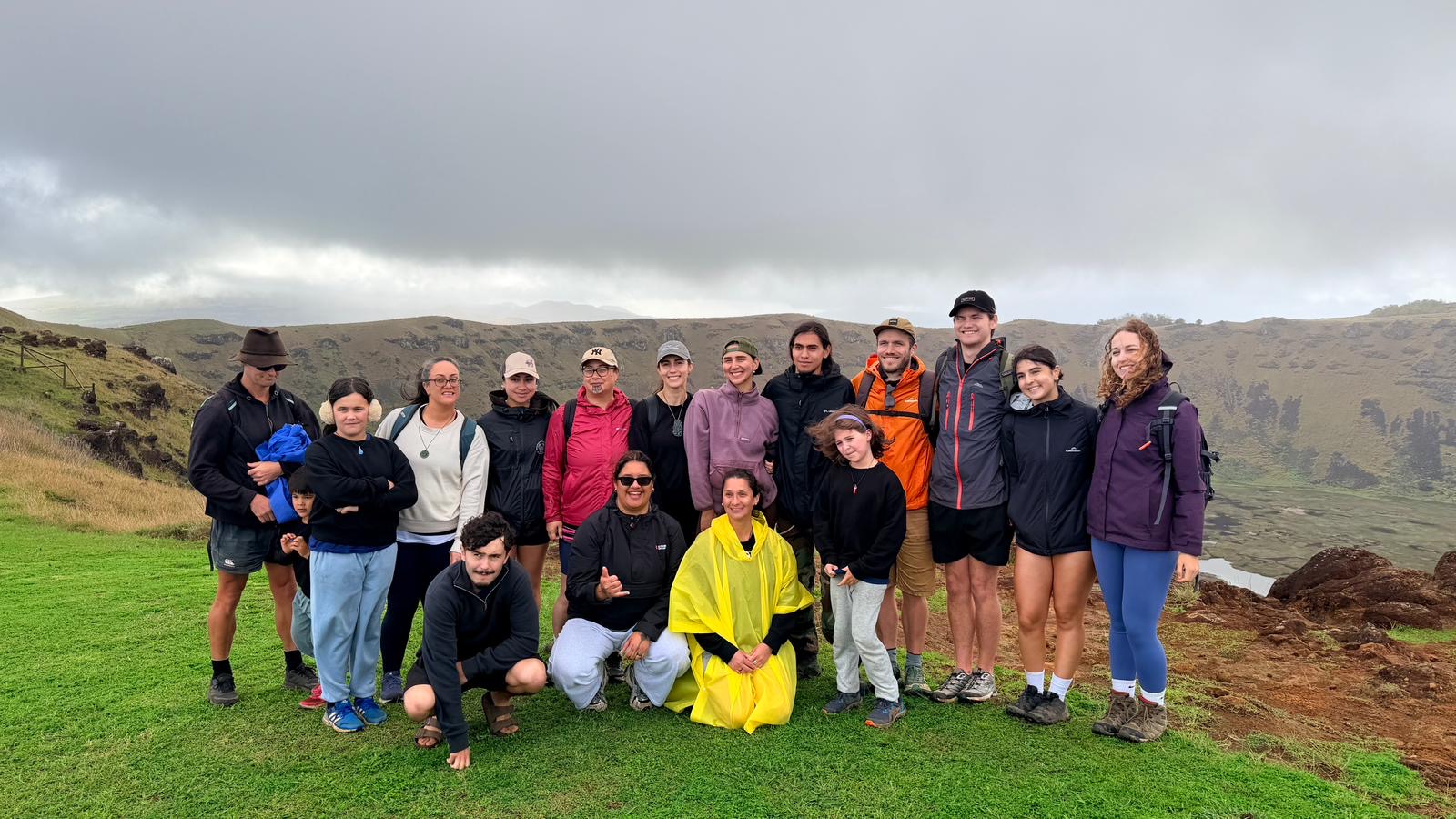
Kāhui after a tour around Orongo historical village, standing above the crater of Rano Kau.
Engaging wānanga centres Māori and Pacific notions of peace: With Professor Georgina Tuari Stewart

By Leighton Williams
Earlier in May, Te Tumu hosted Professor Georgina Tuari Stewart (Ngāpuhi, Ngāti Maru ki Tainui) from AUT for a special wānanga on peace, organised by Associate Professor Liana MacDonald. The wānanga was well attended by Te Tumu staff, postgraduate students, and friends from across the university, all of whom came to share rich stories about how they related to peace in varying ways. Centring Māori and Pacific notions of peace, the session explored what these perspectives might reveal about the limits of how violence, conflict, and peace are currently imagined.
The session began with a storying of peace within our own worlds, facilitated by Georgina with input from Professor Patrick Vakaoti, focusing on how peace is imagined and realised in Māori and Pacific contexts. Drawing on the rich knowledge traditions that shape our work in Te Tumu, Georgina reflected on how Indigenous understandings of peace must constantly negotiate with colonialism, modernity, and institutional forces, including the university itself. This discussion generated considerable engagement as colleagues reflected on how peace features in their own scholarly work, and considered where Māori and Pacific worldviews may offer philosophical alternatives to mainstream discussions of peace, conflict, and violence.
Some discussed the presence of Indigenous peace-making traditions within their own whakapapa, giving voice to practices and methods that few encounter today. Others reflected on the ways Indigenous understandings of peace can collapse under imposed categories such as ‘Indigenous knowledge’ and ‘mātauranga Māori’. Together, these conversations offered rich perspectives and suggested a deeper commitment by Indigenous peoples to enduring principles and practices of peace-making.
While the wānanga was initially planned as a discussion of peace through Indigenous frameworks, the conversation soon drifted toward rethinking peace in alternative terms. Do we recognise peace in Indigenous worlds? Is peace temporary, or is it imagined as a continual process of restoring balance? When considering peace for Indigenous peoples, in both our lives and our work, are we centring peace or centring violence, and what difference does that make? The wānanga left us with many unresolved questions that we hope to continue working through together.
Most excitingly, the wānanga also presented a unique opportunity for colleagues and students not only to discuss what peace means within Māori, Pacific, and Indigenous worlds, but also to contribute to the development of a polyphonic article. The article will be submitted for the upcoming special issue of AlterNative and will be led by new Peace and Conflict Studies doctoral student, Mai Ly, curating everyone’s diverse reflections on the wānanga discussions.
We are humbled by Georgina’s generosity and look forward to sharing our time with her again!
