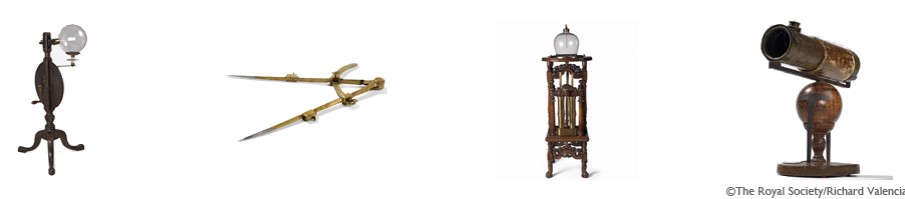
Electricity: A Speculative Newtonian Experimental Science?
Kirsten Walsh writes…
In his book, Franklin and Newton, I. Bernard Cohen described Franklin’s work on electricity as an example of “Speculative Newtonian Experimental Science”. The central thesis of our project is that the most common and the most important distinction in early modern philosophy is that between Experimental and Speculative Philosophy. So ‘speculative experimental science’ sounds like a contradiction in terms. Today, I’ll consider whether this label is appropriate.
Cohen describes electricity as a Newtonian science that only took off after Newton’s death. While Newton was fascinated with electrical phenomena, he, like his contemporaries, didn’t really understand it. However, his discussions of electricity, especially the queries of the Opticks, provided a useful starting point for Franklin’s electrical research. So we can see why Cohen wants to call Franklin’s electrical research a ‘Newtonian science’.
Newton’s discussions of electrical phenomena are always found in speculative contexts, but they usually have an experimental tone. For example, Newton first mentioned electrical phenomena in 1675 in his paper on his ‘hypothesis of light’ – which is explicitly a speculative paper. He specified six hypotheses concerning light and colour. Hypothesis 1 states that “there is an æthereall Medium much of the same constitution with air, but far rarer, subtiler & more strongly Elastic”. In the discussion, he suggested that everything is made of æther. To support this suggestion, he described an experiment involving glass and little pieces of paper. Using friction, he created static electricity in the glass, and caused the paper to dance around. He concluded that: “At least the electric effluvia seem to instruct us, that there is something of an æthereall Nature condens’d in bodies.”
Moreover, at various times, Newton speculated that electricity could provide an explanation for gravity. Again, he discussed this idea in explicitly speculative contexts, and drew on experiments performed by Francis Hauksbee to support his speculations. For example, in query 31 of the Opticks he asked:
- Have not the small Particles of Bodies certain Powers, Virtues, or Forces, by which they act at a distance, not only upon the Rays of Light for reflecting, refracting, and inflecting them, but also upon one another for producing a great Part of the Phænomena of Nature?
He argued that we have observational and experimental evidence that bodies attract one another by gravity, magnetism and electricity: “and these Instances shew the Tenor and Course of Nature, and make it not improbable but that there may be more attractive Powers than these.”
Despite all this speculating, Newton displayed epistemic caution:
- For we must learn from the Phænomena of Nature what Bodies attract one another, and what are the Laws and Properties of the Attraction, before we enquire the Cause by which the Attraction is perform’d. The Attractions of Gravity, Magnetism, and Electricity, reach to very sensible distances, and so have been observed by vulgar Eyes, and there may be others which reach to so small distances as hitherto escape Observation; and perhaps electrical Attraction may reach to such small distances, even without being excited by Friction.
The final paragraph of the General Scholium of the Principia echoes these ideas:
- A few things could now be added concerning a certain very subtle spirit pervading gross bodies and lying hidden in them; by its force and actions, the particles of bodies attract one another at very small distances and cohere when they become contiguous; and electrical bodies act at greater distances, repelling as well as attracting neighbouring corpuscles… [However,] there is not a sufficient number of experiments to determine and demonstrate accurately the laws governing the actions of this spirit.
From these passages, it’s easy to see why Cohen calls Newton’s electicity ‘speculative experimental science’: Newton’s discussions of electricity are speculative in tone, and yet they can be considered experimental, since they draw on experimental and observational evidence. However, there is a sense in which this label isn’t appropriate. I have previously argued that this kind of speculation has a role within Newton’s experimental philosophy. The epistemic caution displayed by Newton suggests that he is indeed following his methodology and that these discussions of electrical phenomena are taking place within his experimental philosophy. So Newton’s electrical work shouldn’t be taken as an example of ‘speculative philosophy’. Taken in this sense, the label ‘speculative experimental’ is indeed an oxymoron.
“Empirical Philosophy” before and after Kant
Alberto Vanzo writes…
In the late 1780s, few years after the Critique of Pure Reason was published, Kant’s followers engaged in a debate with German experimental philosophers on whose system was superior. Kant’s disciples and his adversaries published tables detailing the differences and comparative advantages of Kant’s rationalism (as it was then classed) over his adversaries’ empiricism, or vice versa. An example is the page of an article by Christian Gottlieb Selle, one of Kant’s early critics,
which you can see below.
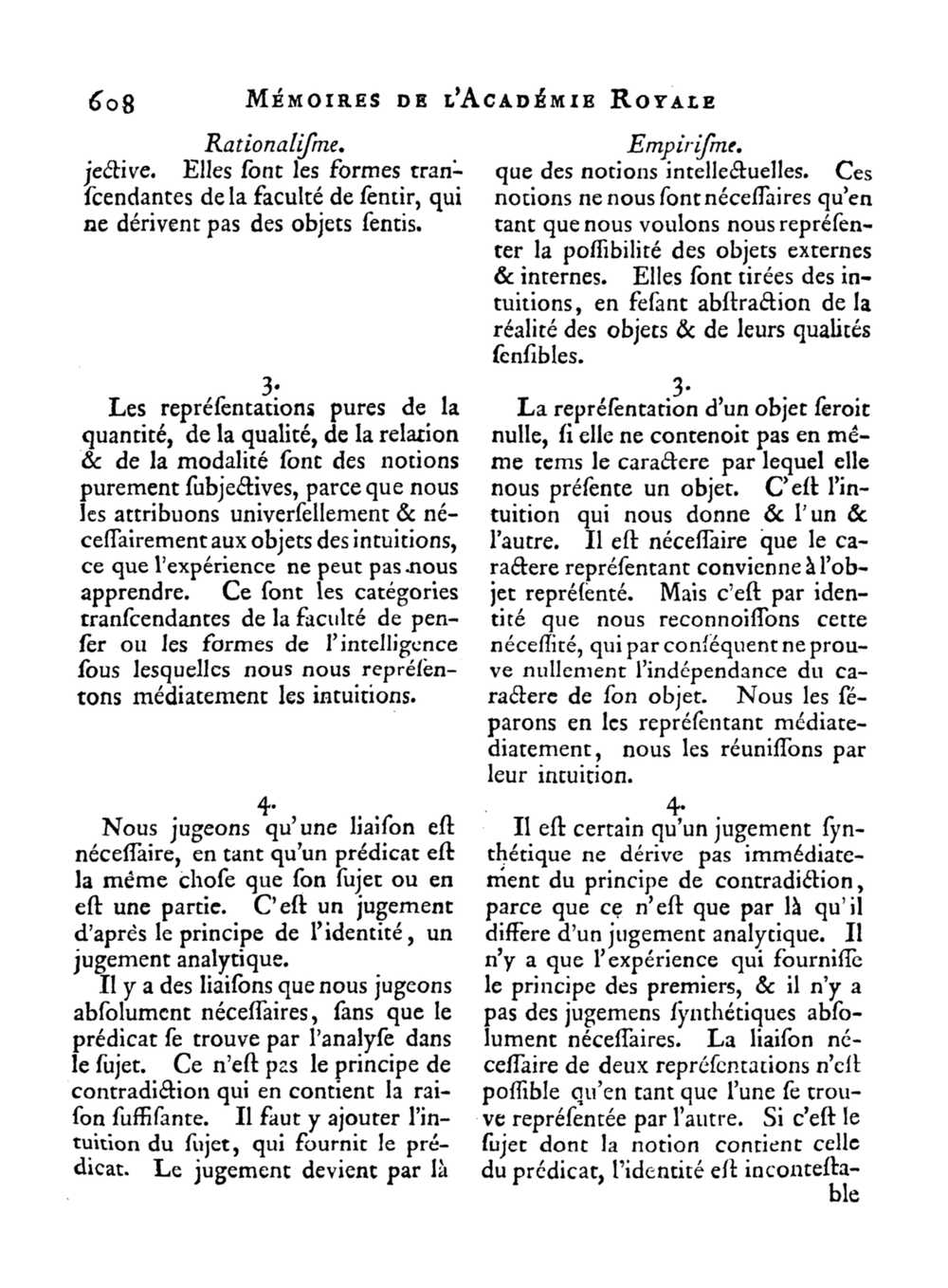
In these debates, “empiricism” and “empirical philosophy” were actors’ categories, that is, categories used to single out certain positions within the then current debates. They were used to identify the positions that we too call empiricist, that is, positions claiming that experience provides the basis for all of our knowledge, knowledge of the world, or substantive knowledge, and that there are no innate ideas or substantive a priori principles.
However, the expressions “empirical philosophy” and “empiricism” were in use well before the debates on Kant’s Critique ensued. There are many occurrences these expressions in seventeenth- and eighteenth-century texts. Can we find the now-familiar, standard meanings of “empiricism” in any of them? Let us survey three pre-Kantian uses of “empiricism” or “empirical philosophy”.
Bacon’s empirical philosophers
Francis Bacon famously classes “empirical philosophy” as one of the three kinds false philosophy, alongside the superstitious and sophistic philosophies, in the Novum Organon. However, Bacon’s empirical philosophers are quite different from our familiar empiricists. Bacon identifies empirical philosophers with William Gilbert (the author of De magnete), “the chymists and the whole pack of mechanics”. According to Bacon, these are not empirical philosophers because they reject innate ideas or defend the empirical origins of our knowledge, but because derived “experiments from experiments”, without managing to “convert and digest” them properly so as to develop true theories on their basis (Novum Organon, I, 95). This characterization hardly maps onto our familiar notion of empiricism.
Priestley’s Philosophical Empiricism
Joseph Priestley wrote a pamphlet entitled Philosophical Empiricism. Commenting on the natural-philosophical pronouncements of his unnamed opponent, he writes:
- These and suchlike long-exploded, and crude notions (so many of which I believe were never thrown together into the same compass since the age of Aristotle or Cartesius) are delivered in a manner and phrase so quaint, and a tone so solemn and authoritative, as gives me an idea that I cannot express otherwise than by the term Philosophical Empiricism.
Here, “empiricism” is used to highlight the crudeness of the opponent’s notions. “Philosophical” may allude, somewhat
ironically, to the solemn tone with which they were presented. This is hardly the sense in which Locke, Hume, or Priestley himself would be later called empiricists.
Adam, the Patriarchs, and Empirical Philosophy
If we turn to German texts, we can find yet another use of “empirical philosophy”. Historians of philosophy, like Heumann and Brucker, were embarrassed as to how they should categorize the wisdom of Jewish Patriarchs and early Greek sages. Reports of their deeds, myths, and ancient rules of political prudence show that they made use of their God-given disposition to philosophize. However, it would seem wrong to put their wisdom on a par with the more recognizably philosophical reflections of Socrates or the Pre-Socratics. German historians found a compromise by classing the reflections of the Patriarchs and early Greek thinkers as forms of empirical philosophy, as opposed to scientific, demonstrative philosophical systems which alone are philosophy in a narrow, proper sense.
The “empirical philosophy” of the Patriarchs, just like Bacon’s “empirical philosophers” and Priestley’s “philosophical empiricism”, has little to do with the current notion of philosophical empiricism. This suggests that that notion saw the light only in late eighteenth-century Germany. Or did I miss any earlier, pre-Kantian uses of that notion? If you have any
suggestions, I would love to hear them. Please leave them in the comments or get in touch.
Laura Bassi: An Eighteenth-Century Newtonian
Kirsten Walsh writes…
Laura Bassi (1711-1778) had a remarkable career. In eighteenth-century Italy, it was rare, but not unheard of, for a woman from a wealthy family to receive a higher education, a doctorate, or even a lectureship. But what made Bassi unique was how she used her positions at the University of Bologna and the Academy of Science (which would ordinarily have been symbolic) to contribute to the scientific community of Europe.
Thony Christie over at The Renaissance Mathematicus recently wrote a very good post about Bassi’s life and career, so I will not go into those details here. Instead, today I’m interested in Bassi as an eighteenth-century Newtonian and experimental physicist.
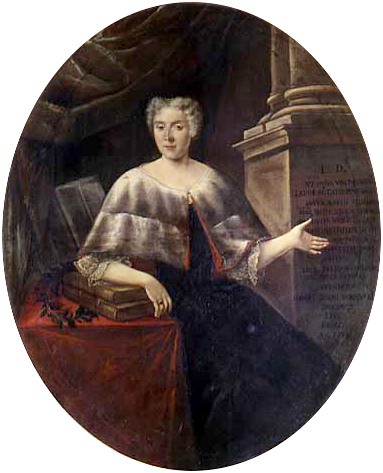 Over the course of her career (roughly 1732 to 1778), Bassi presented papers on mathematics, pneumatics, fluid dynamics, mechanics, optics and electricity. Most of these papers have been lost, but the few surviving papers display Bassi’s talent for mathematics and her commitment to the Newtonian method (as exemplified by Principia). For example, in her paper on differential calculus (“De problemate quodam mechanico”, 1757), Bassi dealt with the problem of how to determine the motion of the centre of mass of two or more bodies moving along any curved paths in a plane. In this paper, she followed the Newtonian method of avoiding metaphysical and empirical assumptions about the nature of matter.
From the 1740s onwards, Bassi and her husband Giuseppe Veratti became very interested in electrical phenomena. Here, we can identify two different Newtonian themes. Firstly, their research appears to have been heavily influenced by the later queries of the Opticks, which attempt to link phenomena such as light, heat, electricity and magnetism with biological phenomena such as muscle movement, growth of plants and phosphorescent fish. Secondly, they supported Franklin’s electrical-fluid theory, which had been systematised in a Newtonian framework by Beccaria.
In the late 1740s, Bassi began teaching privately. Bassi and Veratti had a well-equipped physics laboratory in their home, including an electricity machine. This made it possible for Bassi to teach experimental physics in their home. At the University, the philosophical curriculum was essentially scholastic, and at the Institute of Sciences, the courses on experimental physics had a physiological focus (which reflected the interests of the Bolognese scholars, most of whom had medical degrees). Bassi’s knowledge-base, which by then included advanced mathematics, mechanics, optics, and electricity, made her uniquely qualified to teach a course on Newtonian philosophy and Franklinian electricity. In a letter to Scarselli in 1755 she mentioned the popularity of her classes: “The classes have gathered such momentum that they are now attended by people of considerable education, including foreigners, rather than by youths”.
From this brief survey of Bassi’s work, she appears to have adopted many facets of Newtonianism: she accepted and built on Newton’s rational mechanics, but also followed the leads left by Newton in his optical queries. Indeed, in her own time, Bassi was a well-known Newtonian. Algarotti mentioned her several times (although not by name) in his Sir Isaac Newton’s Philosophy explain’d for the use of the Ladies and explicitly presented her as a Newtonian in ‘Non la lesboa’ – his contribution to the book of poems published in honour of Bassi’s graduation. Also, in 1744 Voltaire implicitly compared Bassi with Newton when he wrote:
- Most Honoured Lady: I would like to visit Bologna so that I might say to my fellow citizens that I have seen Signora Bassi, but, deprived of this honour, I trust that I may with justice cast at your feet this philosophical homage in reverence to the glory of her century and sex. As there is no Bassi in London I should more happily enter your Academy of Bologna than the English one, even though it may have produced a Newton.
But what can we say about Bassi’s ‘experimental physics’? The subject-matter was certainly Newtonian, but what about the methodology? On this blog, we have argued that, from the 1690s onwards, the experimental philosophy was approached in a way that emulated Newton’s mathematical-experimental method. Bassi certainly had the expertise to follow the Newtonian method, which raises the question: Should Bassi’s experimental physics be seen as another facet of her Newtonianism, or should we regard it as a more general interest in the experimental method?
Unfortunately, I haven’t been able to find the evidence to answer this question. I’m not even sure if Bassi engaged in any kind of methodological reflection. Does anyone know how I might find out?
Different concepts of the microscope in the 1660s
A guest post by Ian Lawson from the University of Sydney.
Ian Lawson writes…
Margaret Cavendish’s Observations upon Experimental Philosophy (1666) was a direct criticism of the Royal Society, largely focused on their most prolific work to that date – Robert Hooke’s Micrographia (1665). Cavendish was no fan of experimental philosophy generally, thinking it likely to lead to civil strife, and needing in any case to be guided by speculative thought, she criticised microscopes specifically for a few particular reasons:
- They’re difficult to make and use;
- They’re not very useful (Cavendish asks if observing a louse through a microscope can prevent it from biting); and, relatedly
- They distort nature.
This last, I would like to suggest, points to a different way of understanding and conceptualising the instrument to that of the Society microscopists (I am thinking particularly of John Wilkins, Christopher Wren, and Hooke).
Cavendish writes:
- I do not say, that no glass presents the true picture of an object: but only that magnifying, multiplying, and the like optic glasses, may, and do oftentimes present falsely the picture of an exterior object; I say, the picture, because it is not the real body of the object which the glass presents (pp. 50-51).
A louse, viewed under the microscope, looks like a lobster, and a sharp knife looks blunt. “[I]f the edge of a knife or the point of a needle were naturally and really so as the microscope presents them, they would never be so useful as they are” (p. 51). This is of course a direct reference to Hooke – a needle and a razor were the first two observations in his Micrographia.
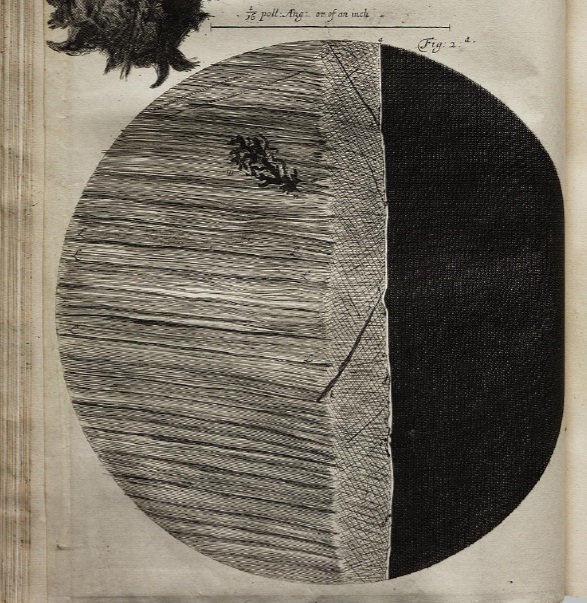
Hooke's drawing of the edge of a razor
Hooke likewise admits that if the razor were “really such as it appear’d through the Microscope, it would scarcely have serv’d to cleave wood, much less to have cut the hair of beards.” Unless, he continues, it were used
- after the manner Lucien merrily relates Charon to have made use of, when with a Carpenter’s Axe he chop’d off the beard of a sage Philosopher, whose gravity he very cautiously fear’d would indanger the oversetting of his Wherry (p. 5).
Hooke’s razor, though lacking a knife’s sharp edge, still has the capacity to rob a philosopher of his wisdom, by showing intuitive assumptions are unfounded. Cavendish appears to suggest there is one scale that an object exists ‘naturally’ at. On the other hand Hooke, Wilkins, and Wren emphasise the contingency of human senses:
- [I]f there were another Species of Intelligent Creatures in the World, they might have quite another kind of Apprehension of the same thing, and neither [theirs nor ours] perhaps as they ought to be.
(Hooke, General Scheme, or Idea of the Present State of Natural Philosophy, p. 8)
The Royal Society microscopists didn’t so much see themselves as altering the objects they were looking at, but rather modifying their own senses. They enter the micro-world, and present the razor as it would seem to someone the size of an insect. It may not retain its traditional use at this scale, but it is the observer who has been distorted rather than the object.
I’m not really sure how illustrative a difference this is to point out, but my feeling is it is tied in with a number of related themes and can possibly help to shed light on them: optimism for the new optical technologies; the new optics of Kepler and Descartes and the naturalisation of vision; experimental as opposed to mechanical philosophy; and Hooke’s approach to instruments more generally.
Emilie du Châtelet on Hypotheses
Kirsten Walsh writes…
Emilie Du Châtelet (1706-1749) is best known in the popular literature as one of Voltaire’s lovers, but among her contemporaries, she was considered to be a brilliant mathematician, physicist and philosopher, whom Voltaire once described as “a great man whose only fault was being a woman”. Her work on heat and light predicted infrared radiation, and her translation and commentary of Newton’s Principia, published ten years after her death, is still considered to be the standard French translation. Today I’m interested in Du Châtelet’s views on hypotheses.

Emilie Du Châtelet (1706-1749)
Du Châtelet’s lengthiest discussion of the use of hypotheses in natural philosophy is found in her Institutions de Physique* (1740), which she wrote as a textbook for her thirteen year old son. Here, Du Châtelet explicitly set up her position on hypotheses in opposition to both Descartes and the Newtonians. She saw both positions as too extreme; and neither position as correct or useful. On the one hand:
- “Descartes, who had established much of his philosophy on hypotheses, … gave the whole learned world a taste for hypotheses; and it was not long before one fell into a taste for fictions. Thus, the books of philosophy, which should have been collections of truths, were filled with fables and reveries.”
But on the other hand, those who follow Newton “have fallen into the opposite excess”:
- “…he alone, who was able to assign and demonstrate the causes of all that we see, would be entitled to banish hypotheses from physics; but, as for us, who do not seem to be cut out for such knowledge, and who can only arrive at the truth by crawling from probability to probability, it is not for us to pronounce so boldly against hypotheses.”
Du Châtelet advocated a more moderate position. She thought that hypotheses performed several important functions:
Firstly, hypothesising is a good way to get the proverbial ball rolling. She wrote:
- “There must be a beginning in all researches, and this beginning must almost always be a very imperfect, often unsuccessful attempt. There are unknown truths just as there are unknown countries to which one can only find the good route after having tried all the others. Thus, some must run the risk of losing their way in order to mark the good path for others; so it would be doing the sciences great injury, infinitely delaying their progress, to banish hypotheses as some modern philosophers have.”
Secondly, hypotheses can provide useful explanations of the phenomena:
- “When certain things are used to explain what has been observed, and though the truth of what has been supposed is impossible to demonstrate, one is making a hypothesis. Thus, philosophers frame hypotheses to explain the phenomena, the cause of which cannot be discovered either by experiment or by demonstration.”
So, unlike Newton, Du Châtelet thought that, if we couldn’t obtain certainties, then we should make do with probabilities:
- “The true causes of natural effects and of the phenomena we observe are often so far from the principles on which we can rely and the experiments we can make that one is obliged to be content with probable reasons to explain them. Thus, probabilities are not to be rejected in the sciences, not only because they are often of great practical use, but also because they clear the path that leads to truth.”
Thirdly, hypotheses suggest new experiments:
- “Hypotheses must then find a place in the sciences, since they promote the discovery of truth and offer new perspectives; for when a hypothesis is once posed, experiments are often done to ascertain if it is a good one, experiments which would never have been thought of without it.”
Moreover, Du Châtelet thought that experimental results could increase the probability of the hypothesis:
- “If it is found that these experiments confirm it, and that it not only explains the phenomenon that one had proposed to explain with it, but also that all the consequences drawn from it agree with observations, its probability grows to such a point that we cannot refuse our assent to it, and that is almost equivalent to a demonstration.”
However, Du Châtelet warned her readers that, when hypothesising, one must proceed with caution:
- “Without a doubt there are rules to follow and pitfalls to avoid in hypotheses. The first is, that it not be in contradiction with the principle of sufficient reason, nor with any principles that are the foundations of our knowledge. The second rule is to have certain knowledge of the facts that are within our reach, and to know all the circumstances attendant upon the phenomena we want to explain.”
Moreover:
- “Since hypotheses are only made in order to discover the truth, they must not be passed off as the truth itself, before one is able to give irrefutable proofs.”
So finally:
- “With this precaution one does not run the danger of taking for certain that which is not; and one inspires those who follow us to correct the faults in our hypotheses and to provide what they lack to make them certain.”
Du Châtelet greatly admired the British philosophers, Locke and Newton in particular. But her views on hypotheses have much more in common with her fellow Continental philosophers, Leibniz and Wolff.
*Translations are quoted from Du Châtelet, E. (2009), Selected Philosophical and Scientific Writings, J. P. Zinsser (ed.), I. Bour & J. P. Zinsser (trans.), University of Chicago Press.
Oldenburg and Newton on ‘Experimental Philosophy’
Kirsten Walsh writes…
During the debate following the publication of Newton’s first paper, Newton provided a set of eight queries, in an attempt to steer the debate towards a satisfactory conclusion. When Henry Oldenburg, Secretary of the Royal Society and Editor of the Philosophical Transactions, published Newton’s queries, he added the following introduction:
- A Serie’s of Quere’s propounded by Mr. Isaac Newton, to be determin’d by Experiments, positively and directly concluding his new Theory of Light and Colours; and here recommended to the Industry of the Lovers of Experimental Philosophy, as they were generously imparted to the Publisher in a Letter of the said Mr. Newtons of July 8. 1672.
However, Newton didn’t describe his own work as ‘experimental philosophy’ until 1713, when he added the General Scholium to the Principia. He wrote:
- … and hypotheses, whether metaphysical or physical, or based on occult qualities, or mechanical, have no place in experimental philosophy. In this experimental philosophy, propositions are deduced from the phenomena and are made general by induction.
In 1672, would Newton have been comfortable with Oldenburg’s label ‘experimental philosopher’? Or did he consciously avoid the label, as Alan Shapiro suggests, in order to distance himself from the methodology of the early Royal Society?
Oldenburg on ‘Experimental Philosophy’
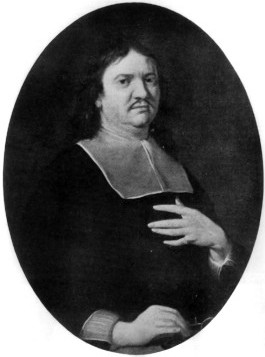
Henry Oldenburg (1619-1677)
To begin, what did Oldenburg mean by ‘experimental philosophy’? Let’s look at his prefaces to each issue of the Philosophical Transactions.
Firstly, Oldenburg was talking about the Baconian experimental philosophy. In the 1672 Preface, Oldenburg chose to adopt Bacon’s term, ‘Operative Philosophy’, which he used interchangeably with the term ‘Experimental Philosophy’. And he wrote:
- But, when our renowned Lord Bacon had demonstrated the Methods for a perfect Restauration of all parts of Real knowledge … The success became on a sudden stupendious, and Effective philosophy began to sparkle, and even to flow into beams of bright-shining Light, all over the World.
Moreover, in 1671, Oldenburg advocated Abraham Cowley’s Baconian-vision for the Royal Society. In his book, Proposition for the Advancement of Experimental Philosophy, Cowley proposed that the Royal Society appoint professors who were:
- bound to study and teach all sorts of Natural, Experimental Philosophy, to consist of the Mathematicks, Mechanicks, Medicine, Anatomy, Chymistry, the History of Animals, Plants …. and briefly all things contained in the Catalogue of Natural Histories annexed to My Lord Bacon’s Organon.
(Incidentally, in a previous post on this blog, Peter Anstey has identified this as the first English book to use the term ‘experimental philosophy’ in its title.)
Secondly, Oldenburg had in mind an experimental philosophy that emphasised the construction of natural histories. For example, in 1669, Oldenburg wrote:
- …we then made an Attempt of laying some Foundation for the Improvement of real Philosophy, and for the spreading of Useful knowledge; in publishing Advices and Directions for the writing of an Experimental Natural History…
Thirdly, Oldenburg had in mind an experimental philosophy that attempted to recover ancient knowledge. For example, in 1671, responding to critics of the experimental philosophy, Oldenburg wrote:
- they call it contemptuously the New Philosophy; when as yet perhaps themselves are not ignorant, that ‘tis so old as to have been the Discipline in Paradise; and from the First of Mankind … to have been practised and countenanced by the Best of Men…
Moreover:
- … we may not lay aside the other expedient, which is so helpful to explicate the Old Wonders of Art, and Old Histories of Nature; namely, To inquire diligently The things that are; What Rarities of Nature, and what Inventions of Men are now extant in any parts of the World.
To summarise, Oldenburg had in mind an experimental philosophy that:
- Followed Bacon’s method;
- Constructed natural histories; and
- Investigated ancient knowledge.
Newton on ‘Experimental Philosophy’
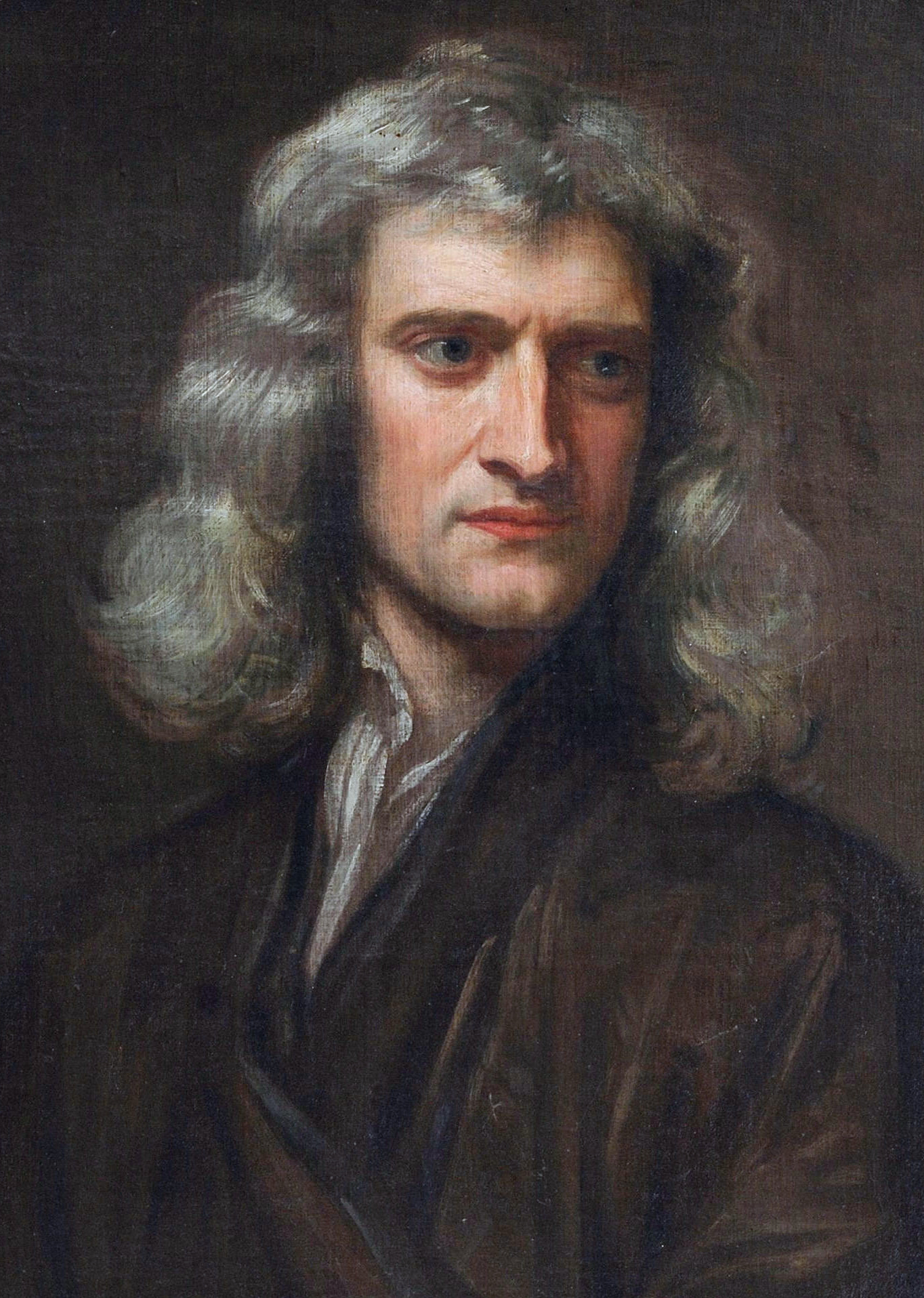
Isaac Newton (1642-1727)
Would Newton have approved of this way of describing his work?
Certainly Newton would have approved of being broadly aligned with the experimentalist philosophers, as opposed to the speculative philosophers. In his ‘Queries Paper’, he wrote:
- … the Theory … was evinced to me … not by deducing it only from a confutation of contrary suppositions, but by deriving it from Experiments concluding positively and directly.
And in the first paper, he wrote: “And I shall not mingle conjectures with certainties”.
While Newton didn’t construct natural histories, he may have approved of the Baconian overtones of the label. For, as I’ve discussed previously, Newton’s 1672 queries resemble Baconian queries.
Newton may even have approved of the suggestion that his method had ties to the Ancients. For example, as early as 1686, in his Preface to Principia, Newton emphasised the influence of the Ancients:
- Since the Ancients (according to Pappus) considered mechanics to be of the greatest importance in the investigation of nature and science and since the moderns – rejecting substantial forms and occult qualities – have undertaken to reduce the phenomena of nature of mathematical laws, it has seemed best in this treatise to concentrate on mathematics as it relates to natural philosophy.
So, I think Newton would have approved of Oldenburg’s label, even though later on, when he came to describe his own experimental philosophy, the emphasis was quite different. For example, in Query 31 of the Opticks, Newton wrote:
- This Analysis consists in making Experiments and Observations, and in drawing general Conclusions from them by Induction, and admitting of no Objections against the Conclusions, but such as are taken from Experiments, or other certain Truths. For Hypotheses are not to be regarded in experimental Philosophy.
The Experimental Role of Hypotheses in Newton’s Principia
Kirsten Walsh writes…
In the first edition of Principia (1687), book 3 contained nine hypotheses. But in the second edition (1713), Newton re-structured book 3 so that it contained only two hypotheses. All but one of the old hypotheses were simply re-labelled. Those that specified explanatory constraints were called ‘Rules of Reasoning’, those that were simply unsupported generalisations were called ‘Phenomena’, and only the assumptions about nature were called ‘Hypotheses’.
| 1st edition | 2nd edition |
| Hypothesis 1 | Rule 1 |
| Hypothesis 2 | Rule 2 |
| Hypothesis 3 | Replaced by Rule 3 |
| Hypothesis 4 | Hypothesis 1 |
| Hypothesis 5 | Phenomenon 1 |
| Hypothesis 6 | Phenomenon 3 |
| Hypothesis 7 | Phenomenon 4 |
| Hypothesis 8 | Phenomenon 5 |
| Hypothesis 9 | Phenomenon 6 |
| Lemma 3 | Hypothesis 2 |
Table: Book 3 changes from 1st to 2nd editions.
These changes seem to indicate that Newton’s attitude to hypotheses changed dramatically between 1687 and 1713 – probably in response to Leibnizian criticisms and Cotes’ editorial comments.
On this blog, I have given you many reasons to suppose that, as early as 1672, Newton was working with a clear epistemic distinction between theories and hypotheses. More recently, I have argued that in fact, Newton was working with a three-way epistemic distinction between theories, which are certain and experimentally confirmed, hypotheses, which are uncertain and speculative, and queries, which are not certain, but provide the proper means to establish the certainty of theories. I call this division Newton’s ‘epistemic triad’. I argued that hypotheses perform a distinctive and vital supporting role to theories and queries, and that this role is an enduring feature of Newton’s methodology.
Today I’ll compare the roles of hypotheses and rules of reasoning in book 3, and argue that Newton’s attitude to hypotheses c.1713 was a refinement of his attitude c.1687, but not a dramatic change.
To begin, consider hypothesis 1 (2nd edition): “The centre of the system of the world is at rest.”
Upon introducing this hypothesis, Newton explained that:
- “No one doubts this, although some argue that the earth, others that the sun, is at rest in the centre of the system. Let us see what follows from this hypothesis.”
This is a simplifying assumption. From this hypothesis, in conjunction with Corollary 4 of the Laws of Motion,
- “The common centre of gravity of two or more bodies does not change its state whether of motion or of rest as a result of the actions of the bodies upon one another; and therefore the common centre of gravity of all bodies acting upon one another (excluding external actions and impediments) either is at rest or moves uniformly straight forward”,
Newton derived Proposition 11: “The common centre of gravity of the earth, the sun, and all the planets is at rest.”
This enabled him to calculate the motions of the planets – that is, to deduce the observational consequences of his theory. I consider this to be the chief role of hypotheses, and it is experimental.
Now compare this with how Newton uses his rules of reasoning.
Rule 1 states: “No more causes of natural things should be admitted than are both true and sufficient to explain their phenomena.”
And Rule 2 states: “Therefore, the causes assigned to natural effects of the same kind must be, so far as possible, the same.”
In his discussion of Proposition 4, Newton explained:
- “And therefore that force by which the moon is kept in its orbit, in descending from the moon’s orbit to the surface of the earth, comes out equal to the force of gravity here on earth, and so (by rules 1 and 2) is that very force which we generally call gravity.”
These rules didn’t help Newton to deduce the observational consequences of his theory in the same way as his hypothesis 1. They provide an important supporting role for his theory, but it is not an experimental role.
To the second edition, Newton also added the General Scholium, in which he (in)famously declared “hypotheses non fingo”. Recently I argued that, in this passage, Newton was not railing against hypotheses in general, but rather, against the use of ‘causal hypotheses’ to illustrate more abstract theories. Given that the first edition did not contain any causal hypotheses, I consider this addition to indicate Newton’s increasing conviction in his method, rather than any dramatic change.
So finally, to summarise the developments between the first and second editions of Principia:
In the first edition:
- Hypotheses are temporarily assumed, untestable propositions that provide a supportive role; and
- There are no causal hypotheses.
In the second edition:
- Hypotheses are temporarily assumed, untestable propositions that provide a supportive experimental role;
- Other temporarily assumed, untestable propositions are given other labels to distinguish them from hypotheses; and
- Emphatically, there are no causal hypotheses.
I see these changes as developments of Newton’s epistemic triad, rather than dramatic methodological changes.
Shapiro and Newton on Experimental Philosophy
Kirsten Walsh writes…
In a recent post, I discussed Alan Shapiro’s paper, ‘Newton’s “Experimental Philosophy”‘, where he argues that
- the apparent continuity between Newton’s usage [of the term ‘experimental philosophy’] and that of the early Royal Society is, however, largely an illusion.
I examined his claim that ‘experimental philosophy’ was used as a synonym for ‘mechanical philosophy’ by the early Royal Society, whereas for Newton, the two terms had different meanings.
Today I’ll address another argument Shapiro makes in that paper.
Shapiro claims that Newton’s adoption of the experimental philosophy occurred quite late – while preparing the 2nd edition of Principia, published in 1713. To support this claim, Shapiro argues that, in the 1713 edition of Principia, Newton uses the term ‘experimental philosophy’ for the first time in public. Moreover, the methodology Newton describes in this context is very different to the methodology he describes in his early optical papers. Shapiro writes:
- At this time [1675] for Newton confirmation is by mathematical demonstration and secondarily – only if you think it is worth the bother – by experiment. He clearly believed that a mathematical deductive approach would lead to great certainty and that experiment could provide the requisite certain foundations for such a science, but until the eighteenth century he did not assign experiment a primary place in his methodology.
If Newton’s ‘experimental philosophy’ is a late development, then this provides additional support for Shapiro’s claim that Newton’s experimental philosophy is not continuous with the methodology of his predecessors, the early members of the Royal Society.
In this post, I’ll argue that (1) experiment is a prominent theme in Newton’s methodological statements between 1672 and 1713, and (2) Newton’s methodology has features that suggest the influence of the early Royal Society.
1. Experiment is a prominent theme between 1672 and 1713
There is a strong experimental theme in Newton’s early optical papers (1672-1675). For example, he says:
- the proper Method for inquiring after the properties of things is to deduce them from Experiments.
And:
- I drew up a series of such Experiments on designe to reduce the Theory of colours to Propositions & prove each Proposition from one or more of those Experiments by the assistance of common notions set down in the form of Definitions & Axioms in imitation of the Method by which Mathematicians are wont to prove their doctrines.
And:
- Now the evidence by which I asserted the Propositions of colours is in the next words expressed to be from Experiments & so but Physicall: Whence the Propositions themselves can be esteemed no more then Physicall Principles of a Science.
In the opening paragraph of De Gravitatione (date of composition unknown), Newton says:
- in order, moreover, that … the certainty of its principles perhaps be confirmed, I shall not be reluctant to illustrate the propositions abundantly from experiments as well…
In the 1st edition of Principia (1686), Newton says:
- The principles I have set forth are accepted by mathematicians and confirmed by experiments of many kinds.
And in the 1st edition of Opticks (1704), Newton says:
- My Design in this Book is not to explain the Properties of Light by Hypotheses, but to propose and prove them by Reason and Experiments…
Experiment doesn’t seem secondary to me!
2. Newton’s methodology suggests the influence of the early Royal Society
As we have said before, the Royal Society adopted the experimental philosophy in a Baconian form – according to the Baconian method of natural history. There is good evidence that Newton was familiar with the work of the Royal Society by the time he wrote his first optical paper in 1672: his notebooks show that he took notes from many issues of the Philosophical Transactions and he took careful notes on Boyle’s work. Newton never adopted the Baconian method of natural history. However, other features of Newton’s methodology suggest the influence of the early Royal Society. For example, he made use of queries, he adopted the familiar distinction between theory and hypothesis, he was concerned with experiments, and he rejected speculation and speculative systems.
Shapiro notices that Newton rejected speculative systems, but fails to recognise that Newton wasn’t the first member of the Royal Society to take this stance. On this blog we have provided ample evidence that the early members of the Royal Society railed against speculation. Newton’s anti-speculation and anti-hypothetical stance, while extreme, was still inside the spectrum of acceptable experimental positions. Consider this passage from Hooke’s Micrographa, addressed to the Royal Society:
- The Rules YOU have prescrib’d YOUR selves in YOUR Philosophical Progress do seem the best that have ever yet been practis’d. And particularly that of avoiding Dogmatizing, and the espousal of any Hypothesis not sufficiently grounded and confirm’d by Experiments. This way seems the most excellent, and may preserve both Philosophy and Natural History from its former Corruptions.
Whether or not Newton explicitly identified himself as such, we have good reason to think that Newton’s first optical paper in 1672 was written by an experimental philosopher.
Is Newton’s Explanation of Gravity a Hypothesis?
Kirsten Walsh writes…
In the General Scholium to Book 3 of Principia, Newton wrote:
- “Thus far I have explained the phenomena of the heavens and of our sea by the force of gravity, but I have not yet assigned a cause to gravity.”
He went on to explain that such a cause would be a hypothesis,
- “and hypotheses, whether metaphysical or physical, or based on occult qualities, or mechanical, have no place in experimental philosophy.”
It might appear that Newton’s methodological statements don’t reflect his real attitude to causal explanations. He explained all the motions of bodies and the sea by the force of gravity. So in some sense, gravity was the cause of those motions. But if gravity was a cause, then wasn’t it a hypothesis? Was Newton’s famous statement “Hypotheses non fingo” a lie?
In this post, I’ll have a closer look at the role of causal explanations in Newton’s method of natural philosophy.
To begin, consider this statement from Query 28 of Opticks:
- “Whereas the main Business of natural Philosophy is to argue from Phaenomena without feigning Hypotheses, and to deduce Causes from Effects, till we come to the very first Cause, which certainly is not mechanical…”
Here, Newton outlined two central tasks for natural philosophers:
- To argue from phenomena without relying on, or giving credence to, hypotheses; and
- To infer causes from effects until you arrive at the first cause.
The first task is methodological, and it places a constraint on the kinds of inferences one may make from effect to cause. The second task is epistemological: it tells the philosopher what kind of knowledge to seek, and when to stop. Newton shed a little more light on this second task in Query 31:
- “By this way of Analysis we may proceed from Compounds to Ingredients, and from Motions to the Forces producing them; and in general, from Effects to their Causes, and from particular Causes to more general ones, till the Argument end in the most general.”
Perhaps recognising that, once constrained by task 1, task 2 would be too difficult for any single philosopher to complete, Newton wrote in Query 28:
- “And though every true Step made in this Philosophy brings us not immediately to the Knowledge of the first Cause, yet it brings us nearer to it, and on that account is to be highly valued.”
Furthermore, in Query 31, he writes:
- “And therefore I scruple not to propose the Principles of motion above-mention’d, they being of very general Extent, and leave their Causes to be found out.”
And so, in Principia, Newton inferred causes from effects as far as he was able to, while still following the advice of task 1. He stopped short of assigning a cause for gravity, because he could not deduce it from the phenomena. So as he wrote in the General Scholium of Principia:
- “It is enough [i.e. for the purposes of his argument] that gravity really exists and acts according to the laws that we have set forth and is sufficient to explain all the motions of the heavenly bodies and of our sea.”
To conclude, Newton doesn’t rail against causes per se, only against causes that cannot be proved by, or inferred from, experiment. I have argued that Newton was working with a clear distinction between theories and hypotheses, where a hypothesis is:
H1. Something that is, at best, only highly probable;
H2. A conjecture or speculation – something not based on empirical evidence; or
H3. A causal explanation – something concerning the nature of the phenomenon, rather than its physical properties.
I have changed the wording of H1 slightly from the definition I have given in previous posts. Now it looks like I might need to alter H3. What do you think?
Conflating the Experimental and Mechanical Philosophies
Kirsten Walsh writes…
Recently I read Alan Shapiro’s paper, ‘Newton’s “Experimental Philosophy”’, in which he argues that
- the apparent continuity between Newton’s usage [of the term ‘experimental philosophy’] and that of the early Royal Society is, however, largely an illusion.
To support this claim, Shapiro argues that, whereas ‘experimental philosophy’ was used as a synonym for ‘mechanical philosophy’ by the early Royal Society, for Newton, the two terms had different meanings. This is demonstrated by the fact that Newton adopted the experimental philosophy, but not the mechanical philosophy.
Shapiro explains that the mechanical philosophy is characterised by adherence to some or all of the following theses:
- the world and its components behave like a machine; or, more strongly, the world can be described solely by the mathematical laws of mechanics; all causation is by contact action so that the immaterial, spiritual agents are banished; matter is composed of invisible corpuscles; and hypotheses about the properties and motions of these invisible corpuscles may be formulated to explain visible effects.
Here Shapiro is conflating mechanism and corpuscularianism. However, Peter Anstey explains in his recent book, John Locke and Natural Philosophy, that these are distinct (but related) philosophies. The leading idea of the mechanical philosophy is that natural phenomena should be explained by analogy with the functioning of machines. The corpuscularian philosophy is primarily a philosophy about the underlying nature of matter, whereby explanations of natural phenomena are constrained by appeal to the invisible corpuscles which constitute all material bodies. Thus, the former is a theory of explanation; the latter, a theory of matter. There is a significant amount of overlap between the mechanical and corpuscularian philosophies, for example the focus on shape, size, motion and texture. But, they are not interchangeable. For example, Anstey points out that it wasn’t the case that everyone who held a corpuscularian theory of matter was a mechanical philosopher.
In contrast, the experimental philosophy emphasises that we can only acquire knowledge of nature by first accumulating observations and experiments and then turning to theory and hypotheses. Thus, the experimental philosophy is a theory of method, which can be viewed as placing epistemic constraints on philosophical endeavours, as opposed to the explanatory constraints of the mechanical philosophy, or the ontological constraints of the corpuscularian philosophy. So, at least notionally, these are three distinct philosophical positions.
Shapiro argues that, in practice, the early Royal Society didn’t distinguish between these philosophical positions. As evidence, he cites a passage from the preface to Robert Hooke’s Micrographia in which Hooke runs together “the real, the mechanical, the experimental philosophy”. But if we look at Hooke’s other work for uses of the term ‘mechanical’, we find that he can and does distinguish the mechanical from the experimental.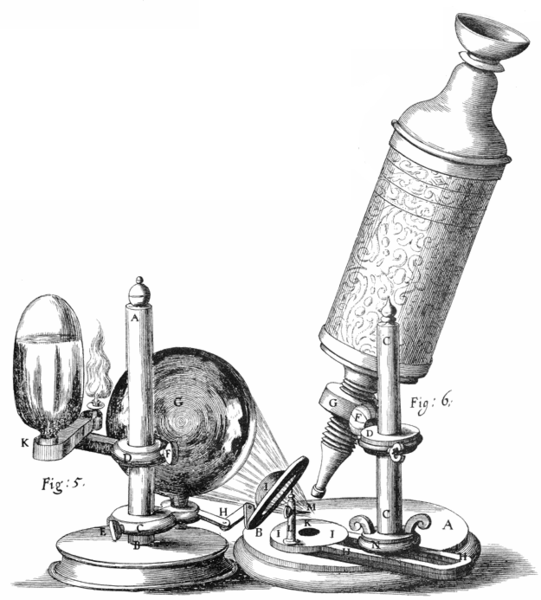
When Hooke explicitly discusses experimental philosophy, he emphasises the importance of constructing natural histories. For example, in his ‘General Scheme’, where he sets out his “Method of Improving Natural Philosophy”, Hooke explains that the best way to proceed is according to the Baconian method of natural history. He says there are three “ways of discovering the Properties and Powers [of bodies]”:
- I. By the Help of the Naked Senses.
- II. By the Senses assisted with Instruments, and arm’d with Engines.
- III. By Induction, or comparing the collected Observations, by the two preceding Helps, and ratiocinating from them.
When he discusses III, Hooke explains that an understanding of mathematics and mechanics “will most assist the Mind in making, examining, and ratiocinating from Experiments”:
- Mechanicks also being partly Physical, and partly Mathematical, do bring the Mind more closely to the business it designs, and shews it a Pattern of Demonstration, in Physical Operations, manifests the possible Ways, how Powers may act in the moving resisting Bodies: Gives a Scheme of the Laws and Rules of Motion, and as it were enters the Mind into a Method of accurate and demonstrative Inquiry and Examination of Physical Operations. For though the Operations of Nature are more secret and abstruse; and hid from our discerning, or discovering of them, than those more gross and obvious ones of Engines, yet it seems most probable, by the Effects and Circumstances; that most of them may be as capable of Demonstration and Reduction to a certain Rule, as the Operations of Mechanicks or Arts.
Later in the same discussion, Hooke enumerates the different kinds of observations one should make when constructing natural histories:
- 25ly, To enquire and try how many Mechanical Ways there may be of working on, or altering the Proprieties of several Bodies; such as hammering, pounding, grinding, rowling, steeping, soaking, dissolving, heating, burning, freezing, melting, &c.
Hooke is using the term ‘mechanical’ in (at least) two different senses. In the first sense, the term describes the processes of machines; in the second sense, the term describes manual work. But he conflates neither of these with the experimental philosophy. They are distinct, albeit related, philosophies.
Previously on this blog we have claimed that some features of Newton’s early methodology, for example his early use of queries, suggest that he was influenced by the new experimental philosophy of the early Royal Society. I do not claim that Newton’s experimental philosophy is continuous with the experimental philosophy of the early Royal Society, so I do not take issue with Shapiro’s main claim. But I do take issue with his claim that the ‘mechanical philosophy’ and ‘experimental philosophy’ were considered by the early Royal Society to be synonymous.
