Te Tumu featuring in a new book on Indigenous Women
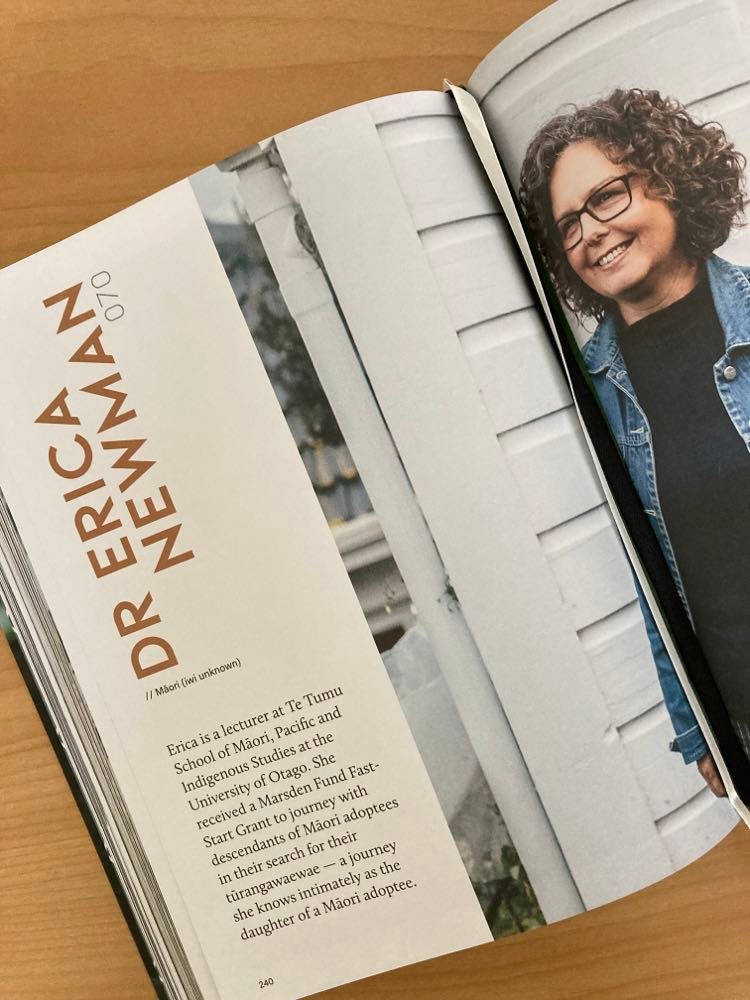
 A new book, Nuku: Stories of 100 Indigenous Women, written by Qiane Matata-Sipu has just been publishing containing (as the title suggests) stories from 100 indigeneous wāhine, mainly wāhine Māori.
“These women and their stories dare to carve their own unique portrait, showing that the world can be positively shaped by our diverse and connected Indigenous voices. Stories about who we are, not who we’ve been told to be.” Qiane Matata-Sipu
Within this book Te Tumu has an alumna, Dr Ani Alana Kainamu, and current Lecturer, Dr Erica Newman. As with all narratives within this pukapuka, both Drs Kainamu and Newman talk about their own journeys within te ao Māori and what they are currently doing.
This book is well presented with fabulous stories from some amazing women.
If you are the type who prefers to listen rather than read, longer versions of each women’s kōrero are available as podcasts on https://nukuwomen.co.nz/nuku100/

Looking for a new Dean
 The university is advertising for a new Dean of Te Tumu, someone who is a great leader, researcher and person, with research and teaching aligning to Māori, Pacific, or Indigenous Studies (or a combination of these). CLICK HERE FOR LISTING.
Please share this to your networks, and to anyone who you feel might be the right person for the job. Te Tumu is an exciting, dynamic school, at the best university in New Zealand.
The Cook Islands (Māori) Imaginary…

Dr Emma Powell
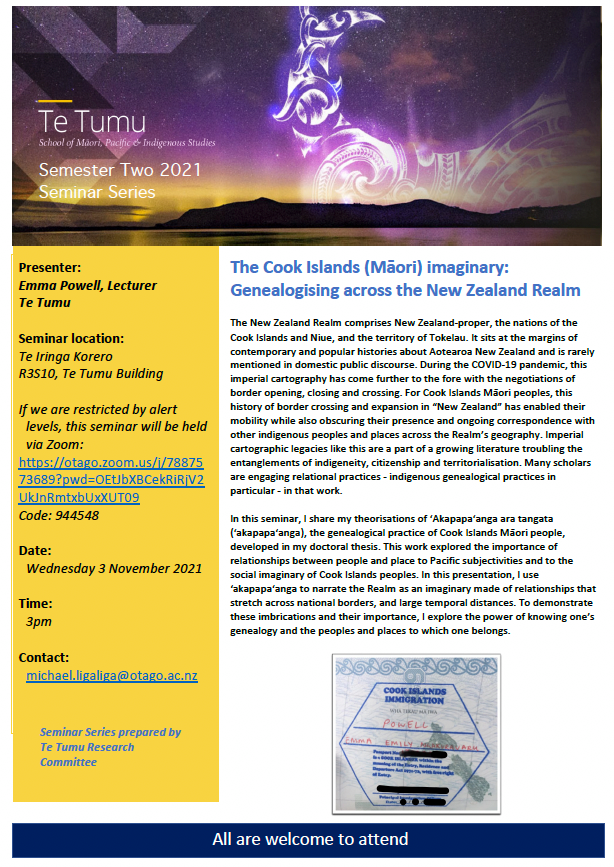
Dr Emma Powell is one of Te Tumu’s newest staff members, a member of our Indigenous Development team who will also be teaching INGS501 next year, the core paper for the Master of Indigenous Studies degree that investigates Indigenous methods and theories.
Emma will be presenting our next seminar, on “The Cook Islands (Māori) Imaginary: Genealogising across the New Zealand Realm” starting 3pm, 3 November. If we are back at Level 1, this will be in Te Tumu, otherwise click here to connect via Zoom. Code: 944548.
Please click on the poster below the abstract of Emma’s talk. Everyone is welcome to attend.
Click to enlarge
Just a few days to make a submission on adoption legislation
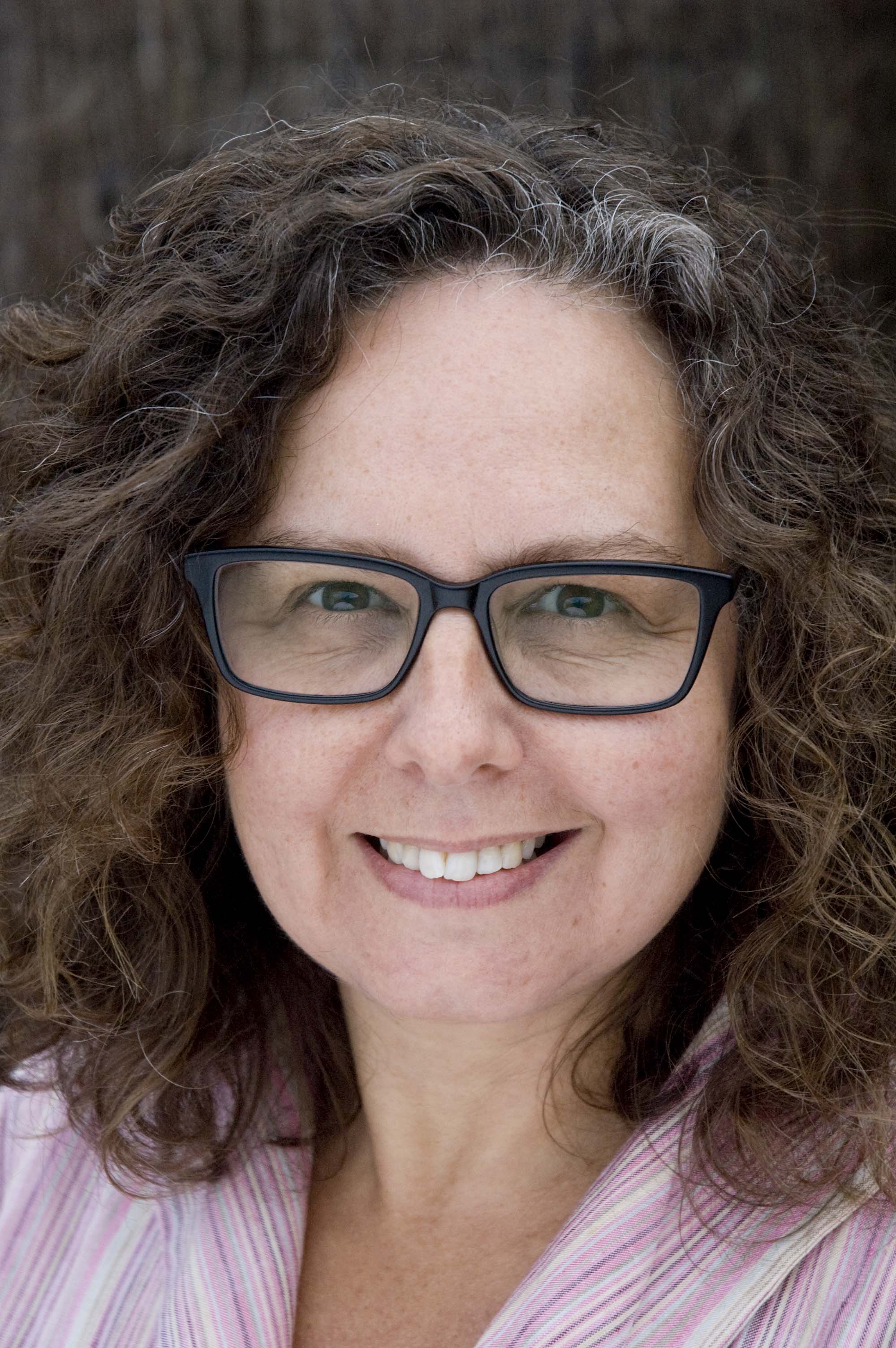
Dr Erica Newman
As you know Dr Erica Newman fronts a Marsden-funded research project, Journey Home: Descendants of Māori adoptees search for their tūrangawaewae. Read more about it here. She has recently been communicating with the Ministry of Justice as they begin to review the 1955 Adoption Act, providing her expert insight regarding the effect of this Act on the identity of Māori adoptees and their descendants, especially if they have not been able to connect to their taha Māori.
Erica writes, “New Zealand’s 1955 Adoption Law has had a detrimental affect on the identity of many adoptees and their descendants. This antiquated piece of legislation is now under review and this is our chance to have a say about what we think this new Act should look like, to a focus on the child rather than the adoptive and/or birth parents.
“For instance, this could be the repeal of the current Act altogether with the intention that a system be developed whereby a child’s identity is nurtured through continued connections with whānau and their history and culture, to allow the child to truly understand who they are through the knowledge of where they are from and where they belong. Or, alternatively, significant changes could be made to the current Act such as not renaming the child when adopted, not having a veto on records, a requirement to maintain whānau connections, and whāngai becoming legally recognised (under the recognition of the child’s hapū and iwi).
“If you have experienced the legal adoption system (personally or whānau members) this is an opportunity to have a say. The more narratives the Ministry of Justice has, the more informed they will be in making change.”
Below are links for more details, please note that submissions need to be in by 31 August 2021.
https://www.justice.govt.nz/justice-sector-policy/key-initiatives/adoption-law-reform/
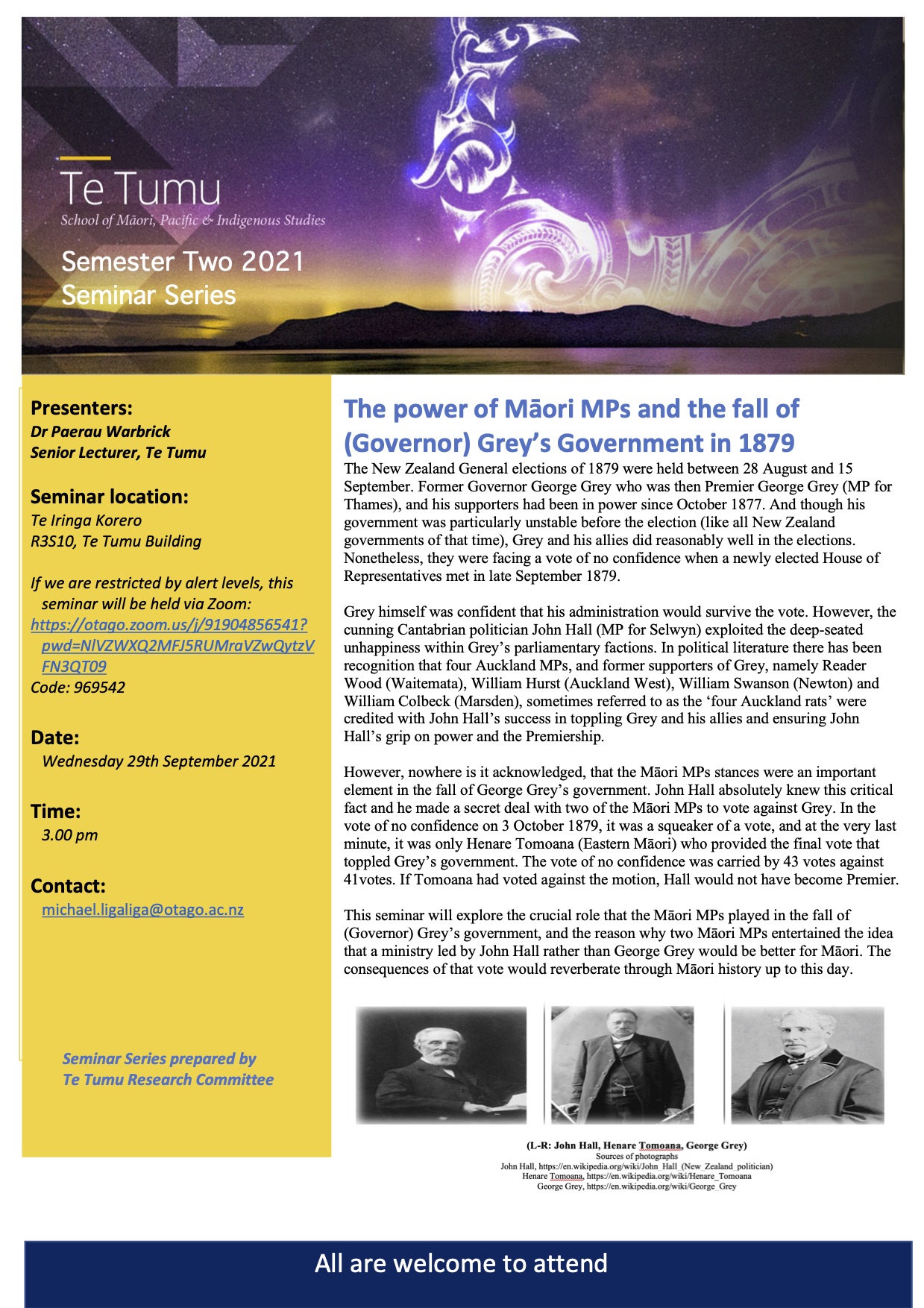
Paerau Warbrick seminar, 28 September
Click on poster to enlarge
Paerau Warbrick will be presenting on “The power of Māori MPs and the fall of (Governor) Grey’s Government in 1879” for the Te Tumu Seminar Series at 3pm Wednesday, 29 September. We may be lucky by then and be able to have the seminar in Te Iringa Kōrero, but if not Paerau will present a Zoom seminar.
There are many interesting stories relating to Māori parliamentary politics and elections, about which Paerau is an expert. His interests in this area span from 1868 when the first Māori members sat in the House right up to the present day; with this seminar looking at the Māori contribution to the fall of the Grey Ministry in 1879. Click on the poster for the full abstract.
Click here for the Zoom connection. The code, if needed, is 969542.
Te Tumu seminars are open to all interested people; please feel free to attend and to share this post.
Upcoming Te Tumu seminar

Click to enlarge this poster
Lachy Paterson‘s seminar, “Periodicals and Proselytising: Māori and religion during the Second World War” was originally scheduled for August, but with the onset of Covid, it has been put off till 3pm Wednesday, 8 September. If we are permitted (unlikely) it will be on campus in Te Iringa Kōrero (3rd floor of Te Tumu); in the more likely event that we will still be under lockdown conditions, it will be a zoom seminar.
Lachy will be looking at aspects of Māori religious experiences during the Second World War, coming out of research from the Te Hau Kāinga: Māori Home Front, the Marsden-funded research project headed by Angela Wanhalla and him. Click on the poster for more information.
Click here for the Zoom connection. The code (if needed) is 969542.
Te Tumu seminars are open to all interested people; please feel free to attend and to share this post.
MIndS students’ success
It’s graduation this coming Saturday (21 Aug), and Te Tumu is lucky to have three Master of Indigenous Studies students who are graduating. This is always a wonderful occasion for graduates themselves, as well as their families and their supervisors.
 Tofilau Nina Kirifi-Alai (Sāmoa) was until recently the Manager of the University of Otago’s Pacific Islands Centre. She is currently the Inaugural Manager of Pacific Community Engagement, University of Otago, based in Auckland. This is a new role that the University of Otago established this year.
Research Title: “The Development of the Pacific Islands Centre at the University of Otago, Dunedin, New Zealand: A Personal Reflection”.
Supervisor: Telesia Kalavite
Abstract: “The purpose of a Centre for Pacific students is to seek and find ways whereby meanings, nuances and metaphors in Pacific cultures can speak to the heart, the soul and the mind of the students. The challenge here, as in other places, lies in how to articulate speech and writing to get meanings, nuances and metaphors of Pacific cultures within a monocultural academic environment” (Comment by His Highness Tui Atua Tupua Tamasese Ta‘isi Efi‘s inauguration speech at the formal opening of the Pacific Islands Centre, University of Otago, in 2003).
The establishment of the Pacific Islands Centre (PIC) in 2001 was a response by the University of Otago (UO) to the Tertiary Education Commission (TEC) initiatives to ensure the success of its Pacific students. Pacific Islands people’s participation in New Zealand society, including education, is still lagging behind that of the general population since the late 1960s. The PIC was the first-ever centre within New Zealand Tertiary Education Organisations (TEOs) and this year, 2021, marks its 20th anniversary. The PIC creates pathways for students’ success at the UO reflecting the government’s continuous attempt to improve the success rate of Pacific peoples in the education system. The PIC strongly becomes the impetus to lead and implement support for Pacific students and staff through its engagement with the UO and Pacific communities locally, nationally, regionally and internationally.
This research takes an autoethnographic Pacific approach. Autoethnographic because it documents my reflections as the inaugural Manager of the PIC since 2002; Pacific because it is a Pacific-focused centre, operated by Pacific staff for Pacific students and, most importantly, I, the researcher am Samoan, and of Pacific decent. My voice becomes central in documenting the Centre’s developmental history because when I first started as the pioneer of the PIC there was no specific Pacific model to build on, or strategic framework or manual to guide it. This research therefore, is basically grounded on Pacific philosophies of attitudes, views, ideas, values, beliefs, customs, traditions, practices and experiences of the researcher.
The PIC is significant for the educational development of Pacific students and staff at the UO. This research documents the journey of the PIC in terms of its history, developmental strategic plans, practices and reviews that enhance the success of everyone involved. This research is unique and authentic in its approach as it provides first-hand information on how the PIC nurtures Pacific Islands students in their academic journeys. It also adds value to the development of educational strategic directions of the UO to benefit both Pacific and non-Pacific communities at Otago, New Zealand, the Pacific region, and the world.
The first generation consists of the maternal and paternal grandparents of the author, in which they discuss vasu in its political definition of ‘half-caste’ or of mixed ethnic heritage. This generation will also elaborate on contributing themes to vasu, such as their relationships with their kinship groups, languages/dialects and their Fijian identity. As this generation is the only group to have regular visits and contact with their rural villages, vasu will be viewed through this lens.
The next generation is of the author’s parents and they will also discuss themes such as their own Fijian identity, as well as the role of Fijian women, domestic workers and accessibility to the village. This particular generation is part of the urban migration and will reflect over vasu with this viewpoint.
Finally, the last generation is of the author’s and her maternal and paternal first-cousins. The supporting themes for this generation’s understanding of vasu are customary Fijian relationships and concepts, mixed ethnicity and the use of Fijian language and knowledge. This generation is a part of the Fijian diaspora in New Zealand and will be using this perspective in sharing their understandings and experiences of vasu. Eventually, similar elements and concepts will be highlighted, with each generation sharing their own narratives on what vasu is to them. Despite the different time periods and physical contexts, the prominence of the maternal lineage has proven to play a significant role in every generation of this family, particularly in a patriarchal society that is known to Fiji.
 Nicola (Nicky) Andrews (Ngāti Pāoa) Nicky is currently a faculty librarian at the University of San Francisco where she teaches undergraduates how to do research; and work on other projects including research into Indigenous information literacy. She is open to pursuing a PhD in the future.
Nicky was initially supervised by the late Alumita Durutalo. Paerau Warbrick took over during the research design and interview phase, and Erica Newman supervised her work during the bulk of the writing and revising phase. Nicky is thankful to all three for their work and care. She will graduate in absentia.
Research title: “Historical Trauma, Indigenous People, and Libraries.”
Abstract: Historical trauma theory (HTT) built on understanding of Holocaust survivors and subsequent generations (Pihama et. al., 2014) and articulated how colonization and genocide against Indigenous peoples also resulted in historical trauma and intergenerational grief (Brave Heart & DeBruyn, 1998; Methot, 2019). In this research report, I examine how modern libraries reinforce historical trauma for Indigenous library users and workers through library origins, professional credentialing, staffing demographics, and policies. While historical trauma theory is rooted in social work (Brave Heart & DeBruyn, 1998), it is applicable to librarianship as a profession of public service that impacts Indigenous access to knowledge and self-discovery.
I conducted my research using kaupapa Māori and autoethnography frameworks, to interview five Indigenous librarians from Aotearoa, Canada, and the United States. Over Zoom, participants detailed their unique experiences as Indigenous people using libraries, studying library science, and working in libraries.
Participants spoke candidly about the racism and microaggressions they routinely encounter; and the isolating nature of often being the only Indigenous worker in their team or place of employment. In particular, participants recounted how historical trauma resurfaced when facing inadequate resources to support Indigenous knowledge, or when organizations reinforced policies that conflicted with Indigenous practices and worldviews.
However, participants also described hope and progress towards equity, aligning with contemporary shifts toward valuing Indigenous peoples in libraries. I make and acknowledge several recommendations in this report ranging from practical changes to library policies and practices, to frameworks to address historical trauma within library spaces. These practices can be applied beyond libraries into higher education, government work, and other sectors.
This Reseach can be accessed through OUR Archive.
Te Tumu would also like to congratulate Pipi Royal who will be graduating with their BA in Māori Studies.
Dr Kalavite features on two international panels
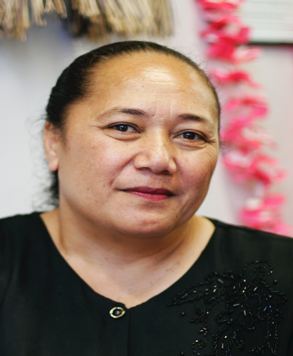 Recently Dr Telesia Kalavite was invited to participate in two online international panel discussions on the 4th, and 5th of August,
She was first invited by Fola-he Ngalu Online Media Network, a Free Weslyan Church of Tonga (Siasi Uesiliana Tau‘atāina ‘o Tonga) online platform, to discuss the topic: “The advice for parents of internet generations to help them understand what it means for their children to be proud of their Tongan identity within and outside of Tonga”. (“Ko e fale‘i, ke tokoni ki he mātu‘a ‘o e to‘utangata Tonga ko eni ‘o e Ope pē ‘Initaneti, kenau ongo‘i ‘oku mahu‘inga kenau ke i pōlepole pē ‘i honau Tonga, ‘o tatau pē ‘i Tonga pea mo muli, (‘I loto-Tonga mo tu‘a-Tonga)”.
Her focus in this panel was on her perspective as a Tongan mother and educator on what it means for this internet generation to be rooted in their Tongan culture. “Pe koehā ‘ene vakai ki he mahu‘inga ‘a hotau ‘ulungaanga faka-Tonga ‘i Tonga (loto-Tonga), ‘i he kuonga pē to‘utangata ko eni ‘o e ‘Initaneti/Vahaope” This panel was mostly in the Tongan language and can be found on the Network’s website, on Youtube, and Facebook.
Telesia was also invited by THE (Times Higher Education) Live ANZ 2021 International Conference, to be one of the panelists on the topic: “Indigenous Knowledge and the Western academy: Reflections from the field”.
Her focus in this panel was on her research, knowledge and experience on Pacific success in New Zealand Higher Education. Click here for the link to this panel.
Dr Kalavite is the Coordinator for Te Tumu’s Pacific Islands Studies programme. It is wonderful to see Te Tumu staff sharing their knowledge to wider audiences, and helping to meet the goals of the university’s Pacific Strategic Framework.
Te Tumu staff in the Māori media
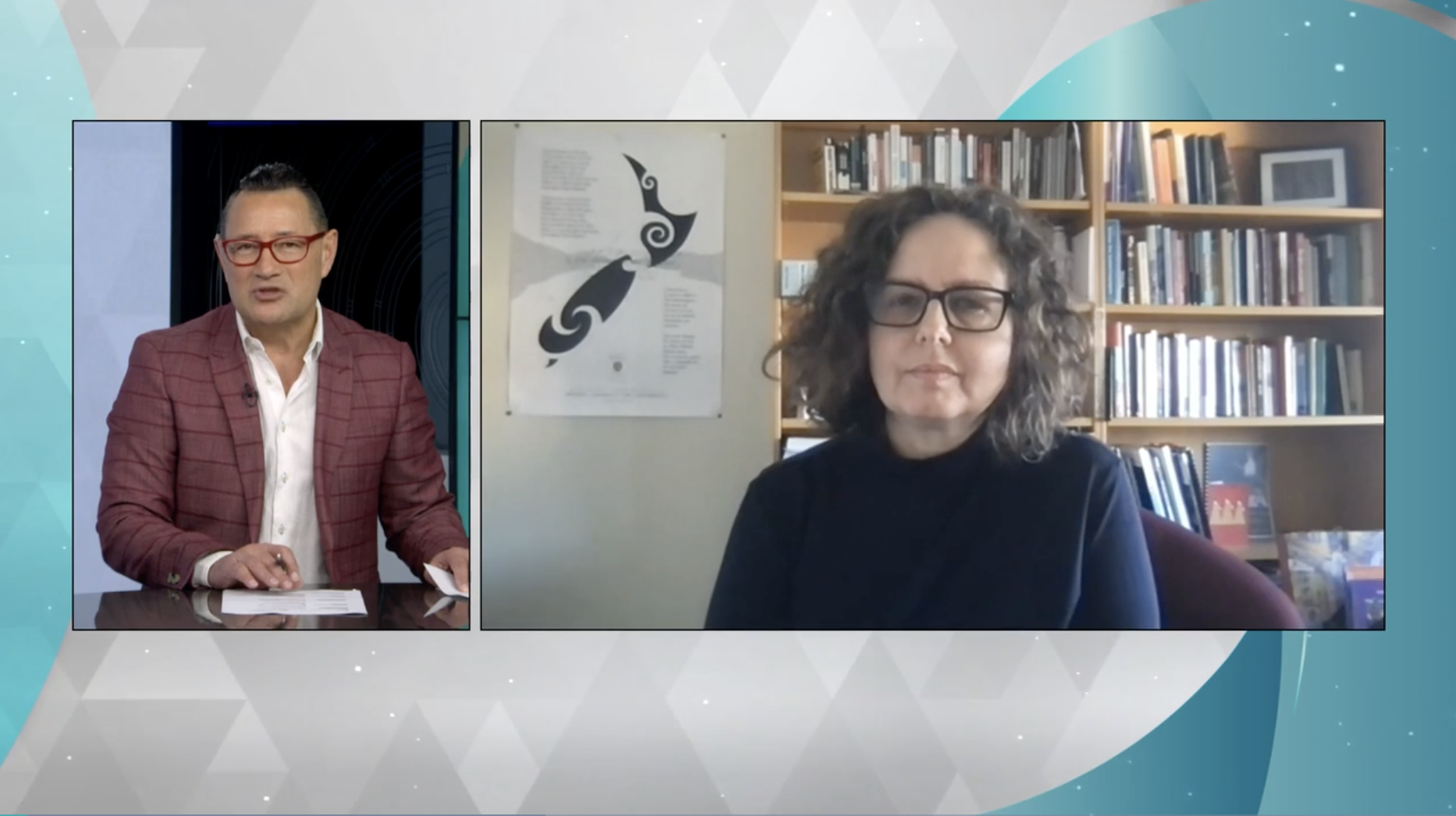
Dr Newman being interviewed on Māori TV
Erica Newman‘s Marsden funded research on the descendants of Māori who were adopted into Pākehā families is continuing to attract attention in the Māori media. Recently she was interviewed by Māori TV, with an accompanying story in Stuff. Click here to access these. She also features in Te Karaka, the Ngāi Tahu magazine. Click on TE-KARAKA-88 (1) to access the magazine (a great read!): the story featuring Erica’s research, and her family history are on pages 38-41.
Paerau Warbrick has always been interested in politics, and his own academic research delves into the some of the lives and contests of historical Māori politicians. Paerau is also always happy to chat and give his opinion on what’s happening now. A couple of days ago, he wrote an opinion piece on National’s use of race as a political tool for E-Tangata. This explores more recent and current National Party leaders and how they did (or could) play the “race card” to their best advantage. Not everyone will necessarily agree with Paerau, but his piece will make you think.
Michelle Schaaf offers commentary on Dawn Raids apology
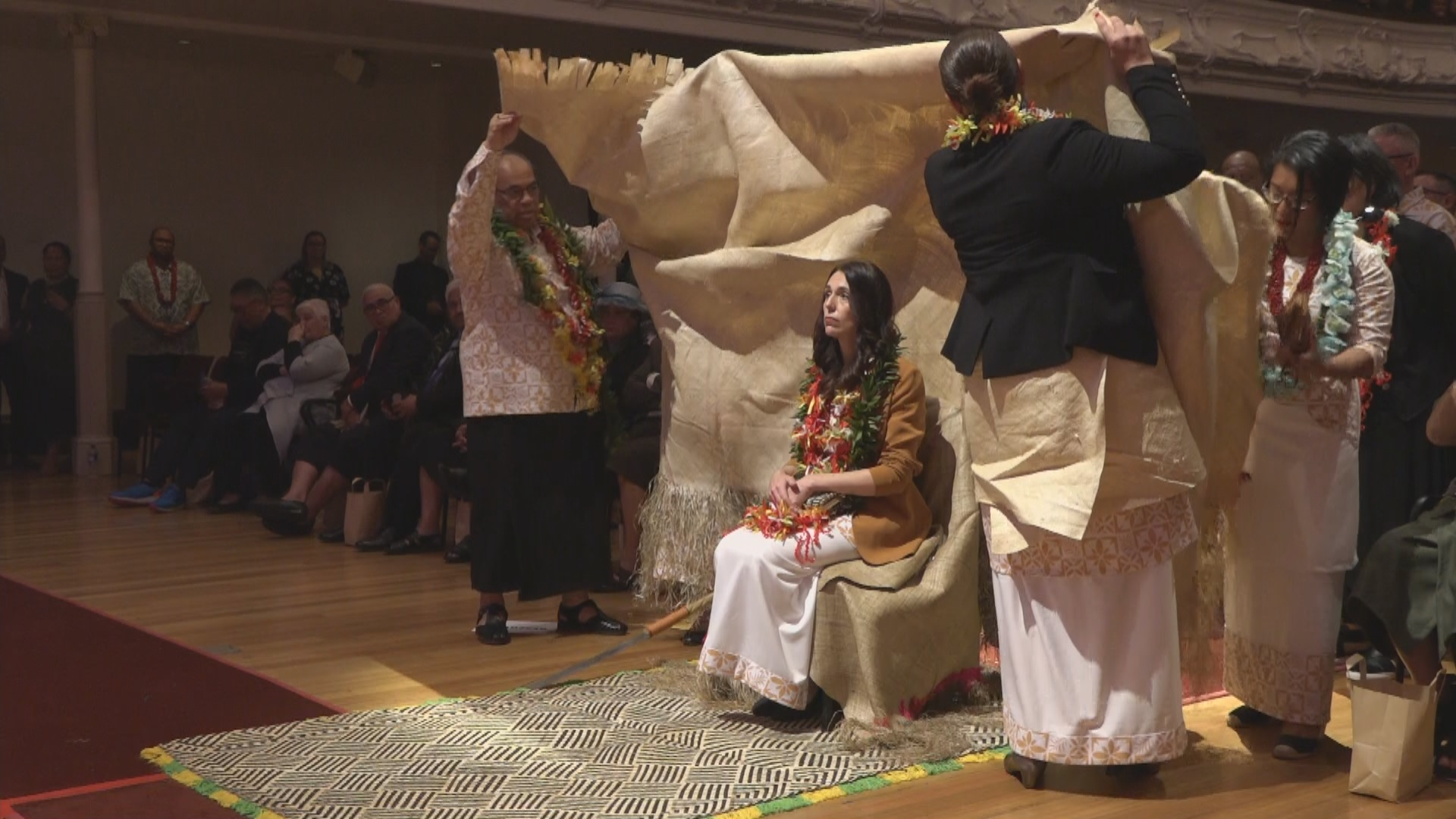 It is great when Te Tumu academics are called upon to comment on important national events as they happen. Yesterday the Prime Minister made an formal apology for the dawn raids of the 1970s when Pasifika people were indiscriminately targeted by the police and officials as “overstayers”. The PM also took part in an ifoga ceremony to assist with healing these traumatic events. Click here for the full One News account, with extensive commentary from Pacific Islands Studies lecturer, Dr. Michelle Schaaf.
