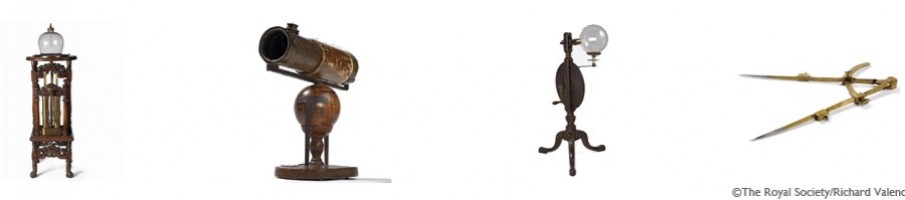
Should we call Newton a ‘Structural Realist’?
Kirsten Walsh writes…
At our symposium last week, someone wondered if we can characterise Newton as a ‘structural realist’. It is certainly anachronistic to attempt to interpret Newton’s epistemic stance in light of the present-day scientific realism debate. But the sin of anachronism may be forgiven, if it advances our understanding. So let us see what advantages this interpretation may provide.
Briefly, structural realism is the view that epistemically, a scientist should only commit herself to the mathematical or structural content of her theories, and remain sceptical about the unobservable entities posited by those theories.
To characterise Newton as a structural realist, one might make the following argument:
- P1. Newton is a realist about his theories, but not about his hypotheses.
P2. Newton’s theories make claims about theoretical structures, whereas his hypotheses make claims about unobservable theoretical entities.
C. Therefore, Newton is a realist about theoretical structures, but not about unobservable theoretical entities.
Firstly, consider Newton’s hypothesis/theory distinction. In a previous post I argued that Newton claims that his doctrine of light and colours is a theory, not a hypothesis, for three reasons:
- T1. It is certainly true, because it is supported by (or deduced from) experiment;
T2. It concerns the physical properties of light, rather than the nature of light; and
T3. It has testable consequences.
In contrast, he attaches no special epistemic merit to his corpuscular hypothesis because:
- H1. It is not certainly true, because it is not supported by experiment;
H2. It concerns the nature of light; and
H3. It has no testable consequences.
T1 and H1 support P1. They tell us that Newton is a realist about theories because they can be shown to be true on the basis of experiment. Moreover, he is not a realist about hypotheses because they cannot be shown to be true on the basis of experiment. This highlights an important feature of Newton’s methodology: Newton is only epistemically committed to those things that are demonstrated experimentally.
T2 and H2 appear to support P2, but only if the ‘entity/structure’ distinction maps onto Newton’s ‘nature/physical properties’ distinction. Prima facie, it does. While Newton probably wouldn’t have been comfortable with the entity/structure distinction, the structural realist debate is often framed in terms of the nature/physical properties distinction. For example, here’s how the Stanford Encyclopedia of Philosophy describes the structural realist position:
- Structural realism is often characterised as the view that scientific theories tell us only about the form or structure of the unobservable world and not about its nature. This leaves open the question as to whether the natures of things are posited to be unknowable for some reason or eliminated altogether.
So it looks like the argument for characterising Newton as a structural realist is well-supported by Newton’s distinction between theory and hypothesis. But what do we gain by characterising Newton in this way?
Chris Smeenk recently pointed out to me in an email that the structural realist label identifies a distinctive feature of Newton’s methodology. Namely, that he is epistemically committed to his abstract mathematical structures. He is not an instrumentalist about his theories, but neither is he a realist about the nature of the phenomena they describe. This might shed some light on the optical debate of the early 1670s, for unlike his contemporaries, Newton does not think there is a contradiction in believing that his theory of light is true, while not committing himself to any particular doctrine regarding the nature of light.
Is this a large enough pay-off to warrant the offence of anachronism? What do you think?
In this brief post, I have only considered Newton’s attitudes to his own theories. There are other questions to be raised in connection with structural realism, for example, is Newton a structural realist about the history of science? In other words, what is Newton’s epistemic commitment to the theories of his predecessors? I shall leave this question for another time.
On another note, we were very pleased with how last week’s symposium went. We look forward to telling you all about it next Monday.
Newton’s Method in ‘De gravitatione’
Kirsten Walsh writes…
Newton’s manuscript De Gravitatione (‘De Grav.’ for short) was published for the first time in 1962, but no one knows when it was written. Some scholars have argued that Newton wrote De Grav. as early as 1664, others, as late as 1685, and there have been arguments for almost every period in between.
Ostensibly, the topic of De Grav. is “the science of the weight and of the equilibrium of fluids and solids in fluids”. Newton discusses this topic in the form of definitions, axioms, propositions, corollaries, and finally a scholium. However, the scholium ends abruptly and the manuscript is unfinished. One of the most notable features of this manuscript is what Hall & Hall describe as a “structural failure”: what begins as a brief discussion of a definition turns into a lengthy and detailed attack on the Cartesian conception of space and time. This digression is significant. Firstly, it is useful for understanding the development of Newton’s thoughts on many topics. Secondly, it supports the view that, in Principia, Newton’s intended opponent was Cartesian, rather than Leibnizian.
In this post, I am not going to talk about Newton’s 23-page digression (which may well form the basis of another post). Rather, I am interested in the opening paragraph of this manuscript, in which Newton describes his method. He begins:
- “It is fitting to treat the science of the weight and of the equilibrium of fluids and solids in fluids by a twofold method.”
The first, he tells us, is a geometrical method. He says he plans to demonstrate his propositions “strictly and geometrically” by:
- Abstracting the phenomena from physical considerations;
- Establishing a strong foundation of definitions, axioms and postulates; and
- Formulating lemmas, propositions and corollaries.
The second is a natural philosophical method. He says he plans to explicate and confirm the certainty of his propositions by the use of experiments. He says that these discussions will be restricted to scholia, to ensure that the two methods are kept separate.
This twofold method bears striking resemblance to two other aspects of Newton’s work:
- It accurately describes the method and structure of Principia; and
- It resembles the quasi-mathematical method he uses to ‘prove’ his theory of colours.
The first point is uncontroversial – almost boring, given how many times it has been mentioned in the literature. But it shows that this method is in use by Newton at least by the mid-1680s. My second point, however, requires some explanation.
In an earlier post I argued that, at least in the early 1670s, Newton’s goal is absolute certainty. He hopes to achieve certainty in the science of colours by making it ‘mathematical’. The clearest demonstration of his quasi-mathematical method is found in Newton’s reply to Huygens, where he sets out his theory of colours in a series of definitions and propositions, in the style of a geometrical proof.
Despite the resemblance, this is not precisely the same method that Newton is advocating in De Grav. Experiment appears to play a different role.
In his early optical work, propositions are founded on experiment. So experiment should be the first step in any inquiry. For example, in a letter written in 1673, Newton says:
- “I drew up a series of such Expts on designe to reduce the Theory of colours to Propositions & prove each Proposition from one or more of those Expts by the assistance of common notions set down in the form of Definitions & Axioms in imitation of the Method by which Mathematicians are wont to prove their doctrines.”
But in De Grav., Newton says that experiment is employed to ‘illustrate and confirm’ the propositions. That is, experiment is supposed to occur as a later step.
This raises several questions about Newton’s methodology. Is there any practical difference between the two methods? Does this represent a significant shift in the role Newton assigned to experiment? Can methodology shed any light on the dating of De Grav.? What do you think?
Next week, we’ll hear from Peter Anstey.
Newton’s Early Queries are not Hypotheses
Kirsten Walsh writes…
In an earlier post I demonstrated that, in his early optical papers, Newton is working with a clear distinction between theory and hypothesis. Newton takes a strong anti-hypothetical stance, giving theories higher epistemic status than hypotheses. Newton’s corpuscular hypothesis appears to challenge his commitment to this anti-hypothetical position. Today I will discuss a second challenge to this anti-hypotheticalism: Newton’s use of queries.
Newton’s queries have often been interpreted as hypotheses-in-disguise. But in his early optical papers, Newton’s queries are not hypotheses. In fact, he is building on the method of queries prescribed by Francis Bacon, for whom assembling queries is a specific step in the acquisition and development of natural philosophical knowledge.
To begin, what is Newton’s method of queries? In a letter to Oldenburg, Newton explains that
- “the proper Method for inquiring after the properties of things is to deduce them from Experiments.”
Having obtained a theory in this way, one should proceed as follows: (1) specify queries that suggest experiments that will test the theory; and (2) carry out those experiments.
He then lists eight queries relating to his theory of light and colours, e.g.:
- “4. Whether the colour of any sort of rays apart may be changed by refraction?
“5. Whether colours by coalescing do really change one another to produce a new colour, or produce it by mixing onely?”
He ends the letter, saying:
- “To determin by experiments these & such like Queries which involve the propounded Theory seemes the most proper & direct way to a conclusion. And therefore I could wish all objections were suspended, taken from Hypotheses or any other Heads than these two; Of showing the insufficiency of experiments to determin these Queries or prove any other parts of my Theory, by assigning the flaws & defects in my Conclusions drawn from them; Or of producing other Experiments which directly contradict me, if any such may seem to occur. For if the Experiments, which I urge be defective it cannot be difficult to show the defects, but if valid, then by proving the Theory they must render all other Objections invalid.”
While Newton’s method of queries is experimental, it does not appear to be strictly Baconian. For the Baconian-experimental philosopher, queries serve “to provoke and stimulate further inquiry”. Thus, for the Baconian-experimental philosopher, queries are part of the process of discovery. However, for Newton, queries serve to test the theory and to answer criticisms. Thus, they are part of the process of justification.
Newton uses queries to identify points of difference between his theory and its opponents. For example, in a letter to Hooke he writes:
- “I shall now in the last place proceed to abstract the difficulties involved in Mr Hooks discourse, & without having regard to any Hypothesis consider them in general termes. And they may be reduced to these three Queries. [1] Whether the unequal refractions made without respect to any inequality of incidence, be caused by the different refrangibility of several rays, or by the splitting breaking or dissipating the same ray into diverging parts; [2] Whether there be more then two sorts of colours; & [3] whether whitenesse be a mixture of all colours.”
And in a letter to Huygens, Newton says:
- “Meane time since M. Hu[y]gens seems to allow that white is a composition of two colours at least if not of more; give me leave to rejoyn these Quæres.
“1. Whether the whiteness of the suns light be compounded of the like colours?
“2. Whether the colours that emerg by refracting that light be those component colours separated by the different refrangibility of the rays in which they inhere?”
In both cases, Newton is using queries to steer the debate towards claims that can be tested and resolved by experiment. On both occasions, Newton devotes a considerable amount of space to discussing the experiments that might determine these queries.
These early queries are not hypotheses. Rather, they are empirical questions that may be resolved by experiment. This is not merely a matter of semantics. In the same letter to Hooke, Newton demonstrates this by distinguishing between philosophical queries and hypothetical queries. A philosophical query is one that can be determined by experiment, a hypothetical query cannot. Newton argues that philosophical queries are the only acceptable queries. He equates hypothetical queries with begging the question.
In his later work, Newton’s queries become increasingly speculative, suggesting that they function as de facto hypotheses. Does Newton ultimately reject his early ‘method of queries’?
Next Monday we’ll have a guest post from Greg Dawes on Galileo and the Experimental Philosophy.
Newton’s ‘Crucial Experiment’
Kirsten Walsh writes…
In his first optical paper, Newton claims that he has performed an Experimentum Crucis, which proves that refrangibility is an original property of the light, not an effect of the prism:
- …the true cause of the length of that Image was detected to be no other, then that Light consists of Rays differently refrangible, which, without any respect to a difference in their incidence, were, according to their degrees of refrangibility, transmitted towards divers parts of the wall.
This experiment and its role in Newton’s theory of colours raises some questions that I’m not really sure how to answer. I hope you can help me.
Firstly, let’s have a closer look at this Experimentum Crucis:

Newton's Experimentum Crucis
White light travels from the Sun (S), through the first aperture (F), through the first prism (ABC), where it is refracted for the first time, producing an image on the first board (DE). A small amount of light passes through the second aperture (G), producing an image on the second board (de). A small amount of light passes through the third aperture (g), through the prism (abc), where it is refracted for the second time, producing an image on the screen (MN). Newton “took the first Prisme in [his] hand, and turned it to and fro slowly about its Axis”, so that different parts of the refracted image could pass through the apertures to the second prism. He took careful note of where each image appeared on the board MN.
Newton finds that each time a particular ray passes through a prism it refracts to precisely the same degree. For example, light that refracts to 50 degrees at the first prism refracts to 50 degrees at the second prism as well. Newton argues that this shows that refrangibility is an original and constant property of light.
Newton’s Experimentum Crucis was heavily criticised by his contemporaries. Hooke, for example, argued that this experiment is not a crucial experiment, because it does not prove that colour is an original property of light. Hooke believes that light becomes coloured as it passes through the prism, and Newton’s experiment does not convince him otherwise.
While colour is conspicuously absent from Newton’s discussion of this experiment, this line of criticism is extremely common. For example, Newton’s contemporaries, Hooke, Huygens and Pardies, and more recently, writers such as Sabra and Bechler have all made criticisms along these lines. As I have previously discussed, Newton used mathematics and measurement in order to achieve absolute certainty. So it is no accident that Newton only discusses refrangibility and not colour in this experiment.
Newton concludes that white light is composed of rays of every colour in equal amounts, but he argues for this in two steps:
1) Light is a “Heterogeneous mixture of differently refrangible Rays”; and
2) There is a one-to-one correspondence between refrangibility and colour.
So, while the Experimentum Crucis only supports step (1), it is often mistaken as an argument for Newton’s conclusion. Newton takes a great deal of care to establish (1) experimentally, but he seems to take little care at all to establish (2), and hence, the conclusion. In his first optical paper he simply asserts it as proposition 2; in his reply to Huygens he asserts it as a note to his definitions.
This raises two questions. Why did Newton take so little care over step (2)? How did Newton’s main opponents miss this lack of care?
Newton on Certainty
Kirsten Walsh writes…
A few weeks ago, I said that in Newton’s early optical papers:
- Newton claims that his doctrine of colours is a theory, not a hypothesis, for three reasons:
1. It is certainly true, because it is supported by (or deduced from) experiment;
2. It concerns the physical properties of light, rather than the nature of light; and
3. It has testable consequences.
From this set of criteria, we can see that early-Newton’s strong anti-hypothetical stance is closely related to his goal of generating theories that are certainly true. Students from Florida have pointed out that Newton’s criterion of certainty seems to set the bar quite high. Indeed it does. So today I will explain early-Newton’s goal of absolute certainty and why he thought it was achievable.
For Newton, absolute certainty is closely related to mathematics – he wants to achieve certainty in the science of colours by making it mathematical. In his first letter to the Royal Society, he says:
- A naturalist would scearce expect to see ye science of those become mathematicall, & yet I dare affirm that there is as much certainty in it as in any other part of Opticks. For what I shall tell concerning them is not an hypothesis but most rigid consequence, not conjectured by barely inferring ’tis thus because not otherwise or because it satisfies all Phænomena (the Philosophers universall Topick,) but evinced by ye mediation of experiments concluding directly & without any suspicion of doubt.
In a letter to Hooke, Newton says, ideally the science of colours will be “Mathematicall & as certain as any part of Optiques”. However, absolute certainty is difficult to achieve because the science of colours
- depend[s] as well on Physicall Principles as on Mathematicall Demonstrations: And the absolute certainty of a Science cannot exceed the certainty of its Principles.
Thus, Newton thinks that absolute certainty is also closely related to experiment. It is no accident that, in his first paper, Newton attempts to establish the physical principles of colour experimentally by focussing on refrangibility rather than colour of light. It would have been difficult to measure precisely changes in colour, but Newton was able precisely to measure degrees of refraction and lengths of refracted images. He hardly even mentions colour until he believes he has established that white light is a mixture of differently refrangible rays. When he is ready to reveal his theory of colour, he does so by first asserting that there is a one-to-one correspondence between refrangibility and colour of light rays. Newton claims that he has established the physical principles of colour with absolute certainty.
When he reveals his theory of colour, he does so in a quasi-mathematical style. In a letter to Oldenburg, Newton says:
- I drew up a series of such Expts on designe to reduce ye Theory of colours to Propositions & prove each Proposition from one or more of those Expts by the assistance of common notions set down in the form of Definitions & Axioms in imitation of the Method by which Mathematicians are wont to prove their doctrines.
This quasi-mathematical ‘proof’ of his theory of colours is set out in his reply to Huygens.
To summarise, Newton’s mathematical method and his experimental method are linked by his notion of absolute certainty. Newton claims his theory of colours is certainly true, because (1) his physical principles are established experimentally and are certainty true, and (2) he can use these physical principles as the basis of his mathematical proof. That a lengthy and sometimes heated debate followed Newton’s original paper, shows that his opponents weren’t as convinced by his careful demonstration as he was.
Does Newton feign an hypothesis?
Kirsten Walsh writes…
Newton’s famous pronouncement, Hypotheses non fingo, first appeared in 1713, but Newton’s anti-hypothetical stance is present as early as 1672, in his first papers on optics. In his first publication, he introduces his notion of certainty, and insists that his doctine of colours is a theory; not an hypothesis:
- For what I shall tell concerning [colours] is not an Hypothesis but most rigid consequence… evinced by ye mediation of experiments concluding directly & without any suspicion of doubt.
Despite these clear anti-hypothetical themes, a corpuscular hypothesis lies beneath Newton’s theory of light and colours. What are we to make of this? Is Newton guilty of feigning an hypothesis? Is Wolff correct when he says that Newton “indulges in hypotheses in those very areas in which they think he abstained from employing them“?
To begin, what does Newton mean by Hypotheses non fingo? ‘Fingo’ has been variously translated as ‘frame’, ‘make’, ‘imagine’ and ‘devise’. Experts argue that ‘feign’ is the most appropriate translation. While it has a variety of meanings, such as to form, to invent, to forge, or to suppose erroneously, the word ‘feign’ also carries the nuance of pretence, counterfeit, or sham. Thus, they argue that while Newton indeed conceived or framed hypotheses, he did not attach any special epistemic status to them. He maintained a clear demarcation between theories that were supported by experimental results and hypotheses that were merely unsupported speculations.
Now let’s take a closer look at Newton’s early optical papers. Newton claims that his doctrine of colours is a theory, not an hypothesis, for three reasons:
- It is certainly true, because it is supported by (or deduced from) experiment;
- It concerns the physical properties of light, rather than the nature of light; and
- It has testable consequences.
These are the three key aspects of Newton’s early methodology. He refers to them again and again throughout the debate that followed the publication of his first optical paper.
Newton explicates his corpuscularian view in his first optical paper and describes light rays as substantial bodies. But when his opponents accuse him of hypothesising, Newton argues that he is not guilty. Firstly he argues that this hypothesis is not necessary for his explanation of colours. Secondly he argues that he attaches no special epistemic merit to his hypothesis because:
- It is not supported by experiment;
- It concerns the nature of light; and
- It has no testable consequences.
While Newton never gives up his corpuscularian view, he attempts to explicate and promote his theory without referring to it. He argues that he doesn’t need to provide any hypothesis on the nature of light – his theory on the properties of light is sufficient on its own.
I claim that Newton isn’t guilty of violating his anti-hypothetical stance. He demonstrates that he can distinguish between theory and hypothesis, giving the former higher epistemic status than the latter. He does not pretend to have empirical support for his corpuscular hypothesis, nor does he try to ‘prop it up’ on other grounds. Perhaps he regrets having ever opened the proverbial can of worms, for the next time he explicates his theory of light and colours, he does so without any reference to the corpuscular hypothesis or the nature of light.
That Newton can tell the difference between good scientific explanations and speculations is further supported by his use of queries in these early optical papers, but more on this next time. To conclude, I think Newton is not guilty of feigning an hypothesis. What do you think?
Newton’s Mathematical Method
Kirsten Walsh writes…
My PhD is on Isaac Newton. Working within the experimental/speculative framework of our project, I am taking a fresh look the development of Newton’s method of natural philosophy. I am addressing the following research questions:
- What does Newton’s method amount to?
- What were the key innovations in Newton’s method of natural philosophy?
- To what extent was Newton’s method influenced by the Baconian method of natural history?
- Where does Newton’s method fit in the experimental/speculative framework?
I am developing a clearer account of the ‘mathematical revolution’ in natural philosophy that began with Newton.
Newton, Opticks, 4th edition. Experiment demonstrating the separation of rays of different 'refrangibility'.
At the moment I am examining Newton’s famous first optical paper, read to the Royal Society in February 1672. Newton’s new theory of light and colours sparked controversy. He had to defend his views against the objections of some important natural philosophers: Hooke, Pardies and Huygens. The debate forced Newton to clarify his views on scientific method. I hope that closer analysis of this controversy will give us a clearer idea of Newton’s early views on method, hypotheses, queries, and experiment.
My work is at an early stage, and I’d love to hear your comments.
