Monthly Update: Events, CFPs, and Readings
Hello, readers!
Below is a list of upcoming events, call for papers, recent posts and a journal article of some relevance to early modern experimental philosophy.
Upcoming Events:
- 29th Symposium of the Scientific Instruments Commission. Florence, 4-9 October.
- Third Annual North Sea Early Modern Philosophy Workshop. Antwerp (Belgium), 12-13 October.
Calls for Papers with deadlines in October-November:
- Annual Conference of the New Zealand Division of the Australasian Association of Philosophy. University of Waikato (New Zealand), 5-9 December 2010. Deadline: 29 October.
- Hume after 300 Years: The 38th International Hume Society Conference. Edinburgh, 18-23 July 2011. Deadline: 1 November.
- New York City Workshop in Early Modern Philosophy. New York, 25-27 February 2011. Deadline: 15 November.
Readings
Brett Fulkerson-Smith discusses Kant’s “experiment of pure reason” in the last issue of the Kantian Review.
Two reviews relating to the early Royal Society have recently been published: a review of John Gribbin’s book The Fellowship at Some Beans and a review of an exposition on John Aubrey and the roots of the Royal Society in the Times Online.
Here on our blog, we introduced ourselves and our project. We wrote about our research on Newton’s mathematical method and on the experimental method in British moral philosophy, in particular in George Turnbull. We discussed the difference between contemporary and early modern experimental philosophy. We argued that it is better to interpret the history of early modern philosophy in the light of the distinction between experimental vs speculative philosophy, rather than rationalism vs empiricism. In the comments, Neil Rickert, Benny Goldberg and Gary Banham provided valuable suggestions. Thanks!
We did not quite manage to fully convince Eric Schliesser. He discussed our ideas over at It’s Only A Theory.
Have we missed some event, call for paper, or reading? Would you like us to include your writings or events in the next monthly update? Do let us know! Also, you can subscribe to our mailing list or RSS feed if you would like to be notified of new posts. For more frequent updates, follow us on Twitter.
See you next Monday with a post on Christian Wolff vs Isaac Newton on the experimental method.
From Experimental Philosophy to Empiricism
Alberto Vanzo writes…
As those of you who’ve been following us since our first post will know well by now, we claim that the most common and important distinction in early modern philosophy is the distinction between experimental and speculative philosophy (ESP). Among others, Bacon, Boyle, Locke, Newton, Turnbull, Hutcheson, Hume, and Reid all employ the ESP. They see themselves as belonging to the tradition of experimental philosophy. They contributed in various ways to the shaping and the evolving of this tradition.
However, if you open any history of philosophy which has been written in the last 150 years or so (say, Kuno Fischer’s, Frederick Copleston’s, or my high school manual), you will find the claim that another distinction was central to the development of early modern philosophy. This is the distinction between empiricism and rationalism.
The ESP and the empiricism-rationalism distinction are far from equivalent. In fact, ESP is best. While the ESP is absent from the histories of philosophy, the rationalism-empiricism distinction is absent from the writings of early modern philosophers – the so-called empiricists and rationalists. The rationalism-empiricism distinction was first adumbrated in Kant’s first Critique (B882). It was later developed in the late eighteenth century and nineteenth century in the histories of philosophy of several authors influenced by Kant (Reinhold and Tennemann are two examples).
This fact raises some questions:
- Did Kant or his followers intentionally obliterate the ESP?
- Did they introduce the historiographical distinction between empiricism and rationalism as a replacement for the historical distinction between experimental and speculative philosophy?
- Did they know the ESP in the first place?
To answer these questions, I started studying the influence of British experimental philosophers in Germany between the beginning of the eighteenth century and the publication of Kant’s first Critique in 1781.
I then want to follow the development of the empiricism-rationalism distinction in the histories of philosophy which were written in Germany from 1781 to the mid-nineteenth century. That’s the period in which some of the basic narratives that we still read today in many histories of philosophy first took shape. The way late eighteenth century and nineteenth century authors articulated and developed the empiricism-rationalism distinction is hardly agenda-free. It reflects their philosophical views and assumptions. I’m curious to learn more about that.
So far, I’ve discovered some interesting texts, especially those by Christian Wolff (1679-1754) and Johann Nicolaus Tetens (1736-1807). Next time I’ll tell you about Wolff’s criticism of Newton’s hypotheses non fingo. Next Monday Juan will tell us about Turnbull’s explicit rejection of hypotheses and his endorsement of the application of the experimental method beyond natural philosophy.
I’d love to hear what you think about my research plans.
Conference: The Rise of Empiricism
Sydney, 6-7 September 2010
Darlington Centre, Institute Building boardroom
From the conference website:
Empiricism is often regarded as the characterising feature of modern scientific method, and, in those approaches to psychology and the social and economic sciences that seek to model themselves on successful scientific practice in the physical and life sciences, it often acts as a model of good practice. Yet what is advocated is a very simplified model in which a rarefied notion of method as value-free inquiry is presented as the essence of empiricism. The failings of such a conception have long been evident, but the motivations behind the various forms of empiricism have remained obscure. The conference will explore new avenues to the original form of empiricism and show how it was able to directly engage questions of value in a novel and revealing way, and how its connection with ‘hard’ sciences was not merely to provide a methodological gloss on these, but went to the core of what scientific explanation consisted in.
Speakers:
- Peter Anstey (Otago University)
- Millicent Churcher (Sydney University)
- Stephen Gaukroger (Sydney University)
- Peter Kail (Oxford University)
- Rhodri Lewis (Oxford University)
- David Macarthur (Sydney University)
- Liam Semler (Sydney University)
- Dejan Simko (Sydney University)
- Alberto Vanzo (Otago University)
- Anik Waldow (Sydney University)
- Charles Wolfe (Sydney University)
Organiser:
Dr. Anik Waldow
Lecturer
Department of Philosophy, SOPHI
University of Sydney, NSW 2006, Australia
Telephone: +61 2 91141245
Fax: +61 2 9351 3918
Email: anik.waldow[at]sydney.edu.au
Experimental Philosophy and the Origins of Empiricism
Philosophers from the early modern period (from Descartes to Hume) are normally divided into Rationalists and Empiricists. Yet this distinction was developed by post-Kantian philosophers from the late 18th century. In this research project we are exploring the hypothesis that there is a far better way of approaching early modern philosophers.
Our central thesis is that the most common and the most important distinction in early modern philosophy is that between Experimental and Speculative Philosophy. This is a distinction that many of the actors actually used, and, we claim, it can explain all that the traditional distinction can explain and more besides.
Here is how John Dunton describes philosophy in his The Young-Students-Library (1692):
- Philosophy may be consider’d under these two Heads, Natural and Moral: The first of which, by Reason of the strange Alterations that have been made in it; may be again Subdivided into
Speculative
- and
Experimental
- .
- We must consider, the distinction we have made of
Speculative
- and
Experimental
- , and, as much as possible, Exclude the first, for an indefatigable and laborious Search into Natural Experiments, they being only the Certain, Sure Method to gather a true Body of Philosophy, for the Antient Way of clapping up an entire building of Sciences, upon pure Contemplation, may make indeed an
Admirable Fabrick
- , but the Materials are such as can promise no lasting one.
Dunton’s comment in a student text reflects the fact that this distinction was very widespread within natural philosophy. Indeed it is to be found in the writings of almost all of the leading British philosophers in the late seventeenth century, including Locke, Boyle and Newton, and many continental philosophers as well. Moreover, by the mid-18th century this distinction between experimental and speculative philosophy had found its way into other branches of philosophy, such as moral philosophy, aesthetics and the study of the understanding. The experimental-speculative distinction thus provided the fundamental terms of reference within which some of the most important developments of early modern philosophy took shape.
Welcome!
We are Peter Anstey, Juan Manuel Gomez, Alberto Vanzo and Kirsten Walsh. We are four students of early modern philosophy based at the Department of Philosophy of the University of Otago in New Zealand. This is the blog of our research project which is entitled “Experimental Philosophy and the Origins of Empiricism”. You can read a description of our project here.
In this blog, we would like to share and discuss our ideas and research with you. We’ll also let you know about forthcoming events and recent publications which are relevant to our research. Whether you are a philosopher, an intellectual historian, a historian of philosophy or science, or you just have an interest for figures such as Boyle, Locke, Newton or Kant, we hope you’ll find these pages interesting.
We would love to hear from you if you have any feedback, comment, or suggestion. Feel free to leave a comment on these pages or to drop us an email. Also, you can subscribe to the mailing list or to our RSS feed or follow us on Twitter if you’d like us to let you know when we publish new posts.
Thanks for stopping by, and happy browsing!
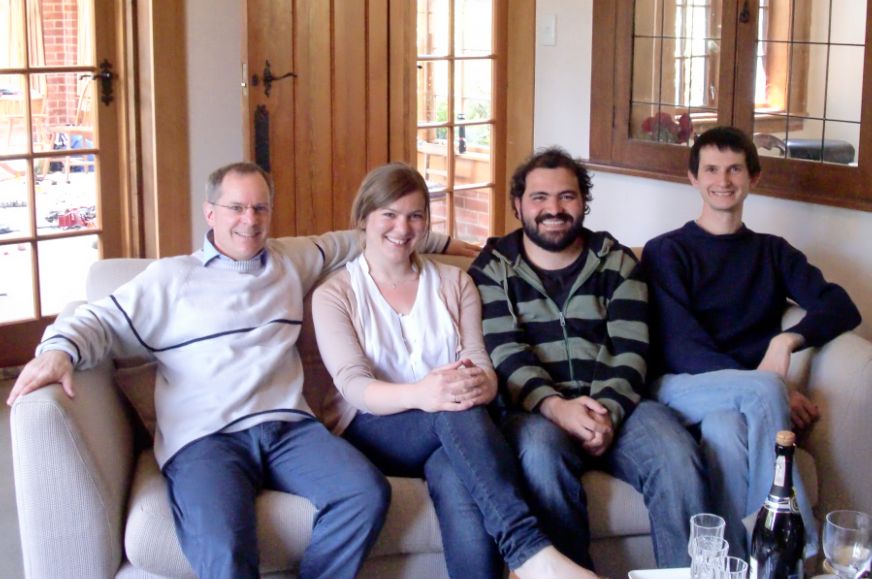
From left to right: Peter, Kirsten, Juan, and Alberto
