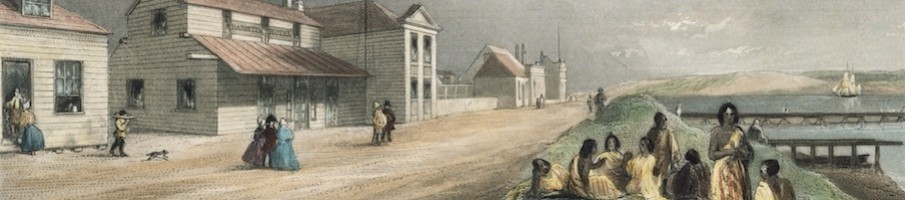
Scots and Indigenous Peoples
We are delighted to announce that Professor Ann Curthoys is giving a free public lecture entitled “Scots and Indigenous Peoples in the Australian Colonies” on Monday 24 November in Castle Lecture Theatre 1 at 3.30. Professor Curthoy’s lecture also doubles as the opening keynote address for the Migrant Cross-Cultural Encounters Conference (24-26 November) being co-convened by the Centre for Research on Colonial Culture, the Centre for Irish and Scottish Studies, the Asian Migrations research theme, and the Cross-Cultural Comparative Studies research theme.
Professor Curthoys is one of Australia’s most respected historians. She is an Honorary Professor at the University of Sydney, and a member of the Australian Academy of the Humanities and the Academy of Social Sciences in Australia. In 2013, she was awarded the History Council of New South Wales Annual History Citation that recognises and honours an individual who has made a significant and lifelong contribution to the profession and practice of history. She was formerly an Australian Research Council Professorial Fellow at the University of Sydney (2008-13) and Manning Clark Professor of History at the Australian National University (1996-2008). She has written widely on questions of Aboriginal history, genocide theory, and race relations in colonial and modern Australia. Her current research focuses on Indigenous-settler relations in the Australian colonies. As part of her ongoing research on the British Empire, settler self-government, and Indigenous peoples, she has a particular interest in Scottish-Indigenous relations in the mid nineteenth century, and it is this aspect of her research that she will detail in her public lecture.
She has provided the following abstract:
We can tell the history of Scottish migration to colonial Australia in several very different ways. We might emphasise a generally positive history of struggle and achievement as Scots migrated from one end of the world to another. Or we might narrate a tragic history of Aboriginal dispossession, displacement and replacement in the face of European settlement, a story of violence and great loss of life, and sometimes the destruction of whole societies as settlers fought to secure their hold on the land. Though these two stories are usually told separately, they are, of course, connected – Scots and Aboriginal people encountered one another constantly, and Scottish upward mobility was built on Aboriginal dispossession. Though the task is challenging and difficult, it is worth considering both Scottish diaspora and Indigenous histories together, for when we do, we can better understand some of the complexities of empire and colonisation in the nineteenth century. A focus on Scots can help us deconstruct the categories ‘British’ and ‘settler’, and foreground in new ways the connections between immigrants’ origins and background (in political, cultural, economic, and social terms) and their cross-cultural interactions in the colonies.
In this paper, I discuss the cross-cultural encounters between Scots and Aboriginal people in Australia from the mid 1830s to the mid 1870s. This was the period when a set of struggling British colonies – mostly dependent on convict labour, covering relatively small regions of settlement, and under direct British rule – were transforming into free self-governing democratic colonies dominating vast regions of the continent. While some areas were still experiencing intense frontier conflict and violence, in others the violence had largely ended and a post-frontier society, involving new settler-Indigenous relationships, was emerging. The Scots I consider included both pastoralists and their critics, such as journalists, politicians, amateur ethnographers, and men of the church, and the Indigenous peoples they met are those whose country lay in the two Australian colonies named after Queen Victoria – Victoria and Queensland.
Speech to text: Missionary endeavours “to fix the Language of the New Zealanders”
A paper given by L.Paterson at the “Dialogues: Exploring the Drama of Early Missionary Encounters” symposium, Hocken Collections, Dunedin, 7-8 November, 2014.
In this paper I am looking mainly at Thomas Kendall, a member of the first batch of missionaries to New Zealand, and his efforts to create an orthography for te reo Māori. This is of course a topic that other scholars have covered in the past, not least Judith Binney and Jane McRae, but the theme of this symposium is “Dialogues: exploring the drama of early missionary encounters”, held as part of the launching of the new online archive of the Hocken Library’s Marsden Collection, so my paper makes an effort to utilize some of the discussions on orthography from that archive.
I perhaps need to state that I am a historian with some Māori-language skills rather than someone with expertise in linguistics, and I am straying a little outside of my normal period, the 1850s to the early twentieth century, to look at this early missionary period. It is also good that Kuni Jenkins and Alison Jones’s paper at this symposium on the early Missionary-Māori encounter, and their reflection on their 2012 book, He Kōrero: First Maori- Pakeha Conversations on Paper, gives a good insight on how Māori contributed to the development of the orthography. The archive, compiled from missionary letters and journals, is less revealing on their input. The “dialogues” that follow are largely between Thomas Kendall, an on-the-ground missionary, Samuel Marsden, his immediate superior in Sydney, and the Church Missionary Society officials in London. What these texts do showcase is the ease with which historical material can be gleaned from the wealth of material contained in the Marsden Online Archive.
One thing that was important to the early missionaries was to make the scriptures available to Māori in their own language. If Māori were able to read the Bible in their own language, then it would be easier to convert them to Christianity. For this to happen missionaries would have to learn not only how to speak the language, but also to develop a system for writing it down. This would then make it possible to teach Māori how to read, as well as to translate and print the scriptures.
Although not yet ordained, Kendall was the best educated of the missionaries, and as can be seen on a letter written to one of the CMS Secretaries when on his exploratory trip to the Bay of Islands in early 1814, he was well aware that the task would not be easy.
As far as I am concerned, I should know but little of myself, did I not feel conscious of my own inability. Even an attempt to fix the Language of the New Zealanders so that they may be instructed in their own Tongue is a great work; and cannot in the very nature of things be accomplished for some years to come…
[Thomas Kendall to Josiah Pratt, 25 March 1814. MS_0054_035and036.]
We can see here some of Kendall’s early efforts at collecting vocabulary from that first trip.
Ire mi kiki (Come & eat)
Haere mai kaikai [Haere mai [ki te] kai.]
Emmera Ho my why (Bring me some water)
E mara homai [he] wai.
Yahheeyahee pi (A fine night)
Ahiahi pai
[Thomas Kendall to Josiah Pratt, 15 June 1814. MS_0054_043.]
When you compare his renditions with how they might be spelled now (in italics) – we can see that he has utilized English vowel sounds in his spelling. However, he has not been consistent, for example writing the AI sound, as in kai, wai and pai, with either an I or a Y.
The whole process was going to be slow, but the CMS was hopeful. We can see here a letter from one of their secretaries less than a year after the mission was first planted expecting Kendall to be making a start at translating some scripture.
We shall hope to hear that you have made proficiency in the New Zealand tongue; and that the way will be thus prepared by you for the Translation of the Scriptures, when you are joined by a Clergyman who understands the originals. In the mean while we hope that you will prepare portions of Scripture, as well as you may be able; and that the little New Zealanders will, under your kind and paternal care, first learn the rudiments of their own tongue out of the Book of God.
[Rev Josiah Pratt to Thomas Kendall, 16 August 1815. MS_0055_019]
However, it was clear that they thought authorative translations were probably beyond Kendall’s skills, and a “real” clergyman who understood the Greek and Hebrew versions would be needed. By October, 1815 Kendall wrote back to Pratt ”I can speak to them in their own tongue, as yet, but very imperfectly” and he asked if a clergyman could come to help with “fixing the Native Language”. [Thomas Kendall to Samuel Marsden, 27 May 1815. MS_0055_012.]
No clergyman was as yet forthcoming, and in 1815 he produced A Korao no New Zealand, the first book produced for a Māori audience. His grammar is slightly better than his original collections, but we can see in an extract that his spelling continues on the same basis – using English vowels. The italicised text is as it would be spelled today.
Kámatte aou te eaki (I am very hungry)
Ka mate au [i] te hiakai.
Iremi taooa kekone kiei (Come let us sit down and eat.)
Haere mai tāua ki konei kai ai.
[T. Kendall, A Korao no New Zealand (1815)]
Kendall was not a trained linguist, and he wrote the sounds as he heard and understood them. Notwithstanding that Māori may have simplified their expressions to make comprehension easier for Kendall, as can be seen in an example he collected in early 1814.
Shoroe ahaw Dingha Dingha Matta
(Wash your hands and face)
Horoia ōu ringaringa [me tōu] mata.
[Thomas Kendall to Josiah Pratt, 15 June 1814. MS_0054_043.]
But why does it seem so different to modern Māori? We should compare his efforts with modern-day language learners. If you asked an average Japanese people today to say “red” he may well say “led” or “red”. That is because the Japanese language does not distinguish between these sounds, and either L or R can be used in Japanese without changing the meaning at all. Indeed, many Japanese people cannot really hear the difference. Similarly many English speakers have difficulty with other languages, such as Russian or Arabic, that distinguish between sounds that English does not.
Ngāpuhi simply did not differentiate between SH and H, or between D and R. Here in Southern New Zealand, Kai Tahu did not differentiate between L and R, which is why we have Lake Waihola just down the road. But H and SH sounds did sound different to Kendall, so he wrote them down as he heard them.
It is well known that Professor Samuel Lee, the famed linguist at Cambridge University, collaborated with Kendall, Hongi Hika and Waikato in 1820 to create an orthography for te reo Māori. But Lee’s involvement had began several years earlier. In 1818 Lee was already working on Māori grammar, with the aid of Kendall’s A Korao no New Zealand, as well as the services of two Māori travellers, Tuai and Tītere. [Edward Bickersteth and Josiah Pratt to Thomas Kendall, 12 March 1818, MS_0056_076]
It is clear too that Kendall was now leaning towards what were called the “continental” vowel sounds, such as used in Italian. In 1819 he wrote “The Taheitians … pronounce the sounds of the letters and vowels after a similar method very readily.” [Thomas Kendall to Samuel Marsden, 21 April 1819. MS_0056_150.]
Although the missionaries in Tahiti had serious disagreements about an orthography for the Tahitian language, one of their number, John Davies, had developed a system based on “continental vowels”, which Kendall was referring to (Davies, p.77). Kendall wrote later,
On the Sunday after easter I had an opportunity to examine some Taheitian sailors belonging to the Ship King George, and they read the Works of their Missionaries both in print & Manuscript very readily, whereas I am told, the Society Islanders [Tahitians] could never be taught by our [English-based] method.
[Thomas Kendall to Josiah Pratt, 20 May 1819. MS_0056_162.]
In another letter to Pratt he wrote,
Tell Mr Lee that in writing the New Zealand Language I have first fixed the Sounds of the vowels and then formed those sounds, without paying regard to the English or any other orthography.
[Thomas Kendall to Josiah Pratt, 17 May 1819. MS_0056_159.]
Several of Kendall’s manuscripts were subsequently sent to Lee and the CMS. The Secretaries wrote to Kendall,
The New Zealanders first Book [A Korao no New Zealand] has greatly pleased us. Our Orientalist, Mr Lee, is making use of Tooi & Teeterree (who have recently arrived) to form a complete Grammar & Vocabulary of the New Zealand Language.
[Edward Bickersteth and Josiah Pratt to Thomas Kendall, 12 March 1818. MS_0056_076.]
However Bickersteth and Pratt were a little more critical of Kendall’s efforts, when they wrote to Marsden.
Mr Kendall appears to have adopted too many marks of aspiration &c. His system would puzzle the New Zealanders. The whole will require deliberate investigation; and time spent herein in the outset will probably save a great deal in the end.
[Edward Bickersteth and Josiah Pratt to Samuel Marsden, 3 August 1819. MS_0056_188.]
So Hongi, Waikato and Kendall travelled to England in 1820, and while there they worked with Lee to work on an orthography, vocabulary and Grammar, published as A Grammar and Vocabulary of the Language of New Zealand in 1820.
Extract
T. Na tána wahíne ra óki i ó mai. Ke táwahi ra óki e O’ngi, ke Ingland. Ki á no koe i róngo nóa?
P. Ki a no ‘au i róngo nóa.
T. Kóa díro ke ráia; kóa tai ke, méa ka e óki mai.
P. A’i! k’wai tóna kaipúke i éke ai ía?
Modern orthography
T. Na tāna wahine rā hoki i homai. Kei tāwāhi rā hoki a Hongi, kei Ingarangi. Kianō koe i rongo noa?
P. Kianō au i rongo noa.
T. Kua riro kē rā ia; kua tae kē, meake e hoki mai.
P. Āe! Ko wai tōna kaipuke i eke ai ia?
Thomas Kendall. A Grammar and vocabulary of the language of New Zealand (1820).
We can see that there is a clear improvement on Kendall’s earlier work. However, the text still sports dropped Hs, and the use of both R and D. Although there are a few things that don’t look right, most of the vowels are pretty close to modern Māori.
Kendall clearly wanted to take the credit for what was clearly a collaboration between Lee, Hongi, Waikato and himself. He wrote to Pratt:
I thank you for indulging me with the privilege of the instruction of the Rev.d Professor Lee so long. I have now nearly completed my work. The Professor has assisted me very much I could not have done without him.
[Thomas Kendall to Josiah Pratt, 4 October 1820. MS_0498_094.]
So how did their efforts go down with the other missionaries? Kendall’s contemporaries did not like it at all, and their main concern appears to be with the use of the continental vowels. Marsden visited New Zealand in 1823. Kendall had been sacked at this point due to his adultery, and was waiting to leave New Zealand, but he had been told to draw up a vocabulary, using the English vowel sounds.
When I called upon you after our Shipwreck I advised you to employ your time untill [sic] an opportunity for our return to Port Jackson, in drawing up a vocabulary of the New Zealand language in as correct and simple a manner as you could retaining the pronunciation of the English Vowels, as I found the Missionaries met with insuperable difficulties in speaking the language according to the Rules laid down in your Grammer. [sic]
[Samuel Marsden to Thomas Kendall, 14 August 1823. MS_0057_098.]
The debate over English versus continental vowels also occurred in Tahiti, where John Davies was initially outvoted in his attempt to do away with the English vowels (Davies, p.78). As in New Zealand, his contemporaries thought learning a new system would be too hard.
Marsden writing in his journal declared the Grammar to be imperfect, and confusing.
The rules laid down in the Grammer [sic] for the Orthography and Pronounciation of the language is not simple enough for the Missionaries to comprehend— They cannot retain in their memory the sound of the vowels as laid down in the rules of the Grammer— and pronounce them as the Natives can understand them.
[Samuel Marsden’s Journal from 2 July 1823 to 1 November 1823. MS_0177_003.]
I do not see any good reason for changing the sound of the vowels as the New Zealanders can with so much ease sound all the English Alphabet— If in speaking and writing the N[ew] Zealand language the Europeans retain the English pronounciation, the whole difficulty of which they complain, will be removed.
[Samuel Marsden’s Journal from 2 July 1823 to 1 November 1823. MS_0177_003.]
Marsden met with Kendall, who admitted that even he could not follow all the rules. Marsden wrote,
It appeared to me absurd to study Mr Kendalls theory, which he himself could not reduce to practice.
[Marsden’s Personal Copy of the Journal of his Fourth Visit to New Zealand. MS_0177_004.]
Marsden also thought it better if Māori first learnt the English sounds, and then learnt the English language, especially as he thought the Māori language “unchaste”.
I also recommended that all the English terms for such things as the native had never seen, should be introduced into the N Zealand language, that a Sheep should be called a Sheep, a Cow a Cow &c.
[Samuel Marsden’s Journal from 2 July 1823 to 1 November 1823. MS_0177_003.]
Rev Nathaniel Turner, one of the Wesleyan missionaries in the Bay of Islands, also called on Marsden to complain about the 1820 Grammar. Marsden reassured him that it would be going back to the way it was. Turner “expressed much satisfaction” at retaining the English vowels. Marsden opined:
I hope this question will now be at rest, as all are unanimously of opinion that the Vowels should retain the English pronounciation [sic]
[Marsden’s Personal Copy of the Journal of his Fourth Visit to New Zealand. MS_0177_004.]
Marsden’s 1823 visit coincided with changes in the Mission. He brought Rev. Henry Williams to New Zealand and Williams soon after became the effective leader of the Mission. Less than six months after arriving, the new missionary had decided that Kendall’s grammar was a dud.
We, in Council, have condemned the book called “The Grammar.” I cannot tell what share Professor Lee may have had in the composition thereof, but it certainly appears far from simplicity.
[Henry Williams to the Rev E. G. Marsh, January 27, 1824, in Carleton, p.37.]
The Grammar did however made its way to Hawai’i, where the missionaries there may have used it, as they too grappled with creating an orthography for the Hawaiian language (Schütz, p.251).
Kendall was still living in the Bay of Islands at this stage, but away from the mission, and therefore sidelined from new developments in the orthography. Williams put more emphasis on learning the language, as his biographer suggested “not in the slovenly style in which it may be learned by conversation, but in a scholar-like fashion, ascertaining the rules by which it is governed, compiling a dictionary, and fitting themselves to undertake a translation of the Holy Scriptures” (Carleton, p.32). In this efforts he was helped by his brother William Williams who arrived in 1826, and Robert Maunsell in 1836.
Over the next few years there was a slow adaptation of Māori-language orthography. Take, for example this example from 1826: a Proclamation by the NSW governor.
Ná tóna Excelenei, iá Sir Thomasa Brisabane, ko te Captani, ko te tíno Rángatira wáka shau; o ténei káinga, o New South Wales, me óna tíne motu atu óki, &c. &c. &c.
II. Na te méa, e máha ngá páshua tanga o ngá Mótu, kí te Moana Pocifica; a, kí te Moana tudiana, e nga tángata kíno: á ko ugá [sic] tàngata shóko ká máte iá rátou;
[Books in Māori, 6]
The translation was probably done by the John Butler, who had been a missionary at Kerikeri, but by 1826 was living in NSW. We can see the use of some English words and names, and some of the consonants of the older orthographies, such as the W for WH, SH for H, and D for R.
This was also the case in the example below, an extract from the Wesleyan Methodist Mission version’s of the Lord’s Prayer also printed in 1826.
To matu Matua e noho’na koe i dunga ki te rangi, kia tabu tou ingwa. [Books in Māori, 7]
But it appears that any move to return to English vowels was now over. As we see from these scriptural selections below from 1829 and 1833, within a few years written Māori had almost achieved its modern form.
Ko te tahi o nga upoko.
1 I te orokomeatanga i hanga e te Atua te rangi me te ’wenua.
[Books in Māori, 9]
Ko te tahi wahi o te Kawenata Hou o Ihu Karaiti te Ariki, to tatou Kai Wakaora. Me nga upoko e waru o te pukapuka o Kenehi. Ka oti nei te wakamaori ki te reo o Nu Tirani.
[Books in Māori, 15]
What is notable is that the Williams brothers did not opt for English vowels, but continued with the continental vowels that the 1820 grammar had introduced. The new missionaries, such as the Williams brothers, were far better linguists than Kendall, and developed the orthography to its more usable form. They were aware that the Māori language did not distinguish between D and R, so opted just for the R. Similarly other unnecessary letters such as B, L, and SH were dropped. The one major exception that remained was the use of W or ‘W for the WH sound, as seen above. As Binney points out Kendall did attempt, unsuccessfully, to republish a revised grammar in the late 1820s, in which the WH sound would have been differentiated (Judith Binney. ‘Kendall, Thomas’, DNZB). But it was not until the 1840s that the WH was incorporated into the orthography. It is quite possible that regularizing the spelling, and the spread of literacy, has, over time, also had an effect on how te reo was pronounced, with sounds such as D and L falling out of favour.
In conclusion, Thomas Kendall was right in 1814 when he said that fixing the language would be a great work, and a task that would take some years to achieve. He struggled initially with his English ear, but together with Hongi, Waikato, and Samuel Lee, created an orthography in 1820 that went some of the way to finding a workable system. Their efforts were not appreciated by the other missionaries, who wanted to keep to the old style of writing Māori down. It was really the next wave of missionaries, better educated and more methodical in approach, who improved on Kendall’s work, translated considerable amounts of the scriptures, and who had the most success with their evangelical endeavours.
Carleton, H. The Life of Henry Williams, Auckland, 1874.
John Davies, A History of the Tahitian Mission 1799-1830, edited by C.W. Newbury (ed), Cambridge: Hakluyt Society, 1961.
Jones A. and K. Jenkins, He Kōrero: First Maori- Pakeha Conversations on Paper, Wellington: Huia, 2012.
Kendall, T. A Korao no New Zealand, Sydney, 1815.
Kendall T. and S. Lee, A Grammar and Vocabulary of the Language of New Zealand, London, 1820.
Parkinson P. and P. Griffith, Books in Māori 1815-1900: Ngā Tānga Reo Māori, Auckland: Reed, 2004.
Schütz, A. J. Voices of Eden: A History of Hawaiian Studies, Honolulu: University of Hawaii Press,1994.
Celebrating Marsden
It’s been a busy few days at the Hocken Collections with the events around the Marsden Online Archive launch and opening of the associated “Whakapono, Faith and Foundations” exhibition, timed to coincide with the bicentennial of the arrival of missionaries in New Zealand.
Considerable publicity had led to these events. For example:
Tony Ballantyne interview on National Radio
Television One News coverage (watch from 17.37)
Te Karere coverage (i roto i te reo Māori – in Māori)
For all the links see the Marsden Online Archive Storify page.
On Thursday afternoon Kāi Tahu and locally-based Northland Māori welcomed Hongi Hika, a self-portrait sculpture by the illustrious Ngā Puhi warrior. Bernard Makoare and Hinerangi Himiona of Ngāpuhi and Chanel Clarke, Māori Curator of the Auckland War Memorial Museum, accompanied this taonga who was installed in the Whakapono exhibition upstairs in the Hocken Gallery. Click here for the full story.
In the evening a good crowd assembled in the Hocken foyer for both the opening of the exhibition and the official launch of the online archive. The event was opened by David Ellison of the Puketeraki Rūnanka of Kāi Tahu, Bernard Makoare, and Kelvin Wright, Anglican Bishop of Dunedin. Particular praise was given to Gordon Parsonson, present in the front row of the audience, whose painstaking work transcribing the Marsden archives over many decades made the creation of the online archive possible.
The Marsden Online Archive was created by the University Library and Hocken Library, with considerable input from Professor Tony Ballantyne and the Centre for Research on Colonial Culture. This will be of great use to researchers interested in early missionary work, Māori-Pākehā interactions, and Māori culture.
The “Whakapono: Faith and Foundations” exhibition runs till 7 February, 2015.
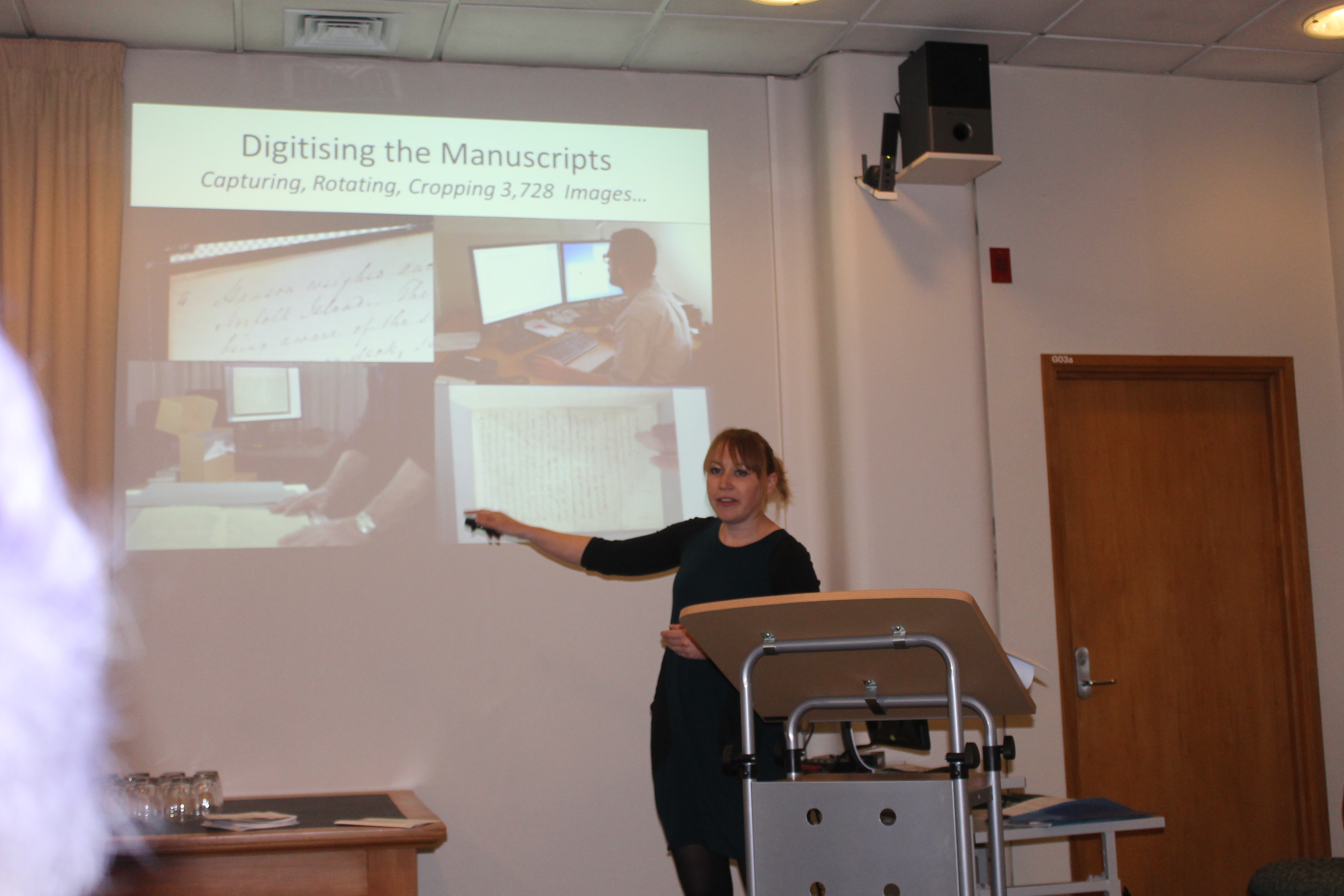
Charlotte Brown, University Library
The following two days were given over to “Dialogues”, a symposium on New Zealand’s early missionary history, held in the Hocken Seminar Room organised by the Centre and the Hocken Collections. This was kicked off with Cate Bardwell and Charlotte Brown of the University Library telling the story of how the Online Archive was created, followed with a demonstration of how to get the most out of the collection.
Three well-known religious historians, Allan Davidson (St Johns), Peter Lineham (Massey) and John Stenhouse (Otago) made up the next session. Allan talked on the “dialogue or disputation” in the first Wesleyan mission at Whangaroa; Peter discussed the Anglican moves into the Bay of Plenty/Waikato district in the 1830s, and how this lead to the sacking of the Matamata Mission Station in 1836; and John focused on Octavius Hadfield, his relationship with his Māori parishoners, and how this influenced his opposition to the Crown’s military actions.

Alison Jones (University of Auckland) and Kuni Jenkins (Te Whare Wananga o Awanuiarangi)
After lunch Angela Middleton (Otago) gave an account of the powerful and influential Hariata, Hongi Hika’s daughter, informed by both historical and archaeological sources. Kuni Jenkins (Awanuiarangi) and Alison Jones followed on with a discussion their interpretation of the encounter at Hohi between Ngā Puhi and missionaries in December 1814. In the afternoon Donald Kerr gave an account of Dr Hocken’s collecting, and how he managed to amass so much of the original missionary papers, now housed in the Hocken Collections. Anna Blackman, the Archives Curator at the Hocken, then gave a talk on exploring the Marsden Collection, and earlier archival practice.
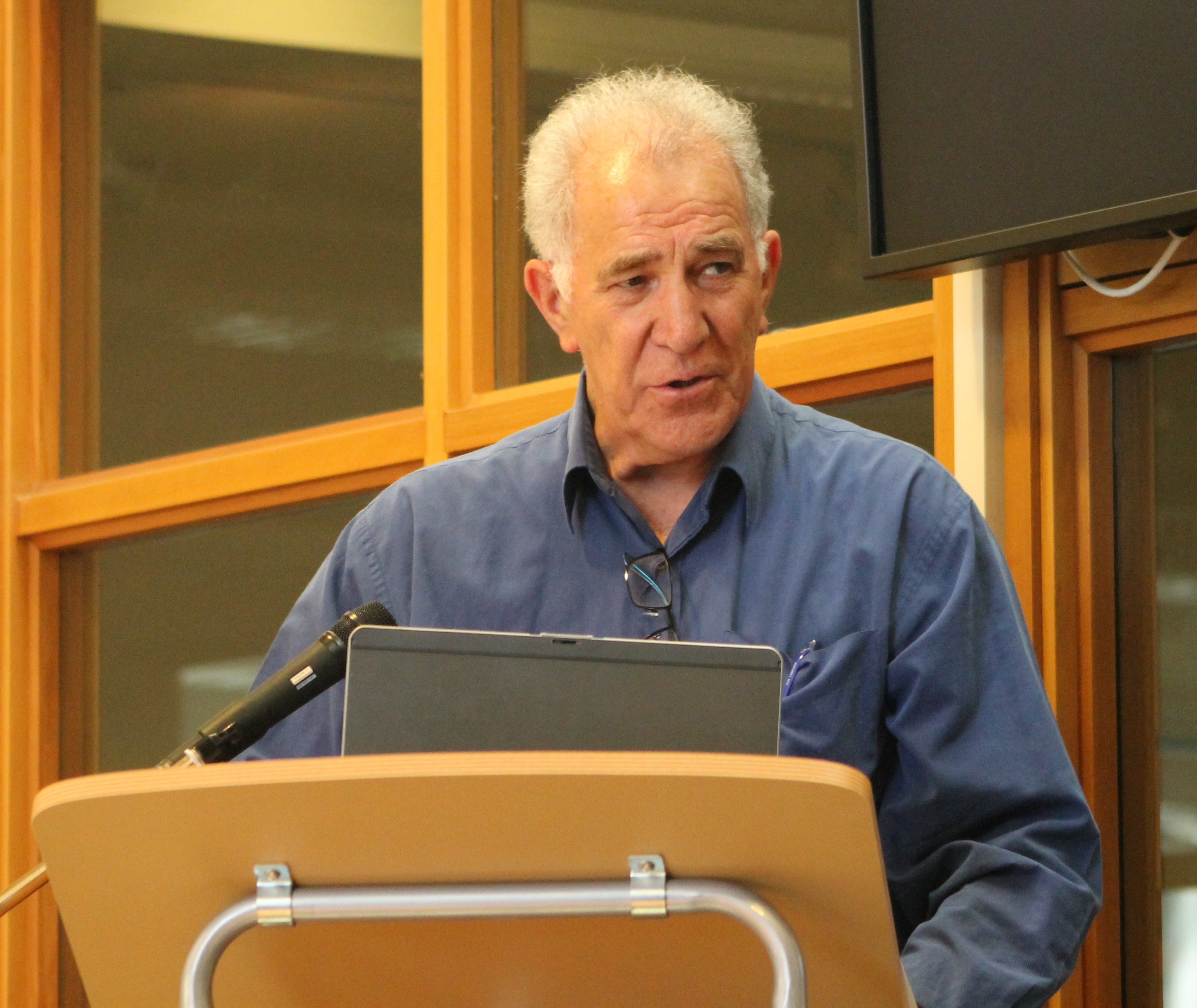
Manuka Henare (University of Auckland) launching Angela Middleton’s new book Pēwhairangi.
In the evening more people assembled for the launch of Angela Middleton’s new book, Pēwhairangi: Bay of Islands Missions and Māori 1814 to 1845. Manuka Henare (Auckland) formally launched the book, along with speeches by the Rachel Scott, Otago University Press publisher, Sharon Dell, the Hocken Librarian, and Paul Diamond, Curator Māori at the Alexander Turnbull Library.
Listen here to Angela’s Radio New Zealand interview, 4 November 2014.
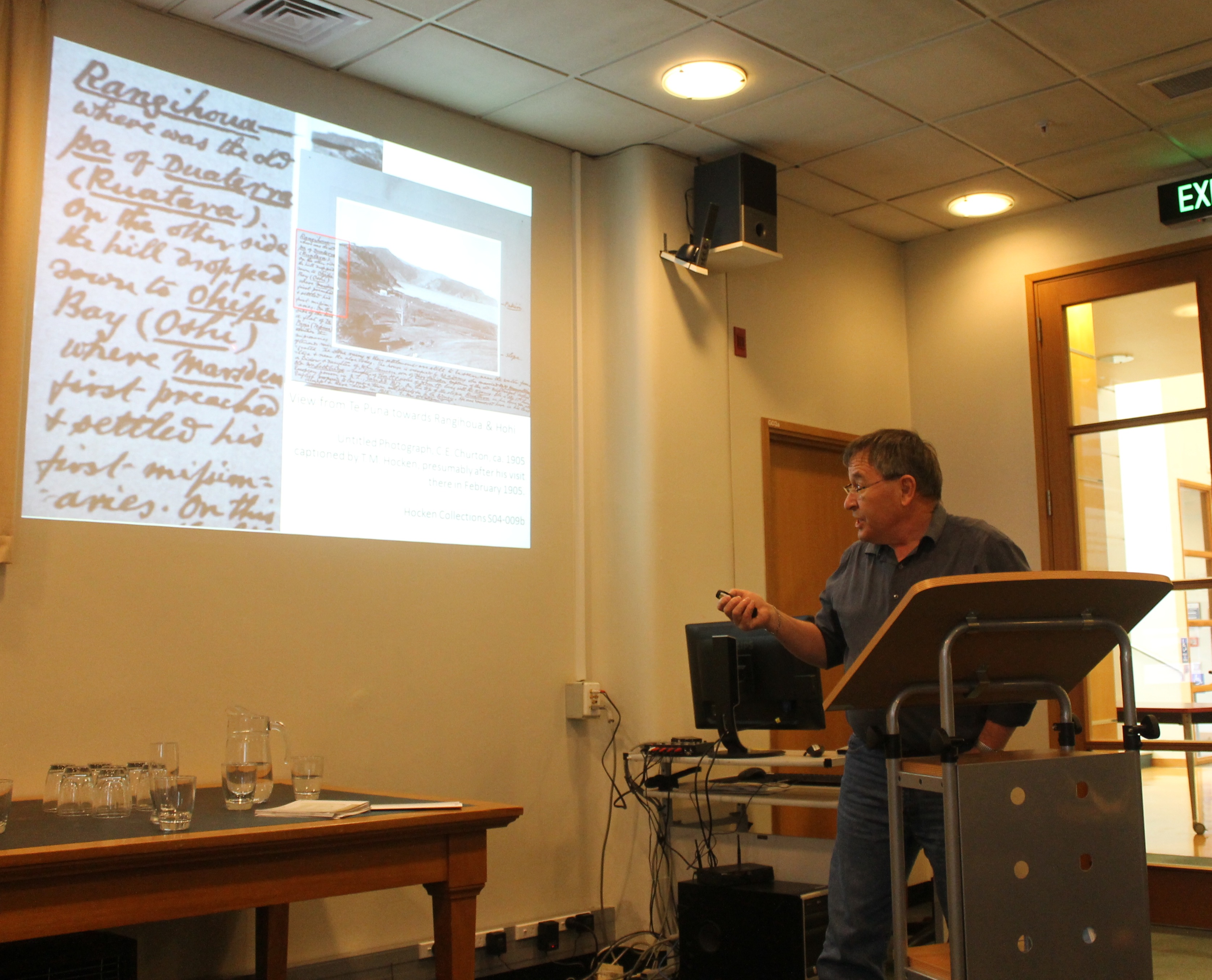
Ian Smith (university of Otago) discussing the site of the Hohi Mission Station.
Saturday was a shorter day. Ian Smith (Otago) gave an account of the archaeological dig and Hohi and how this informs our understanding of this first mission site and its inhabitants. Chanel Clarke and Rose Young (Auckland War Memorial Museum) discussed “Taonga Tuku Iho – Objects in Dialogue”, objects from their collection that spoke to the early interactions between missionaries and Māori.

Paul Diamond (Alexander Turnbull Library)
After morning tea, Lachy Paterson (Otago) discussed Thomas Kendall’s dialogues with Marsden and the CMS on developing a working orthography for the Māori language. Paul Diamond (Turnbull) followed on, bringing to light a Māori vocabulary created by the Wesleyan missionary, Rev James Buller, in the 1830s and what this can tell us the Māori language of that time. After lunch, Tony Ballantyne (Otago) rounded off the symposium with a discussion on how applying new techniques from the field of digital humanities can give new historical perspectives, particularly when working with large collections.

As usual, these events create opportunities for conversation. Chanel Clarke (Auckland Museum) and Allan Davidson (St Johns).
New collaborations for Angela Wanhalla

Dr Angela Wanhalla
Dr Angela Wanhalla, an active CROCC member, has been building on her success (two Marsden funded projects, a Rutherford Discovery Fellowship) with the success of an Australian Research Council Grant of just over $A500,000. Angela is a named international partner investigator on a Discovery Project headed by Profs. Lyndall Ryan, Amanda Nettleback, A/Profs Anna Johnston, Penelope Edmonds, and Victoria Haskins looking at violence and intimacy in settler societies across the Anglophone Pacific Rim, 1840-1940.
Marsden Success for Centre Member
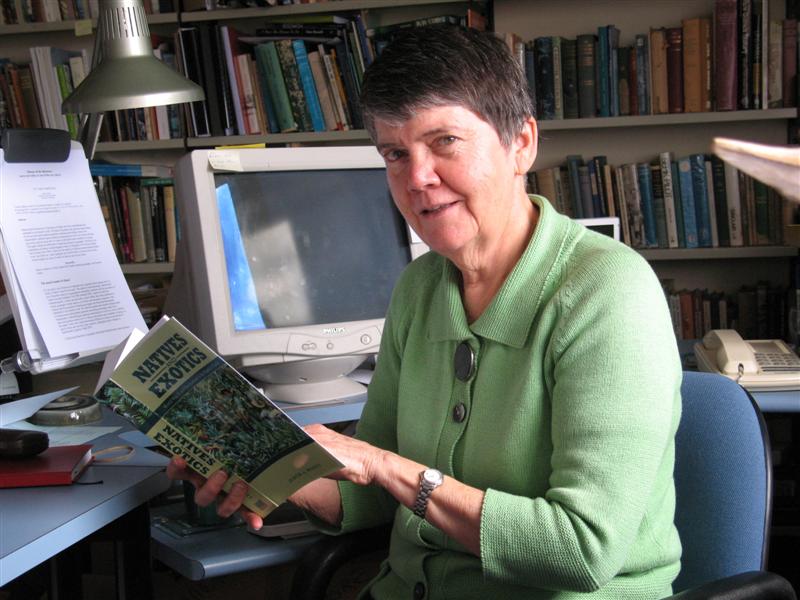
Professor Judy Bennett
Congratulations to CROCC member, Professor Judy Bennett, who was awarded $710,000 in the recent Marsden Fund round. Her research will explore ‘Constant coconuts: a history of a versatile commodity in the Pacific world’. Judy was also the lead investigator in the the Marsden Fund project ‘Mothers’ Darlings: children of indigenous women and World War Two American servicemen in New Zealand and South Pacific societies’ awarded in 2009.
‘Constant coconuts: a history of a versatile commodity in the Pacific world’.
Within the humid tropics, along the shorelines of atolls and high islands, the coconut palm flourishes, providing food, medicines, cosmetics, and household items for myriad Pacific societies. Yet no commodity history of the coconut exists. As a pathway to understanding globalisation, this research will analyse how from c.1840 onwards, products from the “nut” became commodities, how their production and consumption affected individual communities, power relations, mobility, culture, economies, and environment within the Pacific world and beyond. It will consider why, for most Island societies, the coconut became often the sole export staple, and the consequences of such dependency. A key focus is the fluctuating relationship between production and natural conditions, such as rainfall, as well as external challenges, such as declining markets, which tested indigenous agency. Recently, the coconut’s value as a source of biofuel and health and beauty products has significantly revived production. While the distant past is mainly recorded in archives, this network of producers, marketers, governments, and consumers is accessible to ethnographic methods, such as extended observation. The planned book will combine two perspectives: a) commodity chain analysis to trace economic and social linkages; b) ethnographic investigation. Archival and other documentary research will provide evidence for both.
Forthcoming Talks
The Centre is hosting an informal research seminar on ‘Revolutions and Empires in the South-West Indian Ocean, 1788-1810’ by Dr Sujit Sivasundaram (University of Cambridge), on Thursday 6 November, at 2pm, 2N8 (History Department Seminar Room) in the Arts Building.
CROCC is also sponsoring a public lecture by Professor A.G. Hopkins, (University of Cambridge) entitled, ‘Is Globalisation Yesterday’s News?’. This will be held on Monday, 10 November 2014 at 5:15pm in the Moot Court, Level 10, Richardson Building. Professor Hopkins is one of the leading economic historians of his generation and he has produced authoritative works on West African economic history (An Economic History of West Africa (1973)), the economics of British imperialism (the landmark two-volume British Imperialism co-authored with Peter Cain) and was one of the first historians to grapple with the analytical possibilities of globalisation (editing both Globalization in World History (2002) and Global History: Interactions between the Universal and the Local (2006)). Professor Hopkins has provided the following abstract, which suggests it should be an engaging lecture:
Globalization envelopes the world – and historians too. The ‘g’ word is now mandatory in titles of books and articles; Ph.D. students follow their leaders in dedicating their dissertations to the subject. Yet, not so long ago postmodern approaches to the past were equally compelling: if you could not tell your trope from your alterity and your Spivak from your Bhaba, your chances of landing a job were minimal. Wise investors buy at the bottom of the market and get out at the top. So, it is worth asking whether shares in globalization have further to run or whether full value is already in the market. One way of answering this question is by considering the reasons why historiographical phases, like empires, rise, flourish, and decline. This approach provides pointers to the current state of globalization studies and offers an estimate of the current value of the shares. The advice comes with a wealth warning: past performance has limited predictive power. As a famous trumpeter remarked when asked which way jazz was going: ‘man, if I knew which way jazz was going, I would be there already!’
Conference Registration Open
Registration for the Migrant Cross-Cultural Encounters Conference (24-26 November) is now open. This multi-disciplinary conference brings together four major research hubs in the Division of Humanities at the University of Otago, including the Centre for Research on Colonial Culture, the Centre for Irish and Scottish Studies, the Asian Migration research theme, and the Cross-Cultural Comparative Studies research theme and has attracted four great keynote speakers: Brenda Yeoh (NUS), Ann Curthoys (Sydney), Regina Ganter (Griffith) and Ian Smith (Otago). Clicking on the highlighted text will take you to the conference website where you can view a draft programme and also register. Do note that registration closes at 5pm on November 10th. We do hope that you will join us for what promises to be a fantastic conference!
Elemental Histories Programme
Colonial Worlds, Elemental Histories Symposium Programme,
Hocken Collections Seminar Room, Friday 31 October
To register email Tom Brooking (tom.brooking@otago.ac.nz)
9-10: Associate Professor Grace Karskens, University of New South Wales, ‘Colonial worlds, elemental histories.’
Session 1: 10-11.15
Professor Tom Brooking, University of Otago, “Yeotopia Gained: New Zealand 1840-1914’.
Associate Professor Katie Pickles, University of Canterbury, ‘Elementally United: The Case of Canterbury’s Nor’west Wind’.
Dr Michael Davis, Honorary Research Fellow, University of Sydney, ‘Entangled Knowledges: Indigenous and Environmental Histories across the Tasman’.
11.15-11.30: morning tea
Session 2: 11.30-12.20
Emeritus Professor Holland, University of Otago, ‘Getting to Know You: People and Rabbits in Southern New Zealand’.
Dr. Vaughan Wood, University of Canterbury, ‘Mapping the network of a nineteenth century Canterbury farm’.
12.20-1.20: Lunch
Session 3: 1.20-2.35
Professor Michael Roche, Massey University, ‘The Forest as an Elemental Natural Resource in Colonial New Zealand and the First Failure of Scientific State Forestry 1874 to 1877.’
Dr André Brett, University of Melbourne, ‘Forests and Provincial Abolition: Did Conservation Kill the Provinces?’.
Dr James Beattie, University of Waikato, ‘Expanding the Horizons of Chinese Environmental History: Cantonese gold-miners in colonial New Zealand, 1860s-1920s.’
2.35-3.00 afternoon tea
Session 4: 3.00-4.15
Lucy Mackintosh, PhD candidate, University of Auckland, ‘Shifting Grounds: Narratives of Identity in Auckland Landscapes’.
Dr. Joanna Cobley, University of Canterbury, ‘The Nineteenth Century Landscape: economics, heritage and national identity.’
Professor Eric Pawson, University of Canterbury, ‘Writing environmental history’.
4.15-5.00: Grace Karskens wrap up and general discussion
5.15: Book launch of James Beattie, Matthew Henry and Emily O’Gorman (eds)., Climate, Science, and Colonization: Histories from Australia and New Zealand, Palgrave MacMillan, London, 2014.
Placing the Personal Essay Colloquium
On 2 & 3 December 2014, the Placing the Personal Essay Colloquium will be held at Massey University, Wellington. This event is co-convened by the W.H. Oliver Humanities Research Academy at Massey University, the Centre for Research on Colonial Culture at the University of Otago, and the Stout Research Centre for New Zealand Studies at Victoria University and brings together writers, historians, literary critics, cultural theorists and interested others for a discussion about new ways of writing about place in contemporary New Zealand. Featured participants include: Sally Blundell, Alex Calder, Tim Corballis, Martin Edmond, Ingrid Horrocks, Lynn Jenner, Cherie Lacey, Tina Makereti, Harry Ricketts, Jack Ross, Alice Te Punga Somerville, Giovanni Tiso, and Lydia Wevers as well as two members of CRoCC, Tony Ballantyne and Annabel Cooper.
If you want to know more about the colloquium and how to register, go to the Placing the Personal Essay website by clicking on the highlighted text.
Marsden Collection Online Soon
Two hundred years ago (in December) Rev Samuel Marsden gave the first Christian service on New Zealand soil at Oihi Bay, in the Bay of Islands, and planted the first group of missionaries before he sailed back to New South Wales. This early missionary activity generated considerable paper records between the missionaries, marsden, and the Church Missionary Society. These comprise the Marsden Papers at the Hocken Library, containing journals as well as hundred of letters. For over 20 years, Gordon Parsonson, a former member of Otago’s History Department – now aged 94, has been transcribing this hand-written material, some of which will soon go online.
Click here to see a recent Otago Daily Times article on Gordon Parsonson.
The digitization project has been led by the University Library and Hocken Library, with considerable input from the Centre for Research on Colonial Culture.
The Marsden project will go live in November, and will become a great resource for historians and other Humanities scholars.
