Cowan Symposium Call-for-Papers
Call for Papers
New Perspectives on James Cowan
A One-Day Symposium
Centre for Research on Colonial Culture and the Alexander Turnbull Library
National Library, Wellington, 21 February 2014
James Cowan is best known for his official history of the New Zealand Wars, but his significance for the production and circulation of knowledge about Māori in the late colonial era covered a broad range of subjects. Alan Mulgan wrote after Cowan’s death in 1943 that more than anyone else, he had ‘shown us how to think as New Zealanders’. Mulgan signaled here not only Cowan’s prolific writing, but also his cross-cultural engagement from the 1890s to the 1940s. He was himself a figure of the type he so admired: the cultural go-between. Although his work often purveys the racial ideologies of his time, Cowan’s early use of oral historical methods, and familiarity with a wide range of Māori informants, effected the transition to print of much that would not otherwise have been circulated in Pākehā contexts, or recorded in print.
Cowan’s reputation has fluctuated in response to shifts in cultural politics, writing and historiography. His work began to attract contemporary scholarly attention with an article by Chris Hilliard in NZJH in 1997. Stories of the New Zealand Bush has been republished recently with a critical introduction by Alex Calder. The Adventures of Kimble Bent was read on National Radio in 2011, and re-written as a graphic novel, and film-makers have drawn on his work over decades. Some dimensions of Cowan’s work invite closer study: his significance for iwi history, his photographic collection, and the personal life of this particularly colonial figure, for example, would repay investigation.
For this one-day event, we invite papers which evaluate Cowan’s contribution to colonial encounter and colonial memory from a wide range of perspectives.
Please send abstracts (up to 250 words) and a bio (up to 100 words) in a Word attachment, by 30 September 2013.
Abstracts and enquiries should be sent to: cowan.symposium@otago.ac.nz
Further information about the symposium will be forthcoming.
Associate Professor Chris Hilliard, University of Sydney, will give a concluding commentary.
Convenors
Annabel Cooper (Centre for Research on Colonial Culture, U of Otago)
Ariana Tikao (Research Librarian, Māori, Alexander Turnbull Library),
Colonial Origins of NZ Politics and Government
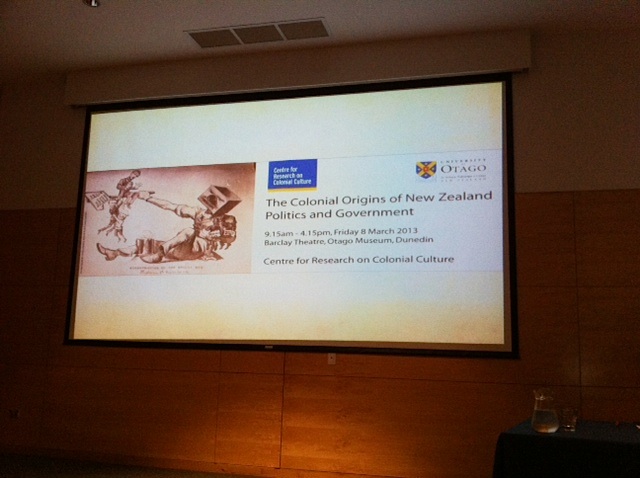 On Friday March 8th, members of the Centre gave presentations on aspects of the colonial origins of New Zealand politics and government. This was our contribution to the “conversation” with the Constitutional Advisory Panel, a body established by the government to canvass public views on the constitution. This was a public event, held at the Otago Museum, and attended by a variety of people throughout the day. Present were two panel members, Peter Chin and Sir Tipene O’Regan, and the panel’s administrative organiser, Lison Harris.
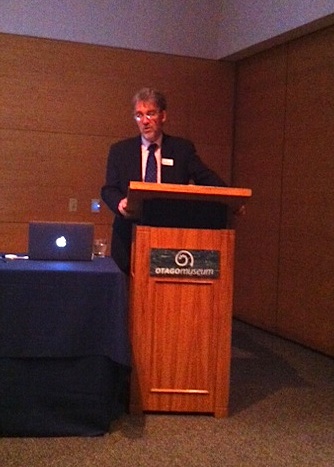
John Stenhouse gave a paper on ‘The Secular State?’
Professor Tony Ballantyne, the Centre director, welcomed those attending, and this was followed by talks on theimpact of religion (Assoc Prof John Stenhouse); the political aspirations of early colonists (Prof Ballantyne); how rangatiratanga was understood in the colonial period (Dr Lachy Paterson); Māori voting patterns (Dr Paerau Warbrick-Anderson); iwi and the state (Dr Michael Stevens); the making of modern politics (Prof Tom Brooking); and the relationship between art and politics (Assoc Prof Mark Stocker). To round off the day, Sir Tipene O’Regan and Prof Erik Olssen offered their thoughts on the day’s events.
Check out more images here on the Department of History and Art History Facebook page.
Vicente Diaz Seminar
The Department of History and Art History and the Centre for Research on Colonial Culture are delighted to be hosting a talk by renowned indigenous scholar, Vicente M. Diaz (American Indian Studies and Anthropology, University of Illinois at Urbana-Champaign). The talk will take place on Tuesday 11 December at 10.00-11.15 AM in the History & Art History seminar room, 2N8, Burns Building. His title is: ‘Voyaging Ancient Futures’
Abstract: This multimedia talk presents two decades of outrigger canoe voyaging in Micronesia, and in the US Heartland (Michigan and Illinois), to broach alternative ways of reimagining the links between history and future, and links between narratology and archives. This work ranges from building and sailing traditional voyaging canoes to more recent work in advanced visualization technology (3-D, Virtual, and Augmented Reality) enroute to producing virtual voyaging and simulating atolls and their cultural practices as a counter archive.
Practice Conference Presentations
Megan Ellison and Lachy Paterson of Te Tumu are two thirds of the panel “He Kōrero, he Tuhituhinga: Utilizing Indigneous-Language Texts”, presenting at the upcoming Pacific History Conference in Wellington later next week.
They will be giving their presentations as a “dry-run” at 2pm on Monday (3 December) in Te Iringa Kōrero (R3S10) on the third floor of Te Tumu.
Lachy’s topic is “He Reo Wāhine: Māori Women’s Voices from the Nineteenth Century” which discusses Angela Wanhalla’s and his research on Māori women’s voices in the archives. Megan’s topic, “Te Ripa Tauārai o kā Reo e Rua: the Crossroads of Two Languages”, investigates some of the texts she will be using for her doctoral study.
If interested, please feel free to come along.
Presenters Perform
A very successful symposium on Colonial Performance was held at the Hocken Collections Seminar Room on Monday, November 19th. Presenters gave illuminating talks on a wide range of colonial performances from Irish drama in Dunedin, to Maori performers in Manhattan, to the theatre of the Dunedin police court, among other topics.

Barbara Brookes gives the opening presentation at the symposium
Barbara Brookes, who convened the day-long symposium, kicked off the event with a discussion of touring medical lecturer Dr. Anna Longshore Potts.
Barbara was followed by two presentations on the theatre scene in Dunedin. Lisa Warrington invited us into Dunedin’s first theatre, a converted horse stable, and Peter Kuch drew attention to the importance of Irish drama in the development of Dunedin theatre during the 1860s. Kirstine Moffatt entertained us all with stories about the amateur pianist, who appeared in private homes, at concerts held in church halls, and barns.
Unlike Richard John Seddon, who spoke for hours at a time, Tom Brooking used a mere 20 minutes to describe the role of performance in colonial politics. At the same time he revealed some of the popular prejudices against Seddon in New Zealand’s historiography. Rosi Crane drew upon her doctoral research in the history of science to show how university professors used their role as public intellectuals to advance scientific understanding, for example in the field of evolution.
Bronwyn Dalley gave a vivid account of the many re-inventions of ‘urban investigator’, free-thinker and spiritualist, Lotti Wilmott in 1880s Christchurch. The tensions between ethnographic ideas about race and “primitive” societies were put to the test by the appearance of Maori performers at New York City’s Hippodrome in 1909-10. Marianne Schultz, from Auckland University, also explored how the leaders of the US suffragette movement used the case of Maori women, who had the right to vote, in their own campaigns for enfranchisement. Michelle Willyams also looked at Maori performers and performance, highlighting the hybrid nature of the musical repertoire developed by Reverend Seamer’s Waiata Maori Choir in the 1920s and 1930s.

Fabia Fox preparing to present.
University of Otago MA student Fabia Fox walked us through the streets of nineteenth-century Dunedin, and into the backyards of homes in the ‘Devil’s Half-Acre’ famous for its criminal underclass. Their exploits were often played out in the Dunedin police court, and relayed to a voyeuristic reading public through the column of the court reporter. In contrast, John Stenhouse embellished his talk on the Rev. Rutherford Waddell with his own rendition of excerpts from his famous sermon on the sin of cheapness. Prof. Lyn Tribble (English) eloquently wrapped up the day, drawing together the various themes into what she described as an ecology of performance.
Imperial Science Lecture
Imperial-Science1 In association with a symposium on the naturalist John Buchanan, a public lecture will be held at the Hutton Theatre, Otago Museum at 5.30, 29 November. Dr Jim Endersby will be talking on “Imperial Science: the Invention of New Zealand’s plants”.
Tony Ballantyne’s new book
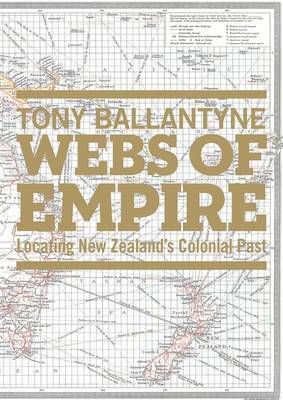
Join us to celebrate the publication of Tony Ballantyne’s new book. It’s being launched by Professor Charlotte Macdonald and Bridget Williams Books on Monday, November 12th in the Dunningham Suite, Dunedin Public Library at 5.30.
Commanding an Audience
A research symposium concerned with colonial performance will take place at the Hocken Collections on Monday, November 19th.
Have a look at the Symposium Programme here.
This is a free event, but numbers are limited! If you are interested in attending contact Professor Barbara Brookes
Colonial Objects Conference
Registration for the Colonial Objects Conference (11-13 February 2013) is now open. To start the process click here.
