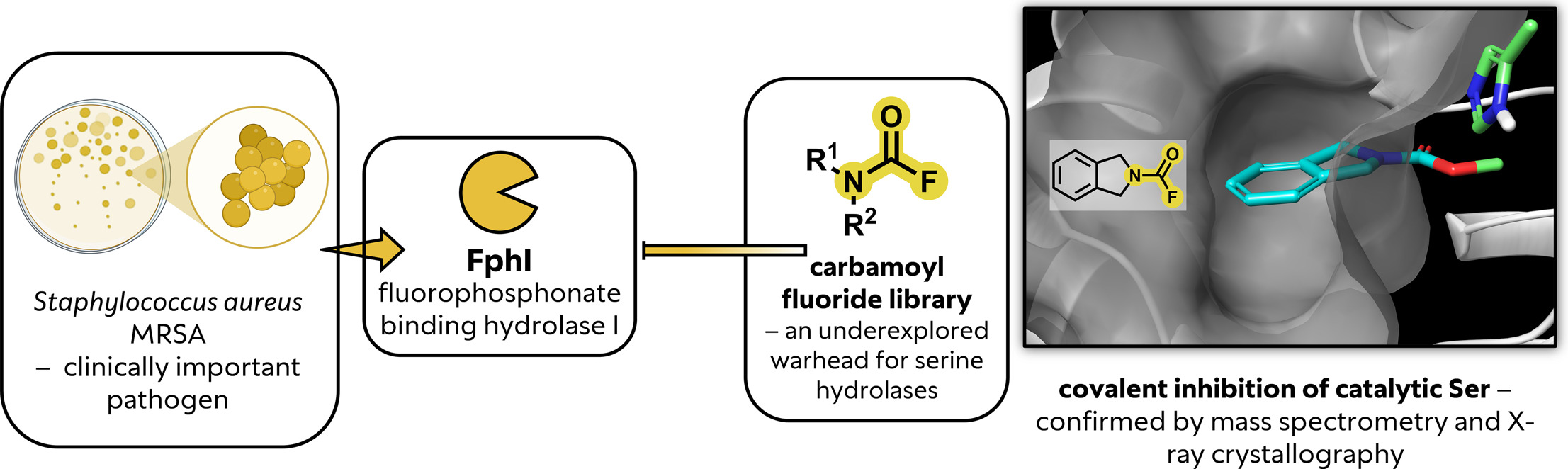
Our latest publication “Carbamoyl fluorides as serine hydrolase inhibitors: a case study on FphI from Staphylococcus aureus.” is now online at 10.1016/j.bioorg.2026.109834
Exactly two years from cold email contact to joint publication between Otago and University of Ljubljana
First Email Wednesday, April 3, 2024 & published: Available online 3 April 2026
The group at Ljubljana is developing a new class of serine hydrolase inhibitors based on a carbamoyl fluoride warhead and we were working on the perfect test enzyme to demonstrate their potential in FphI from S. aureus. Driven by George Randall and Anže Meden who share first authorship it all came together quickly and very well. Also a big thank you to all the other involved co-authors. We are looking forward to expanding the collaborations in this area to many other projects.
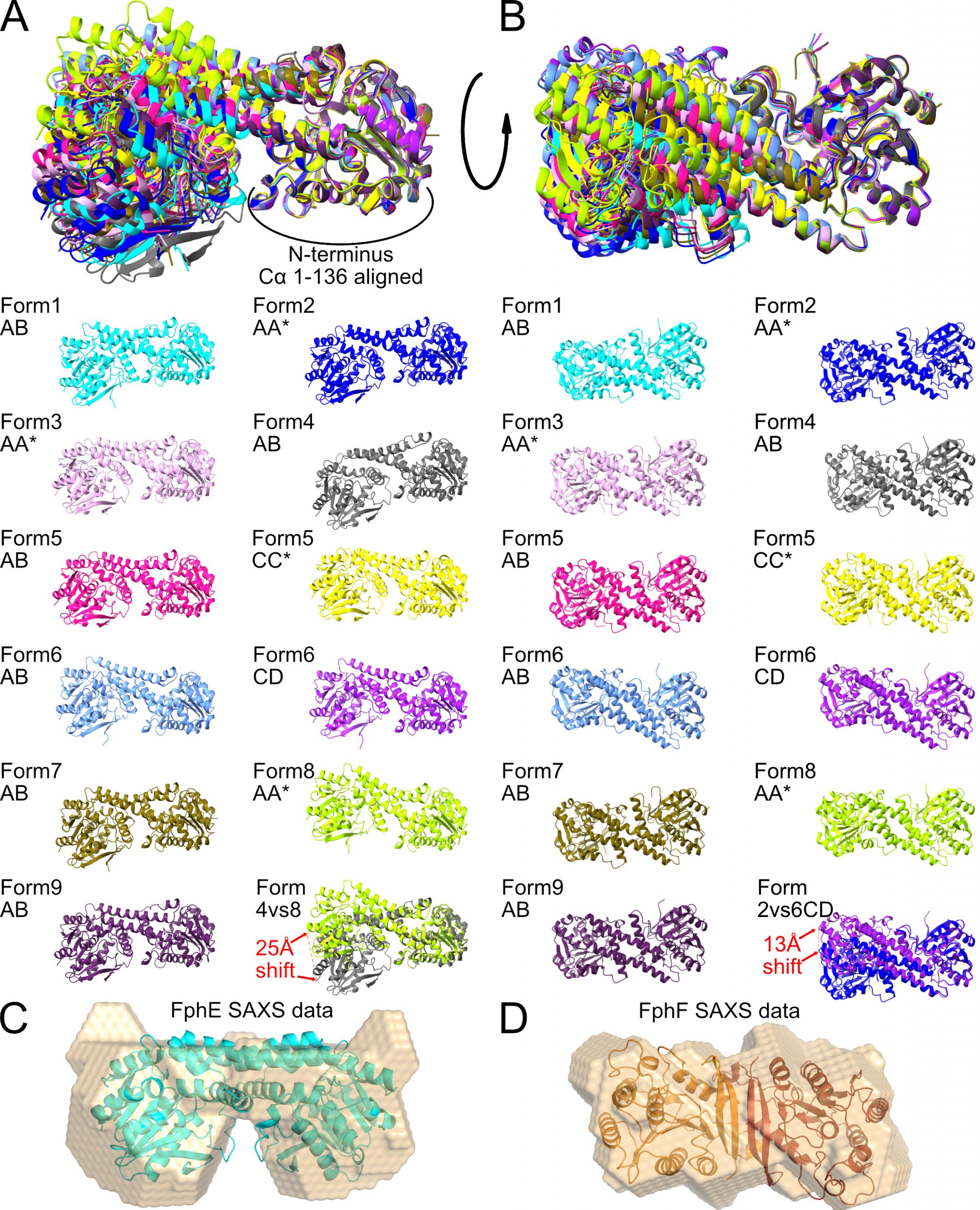
Our PNAS article, “Unique structural and ligand binding properties of the Staphylococcus aureus serine hydrolase FphE”, has published and is now available at: www.pnas.org/doi/10.1073/pnas.2532683123 with DOI number 10.1073/pnas.2532683123.
Between 2022 and 2024 we crystallised and examined hundreds of protein crystals of the protein FphE from Staphylococcus aureus. Now the results are finally published, revealing a highly unique dimer arrangement of FphE. This arrangement has never been observed for any other protein within one of the largest protein superfamily – alpha/beta hydrolases. The structure could also not be predicted. Across 12 distinct crystal forms a flexible dimer interface formed by two anti-parallel helices is observed. A PhD student in the laboratory Xiangyan You examined FphE via Small-angle X-ray scattering (SAXS) and showed that the crystal structure represents the in-solution structure. The structural aspects were then combined with efforts from our collaborators at the Stanford Bogyo laboratory. They demonstrated that the dimer influences enzymatic activity and interaction with FphE specific diagnostic probes. Combined these results show the dynamic dimer FphE to be important for future efforts to target this protein in Staphylococcus aureus. It remains to be seen if other proteins within the superfamily are also able to form this structural arrangement with implications into many research fields as alpha/beta hydrolases are used in industry to cleave molecules while also being important for all aspects of life as we know it.
University of Otago Research Grant (University of Otago)
Commercialising Knowledge Assets Fund (UK Research and Innovation)
Publications
Sun, M.; Fellner, M.; Lv, C.; Carne, A.; Zang, J.; Zhao, G.; Bekhit, A. E. A.; Zhang, T. (2025) Dual mechanisms of digestion-resistant proteins in food systems: structural resistance and enzyme inhibition. Crit Rev Food Sci Nutr, 1-22. 10.1080/10408398.2025.2551784
Upadhyay, T.; Woods, E. C.; Dela Ahator, S.; Julin, K.; Faucher, F. F.; Uddin, M. J.; Hollander, M. J.; Pedowitz, N. J.; Abegg, D.; Hammond, I.; Eke, I. E.; Wang, S.; Chen, S.; Bennett, J. M.; Jo, J.; Lentz, C. S.; Adibekian, A.; Fellner, M.; Bogyo, M. (2025) Identification of covalent inhibitors of Staphylococcus aureus serine hydrolases important for virulence and biofilm formation. Nat Commun 16 (1), 5046. 10.1038/s41467-025-60367-3
Warring, S. L.; Sisson, H. M.; Randall, G.; Grimon, D.; Dams, D.; Gutierrez, D.; Fellner, M.; Fagerlund, R. D.; Briers, Y.; Jackson, S. A.; Fineran, P. C. (2025) Engineering an antimicrobial chimeric endolysin that targets the phytopathogen Pseudomonas syringae pv. actinidiae. J Biol Chem, 110224. DOI: 10.1016/j.jbc.2025.110224
Wang, S.; Woods, E. C.; Jo, J.; Zhu, J.; Hansel-Harris, A.; Holcomb, M.; Llanos, M.; Pedowitz, N. J.; Upadhyay, T.; Bennett, J.; Fellner, M.; Park K. W.; Zhang A.; Valdez T. A.; Forli S.; Chan A. I.; Cunningham C. N.; Bogyo M. (2025) An mRNA Display Approach for Covalent Targeting of a Staphylococcus aureus Virulence Factor. Journal of the American Chemical Society 147 (10), 8312-8325. DOI: 10.1021/jacs.4c15713
Nair, S. S.; Kleffmann, T.; Smith, B., Morris, V.; Goebl, C.; Pletzer, D.; Fellner, M. (2025), Comparative lipidomics profiles of planktonic and biofilms of methicillin-resistant and -susceptible Staphylococcus aureus, Anal Biochem, 115746. DOI: 10.1016/j.ab.2024.115746
Please visit the individual pages to learn more about the Fellner Research Group at the University of Otago, Biochemistry Department.
If you are a student looking for a project and supervisor please email me (matthias.fellner@otago.ac.nz). Likewise, if you are interested in collaborating on any of the projects please do not hesitate to email.