New Book on Religious Childhoods
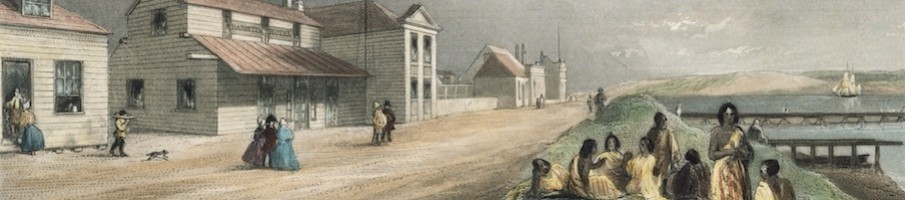
Creating Religious Childhoods in Anglo-world and British Colonial Contexts, 1800-1950 is a new co-edited collection from Centre member, Hugh Morrison, and Mary Clare Martin (Greenwich University, UK). This new book, published by Routledge, features children and religion in colonial society contexts such as New Zealand, and aims to develop greater understanding of religion as a critical element of modern children’s and young people’s history.

‘Mrs Stevens and her probationers with the hospital baby’, alongside article by Mary Budden, ‘Almora Christian Families’, in LMS Chronicle, July 1895, p. 182 (from Chapter 1, p. 27)
Arguing that religion was an abiding influence (positive, negative and benign) among British-world children throughout the nineteenth century and much of the twentieth, the book places ‘religion’ at the centre of analysis and discussion, while at the same time positioning the religious factor within a broader social and cultural framework. Essays written by an international grouping of scholars focus on a range of geographical settings: America, Australia, Britain, Canada, Fiji, India, New Zealand, South Africa and the South Pacific. The various contexts within which religion shaped childhood in these settings – mission fields, churches, families, communities, institutions, camps, schools and youth movements – are treated as ‘sites’ in which religion contributed to identity formation, albeit in different ways relating to such factors as empire, nation, gender, race, disability and denomination. Chapters on New Zealand include: an examination of southern Dunedin’s religious identity; children’s religious literature published by A.H. & A.W. Reed; and the ways in which religious identity was conflated with civic qualities of sacrifice and service.
Film in the Colony
The due date to submit abstracts for Film in the Colony has been extended to 25 March. We can confirm that the keynote speakers have been finalised and include: Dame Professor Anne Salmond, Natalie Robertson (Auckland) Dr Ian-Malcolm Rijsdijk, Dr Litheko Modisane (Cape Town). Exhibiting: Lisa Reihana (Auckland).
Make sure you get those abstracts in!
https://blogs.otago.ac.nz/crocc/film-in-the-colony-symposium/
Rage Against the Machine Symposium
On April 8, Victoria University is hosting the symposium Rage Against the Machine: Biopolitics, Individualism and Collectivism in 19th Century New Zealand and the British Empire in Wellington.
At the event, discussion is invited around the subject of the current comparative research project on individualism vs collectivism of Fulbright Scholar Anna Clark (University of Minnesota). Responses to the themes, topics and questions posed by the project are warmly invited.
For more information on Professor Clark’s project and the symposium, click: RageAgainsttheMachineSymposium
VUW Contact: Charlotte Macdonald, tel + 64 4 463 6761, charlotte.macdonald@vuw.ac.nz.
REMINDER: CFP, Film in the Colony Symposium
Don’t forget the Film in the Colony Symposium, to be held in Wellington, 13-14 July.
https://blogs.otago.ac.nz/crocc/film-in-the-colony-symposium/
If you are interested in presenting a paper, send a 200-word abstract and a brief bio to: filminthecolony@otago.ac.nz by 28 February 2017.
Valued Coconuts
Scholars in Pacific history and culture met to share their knowledge on the use and economies of the coconut in a symposium on Monday and Tuesday this week in Dunedin, the first event in what looks like a busy year for the Centre. Professor Judy Bennett organised and hosted the Valued Coconuts: Hear Our Voices symposium and workshop as part of her Marsden project, Constant Coconuts: A History of a Versatile Commodity in the Pacific, and with support from CROCC.
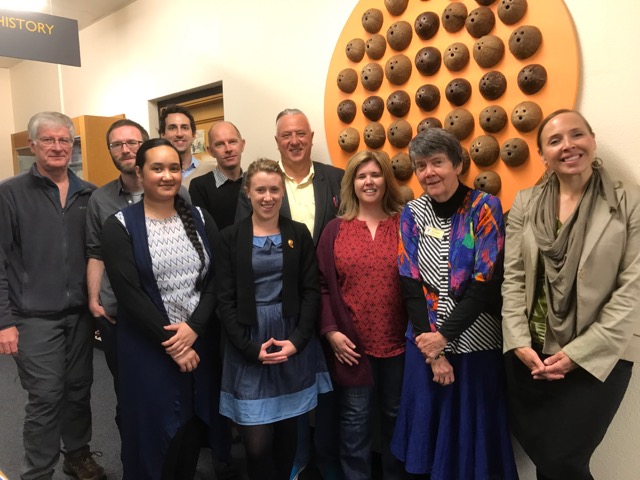
From left: Steve Talley, Josh Levy, Toaga Alefosio, Holger Droessler, Adrian Muckle, Kate Stevens, Lachy Paterson, Angela Wanhalla, Judy Bennett and April Henderson.
Valued Coconuts was a pre-read workshop featuring six papers. April Henderson and Toaga Alefosio’s (Victoria University of Wellington), On Skin and Bone: Samoan Coconut Oil in Indigenous Practice discussed how coconut oil is used in the continuing Samoan practices of fofō (healing massage), samaga (tattooing) and liutofaga (cleaning of ancestors’ bones) and the meaning for people today. This paper comes of out of summer scholarship for Toanga (who will be an Honours student this year) and April’s current research on virgin coconut oil use, “Kernals of Hope: Following Coconut Commodities from the Pacific to the West” supported by a Royal Society of New Zealand Marsden grant. In the second paper, Wasting coconuts? Consumption versus commerce in Wallis and Futuna, Kate Stevens discussed how French colonisers’ desire for scientific production of copra clashed with the Indigenous people’s views on the value of coconuts. Kate is a postdoc in Otago’s Department of History and Art History, working with Judy on their Marsden project.
Josh Levy is a PhD student at University of Illinois, Urbana-Champaign, who is researching the successive colonial regimes on Pohnpei through food history. His paper, Ideal coconut country: Persuasive coconuts and the scientific plantation in Pohnpei, Micronesia, looked at the German colonial period and the effects of copra production on the Pohnpeian population. Steve Talley, an Otago PhD student’s paper set to Defining indigenous entrepreneurship in the New Hebrides copra trade, and how the opportunities and constraints of the French and British rule moderated the Indigenous peoples’ engagement in the coconut trade.
Holger Droessler‘s Coconuts in Samoa explored how the cultivation of coconuts and production of copra mediated the German colonisers’ attitudes to Samoans, and how Samoans were able to maintain a subsistence economy despite the German desire for greater productivity. Holger is a Visiting Assistant Professor of History at Bard College in New York state. In the last paper, Judy Bennett’s Voices of Rotuma: Enduring Refrain examined the copra trade of Rotuma both in the colonial and post-colonial eras and tensions brought about through the necessity of having to ship its copra through Fiji.

Click image to enlarge
Centre members, Angela Wanhalla and Lachy Paterson, acted as commentators for these papers alongside Adrian Muckle from Victoria University of Wellington. The format of the symposium allowed for extensive discussion of the papers; the plan at this stage is for all the papers to be incorporated into a special journal issue. Thanks to the Hocken Collections for providing the venue for the event, and for the tour of some of their Pacific material. Thanks also to the Otago Museum for a tour of some of its coconut-related holdings.
Connecting the Colonies: Empires and Networks in the History of the Book
The Bibliographical Society of Australia and New Zealand Inc (BSANZ) Annual Conference 2017
Connecting the Colonies: Empires and Networks in the History of the Book
Hobart, Tasmania, Australia
22-24 November 2017
Call for Papers
Empires of all kinds – commercial, geo-political, bureaucratic – are defined by their peripheries as well as their centres, by the flows of information that maintain or destabilise their structures of authority and control.
BSANZ, in collaboration with the Society for the History of Authorship Reading and Publishing, invites scholars and researchers to consider the printed word, the book, and texts of all kinds, as both mechanism and matter of transmission.
We invite proposals for 20-minute papers on any matters of bibliographical interest, traditional and contemporary. Possible topics include, but are not limited to:
- Commercial empires: the book as a commodity in colonial contexts
- Across boundaries: print networks across geo-political, commercial or bureaucratic borders
- The trans-temporal: the afterlife of books and re-imagining of ideas
- Indigenous cultures, frontier encounters, and the presence or absence of print
- The stuff of legend: the role of print in constructing colonial and imperial consciousness
- The book as treasured possession: emotion, ownership and display
Proposals for three-person panel discussions are also welcome.
Some financial assistance towards travel costs may be available for postgraduate students who are presenting papers. Please enquire when submitting your proposal, and include a brief budget outlining your anticipated travel costs.
Proposals – including, a 250-word abstract title of paper, name and institutional affiliation of each author, a brief biography of each author, email address of each author, and 3-5 keywords – should be sent to the convenor, Ian Morrison ian.morrison@education.tas.gov.au.
Presenters must be members of the Bibliographical Society of Australia and New Zealand. The deadline for submissions is Friday 31 March 2017.
Forthcoming Symposium. Valued Coconuts: Hear Our Voices
Prof. Judy Bennett is convening a pre-read symposium at the Hocken Collections on 16 & 17 January 2017. It is a key outcome from her Royal Society of New Zealand Marsden Project with Dr. Kate Stevens, Constant Coconuts: A history of a versatile commodity in the Pacific World.
This symposium focuses on six pre-circulated papers. They address different Pacific sites in regard to the history of a range of Indigenous interactions with coconuts in everyday life as well as a commodity. In addition to considering the variety of Indigenous voices, most papers also examine interactions of colonial agents—administrators, traders, planters, and mission organisations—with this commodity in the form of coconut oil or copra. There are to be assigned commentators for each paper, but presenters also have 20 minutes each to introduce and discuss their research to the wider audience.
All are welcome to attend and contribute to the discussions where appropriate. For more information contact Judy Bennett (judy.bennet@otago.ac.nz)
CFP: Film in the Colony
On 13 and 14 July 2017, the Centre for Research on Colonial Culture and Ngā Taonga Sound and Vision are hosting the Film in the Colony Symposium in Wellington.
Keynote Speakers: Dame Professor Anne Salmond (University of Auckland), Dr Ian-Malcolm Rijsdijk (University of Cape Town)
Organisers invite papers that investigate the cross-cultural processes of film production in the colonial context, and the ways in which indigenous and settler participants – performers, crew, or people from the localities where filming took place – took part in productions. In focusing primarily on New Zealand, South Africa and Australia, the symposium also seeks to develop a comparative analysis of the means through which film contributed to the making of national stories in the late colonial era, and how indigenous communities within these colonies engaged with the first few decades of film culture.
Contributions from a variety of disciplines and backgrounds are welcome, such as film studies, history, Māori and/or indigenous studies, anthropology, archives, screen industries, and communities.
Send a 200-word abstract and a brief bio to filminthecolony@otago.ac.nz by 28 February 2017.
Convenors: Annabel Cooper (Centre for Research on Colonial Culture, University of Otago), Diane Pivac, Honiana Love (Ngā Taonga Sound and Vision), Minette Hillyer, Jo Smith (Media Studies, Victoria University of Wellington).
CROCC Successes
The Centre would like to congratulate recent successes of our members.
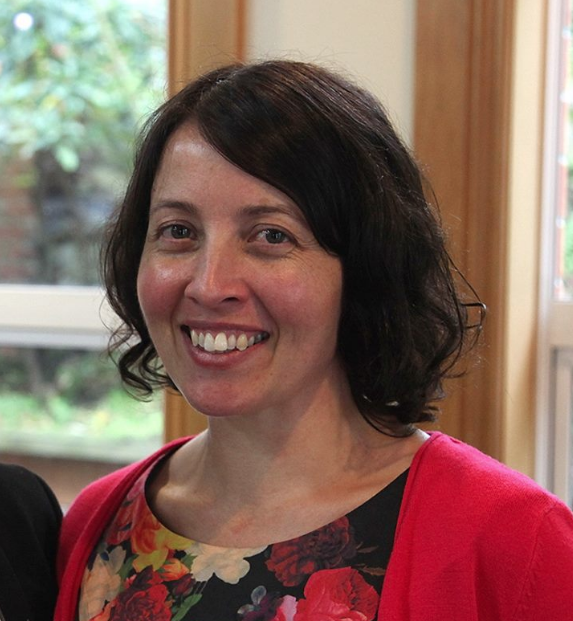
Dr Jane McCabe
Earlier this month the Royal Society of New Zealand announced the successful applicants for its prestigious Marsden Fund. Centre member, Dr Jane McCabe won a three-year Marsden Fast-Start research grant, valued at $300,000 for her new project “Splitting up the farm? A cross-cultural history of land and inheritance in Aotearoa”.
Jane will be investigating two rural districts at different ends of the country, the Taieri in Otago and the Hokianga in Northland, looking at how people of various ethnic backgrounds owned and inherited land. This project marks a shift in focus from Jane’s previous research around her PhD topic on the “Kalimpong Kids” on teenage Indian migrants sent to New Zealand in the early twentieth century.
Last week Centre director, Professor Tony Ballantyne was awarded the Humanities Aronui Medal by the Royal Society of New Zealand. This medal recognises his work over time in reshaping scholarly thought on British imperial history. In particular Tony has advanced the metaphor of “webs of empire” to explain the nature of the British Empire, that it was less a wagon wheel, with London as the hub, and more like a spider web with multiple interconnections between nodes.

Professor Tony Ballantyne
Humanities Aronui Medal: For innovative work of outstanding merit in the humanities. Citation: To Anthony John Ballantyne for reshaping the scholarly interpretation of British imperial history by demonstrating the importance of networks, cultural difference and mobility, and reconstructing the centrality of colonialism and empires in the making of the modern world.
We are also very pleased to note that Professor Hamish Spencer of Genetics Otago, who co-organized the CROCC symposium ““Eugenics in British Colonial Contexts: Australia, Canada, New Zealand and South Africa” in February 2015 was the recipient of the Callaghan Medal “for an outstanding contribution to science communication and raising public awareness of the value of science to human progress” for his work with with Ngai Tāmanuhiri, and the people of Tolaga Bay/Uawa.
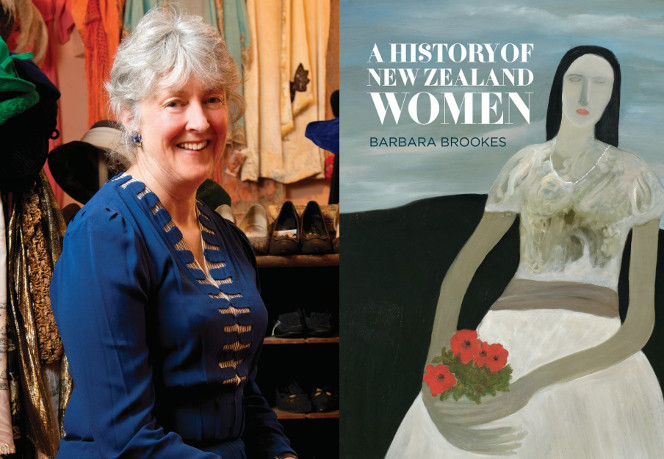 Last but not least, it is wonderful news that Professor Barbara Brookes’, A History of New Zealand Women, has been long-listed for the Illustrated Non-Fiction Award for the 2017 Ockham NZ Books Awards. The judges will announce their shortlist on March 7 next year, and the winner will be announced on May 16 at the Auckland Writers Festival. Her book provides a wide-ranging and comprehensive history of New Zealand as seen from a female perspective. Barbara has long been a leader in the field of New Zealand women’s history, with CROCC honouring her and her work at the “Making Women Visible” conference in February this year.
