




Continuing on our theme of Science that is not heard is not science at all; what if your science is not heard by your fellow scientists, let alone the public?
For this post we are going to back to 1903 to the Urania Observatory, Zurich; an observatory whose purpose was (and still is) to bring astronomy to the public. An 18 year old student by the name of Alfred Wegener studying PhD in Astronomy had taken up a 1 year position, having studied astronomy, meteorology and physics at Berlin. Believing he could make a greater contribution to science via meteorology he left and took up a scientific position at metrological station near Beeskow, north east of Zurich.
There, along with his brother, he carried out pioneering work studying air movements with weather balloons to study air movements and was appointed official meteorologist for the Danmark Scientific Expedition 1906-08 to Greenland’s unexplored North East coast. It proved a dangerous place to work with 3 expedition members dying of exposure and starvation.
But it is not in the fields of astronomy or meteorology that Alfred Wegener is remembered most.
Looking at a world map in 1910 he recalls pondering on how well the coastlines of eastern South America and western Africa seemed to fit together jigsaw puzzle like. While not the first to notice this he became intrigued when he went on to learn that fossils of several species were present in both Brazil and western Africa. Surely that meant that South America and Africa had once been in physical contact in the past when the fossilized animals roamed the earth.
Further studies of geological formations gave further credence to this assertion.
When WW1 broke out he was conscripted into the and while recovering from a wound in 1915, he pulled together his ideas and research to date on the movement of Earth’s continents in a book entitled The Origin of Continents and Oceans. That book is now regarded as groundbreaking work in the area that would go onto be known a ‘Continental Drift’ or Plate Tectonics.
At the time however, fellow scientists largely ignored the work, not giving much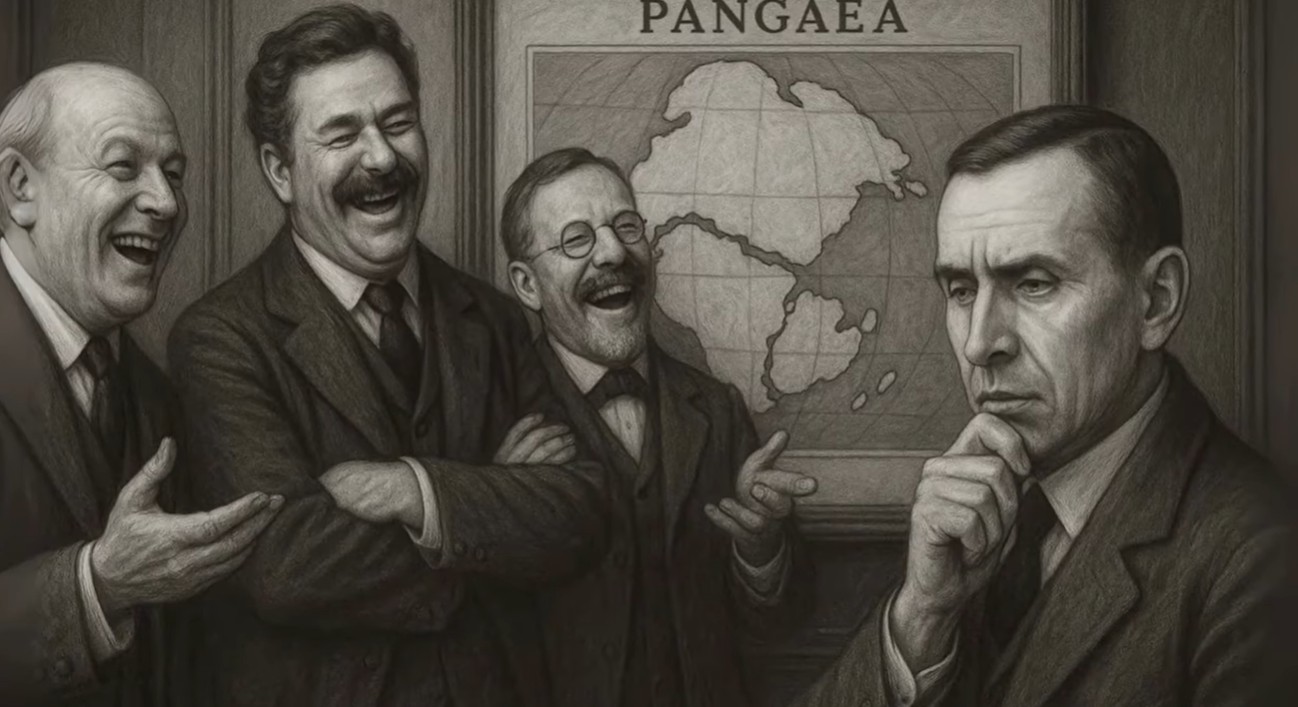 credence to scientists who stray into a field outside of their speciality. The same still happens today to some extent. (See previous blog post). Wegener was a meteorologist not a geologist and the mechanisms of ‘how’ the continents could move, however slowly had yet to be determined ( and wouldn’t be until the 1960’s).
He was not totally alone though. An American geologist by name of Frank Bursley Taylor also published research supporting the theory of continental drift or the Taylor-Wegener Theory as it was known in the 1920’s.
Wegener’s own attempts to account for their movement he got totally wrong in his Polflucht theory that proposed that a geological force was pushing the continents away from North and South poles towards the equator.
In pointing out to him that no such force existed geologists went on to reject his whole premise of continental drift at that time including his idea that solid continents float on a fluid mantle that we now know to be true.
In 1963 Frederick Vine and Drummond Matthews published a paper entitled, “Magnetic Anomalies Over Oceanic Ridges“. It explained the symmetric magnetic “stripes” on the seafloor, providing the first testable evidence for seafloor spreading and validating plate tectonics. A Canadian geologist Lawrence Morley came up with the same idea earlier the same year.
Now referred to as the Vine-Matthews-Morely Hypothesis it demonstrated that as you moved away from the mid ocean ridge the rocks were older and therefore ocean spreading was taking place moving the continents ever so slowly on either side of the Atlantic. This led to the development of the modern theory of Plate Tectonics and acceptance that continents move over geological time as proposed by Alfred Wegener way back in the 1920’s.
Another famous example of a scientist who struggled to convince his fellow scientists on a theory that later proved to be true was Physicist Luis Alvarez with his theory that a meteor impact led to extinctions of the dinosaurs. But that’s a story for another day.
Recent Comments