


The Theory Scientists Called Impossible

Tuesday, April 21st, 2026 | STEPHEN BRONI | No Comments

Continuing on our theme of Science that is not heard is not science at all; what if your science is not heard by your fellow scientists, let alone the public?

For this post we are going to back to 1903 to the Urania Observatory, Zurich; an observatory whose purpose was (and still is) to bring astronomy to the public. An 18 year old student by the name of Alfred Wegener studying PhD in Astronomy had taken up a 1 year position, having studied astronomy, meteorology and physics at Berlin. Believing he could make a greater contribution to science via meteorology he left and took up a scientific position at metrological station near Beeskow, north east of Zurich.
There, along with his brother, he carried out pioneering work studying air movements with weather balloons to study air movements and was appointed official meteorologist for the Danmark Scientific Expedition 1906-08 to Greenland’s unexplored North East coast. It proved a dangerous place to work with 3 expedition members dying of exposure and starvation.
But it is not in the fields of astronomy or meteorology that Alfred Wegener is remembered most.

Looking at a world map in 1910 he recalls pondering on how well the coastlines of eastern South America and western Africa seemed to fit together jigsaw puzzle like. While not the first to notice this he became intrigued when he went on to learn that fossils of several species were present in both Brazil and western Africa. Surely that meant that South America and Africa had once been in physical contact in the past when the fossilized animals roamed the earth.
Further studies of geological formations gave further credence to this assertion.
When WW1 broke out he was conscripted into the and while recovering from a wound in 1915, he pulled together his ideas and research to date on the movement of Earth’s continents in a book entitled The Origin of Continents and Oceans. That book is now regarded as groundbreaking work in the area that would go onto be known a ‘Continental Drift’ or Plate Tectonics.

At the time however, fellow scientists largely ignored the work, not giving much credence to scientists who stray into a field outside of their speciality. The same still happens today to some extent. (See previous blog post). Wegener was a meteorologist not a geologist and the mechanisms of ‘how’ the continents could move, however slowly had yet to be determined ( and wouldn’t be until the 1960’s).
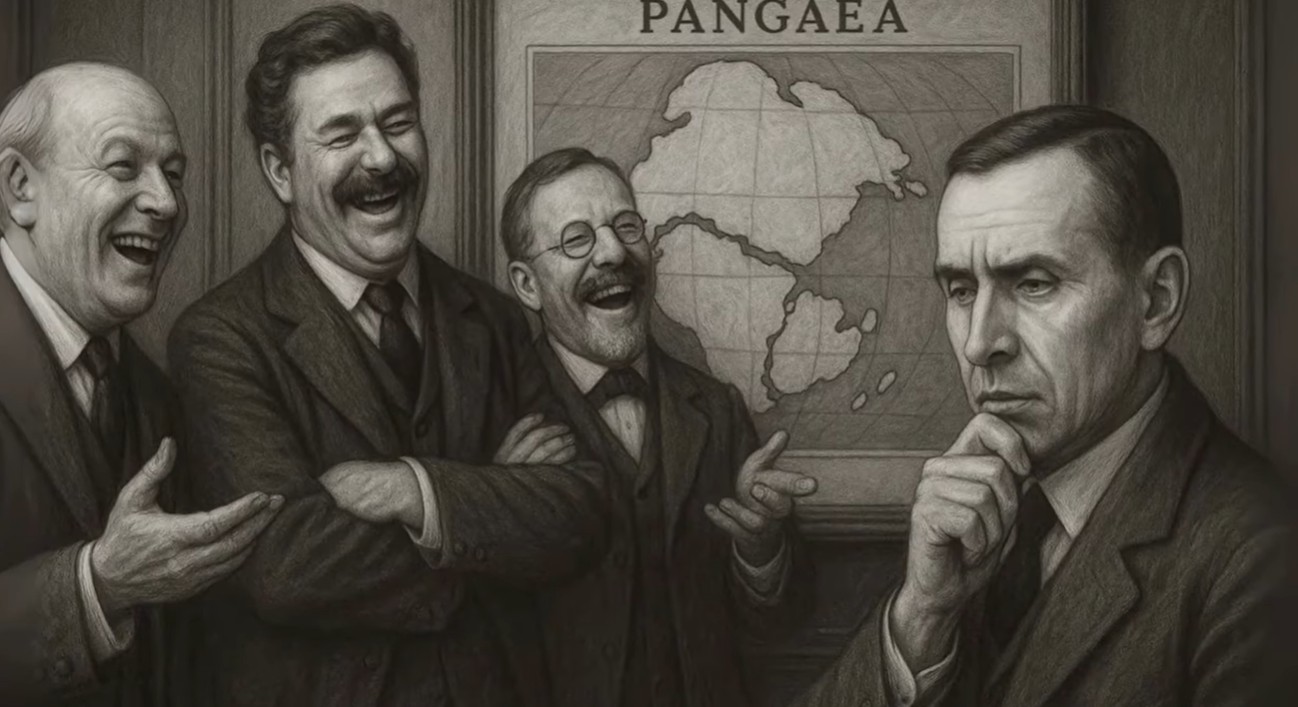
He was not totally alone though. An American geologist by name of Frank Bursley Taylor also published research supporting the theory of continental drift or the Taylor-Wegener Theory as it was known in the 1920’s.
Wegener’s own attempts to account for their movement he got totally wrong in his Polflucht theory that proposed that a geological force was pushing the continents away from North and South poles towards the equator.
In pointing out to him that no such force existed geologists went on to reject his whole premise of continental drift at that time including his idea that solid continents float on a fluid mantle that we now know to be true.
In 1963 Frederick Vine and Drummond Matthews published a paper entitled, “Magnetic Anomalies Over Oceanic Ridges“. It explained the symmetric magnetic “stripes” on the seafloor, providing the first testable evidence for seafloor spreading and validating plate tectonics. A Canadian geologist Lawrence Morley came up with the same idea earlier the same year.
Now referred to as the Vine-Matthews-Morely Hypothesis it demonstrated that as you moved away from the mid ocean ridge the rocks were older and therefore ocean spreading was taking place moving the continents ever so slowly on either side of the Atlantic. This led to the development of the modern theory of Plate Tectonics and acceptance that continents move over geological time as proposed by Alfred Wegener way back in the 1920’s.

Another famous example of a scientist who struggled to convince his fellow scientists on a theory that later proved to be true was Physicist Luis Alvarez with his theory that a meteor impact led to extinctions of the dinosaurs. But that’s a story for another day.

Not Your Stereotypical Scientist

Thursday, March 19th, 2026 | STEPHEN BRONI | No Comments

The 2nd in our series of blogs on the theme of ‘Science that is not heard is not science at all’  taken from the cover of Shaun Hendy’s book Silencing Science[1]

In our last blog we focused on a scientist who described himself as a reticent male scientist who felt compelled to speak out for science.

In this post I’d like to explore the case of an enthusiastic high achieving female scientist who, in speaking out for science faced criticism not only from certain sectors of the public but from other scientists even with regards her hair colour (as if that has anything to do with scientific credibility)

Her commitment to speak out for what she believed was good science especially during the Covid Crisis led to harassment and death threats and a court case that saw the University she worked at pay over $200,000 in compensation for failing to meet its contractual obligations to provide appropriate support as harassment against her intensified during the Covid-19 pandemic

The scientist in question is none-other than Associate Professor Siouxsie Wiles.

Born in UK and grew up in South Africa, Siouxie’s academic career began in Scotland at Edinburgh University where she studied medical microbiology followed by a PhD at Oxford before heading to New Zealand in 2009 . She now heads the Bioluminescent Superbugs Lab, where she and her team are searching for new antibiotics and trying to understand how bacteria evolve to become more infectious. Winner of numerous research and science communication awards here and overseas she was named as one of BBC’s 100 most influential women of 2020 and the Kiwibank New Zealander of the Year for 2021.

So, what’s with all the criticism, controversy and death threats and problem with her hair colour.

Well, with a 1980’s rock star name and bright pink hair she doesn’t fit the age-old stereotype of the traditional scientist, does she? So what? Her scientific credentials are more than impressive. Well, it seems it IS a problem for a lot of people. How can she be taken seriously if she has pink hair?

Here is an example of one of the kinder emails she has received about her hair:
“You have always been recognised by this hair colour even though the majority of people do not like it. I think everyone tolerates it as your knowledge is necessary. You will look stunning with dark brown, black hair. Just think about it, as I would hate for you to become replaceable when we need an expert to interview. I know this is not a nice email, but it is founded purely by concern for you. Take care.”[2]

And from the less `kind’ end of the spectrum:

`Oh I thought you hung yourself, ok I’ll keep praying’.
`Time to fly out on your broom’.
`Fark off back to the hole you oozed out from. Probably needed to keep your mouth shut’.
” How are you not in prison for covid fraud? Pretending virus exist. Pretending covid is real”.

That last one is surely a beacon call for more public science education/outreach.

So, she’s not your typical middle-aged male in a lab coat scientist.

Should the focus not be on the message not the messenger?

During the Covid crisis in 2020 she made countless media appearances in the efforts to increase public awareness of the Covid virus, how it and viruses in general behave and the need for the stringent control measures in place at the time that are estimated to have saved about 20,000 lives.[3]

The public health measures weren’t going to work if people didn’t follow them and that really involved understanding the science, and that was what we were doing as part of our job. It would be a bit of a tragedy if no one spoke about it. I have very strong values, and I didn’t want lots of people dying during the pandemic[4]

Acclaimed NZ Journalist John Campbell said voiced his support by saying “I can’t begin to explain how universities would have let us down if [the university’s suggestion that academics limit their public commentary] had been consistent and universal policy during 2020 and 2021”

Associate Professor Siouxie Wiles is unabashed in her view that one of the drivers of her maintaining a public profile is to overcome the age-old stereotypes of what a scientist looks like with hope of encouraging a wider range of people into science.

You can read more here from a variety of sources:

Issues to think about:

  • To what extent should scientific credibility be based on how a scientist looks/dress?
  • To what extent should a scientist speak up on an issue outside of their primary area of expertise.[5]
  • To what extent and how should a university support and protect a scientist’s academic freedom to speak out in public and is subjected to harassment and threats for doing so.

[5] The NZ Royal Society Code of Professional Standards and Ethics asks that scientists not present themselves as experts outside their area of expertise. However, is it ok to answer a follow up question by a journalist on such an area by making their limits of expertise known and citing only scientific sources to support any answer to a question outside of their primary area of expertise?

Finally, here are  Associate Professor Wiles’s Top Ten Tips for working with the media:


Science that is not heard is not science at all

Monday, February 23rd, 2026 | STEPHEN BRONI | No Comments

Our Science Academy theme for 2026 has a strong science communication focus.

Photo By Vlad Tchompalov

We want you to think about how the 21st century scientist can make their science heard and relevant not only to other scientists but to the wider public.

We’ll look at a few examples of scientists who have spoken out for science on the world stage and what motivated them to do so.

No matter how shy and reticent a scientist may be, sometimes there is an issue they feel compelled to speak out about given the implications of their research and its profound impact on our life.

Our first example of one such scientist is James Hansen. Born in 1941 he is currently Director of Climate Science, Awareness and Solutions Program at Columbia Climate school before which he was the Director of NASA’s Goddard Institute for Space Studies from 1981 to 2013.


“What do I know that would cause me, a reticent, Midwestern scientist,
 to get myself arrested in front of the White House protesting.
 And what would you do if you knew what I know?”

 The opening lines of his 2012 TED talk:  
Why I must speak out about climate change

Or

If you prefer listening to podcasts

James Hansen: What Makes a Scientist Take a Stand?  TED Radio Hour (8 mins)

[The Title Quote ‘Science that is not heard is not science at all’ comes from Prof Shaun Hendy’s book  ‘Silencing Science’  Pub by Bridget Williams Books 2016]