Call for Papers (September 2026 and Academic Year 2027)
The convenors of the Visual Studies Network invite expressions of interest from its members. In particular, we are seeking one presenter for the seminar currently scheduled between September 1 and 15.
As you may already know, the seminar series is conceived as a collegial space for sharing research in progress rather than finished, published, or fully polished papers. Contributions may take the form of exploratory arguments, methodological reflections, archival or visual material under analysis, or chapters/articles in progress. Please note this call is circulated among the current members of this network.
We especially welcome contributions that engage with, but are not limited to:
Art history and visual culture
Photography and film
Exhibition histories and curatorial practices
Visual archives and material culture
Theoretical and methodological approaches to the visual
ETHOS OF THE SEMINAR SERIES
The seminars aim to foster a supportive, experimental, and interdisciplinary environment. Participants can test ideas and receive thoughtful, constructive feedback. We encourage open discussion across disciplinary boundaries and career stages. Each presentation may vary in length, from roughly 30 minutes to a maximum of 1 hour, excluding discussion. We hold three seminars per semester.
If you are interested in presenting in September 2026 please get in touch by July 15, 2026, with a brief description of your proposed topic and a short bio.
We also welcome expressions of interest for the academic year 2027.
Editors-in-Chief: Éva Forgács, Benedikt Hjartarson, Cecilia Novero, Sami Sjöberg
Published biannually by Brill
About the Journal
The Journal of Avant-Garde Studies (JAGS) is a peer-reviewed, interdisciplinary journal dedicated to the critical exploration of the experimental, the provocative, and the unclassifiable in the arts and literature. With a global outlook and a wide range of theoretical approaches, The Journal of Avant-Garde Studies examines avant-garde practices from the historical avant-gardes through the neo-avant-gardes and into the present, engaging both canonical figures and those marginalized or overlooked by existing histories.
The Journal of Avant-Garde Studies seeks to broaden and enrich our understanding of the vanguard by fostering dialogue across disciplines, geographies, and methodologies.
Scope of the Issue
For this open issue, the editors invite finished, original research articles on any avant-garde artist, movement, theory or practice, from any geographical or cultural context. Contributions are not limited to Europe and are especially welcome if from underrepresented regions, traditions, and perspectives.
The journal approaches the avant-garde not as a loose label, but as a historically and conceptually defined field shaped by practices, discourses, and institutions committed to rupture, experimentation, antagonism, and the rethinking of art’s social, political, and epistemic roles. Within this framework, the scope of the issue includes:
Historical avant-garde movements of the late 19th and early 20th centuries
Neo-avant-garde formations of the 1960s-1980s
Post-1970s and contemporary practices that explicitly engage with, reactivate, critique or transform avant-garde paradigms.
While The Journal of Avant-Garde Studies welcomes scholarship on later and contemporary work, submissions must explicitly engage with the concept, history or legacy of the avant-garde, rather than modernism in a general or purely stylistic sense.
Possible Topics (Indicative, not Exhaustive)
Reconsiderations of avant-garde movements, groups, manifestos, and networks
Global, transnational, and decolonial perspectives on the avant-garde
Avant-garde practices beyond the visual arts and literature (performance, sound, film, media, architecture, design, fashion, etc.)
Theories and philosophies of the avant-garde
Gender, sexuality, race, class, and the avant-garde
Political, social, institutional dimensions of avant-garde practices
Archival discoveries, neglected figures, and alternative genealogies
Neo-avant-garde and post-avant-garde debates
Avant-garde strategies in contemporary art and culture
Intersections between avant-garde practices and activism, technology, or popular culture
Reception, criticism, and the afterlives of the avant-garde, including how audiences, markets, and cultural memory have interpreted and recontextualized avant-garde work over time.
Submission Guidelines
Submissions must be original, unpublished, and not under consideration elsewhere
Articles should be submitted as completed manuscripts by the deadline (August 31, 2026)
Manuscripts should generally fall within the journal’s standard length (approximately 6,000-10,000 words, including notes and references)
Please include an abstract (max. 100 words), up to six keywords, affiliation details, and an email address
All submissions must comply with the journal’s style guidelines and will undergo double-anonymous external peer review
Whenever possible articles should be submitted in English (the journal’s primary language of publication).
All articles published in The Journal of Avant-Garde Studies, including those in open and special issues, undergo a double-anonymous external peer review process.
Important Dates
Submission deadline for completed manuscripts: August 31, 2026*
Anticipated publication: December 2026
*Please note: if you wish to submit an abstract first to check whether your article falls within the scope of the journal, please do so by mid-June, 2026.
How to Submit
Manuscripts should be submitted via Brill’s online submission system for The Journal of Avant-Garde Studies. Please select “Open Issue” when prompted during submission. For any questions about your manuscript, please contact Editor-in-Chief, Benedikt Hjartarson, University of Iceland. For any questions about submission via Editorial Manager, please contact Brill’s EM support. All other matters can be directed to the publisher at BRILL, Masja Horn.
This volume brings together an international array of contributors to analyse Greta Gerwig’s unprecedented success, Barbie (2023), exploring how a film released in a moment of industrial crisis for Hollywood became the highest-grossing film directed or co-directed by a woman.
Uniting scholars from Aotearoa New Zealand, Australia, France, Turkey, the UK, and the USA, this volume provides a set of essays that reflect the complexities of what is, in many ways, a fable for our times. Greta Gerwig’s Barbie: Popular Culture, Cinema, and Gender opens with a chapter on the current state of the film industry. Further topics include: the treatment of American girlhood; fashion and feminism; the auteur director; post-indie cinema; queer identities; masculinity; the politics of race, class and gender; contemporary feminisms; consumerism; and the ecology of plastic. As such, the book offers a detailed and nuanced perspective on a benchmark film, produced and distributed by an industry in crisis––the brainchild of a significant director whose star is on the rise.
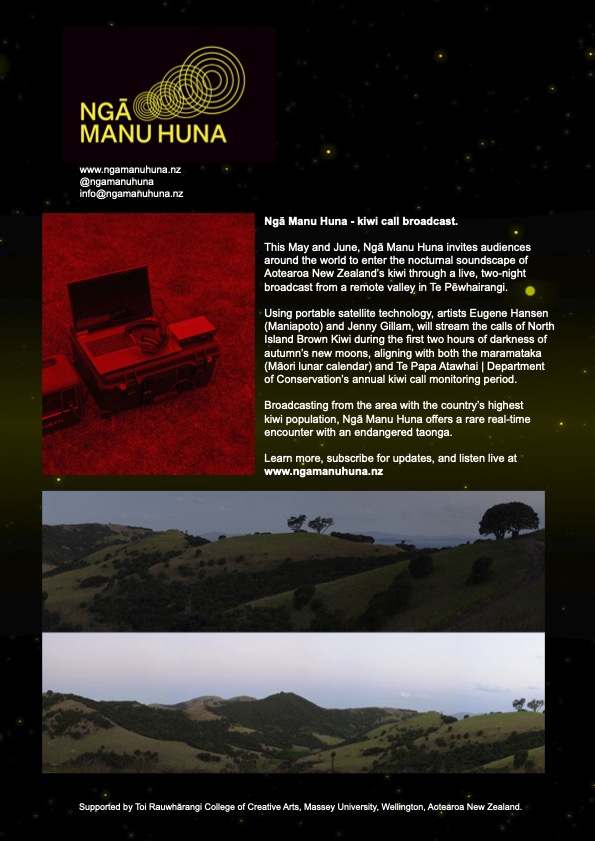
This May and June, audiences around the world are invited to enter the nocturnal world of Aotearoa New Zealand’s kiwi. Ngā Manu Huna is a live, two-night broadcast transmitting the calls of North Island Brown Kiwi from a remote valley in Te Pēwhairangi.
The project brings together environmental sound, the maramataka (Māori lunar calendar), conservation science, and contemporary art, offering a rare real-time encounter with one of the world’s most distinctive and widely recognised endangered birds.
Ngā Manu Huna broadcasts take place in the first two hours of darkness of autumn’s new moons and align with Te Papa Atawhai | Department of Conservation’s annual kiwi call monitoring period.
The first 2026 livestream will take place on 17 May, 6:00–8:00pm NZST (UTC+12), weather dependent. A second broadcast is planned for 15 June. The project will return annually.
Learn more about the project, subscribe for updates, and listen live at www.ngamanuhuna.nz
We warmly welcome all members of the Visual Studies Network to our 2026 Research Seminar Series.
This semester, we are delighted to present three research seminars that explore perspectives in visual studies, through engagement with 3 women artists and photographers, both from New Zealand and overseas. These sessions provide an opportunity to connect, exchange ideas, and deepen our shared interests in visual culture, theory, and practice.
All seminars will take place in:
Room F209, F Block, Otago Polytechnic | Te Kura Matatini ki Otago – Forth Street, Dunedin.
We aim to start at 5:00 pm with refreshements. The talks will commence at 5:30 and end around 7:00 pm.
SEMINAR 1
“Angela Gunn, of Waimate,” Ed Hanfling, Dunedin School of Art
Wednesday, March 11
Abstract: Angela Gunn (1961–1995) was a photographer and painter who studied at the Ilam School of Fine Arts, Christchurch, and subsequently lived in Waimate, South Canterbury. She had dealer gallery representation in Auckland, Wellington and Christchurch and exhibited paintings that most frequently depicted her garden; she evidently devoted a considerable amount of time to both the paintings and the garden. The paintings are evidence of the artist’s facility for turning closely observed phenomena into lyrical abstract patterns. Gunn was far from being a household name during her life, and since her untimely death her work has not gained further public exposure. This seminar offers an introduction to a small number of paintings encountered, and information gleaned, at the beginning of a research project that, it is hoped, will culminate in an exhibition and catalogue.
Ed Hanfling is an art historian, critic and occasional curator, who writes regularly for Art New Zealand and has contributed articles to international journals, including the Burlington Magazine and Third Text. He is co-author (with Gil Docking and Michael Dunn) of 250 Years of New Zealand Painting (Bateman, 2021) and his book provisionally titled Art is Good: A Critic’s History of Contemporary New Zealand Art is scheduled for publication by Bateman later this year. Ed is Postgraduate Coordinator at the Dunedin School of Art and is co-chair of the Otago Polytechnic Research Ethics Committee. He is the editor of two journals, Scope: Art & Design and Junctures: The Journal for Thematic Dialogue.
SEMINAR 2
“Sibylle Bergemann & Fashion Photography in the GDR,” Cecilia Novero, University of Otago
Wednesday, April 8
Abstract:This talk offers a series of close readings of photographs by Sibylle Bergemann, situating her fashion and fashion-adjacent work within the broader visual culture of the German Democratic Republic (GDR) and the field of women’s fashion photography. It argues that Bergemann’s photographs articulated historically specific forms of subjectivity, relationality, and everyday experience that exceeded both official ideology and conventional modes of fashion representation, whether in the GDR or in the capitalist West. Attending to gesture, distance, and practices of looking, the chapter shows how these photographs negotiated intimacy and reserve, agency and constraint, producing “touching” encounters that enabled forms of communal recognition among viewers. In foregrounding photography’s relational dimensions, the chapter positions Bergemann’s work as a distinctive intervention by a woman photographer working under real-existing socialism.
Cecilia Novero is a trained Comparatist and Germanist, in particular with a focus on the GDR and Visual Culture. She has published on contemporary European art and photography, especially the historical and neo-avant-garde movements of the 20th century, as evinced from her book Antidiets of the Avant-Garde (UMP 2010). In the last few years, her research in Visual Culture has intersected with Animal Studies and the Environmental Humanities. Her theoretical approach draws, among others, on critical theory (T.W. Adorno and W. Benjamin). She is on the editorial boards of several journals, including The Journal of Avant-Garde Studies, Antennae: The Journal of Nature in Visual Culture, and the Animal Studies Journal. She is co-editor of Otago German Studies (University of Otago). A call for articles on Daniel Spoerri is soon to be circulated. You are welcome to send an abstract for consideration to: cecilia.novero@otago.ac.nz.
SEMINAR 3
“Pippi Miller: Dunedin Artist,” Hilary Radner, Emeritus Professor
Wednesday, May 20
In this presentation, I propose to discuss the exhibition “Taking Advantage of Poor Light” (22 August–15 September 2025) by Pippi Miller at Olga Gallery in the context of what I will call the Dunedin “art world,” borrowing the term from sociologist Howard Becker. This presentation will, then, seek to demonstrate that the works in this exhibition offer a set of figures and interlocking images that speak both to the artist’s position as a member of a particular generation who came of age in the second decade of the 21st century––and to her position as a member of a small art world, that of Dunedin.
Pippi Miller (b.1997) holds a BA HONS first class (2019) from the University of Otago; a GradDip (2020) and an MFA (2023) from the Dunedin School of Art. She was born in Te Whanganui-a-Tara | Wellington, grew up in Ōtepoti | Dunedin and attended Logan Park High School, graduating in 2015. Her drawing and painting-based practice focuses on exploring line, colour, illustration, and children’s literature.
Hilary Radner is Emeritus Professor of Film and Media Studies, University of Otago, Dunedin. Author of three monographs addressing the formation of contemporary feminine identity, Shopping Around: Consumer Culture and the Pursuit of Pleasure (1995), Neo-Feminist Cinema: Girly Films, Chick Flicks and Consumer Culture (2011), and The New Woman’s Film: Femme-centric Movies for Smart Chicks (2017), her more recent publications include Raymond Bellour:Cinema and the Moving Image (2018), a special issue of the Journal of New Zealand Studies, on Art and Aotearoa New Zealand, co-edited with Edward Hanfling and Mark Stocker (NS38, September 2024), and Greta Gerwig’s Barbie: Popular Culture, Cinema, and Gender (2026), co-edited with Rebecca Stringer.
The convenors of the Visual Studies Network invite expressions of interest from its members, with a particular (but not exclusive) emphasis on the study of visual disciplines, for our 2026 series of seminars. Preference will be given to those who regularly attend the seminar, which has been running in its current form since 2020.
As you may already know, the seminar series is conceived as a collegial space for sharing research in progress rather than finished or fully polished papers. Contributions may take the form of exploratory arguments, methodological reflections, archival or visual material under analysis, or chapters/articles in progress. It is best if the presentations focus on not-yet published material.
We particularly welcome contributions that engage with, but are not limited to:
Art history and visual culture
Photography and film
Exhibition histories and curatorial practices
Visual archives and material culture
Theoretical and methodological approaches to the visual
Ethos of the seminar series The seminars aim to foster a supportive, experimental, and interdisciplinary environment. Participants can test ideas and receive thoughtful, constructive feedback. We encourage open discussion across disciplinary boundaries and career stages. Each presentation may vary in length, from roughly 30 minutes to a maximum of 1 hour, excluding discussion. We plan to hold three seminars per semester.
This call will be circulated only within our existing network.
If you are interested in presenting, please get in touch by February 13, 2026, with a brief description of your proposed topic and your preferred timing (Semester One [March-Early June] or Semester Two [End of July- End of October]).
Room F209, F Block, Otago Polytechnic, Forth Street, Dunedin
5:00 pm refreshments; start 5:30 – 7:00 pm
Iconographies of Civilisation and Ruins – Aotearoa
New Zealand Soldiers’ Encounters with Ancient Egypt during the First World War
Dr Anya Samarasinghe
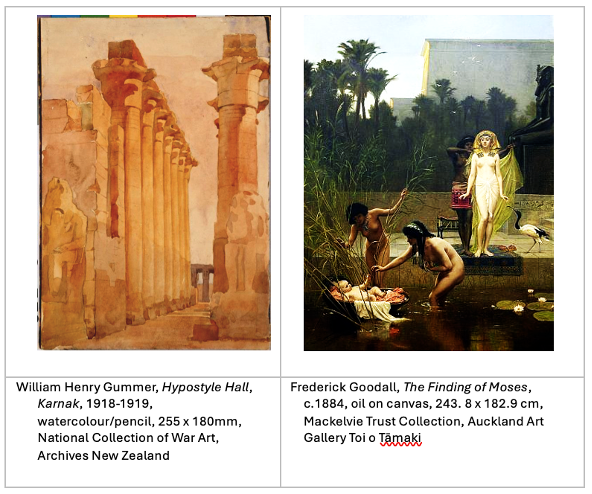
Letters written by Aotearoa’s soldiers stationed in Egypt during the First World War reference the ancient monuments, sites, and stories associated with Egypt’s ancient past. These accounts have a vivid visual character expressed through descriptions of ruins. Some of these descriptions are echoed in sketches and watercolours made by soldiers. Formal and iconographic analysis of this visual material situates ancient Egypt in a wider cultural imaginary space and encapsulates an interest in the picturesque and the concept of ancient Egypt as a mysterious landmark in the history of Western civilisation. This paper considers how contested histories, visual imagination, and concepts of Egypt, the British Empire, and Aotearoa New Zealand are refracted through the prism of Aotearoa soldiers’ encounters with Egypt’s ancient past during the First World War.
Anya Samarasinghe is the 2025 Ihupukutaka Kairaupī Curatorial Intern at Dunedin Public Art Gallery. She completed her PhD on Victorian art collections in Aotearoa’s public art galleries in 2023 and has worked on projects involving the reception of ancient Egypt and medieval culture in Aotearoa.
For a link to attend online please contact Ed Hanfling: ed.hanfling@op.ac.nz
Welcome to our Research Seminars, Semester Two, 2025.
Below you will find a schedule of the forthcoming presentations. In a separate post you will also be able to read a short abstract for each of these presentations. We hope to see you there and then!
Ngā mihi!
SCHEDULE
Sponsored by Research Network in Cultures, Histories and Identities, a University of Otago/Dunedin School of Art Initiative
Wednesday, 13 August, 5 – 7pm, Cecilia Novero: “Kafka’s Drawings as Sites for Form and Play: A Reading Informed by Walter Benjamin,” cecilia.novero@otago.ac.nz, Boardroom, rm F209, Forth Street Building, Otago Polytechnic.
Wednesday, 3 September, 5 – 7pm, Anya Samarasinghe, “Iconographies of Civilisation and Ruins – Aotearoa New Zealand Soldiers’ Encounters with Ancient Egypt during the First World War,” anya.samarasinghe@dcc.govt.nz, Boardroom, rm F209, Forth Street Building, Otago Polytechnic.
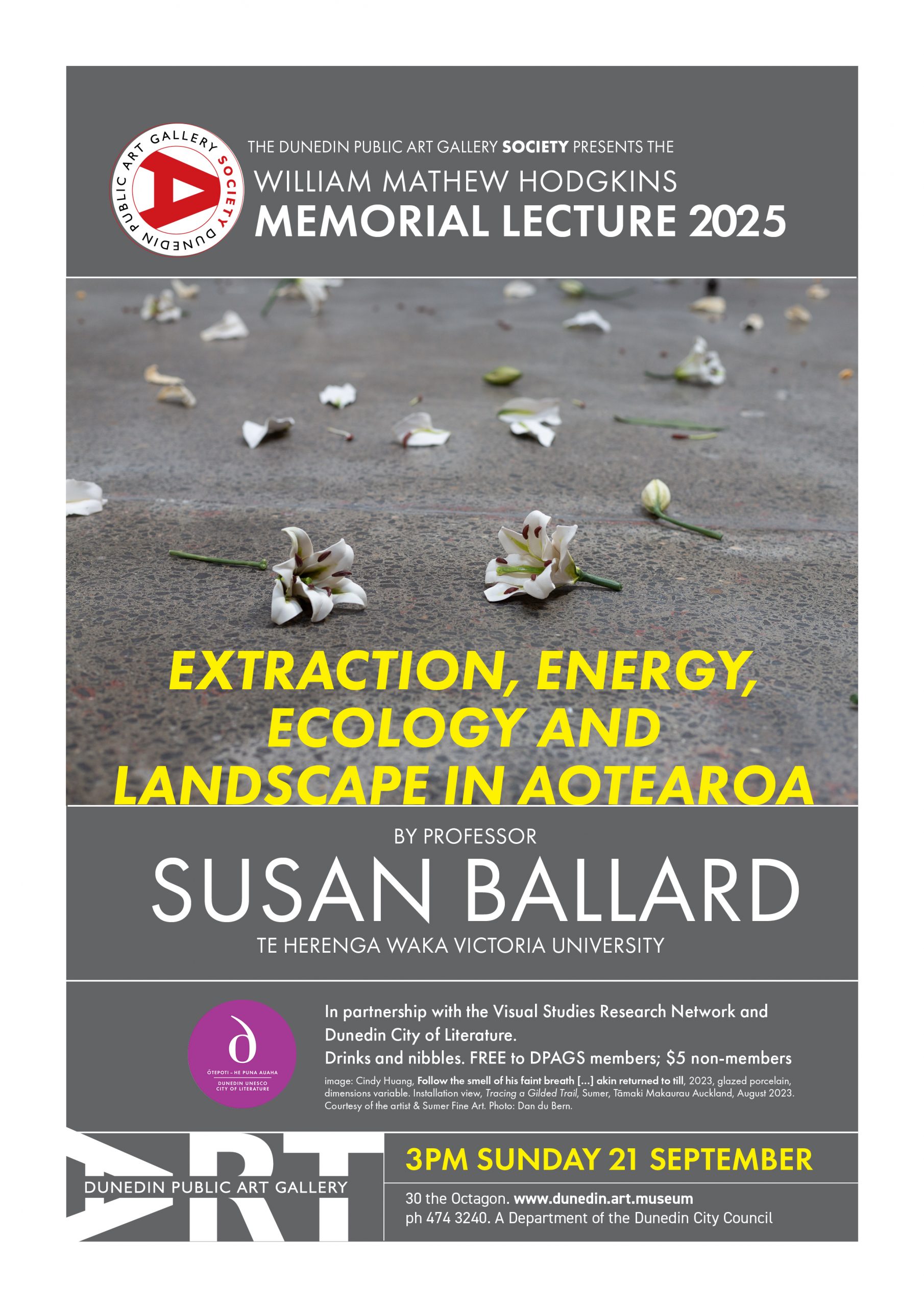
Sunday, 21 September 2025, 3 – 5pm, Sue Ballard: “Extraction, Energy, Ecology and Landscape in Aotearoa,” Dunedin Public Art Gallery Society: William Hodges Annual Lecture 2025, sponsored by the Dunedin Public Art Gallery Society, susan.ballard@vuw.ac.nz, Dunedin Public Art Gallery Auditorium.
Wednesday, 1 October 2025, 5 – 7 pm, Panel Chaired by Leoni Schmidt, with: Metiria Stanton Turei, on “Indigenous Visual Jurisprudence,” metiria.stantonturei@otago.ac.nz; & Ana Terry, “A Pictorial Turn: Visualising Education,” Ana.Terry@op.ac.nz; Boardroom, rm F209, Forth Street Building, Otago Polytechnic.
For further information, and for recording links, contact: Ed Hanfling, ed.hanfling@op.ac.nz
This edited volume marks the centennial of Surrealism with a focus on its ties to German culture. Essays in German and English explore the movement’s roots in German Romanticism, particularly through Novalis, and its reception by German critics and writers such as Walter Benjamin and Walter Serner. Contributors examine Surrealism’s intersections with avant-garde currents like Dada and New Objectivity, as well as the artistic innovations of Max Ernst. The volume also features a personal narrative, inspired by Walter Benjamin’s “profane illumination,” recounting early encounters with surrealist books in remainder markets. A concluding essay analyzes Surrealism’s influence on the aesthetics of the TV series Hannibal.
The collection opens with an original German story by Benedikt Wolf, followed by an interview with the author, and is complemented by a cover painting by Manfred Melitta Poppe, adding a creative dimension to this scholarly work. Extending this artistic engagement, the volume closes with an insert featuring a selection of original photographs by Chicago-based artist Tom Denlinger, and a short exegesis.
No. NS38 (2024): Journal of New Zealand Studies Art and Aotearoa New Zealand: Cultures, Controversies and Histories Editors: Edward Hanfling, Hilary Radner, Mark Stocker https://ojs.victoria.ac.nz/jnzs/issue/view/1015 (permanent link)
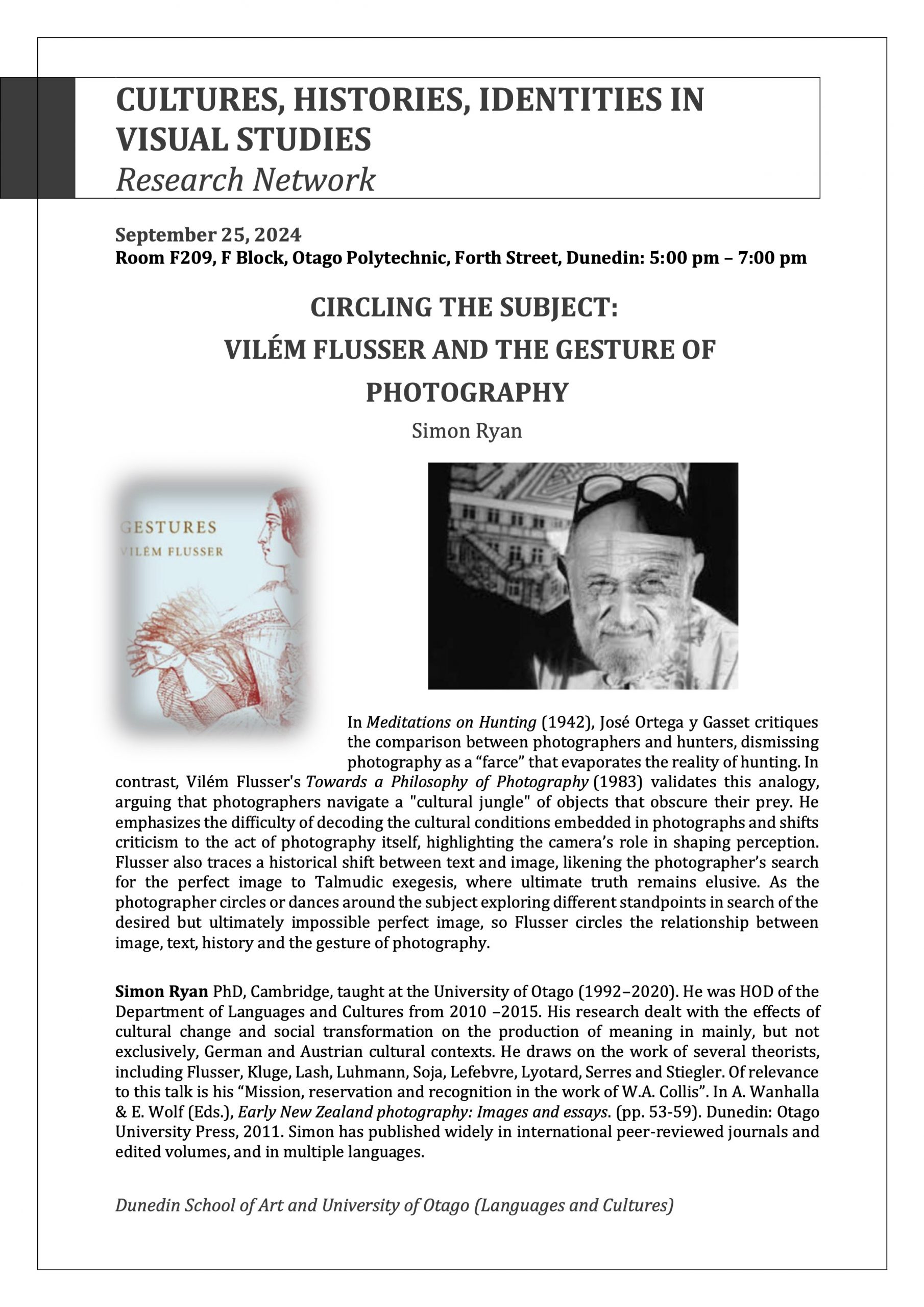
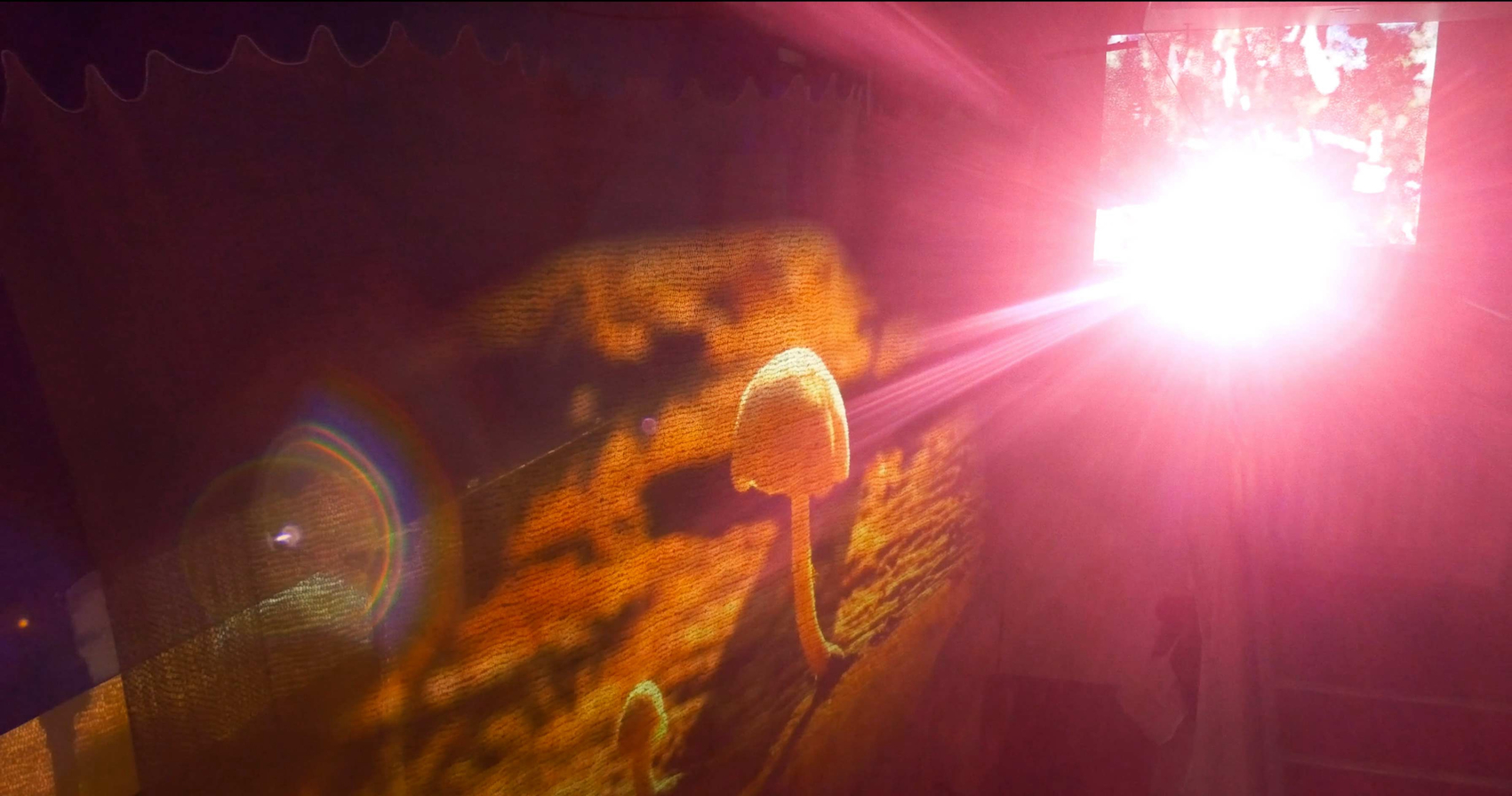
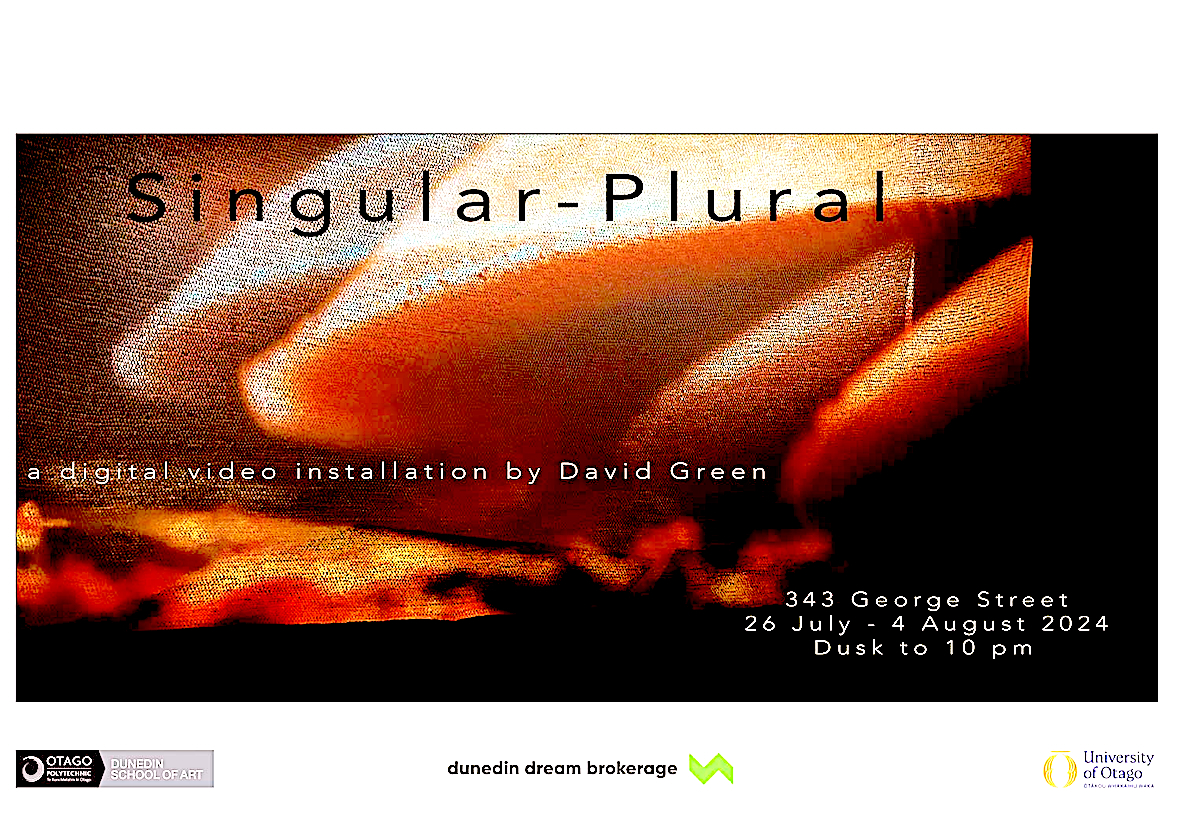
“Singular-Plural” David Green, moving image installation, 343 George Street, Dunedin, August 2024
David Green
Disarticulated Cinema and
the Human Predicament
Wednesday 11 September 2024
5:00 for 5:30–7:00
In this talk, I will discuss my practice-led PhD project, which I describe as “disarticulated cinema.” This approach involves a reciprocal system of writing and making, initiated by the fragmentation and redistribution of moving images in space. I will begin by showcasing documentation of my recent installation, “Singular-Plural,” which embodies the practice-oriented aspects of my research methodology. Following this, I will introduce the concept of the “ontological organon”—man-made objects of art, science, and innovation that fundamentally alter one’s internal position in the world.
David Green is a video installation artist based in Ōtepoti and a lecturer at the Dunedin School of Art. His practice explores the phenomenology and neurology of perception through collaborative engagements between artwork and viewer. David creates work for both white cube galleries and site-specific architectural spaces. He is currently a PhD candidate in Languages and Cultures, the School of Arts, at the University of Otago.
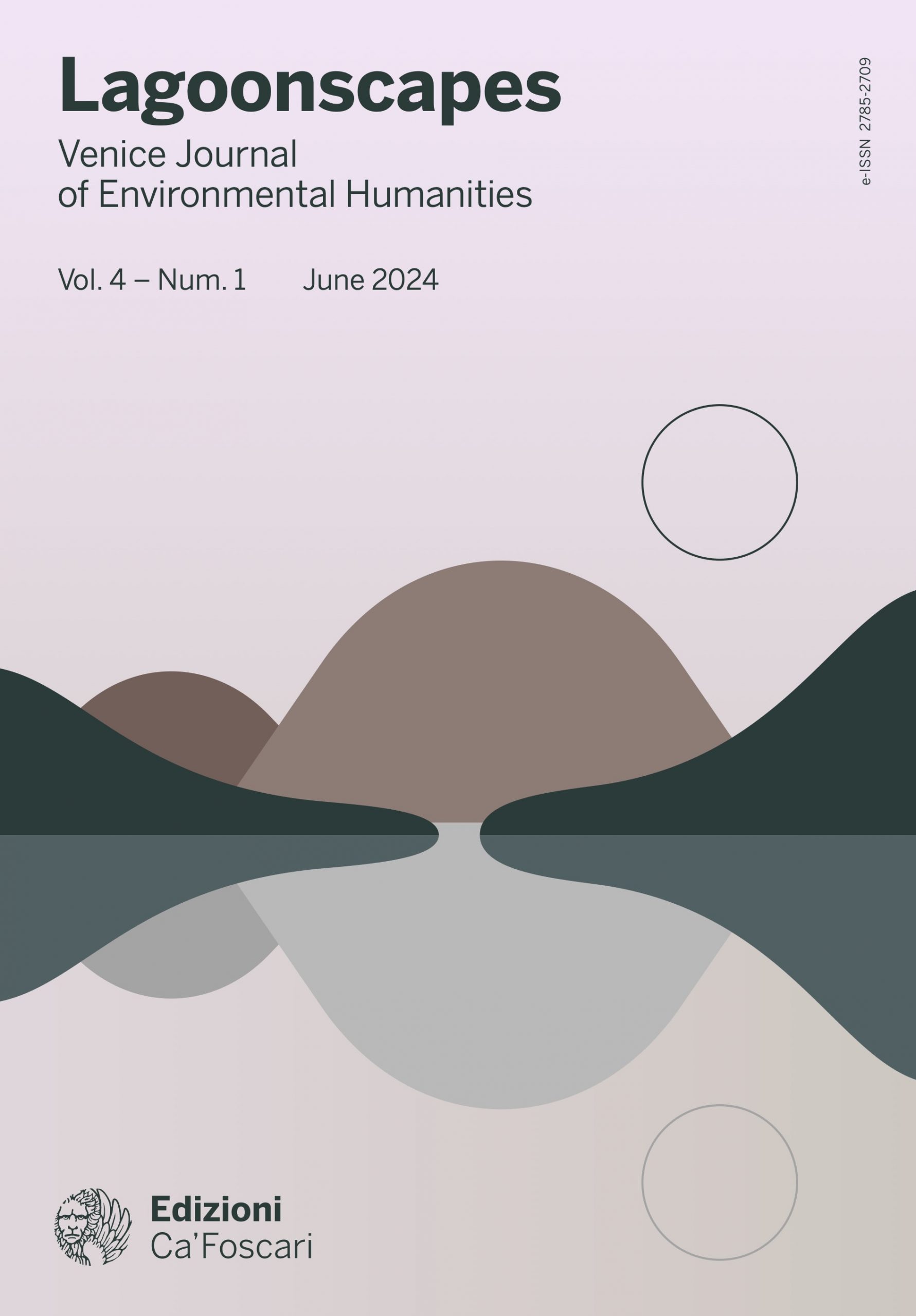
See Leoni Schmidt, “Anatomy Lessons: Michele Beevors as Eco-Political Agent,” Lagoonscapes 4, no. 1: 181–199.
Abstract: This article responds to the large scale sculptural work by eco-political artist
Michele Beevors, whose work has recently been extensively exhibited in New Zealand,
Australia, and Austria. She brings her audience close to the tragedies of eco-extinction
and the brutalities of human interaction with our vulnerable animal co-species. The
article considers her work through four frames: 1. Violence: Dissection and Restitution;
2. Death: Specimen and Requiem; 3. Grief: Solastalgia and Entanglement; and 4. Labour:
Materiality and Companionship. Through these four frames, the artist’s exploration of
human relationships with non-human forms of life is highlighted as based in decolonial,
feminist and activist values. The text includes memories and reflections from the au-
thor’s life where relevant to the themes presented by the artist.
Keywords: sculpture, eco-political, animal ethics, extinction, solastalgia, care
List of Figures; Preface; Acknowledgments; Introduction;
1. Italian Neorealism and the Emergence of the Male Melodrama: Vittorio De Sica’sBicycle Thieves(1948) andUmberto D.(1952)
2. The Migration of Male Melodrama into Non-Western Cultures: Satyajit Ray’s The Apu Trilogy (1955–59) and “Fourth Cinema”
3. Hollywood Melodrama as a Vehicle for Self-Projection: Vincente Minnelli’sTea and Sympathy(1956) andHome from the Hill(1960)
4. The Political Turns Personal: Neo-Neorealism and Pier Paolo Pasolini’sAccattone(1961)
5. Personal Cinema as Psychodrama: Ingmar Bergman’sWild Strawberries(1957),Winter Light(1963) andHour of the Wolf(1968)
6. François Truffaut and the Tyranny of Romantic Obsession:The Soft Skin(1964),Mississippi Mermaid(1969) andThe Woman Next Door(1981)
7. Figuring an Authorial Fantasmatic: Jacques Demy’sThe Umbrellas of Cherbourg(1964),A Room In Town(1982) andParking(1985)
8. Rainer Werner Fassbinder and the Emergence of Queer Cinema:The Merchant of Four Seasons(1972),Fox and His Friends(1975) andIn a Year with 13 Moons(1978)
9. Visual Aestheticism and the Queer Prestige Melodrama:Call Me by Your Name(2017) and Luca Guadagnino’s Desire Trilogy; Conclusion
Animal and Human Intersections in the Work of Three Contemporary Artists
Jane Alexander, Roger Ballen, and Michele Beevors
This seminar focuses on the recent work of artists Jane Alexander, Roger Ballen, and Michele Beevors. Animals feature large in their exhibitions to address the fraught relationships with humans. Their works unmask the abuse of power, suggest hidden menace, and signal the urgency of care.
Michele Beevors in her studio (photograph: Adrian Hall)
Leoni Schmidt is an art historian and theorist, writer, reviewer, and postgraduate assessor. She was the Head: Dunedin School of Art (2009-2017), Director: Research & Postgraduate Studies (2017-2022) at Otago Polytechnic and the DCE: Academic at the Otago Polytechnic International Campus in Auckland (2019-2022). A full professor since 2006, she is currently professor emerita at Otago Polytechnic/Te Pūkenga. Her research focuses on contemporary visual arts practice with an emphasis on political agency.
5 for 5:30, Room F209 Puna Kawa, F Block, Otago Polytechnic, Forth Street, Dunedin
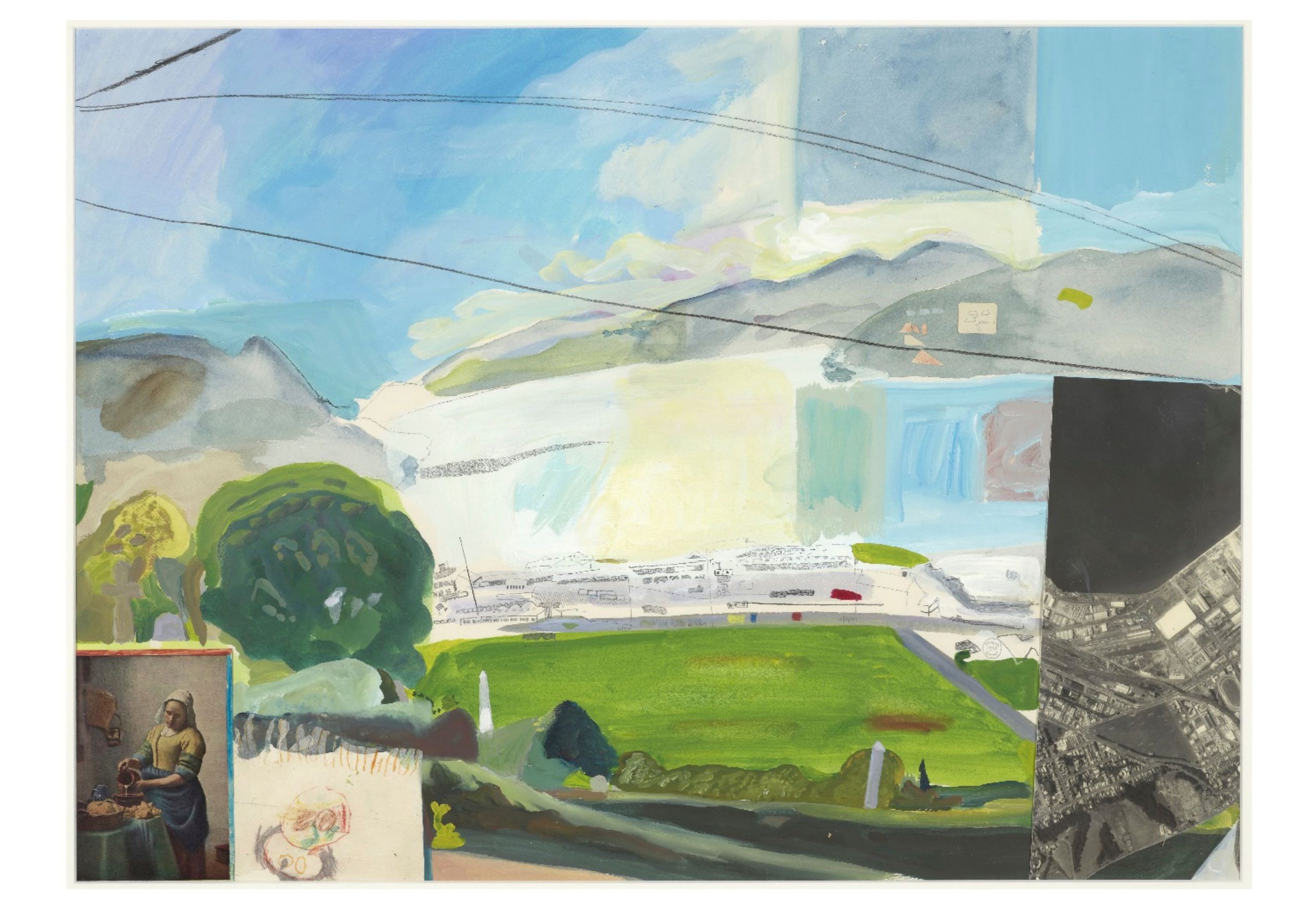
Synthetic polymer paint and collage on paper, 535 x 740 mm.
Hocken Collections Uare Taoka o Hākena, University of Otago, acc. no. 78/205.
Otago Harbour is a picture in the Hocken Collections made by Joanna Margaret Paul in 1978. It is, in large part, a lively acrylic-painted and pencil-drawn view, or views, of Dunedin from the top of Southern Cemetery, Mornington, with collage additions – notably, a cropped reproduction of Johannes Vermeer’s Milkmaid (c1660), a scrap of still life drawing and a carefully sliced aerial photograph of the part of Dunedin represented in the painted view. In combining different modes of representation, Otago Harbour has much in common with a series of works Paul called “Intimate Maps.” Paul draws attention to the subjective or contingent act of representing place, rather than place as an objective fact, and exhibits a curiously contemporary sense of intimacy with, or embeddedness in, her environment. This seminar presents a detailed analysis of a complex picture, considering its significance in the context of other bodies of work by Paul (including her photographs and films) and New Zealand art history.
Ed Hanfling holds the position of Lecturer in Art History and Theory at Dunedin School of Art. He writes regularly as a critic for Art New Zealand, and has published journal articles and books on such topics and artists as modernism in New Zealand art, values and judgements, Morris Louis, Milan Mrkusich and Ian Scott. His recent publications include 250 Years of New Zealand Painting (Bateman 2021) as co-author, and as co-editor, a special issue of the Journal of New Zealand Studies, “Art and Aotearoa New Zealand: Cultures, Controversies and Histories,” forthcoming December 2024. He currently serves as co-editor of Junctures: The Journal for Thematic Dialogue.
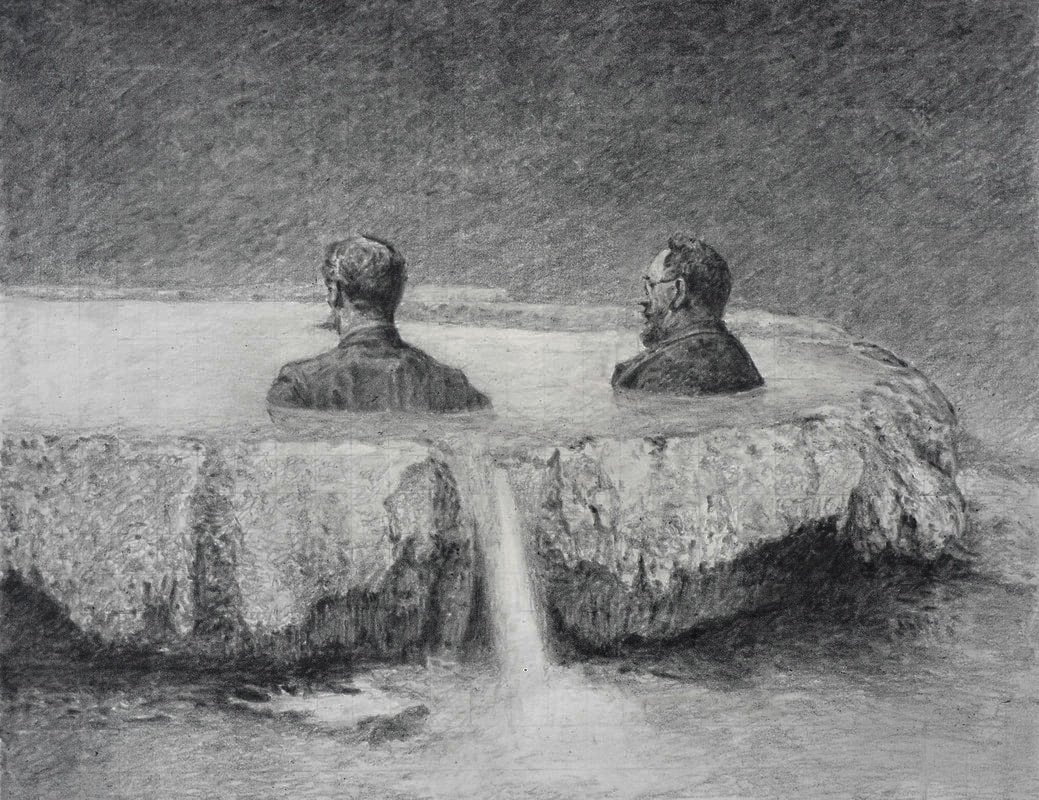
Philip Madill, Displacement of Accent, graphite on paper, 2023
This seminar will explore, through practice-based research, the evolution from pre-cinema to contemporary mixed-reality entertainment. Mixed reality in this context refers to the coexistence of overlapping virtual and physical spaces achieved by creating and experiencing immersive environments. It will also cover the historical role pre-cinema played, as a form of instructive entertainment, in the promotion and colonisation of New Zealand during the Nineteenth Century. The artistic phenomenon not only served to inform prospective immigrants but propagate ideas of ‘otherness’ through the selective use of imagery and the layout of the exhibition spaces. The discussion will conclude with an analysis of contemporary works by Janet Cardiff, William Kentridge, and Victor Burgin and their use of digital animation to explore the historical impact of pre-cinema entertainment.
Philip Madill is a Dunedin-based artist whose practice explores the historical relationship between photography and drawing. In 2014, he completed a master’s degree from the Dunedin School of Art and holds a bachelor’s degree in history from the University of Otago. Madill is also working towards a Doctor of Philosophy in Art and Design at the Auckland University of Technology.
Dunedin School of Art and University of Otago (Languages and Cultures)
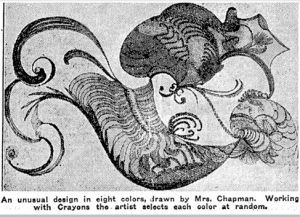
Visual diffusion and spiritualist practice: a research project on three spiritualists in Aotearoa New Zealand. Minnie Chapman (1856-1949) Sophia Garland Allan (1867-1959) Berta Sinclair Burns (1893-1972)
Joanna Osborne
Image credit: New Zealand Truth, 8 May 1930
With an emphasis on the joys and pitfalls of primary research, Osborne shares some of her findings on the practice of ‘spirit drawing’ in early 20th Century Aotearoa New Zealand. Within a broader scope of new religious movements, histories of feminism and the arts, emerge questions that consider the international diffusion, material expression and interpretive complexities of this art as spiritual practice.
Joanna Osborne is an independent researcher in art history with interests in studies of religion and spirituality. She has a PhD from the University of Otago, was the Dunedin Public Art Gallery 2020 Creative New Zealand Toi Aotearoa Curatorial Intern and has published on the work of Allie Eagle (1949-2022) and Joanna Margaret Paul (1945-2003). She currently works as an academic literacies tutor and quality assurance specialist for an international student support company.
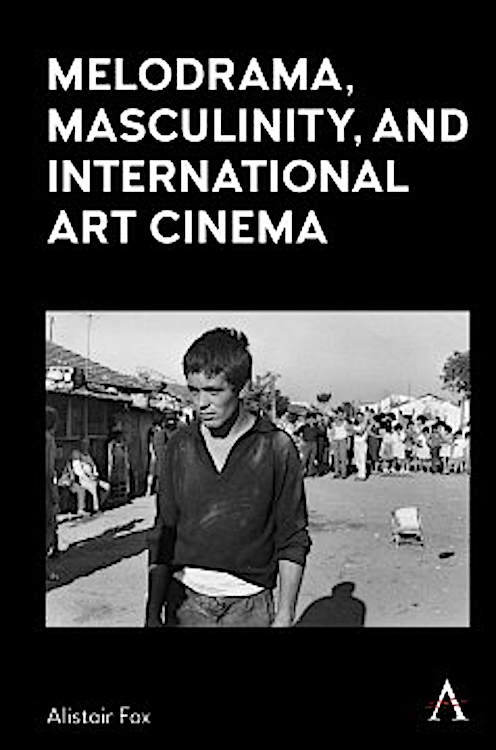
Fox, Alistair. Melodrama, Masculinity and International Art Cinema. London/New York: Anthem Press, 2022. [236 pages]
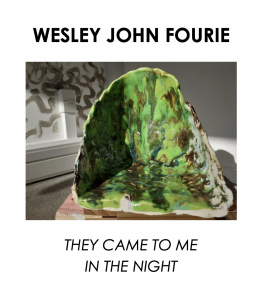
Fox, Alistair. “‘They Came to Me in the Night’: A Midnight Sanctuary by the Torchlight of Memory.” In Wesley John Fourie: They Came to Me in the Night, edited by Alistair Fox and Hilary Radner, NP. Published on the occasion of the exhibition “Wesley John Fourie: They Came to Me in the Night,” 27 August–24 September 2022, RDS Gallery, Dunedin.
Freschi, Federico. “Not Just Another Travelogue: Silence, Nostalgia and Pathos in Rachel Hope Allan’s Photographs of Japan.” In Rachel Hope Allan: Not Just Another Shinjuku Love Hotel, edited by Alistair Fox and Hilary Radner, pp. 5–10. Published on the occasion of the exhibition “Not just Another Shinjuku Love Hotel,” 13 May-18 June 2022, RDS Gallery, Dunedin.
Freschi, Federico. “Between Palimpsest and Pentimento: Abstraction and Painterly Process in Michael Greaves’s ‘The Promise and the Fall.’” In The Promise and the Fall, edited by Michael Greaves, pp. 5–7. Published on the occasion of the exhibition The Promise and the Fall, May 2022, Olga Gallery. Dunedin: Otago Polytechnic, 2022.
Hanfling, Edward. Review of Robert P. West, “Exact Air.” Art New Zealand 186 (Winter 2023): 55.
Hanfling, Edward. Review of Kirsten Carlin, “Yellow Ground.” Art New Zealand 184 (Summer 2022): 58.
Hanfling, Edward. Review of Deborah Rundle, “Tomorrow Is Today Now.” Art New Zealand 183 (Spring 2022): 65.
Hanfling, Edward. “Behind the Fortress Walls: A Conversation with Grahame Sydney.” Art New Zealand 182 (Winter 2022): 52–61.
Hanfling, Edward. Review of Felix Harris, “Magical Thinking.” Art New Zealand 182 (Winter 2022): 51.
Lonie, Bridie. “Felix Harris.” In Felix Harris: Silence in Paradise, edited by Alistair Fox and Hilary Radner, NP. Published on the occasion of the exhibition “Felix Harris: Silence in Paradise,” June 2023, Olga Gallery, Dunedin.
Lonie, Bridie. “Ecological Thought in the Paintings of James Robinson, Jenna Packer and Ayesha Green.” In The Dialogics of Contemporary Art Painting Politics, edited by Simon Ingram, Gregory Minissale, Caroline Vercoe, Victoria Wynne-Jones, pp. 205-217. Bielefeld/Berlin: Kerber Art, 2022.
Lonie, Bridie. “‘Mind Wandering’: the Art of Wesley John Fourie.” In Wesley John Fourie: They Came to Me in the Night, edited by Alistair Fox and Hilary Radner, NP. Published on the occasion of the exhibition “Wesley John Fourie: They Came to Me in the Night,” 27 August–24 September 2022, RDS Gallery, Dunedin.
McLean, Thomas. “Beyond the Frame,” North & South, June 2023, pp. 50–55.
McClean, Thomas. “Engraving and More: The Curious Career of Rona Dyer (1923-2021).” Art New Zealand 185 (Autumn 2023): 84-88.
McLean, Thomas. “Gorse! What is it good for?” North & South, February 2023, pp. 67–69.
McLean, Thomas. “Gorse Is People.” In The Making and Remaking of Australasia: Mobility, Texts and ‘Southern Circulations, edited by Tony Ballantyne, pp. 183-196. New York/London: Bloomsbury, 2022.
McLean, Thomas. “Beyond Steampunk,” North & South, November 2022, pp. 80–1.
Novero, Cecilia. “Striking (Up) Multispecies Friendships: Creative Collaborations with Crows and Hawks.” Società Italiana Antropologia Applicata, Verona, Italy, 14-17 December 2022. Refereed Conference Presentation; Libro del Convegno, pp. 84-87.
Novero, Cecilia. “Messmates at the Table: From Companion Pieces to Companion Species.” In Kate Fitzharris: Companion Piece, edited by Alistair Fox and Hilary Radner, NP. Published on the occasion of the exhibition Companion Piece, October 2022, RDS Gallery, Dunedin.
Novero, Cecilia. “Avant-Garde Cli-Fi Avant-la-Lettre: Döbin’s Mountains Seas and Giants (1924).”Centro Studi Arti della Modernità, Turin, Italy, 14-18 May 2022. Refereed Conference Presentation.
Osborne, Joanna. Reviews of “Te Whanaketanga / Something is Happening Here,” Robin White; “Len Castle”; “Ka Kore Kua Kore,” Aidan Taira Geraghty (Kāi Tahu, Ngāi Tūāhuriri) & Moewai Marsh (Kāi Tahu, Kāti Huirapa, Ngāti Kahungunu ki te Wairoa), ODT, 15 June 2023.
Osborne, Joanna. Reviews of “Nirun,” Sorawit Songsataya; “The Wandering Womb,” Pleun Gremmen (Netherlands) and Menahem Wrona (Brazil); “For the Love of Birds: The artistic depiction and classification of New Zealand birds,” Dunedin Public Libraries, ODT, 25 May 2023.
Osborne, Joanna. “Sandra Bushby and Natalie Guy in Conversation with Margaret Johanna Paul,” NP. Published on the occasion of the exhibition “Blue Fleur,” Olga Gallery, May 2023, Dunedin.
Osborne, Joanna. Reviews of “Noise Collector,” Sujii Park; “Kā Kaihōpara,” Peter Robinson; “Tintypes,” Bridget Reweti, ODT, 27 April 2023.
Osborne, Joanna. Reviews of “Te Mai Peita,” and “Kare ā-Roto,” Angus Tahere Hayes, both at Tini Whetū Project Space; “Irreplaceable,” Kirstin O’Sullivan Pere; “Leaf,” Jae Hoon Lee, ODT, 30 March 2023.
Osborne, Joanna. “Allie Eagle (1949-2022).” Art New Zealand 183 (Spring 2022): 55-57.
Radner, Hilary. “The Cat’s Tale: Two Paintings by Felix Harris.” In Felix Harris: Silence in Paradise, edited by Alistair Fox and Hilary Radner. Published on the occasion of the exhibition “Felix Harris: Silence in Paradise,” June 2023, Olga Gallery, Dunedin.
Radner, Hilary.“The Greening of Aotearoa: Art and the Death of the Earth.” In Wesley John Fourie and Ngā Roma Poa: Green-screened, edited by Alistair Fox and Hilary Radner, NP. Published on the occasion of the exhibition Green-screened, February 2022, Wave Project Space, Dunedin.
Radner, Hilary, “Kate Fitzharris: Companion Piece.” In Kate Fitzharris: Companion Piece, edited by Alistair Fox and Hilary Radner, NP. Published on the occasion of the exhibition Companion Piece, October 2022, RDS Gallery, Dunedin.
Radner, Hilary.“I don’t want your golden apple.” In I don’t want your golden apple, edited by Anita De Soto, NP. Published on the occasion of the exhibition I don’t want your golden apple, August 2022, De Novo Gallery, Dunedin. Dunedin: Otago Polytechnic, 2022. doi.org/10.34074/cata.220826
Radner, Hilary and Michael Greaves. “In Conversation with Michael Greaves, February 2022.” In The Promise and the Fall, edited by Michael Greaves, pp. 11-13. Published on the occasion of the exhibition “The Promise and the Fall,” May 2022, Olga Gallery. Dunedin: Otago Polytechnic, 2022. doi.org/10.34074/cata.220512
Raghav, Radhika. “Seeing is Believing: A Study of the Hindu Diaspora’s Visual Culture in North America.” In “The Politics of Representation in South Asian Visual Culture: Historical and Contemporary Perspectives,” panel organised by Radhika Raghav. Popular Culture Conference, the Society for Cultural Studies, Kulturwissenschaftliche Gesellschaft (KWG), Saarland University, 27–30 September 2023. Refereed conference presentation and panel. [Presenter and panel organiser; panel and paper accepted.]
Special Issue of the Journal of New Zealand Studies
Art and Aotearoa | New Zealand: Cultures, Controversies and Histories
Edited by Edward Hanfling, Hilary Radner, and Mark Stocker
This proposed special issue is an expression of our desire to provide a forum for scholars focusing on New Zealand art history, while highlighting the importance of their research to our understanding of history and culture more generally.
Culture, and the ideas and attitudes that it generates and supports, form a complex ecosystem in which the arts play a critical role. Our topic “Art and Aotearoa | New Zealand: Cultures, Controversies and Histories” acknowledges these complexities, asking prospective authors to focus on moments of difficulty and disagreement in order to tease out the stakes in the ever-evolving conversations about art over time––as well as the impact of these conversations on the directions that artists have, or have not, taken.
We invite submissions from scholars engaged in research on New Zealand art, including the wide range of forms and media often marginalised within existing histories. The final output will be a scholarly article on New Zealand art history of 5,000–8,000 words. In the first instance, we ask that interested authors submit an abstract on their proposed topic of 200–300 words for review by the editorial board (blind) with regard to the scope and coherence of the proposed issue. Abstracts are due 14 July, Friday 5pm at visual-studies@otago.ac.nz. [See further details below.]
Abstracts will be accepted provisionally, being subject to a further double-blind review per JNZS practices by two referees once the full article is completed. The completed article (5,000–8,000 words) is due 15 December 2023. Notifications will be sent to authors by 11 August 2023 (abstract), by 28 February 2024 (article). Publication is scheduled for December 2024.
Guidelines for Abstract Submission: Two Pages
Page #1–information page: the title of the proposed article, name of the author, institutional affiliation, position (as appropriate), and contact information at the top of the page, left justified.
Page #2–abstract (200–300 words, excluding title and bibliographic information): the title of the proposed article, a description of the proposed topic, and a sentence or two indicating how the topic will intersect with the special issue’s stated focus.
Format: An attached two-page Word document (200–300 words, excluding bibliographic information, title, contact information, etc.) sent via email, double-spaced, in Times New Roman or similar font.
Submission: via email to visual-studies@otago.ac.nz by 14 July 2023.
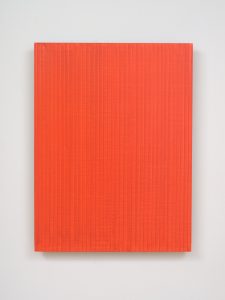
“Digit Painting – brown/purple over pink, 2022, by Noel Ivanoff”
Ed Hanfling, Dunedin School of Art
Noel Ivanoff, Digit Painting – brown/purple over pink, 2022, oil on plywood panel, 740 x 560 mm
This talk is an attempt to come to terms with one abstract painting by Auckland artist Noel Ivanoff, attending to the “touch” of the painter and (perhaps) having recourse to the seemingly unremarkable (but possibly contentious) notion of the artist’s personal sensibility, and (with some trepidation) placing Ivanoff’s work in relation to an unfurling tradition of abstract painting in New Zealand by male artists, notably Milan Mrkusich and Ian Scott.
Ed Hanfling is an art historian, critic and occasional curator, and a lecturer in art history and theory at the Dunedin School of Art. His research focuses on issues of judgement and value, modernist abstraction and twentieth-century art in Aotearoa New Zealand. He is a co-author of 250 Years of New Zealand Painting (Bateman 2021), and has published books and/or articles on a succession of male abstract artists – Milan Mrkusich, Ian Scott, Morris Louis, Mervyn Williams, Roy Good, et al.
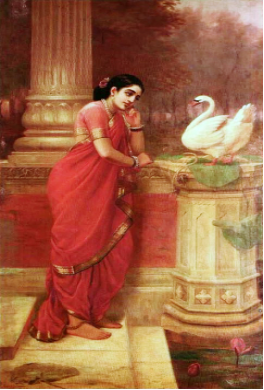
Painted Visions of Propriety: Raja Ravi Varma and the Feminine Ideal in Indian Visual Culture
Radhika Raghav, University of Otago
Raja Ravi Varma (1848–1906) Damayanti and the Swan, (c.1880s), oil on canvas.
In nineteenth-century India, against the backdrop of colonial industrialisation and rising Hindu nationalism, a new set of images was finding its way into the visual realm—lithographic prints by artist Raja Ravi Varma (1848–1906). The colourful prints were reproductions of Varma’s hugely popular academic-style oil paintings of the Vedic heroines depicted as virtuous consorts of the mythical Hindu ancestors. Thereafter, Varma’s female models were sustained across industrial arts, including cinema, and shaped the visual prototype of ideal (Hindu) femininity. This seminar frames the iconographical development and commercial distribution of the canonical heroines painted by Varma vis-à-vis the question of a woman’s beauty and duty in modern India. Furthermore, it sheds light on how Varma’s female model continues to enjoy supremacy over other modes of womanhood in the visual culture of twenty-first century India.
Radhika Raghav currently teaches in the School of Social Sciences and Humanities at the University of Otago, Dunedin. She holds a PhD in Visual Studies and a master’s degree in Art History. Her research interests revolve around the representations of gender and sexuality in South Asian popular culture and media.
Dunedin School of Art and University of Otago (Languages and Cultures)
Call for Articles and Creative Work to be published in a special volume on Surrealism with an emphasis on its activities and reception in German-speaking countries.
This volume on Surrealism is part of the book series Otago German Studies, edited by August Obermayer, Cecilia Novero and Peter Barton, University of Otago, Dunedin — New Zealand.
On the Series:
This book series was conceived and founded in 1980 by Dr August Obermayer who has also been editing it until the present day. Prof E. W. Herd joined in 1981 as co-editor and carried out this function until his death in 1997. The series has so far published 30 volumes. Dr Cecilia Novero became co-editor, in 2015. Dr Peter Barton joined the team, in 2017.
On the Editorial Board are Prof. Christian Grawe, Dr Norbert Griesmayer, Prof. Bernhard Greiner, Prof. Tim Mehigan, Prof. David Wellbery and Prof. Hansgerd Delbrück
CALL:
Otago German Studies is seeking contributions for a peer-reviewed volume to be published in February 2024 for the centennial of Surrealism. The volume is devoted to the notion of the OUTMODED in Surrealism.
When we speak of the “outmoded,” we intend it as art historian and critic Hal Foster once put it, namely as “the uncanny return of past states” such as the “repressed historical as well as psychic materials,” which Surrealism recovers and puts to “anarchic” use. As noted by Foster, following Walter Benjamin, “these recoveries are intended as a disruptive return but sometimes they intimate a transformative working-through too.” (Compulsive Beauty 157) Hence, in tackling the “outmoded” we are interested in its potential “revolutionary and collective charge” rather than the “parodic” or affirmative qualities the “outmoded” could also conceal.
On the one hand, our volume would like to return to the question of whether the Surrealists’ “outmoded” successfully functioned as a means to imagine alternative “modes of life” in their time, by playing “upon the tension between cultural objects and socio-economic forces, between mode as fashion and mode as means of production” (Ibid.).
On the other, and most important, the volume would also like to put this very question to Surrealism’s own practices of resistance and refusal (Surrealist Sabotage), including the “outmoded,” from our contemporary perspective. In other words, we would welcome scholarly as well as creative interpretations of how what appears outmoded in Surrealism itself from today’s perspective, in fact, irrupts with new momentum into our “rationalized” lives, and –as the “outmoded” for the Surrealists– might now have the power to disrupt our every day in uncanny ways. Foster argues that „artisanal relics“, „old images within bourgeois culture“, „outdated fashions“ and „outdated spaces“ are citations from capitalism that subtly attack „the socioeconomic complacency of its present moment“. If this is so, where might we today find collective forms of the ‚outmoded‘ such that they bear the power of the utopian and the nonsynchronous, without being redemptive or nostalgic?
We welcome essays or other creative work (photographic essays, poems, short stories, etc.) that deal with the “outmoded” both as a concept and an engagement with or an experience of space, objects, texts, myths, and images beyond the original surrealist use of the term are welcome. Please make explicit reference to the emergence and adoption of the “outmoded” within the Surrealist movement. In addition, we are particularly interested in contributions that may consider the “outmoded” and/or any of its interpretations in work by Surrealism-inspired authors/artists in the German-speaking world, whether active today or in the past.
Please submit your 300-500 word abstracts with 5 keywords by February 15, 2023 to:
Otago German Studies, attention of the Editors: cecilia.novero@otago.ac.nz; peter.barton@otago.ac.nz
Final contributions (5000-6500 words more or less, including works cited and footnotes) for peer-reviewing are due June 30th, 2023. Final versions following the peer review are due no later than November 1, 2023. The volume is scheduled to appear online in 2024. Online, peer-reviewed, open-access publication.
Approaching Extinction: Anthropological and Environmental Encounters in Literature and Cinema
Sydney University and Online, 12–14 July, 2023
Deadline for submission: 15 March, 2023
The Sydney Literature and Cinema Network welcomes proposals for single papers, audio-visual essays and pre-constituted three-person panels on the topic of ‘Anthropological and Environmental Approaches to Literature and Cinema’.
In the wake of the global environmental crisis, we welcome contributions that address the capacity of art to illuminate, challenge, and inspire researchers and practitioners to address the existential threat of our climate emergency.
We invite responses to this theme across the broad spectrum of aesthetics, politics, philosophy, and practice-based research.
The Sydney Literature and Cinema Network was created in 2015 and has convened four successful international conferences and several symposia. It brings together researchers from Australia, the US, the UK and across the globe to examine the interconnections between mediums, technologies, expressive modalities and representational forms.
The Sydney Literature and Cinema Network is seeking a variety of applications to present on the themes of the conference that may include:
Eco-politics
Eco-philosophy
Eco-aesthetics
Eco-fiction
Post-humanism
The Anthropocene
Technological Futures
AI and the Environment
Cultural Anthropology
Environment and Culture
The Sovereignty of Environmental Communities
Guide for Authors:
We welcome 20-minute papers, video lectures and essays, pre-organised panels (can be longer than twenty minutes), forums and other presentations on these themes and more.
Please submit a 300-word abstract and a short biography by Wednesday March 15th 2023(AEDT) to camerastylo5conference@gmail.com
Panels should include a short abstract addressing a common theme in addition to individual abstracts
Presenters at CS5 will be invited to submit papers for the inaugural special issue of the international journal Camera-Stylo: Intersections in Literature and Cinema.
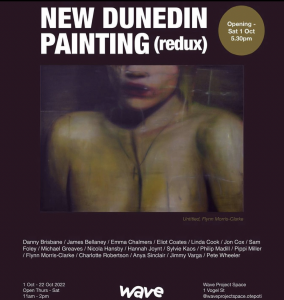
Exhibition New Dunedin Painting (redux) is co-curated by Cultures, Histories and Identities Research Network member Michael Greaves. Its catalogue features writings from Ed Hanfling and Leoni Schmidt.
For more information click on the following links:
This new issue of the Occasional Essay Series, Kate Fitzharris: Companion Piece, includes essays by Visual Studies Research Network members Cecilia Novero and Hilary Radner.
Alistair Fox and Hilary Radner, eds, Kate Fitzharris: Companion Piece (Dunedin: RDS Gallery, 2022). ISBN 978-1-99-117302-7 (softcover); ISBN 978-1-99-117303-4 (PDF) with essays by Cecilia Novero and Hilary Radner
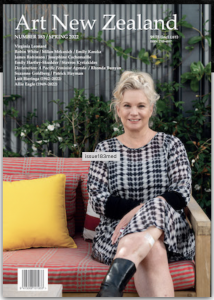
The current issue of ART NEW ZEALAND includes the following articles by our Research Network members, Joanna Osborne and Ed Hanfling. Congratulations to both!
Joanna Osborne, ”Allie Eagle (1949-2022),” Art New Zealand 183 (Spring 2022): 55–57.
Edward Hanfling, review of ”Deborah Rundle: ’Tomorrow is Today Now,’” Art New Zealand 183 (Spring 2022): 65.
RE-EVALUATING THE CONTEMPORARY MĀORI ART OF THE 1990S
Ed Hanfling, Dunedin School of Art
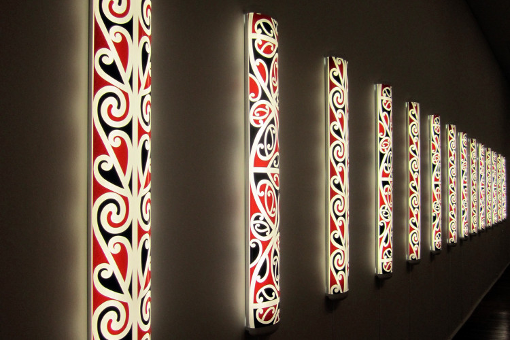
Michael Parekowhai (Ngā Ariki Kaiputahi, Ngāti Whakarongo), The Bosom of Abraham, 1999 Screen printed vinyl on fluorescent light housings
Collection of the Dunedin Public Art Gallery
In 2001, Manuka Henare wrote: “Māori art is vitalistic in its expression of religion and philosophy, particularly where it is the intention of the artist to enhance vital potential. The art is said to be alive.” It is unlikely that he had in mind the work of the “Young Guns” – the artists who became identified with Contemporary Māori Art in the preceding decade, the 1990s. Shane Cotton, Jacqueline Fraser, Michael Parekowhai, Lisa Reihana and Peter Robinson enjoyed critical acclaim for work that was irreverent and referential, but also provoked debate about the extent to which their art could be seen as “Māori art” or consistent with the “vitalistic” basis of Te Ao Māori. This seminar considers the metaphysical dimensions of 1990s Contemporary Māori Art, activated through recontextualisation and reappraisal (as in the recent Auckland Art Gallery Toi o Tāmaki exhibition Toi Tū Toi Ora), while suggesting that there is value in holding on to the humour and calculated impropriety that initially gave the work its vitality.
Ed Hanfling is a prolific Pākehā critic, art historian, and curator who teaches at the DSA. His research focuses on judgement and value, modernist abstract art, and 20th-century art in Aotearoa New Zealand. Among his books are 250 Years of New Zealand Painting (co-authored, Bateman 2021) and texts on Milan Mrkusich and Ian Scott.