
Otago biochemists secure HRC project grants to research treatments for stomach cancer and heart disease
Two teams led by researchers in the Department of Biochemistry at the University of Otago have secured three-year Health Research Council of New Zealand project grants to support their ongoing investigations into exciting new treatment ideas for two very different, and very serious diseases – hereditary diffuse gastric cancer and heart disease.
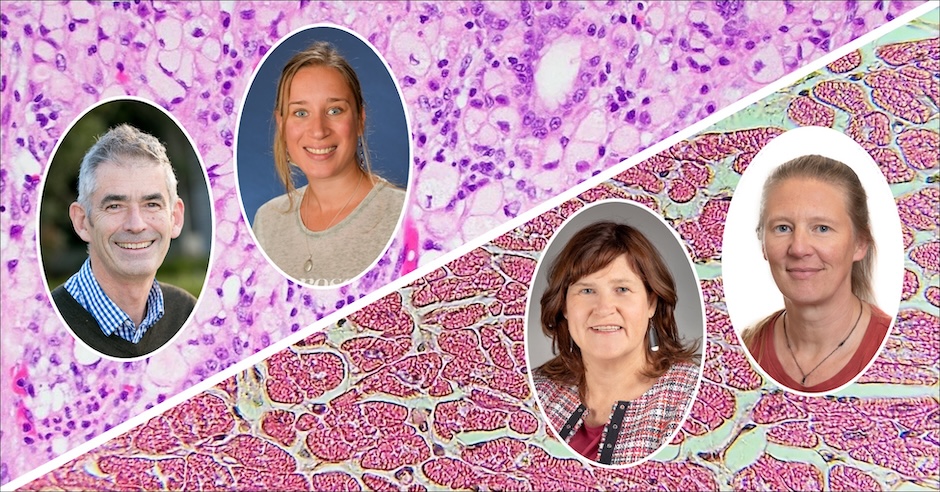
Professor Parry Guilford’s team is developing a drug treatment for people with hereditary diffuse gastric cancer, while Professor Sally McCormick’s team is looking to repurpose antidepressant drugs to lower a form of blood cholesterol that increases the risk of heart attacks.
Both multidisciplinary teams include early career researchers from the Department who will play central roles in the funded projects: Dr Lyvianne Decourtye-Espiard and Dr Katie Peppercorn.
Direct-to-stomach delivery of drugs for the chemoprevention of inherited stomach cancer – Guilford research group
People with hereditary diffuse gastric cancer have a high risk of dying at an early age from stomach cancer. Currently, the recommended preventive measure is surgical removal of the stomach—a life-saving but drastic procedure that significantly affects daily life. Professor Parry Guilford leads a team developing a drug-based alternative to surgery.
The team have found that a group of molecules called AKT inhibitors are effective at stopping the early stages of inherited gastric cancer in preclinical models.
A major concern about a drug treatment for this disease, however, is the potential for side effects. People carrying the mutation for hereditary diffuse gastric cancer are unlikely to take preventative medication for many years if it makes them feel unwell.
To minimise this risk, Professor Allan Gamble and Dr Jess Fairhall from the University of Otago’s School of Pharmacy have developed an oral drug delivery system in which a drug is attached to a polymer molecule by a linker that can be dissoved by acid. This polymer will attach to the stomach lining, allowing the stomach acid to gradually dissolve the linker, releasing the drug exactly where it is needed, and no-where else, over a few hours.
Parry explains the next steps: “In this new HRC funding, we are putting these two workstreams together to generate a range of AKT inhibitors that are coupled to the stomach delivery polymer. Once the chemistry is complete, we will test each construct in our pre-clinical models, with the best drug formulation proceeding to a clinical trial.”
The ultimate goal is to deliver effective, cancer-preventing drugs directly to the stomach of people with hereditary diffuse gastric cancer, avoiding the side effects experienced with normal oral or intravenous drug delivery routes.
Dr Lyvianne Decourtye-Espiard, a research fellow on the project, will test the candidate drugs in preclinical models and assess tumour burden following treatment. She highlights the benefits for scientific workforce development that come with a significant funding grant like this one: “Receiving this HRC grant is a major step forward in my career, as it enables me to advance my ongoing research on the AKT inhibitor, generate robust preclinical data, and foster collaborations both within New Zealand and internationally. It also provides valuable opportunities to support and mentor early-career researchers and strengthens my competitiveness for future funding and research leadership roles.”
Learn more about Parry’s research on his profile page.
Uncovering the connection between serotonin and Lp(a) metabolism – McCormick research group
Professor Sally McCormick’s team is focused on a different health challenge – blood cholesterol and heart disease. Around twenty percent of people have high levels of a form of blood cholesterol called “Lp(a)”, which increases their risk of heart attacks.
Although drugs currently in clinical trials can lower Lp(a) levels, they are expected to be prohibitively expensive. Sally’s team is looking for cheaper alternatives and have found an unexpected group of candidates– already used as drugs in an area of health that you might think was unrelated – antidepressants.
The team recently discovered a pathway that the body uses to clear Lp(a) in liver cells, which is regulated by serotonin-enhancing antidepressant drugs. Yes, medications used to treat depression and other mental health conditions such as anxiety disorders.
Repurposing approved drugs for new uses is often more cost-effective, as their safety profiles are already well established. The drugs still need to be proven to work in the second health problem, but this cuts down on the number of expensive trials that need to be carried out.
Sally explains the origin of the project: “The project came from a serendipitous finding during the course of a previous Marsden grant in which former postdoctoral fellow Dr Gregory Redpath found that an old antidepressant – imipramine, which was being used as an inhibitor of macropinocytosis at the time, promoted liver cells to take up Lp(a). Then followed a series of experiments looking at other antidepressants, all of which did the same thing, to varying degrees. As there are connections between antidepressants and lipoprotein levels in the literature, we thought we should follow this lead. We know want to find out exactly what pathway(s) these compounds are invoking to promote Lp(a) endocytosis and whether we can translate the research to the clinic.”
It is still early days for this research – the recently awarded HRC grant will allow the team to figure out the molecular details of how serotonin controls Lp(a) clearance in cell and animal models. They ultimately aim to establish whether serotonin-enhancing antidepressants can be repurposed to lower Lp(a) and reduce heart disease risk. This approach has the potential to reduce medication costs and also help problems with adherence to multiple drugs for people suffering from these often co-existing health problems.
Dr Katie Peppercorn, a postdoctoral fellow also in the Department of Biochemistry, will play a key role in the laboratory: “I’m super excited for the opportunity to work with Sally and her laboratory over the next three years, contributing to research that supports people affected by heart disease. I really value our friendly, hard-working team and its supportive, collaborative culture — and the birthday morning teas! This will be my first postdoctoral position, and I’m looking forward to honing my critical thinking, paper and grant writing skills, and further developing my experimental capabilities.”
Sally’s research team for this project also includes experts from across New Zealand and Australia with expertise in cell biology and imaging, bioinformatics, metabolism, pharmacogenetics, and clinical cardiology and psychiatry: Dr Gregory Redpath (University of New South Wales), Professor Peter Shepherd (University of Auckland), Dr Megan Leask (Department of Pathology, University of Otago), Dr Claire Wang (University of Auckland), Professor Michael Williams (Department of Medicine, University of Otago), Professor Paul Glue (Department of Psychological Medicine, University of Otago).
Learn more about Sally’s research on her profile page.
