

Is Keytruda for advanced melanoma cost-effective? Applying the BODE3 rapid cost effectiveness calculator

Tuesday, December 15th, 2015 | Kate Sloane | 1 Comment

Professor Tony Blakely

Keytruda, or pembrolizumab, is a new immune inhibitor drug that appears to have pronounced effectiveness in slowing – even reversing – disease progression in patients with advanced melanoma. It has received much media attention in recent months, and even calls from politicians to over-rule the PHARMAC process (currently PHARMAC do not recommend funding). In this blog I apply our BODE3 rapid cost-effectiveness calculator, and find that Keytruda may well be (just) cost-effective – but with huge uncertainty, and variably by age. This blog closely reflects a Radio New Zealand interview with Wallace Chapman last Sunday.

Continue reading

NZ Health Strategy Consultation Draft – are the big prevention programmes really in there?

Thursday, December 3rd, 2015 | Kate Sloane | No Comments

Prof Tony Blakely, Prof Nick Wilson

In this blog we comment for a second time this week on the consultation draft of the NZ Health Strategy, focusing this time on preventive interventions that actually would make a meaningful difference to health in Aotearoa NZ. The draft Strategy has many strong aspects, but by having a ‘people centred’ approach it gravitates to IT systems and individual-level actions, and drifts away from population-level prevention activities that would have the biggest health impact (a goal of the strategy), reduce health inequalities (another goal of the strategy) and be best value for money (yet another goal of the strategy). We recommend that the word ‘prevention’ needs to be more than a garnish sprinkled through the document, but rather an actual substantive item on the menu of offerings. We conclude by offering up some interventions for comparison, and note that the population-wide interventions not highlighted in the Strategy can have an impact on health gain and costs (savings) far in excess of those implicitly in the Strategy’s focus.

Continue reading

The Draft NZ Health Strategy: Will it enable New Zealanders to “live well, stay well and get well”?

Tuesday, December 1st, 2015 | Kate Sloane | 2 Comments

Prof Nick Wilson, Prof Richard Edwards, Prof Tony Blakely

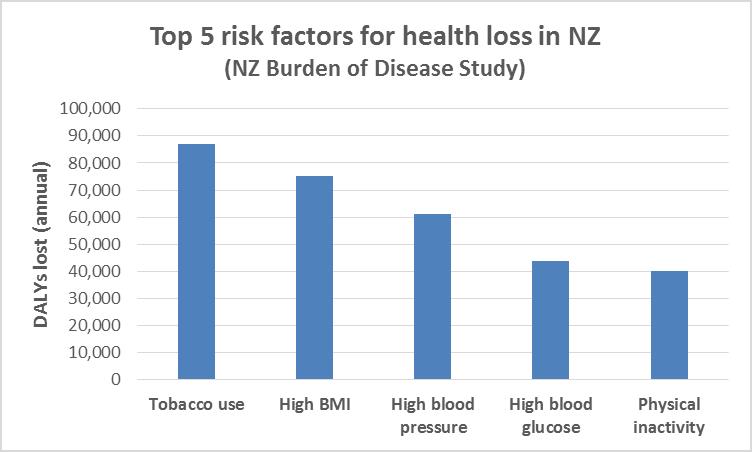
The new draft NZ Health Strategy is strong on strengthening the health care system and has some strong population health aspects, at least rhetorically. It includes phrases like a system moving “from treatment to prevention”. But how does it fare when considering the science around burden of disease and interventions to address the 10 top risk factors for health loss in NZ? Unfortunately not well at all. There are no population health goals and minimal evidence of concrete action to address the major preventable causes of poor health and premature death. In summary, there seems plenty of scope for upgrading the draft Strategy if it is going to enable New Zealanders to “live well, stay well and get well”.

NZ Health Strategy blog Continue reading

Health system costs in NZ: variation by sex, age & proximity to death

Monday, November 16th, 2015 | Kate Sloane | No Comments

Dr Giorgi Kvizhinadze, Prof Tony Blakely, Prof Nick Wilson

This blog aims to discuss a study we recently published on NZ health system cost estimates by sex, age and proximity to death. Such work is only possible due to extraordinary richness of routine NZ data. We highlight four findings. First, costs – not surprisingly – vary markedly by age, and also are highly correlated with expected morbidity by age. Second, there is much less variability by age for costs in the last year of life – indeed, the ‘costs of dying’ peak at about 60 years of age, then fall dramatically. Put another way, we spend more on middle-age people in the last year of life – which seems appropriate. Third, there is concern about ballooning health system expenditure due to population aging – but one needs to factor in that the age at which people die will increase in the future. We probed Treasury estimates of future Vote:Health funding, and suggest their models slightly over-estimate future spending by up to 4% by not explicitly allowing for increasing average age of death.

Continue reading

Red Meat & Processed Meat: Summarising the Public Health Issues

Thursday, November 5th, 2015 | Kate Sloane | 3 Comments

Dr Cristina Cleghorn, Associate Professor Nick Wilson, Professor Tony Blakely

Processed and reat meat blogThis blog was triggered by the recent highly publicised review on the cancer risk from processed meat and red meat. Here we briefly look at this topic and also take a wider perspective on other aspects of meat consumption on human health and the environment, and risk communication.

Continue reading