Research Talk by Samia Khatun
Dr. Samia Khatun, who is a guest of the Centre for Research on Colonial Culture, will give a research presentation to the Department of History and Art History on Wednesday 18th September.
The title of her talk is ‘Placing Indian Ocean Travellers: Aboriginal Language Stories about South Asian Workers in the Australian Interior, 1860-1930’.
ABSTRACT: Late on a Tuesday afternoon in c.1895, two young Aboriginal sisters were waiting at Alberrie Creek railway siding in the South Australian desert, when two Muslim men on camels rode past on their way to the nearby dam. Upon sighting the waiting girls, the men brought their beasts to a sudden halt. To the dismay of the sisters, ‘the train was running late.’ The story of what happened that evening at Alberrie Creek railway siding remains in the oral records of Arabunna people today and is a tale of two intersecting geographies rarely examined together: An Indian Ocean world peopled by itinerant peddlers and princes and arid Australian deserts criss-crossed by paths of Aboriginal mobility. With close attention to Arabunna language tales of sexualised encounter between distinct subject peoples of the British Empire, I examine the space/place politics that belie Arabunna memories of Indian Ocean travellers in Australian deserts.
Samia’s talk will take place in Burns 5, Arts Building, University of Otago starting at 3.30.
See you there!
James Cowan Symposium
A reminder that abstracts for the James Cowan Symposium (to be held in early 2014), co-hosted by the Centre for Research on Colonial Culture and the Alexander Turnbull Library, are due by 30 September. More details about the event can be accessed here: Cowan Symposium ePoster
Warm Welcome to Dr. Samia Khatun
The Centre for Research on Colonial Culture is pleased to announce that Dr Samia Khatun will be based in Dunedin from September 2013 to February 2014 as a guest of CRoCC.
Samia completed her PhD at the University of Sydney, where her research examined cultural encounters and translation in the Australian interior using both Aboriginal and South Asian language materials. She has held a postdoctoral fellowship at Zentrum Moderner Orient (ZMO), Berlin and has recently completed a residency at the Asian-American Writers Workshop, New York, USA. Samia is also an accomplished film maker.
While in Dunedin she will be completing her book manuscript Camels, Ships and Trains: Australia in an Indian Ocean Context.
Visiting Speakers
This week CROCC is co-sponsoring two visiting speakers. The first is Professor A. R. Venkatachalapathy (Madras Institute of Development Studies), who will deliver an open lecture entitled, “The Birth of the Tamil Author” today (September 2) at 5.15pm (Archway 2). Professor Venkatachalapathy is a leading expert on print culture in south India.
On Thursday 5 September we are co-sponsoring a lecture by Professor Luke Gibbons (NUI Maynooth), a leading Irish cultural critic and literary scholar. Professor Gibbons will be speaking on “Limits of the Visible: Representing the Great Irish Famine” at 5.15pm in Burns 5.
Please do come along!
Paper Work
Professor Tony Ballantyne (Otago) and Associate Professor Craig Robertson (Northeastern University), who is spending his sabbatical in the Department of History and Art History, have organised two events that explore the history and meaning of paper work.
On Thursday evening 23 May (5.30 Burns 2) the distinguished media historian Professor Lisa Gitelman (NYU) will deliver a public lecture entitled the ‘The Social Life of Paper’.
On Friday 24 May there will be a one day research symposium at the Hocken Collections on ‘Paper Work: The Materials and Practices of Modern Information Cultures’. The programme is below. Please email Tony if you would like to attend: tony.ballantyne@otago.ac.nz
Paper Work: The Materials and Practices of Modern Information Cultures
9.20am: Welcome
9.30-11.45am
Barbara Brookes, Committed by Paper: Incoherence and Accountability in the Seacliff Asylum Files
Jane McCabe, The Kalimpong Files: Private and Confidential
1.30-3.00pm
Stephen Robertson (University of Sydney), Private Detectives and the Paper Work of Surveillance in the US, 1855-1939
Craig Robertson (Northeastern University), Handling Information: File Clerks, Efficiency, and the Emergence of the Modern Office
3.15-4.45pm
Tim Rowse (University of Western Sydney), Tabulating Indigenous Populations: Colonial Knowledge in Two Dimensions
Tony Ballantyne, Paper and the Work of Empire: Bureaucracy and British Colonialism
CFP: Collectors, Collecting and Collections
Collectors/Collecting/Collections
A Call for Papers
The Centre for the Book at the University of Otago will be holding a two day symposium on Collectors/Collecting/Collections on 17 & 18 October 2013.
On the evening of 17 October in the Dunningham Room, Dunedin Public Library, Jim E. Traue, ex-Turnbull Librarian, Wellington, will give an open lecture entitled: ‘Treasured up on purpose to a life beyond life’.
The Symposium proper will begin at 10.00 on 18 October at the Auditorium, Toitū Early Settlers Museum. It will finish at 5.00 pm.
*
There is no end to collecting. There are collectors of the first editions or earliest printings of various works of literature, history, science, and philosophy; of bibles, children’s books, travel books, and almanacs; and still others ranging from limited private press productions to collectors of manuscripts and illustrated books. There are also those who collect thimbles, decorative teaspoons, cakes tins, art, motorcycles, and a whole lot more.
The methods by which collectors amass their materials are equally varied, including through catalogue, auction, gifts, and e-sites like Trademe and abebooks.com. Indeed, by accumulating such items, the question arises: what constitutes a collection? Is it a disparate mass of stuff, or something much more organised?
Institutions throughout New Zealand have been fortunate to benefit from collectors such as Alexander Turnbull, Sir George Grey, A. H. Reed, and Dr Hocken, to name but a few. Their collections are in the public domain for all to use and enjoy; we would be much poorer without their efforts. There are, however, those that are lost, such as General Robley’s moko collection, and Rex Nan Kivell’s New Zealand-related collection (now in Australia). And what of the future? Will institutions continue to receive collections from generous public-spirited collectors, or will they disperse them to the four winds, for others to enjoy?
If you would like to participate in this symposium, which we hope will be wide ranging, please send your abstracts to Dr Shef Rogers, English Department, University of Otago (shef.rogers@otago.ac.nz) or Dr Donald Kerr, Special Collection Librarian, University of Otago (Donald.kerr@otago.ac.nz) by 31 August 2013.
Registration for the full day will be $25 (waged); $10 (unwaged). Details of how to register will be notified on the Centre’s website closer to the event.
CFP: New Zealand Historical Association Conference
The biennial New Zealand Historical Association conference is being held in Dunedin from Wednesday 20 November until Friday 22 November.
Keynote Speakers are:
Constitutional Conversation
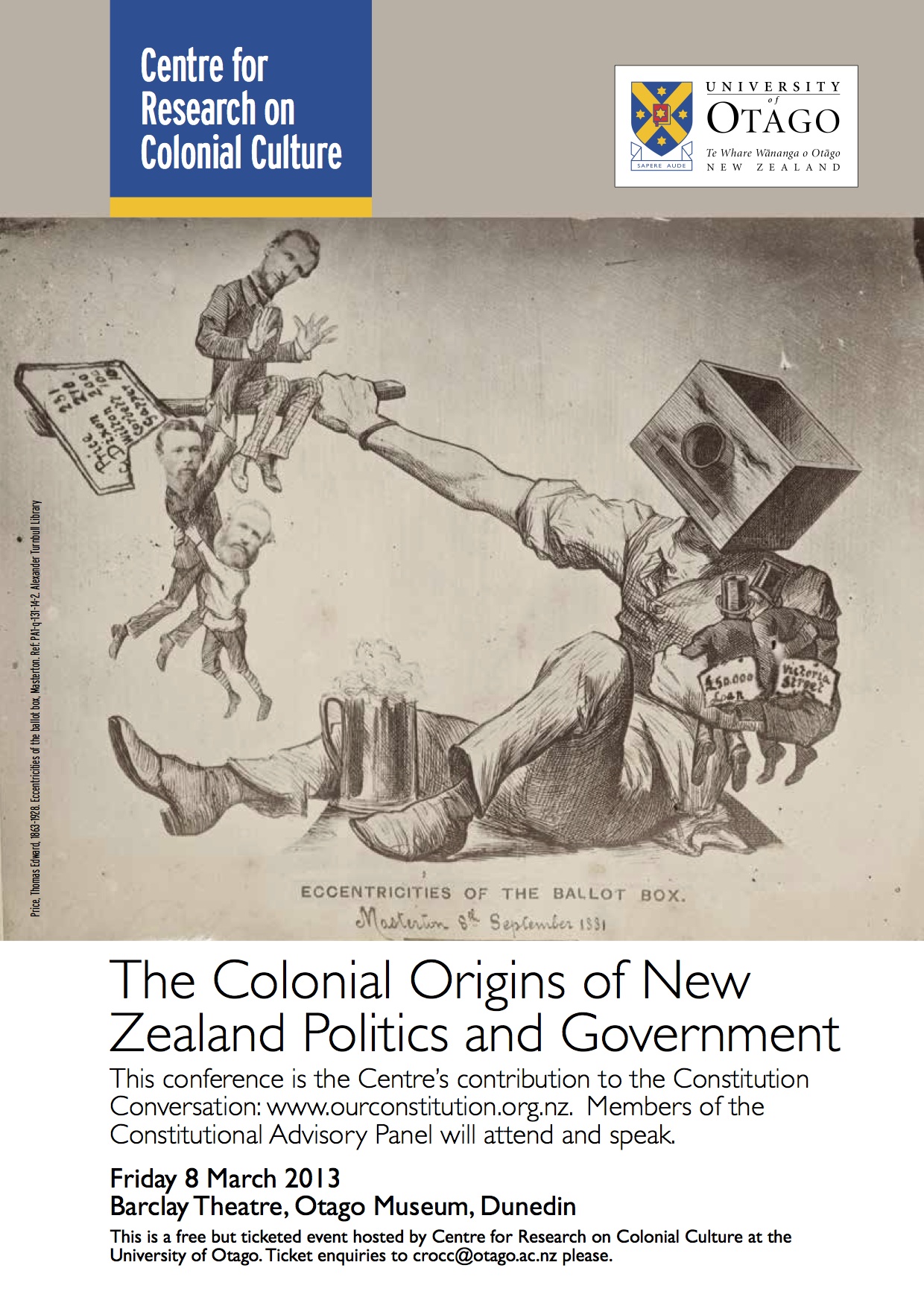 The Centre for Research on Colonial Culture is holding a one-day symposium at the Otago Museum (Barclay Theatre) on Friday 8 March. The speakers in this event will reflect on New Zealand’s political history and its constitutional development. This symposium is designed to cast new light on important historical questions but it also functions as the Centre’s contribution to the ‘Constitutional Conversation’. Members of the Constitutional Advisory Panel (CAP) will be attending and Sir Tipene O’Regan, co-chair of CAP, will participate in the final discussion session. This event is open to the public and there is no registration fee: morning and afternoon tea will be provided (but not lunch). But entrance will be by ticket only as space is restricted. If you want a ticket please email <crocc@otago.ac.nz> – there is limited space and tickets will be issued on a first come, first served basis.
Research Seminar on Transnational Indigenous Women’s Activism
On March 1st the Centre for Research on Colonial Culture will co-host a research seminar by visiting scholar Professor Margaret D. Jacobs, University of Nebraska. Her seminar is entitled: “Transnational Indigenous Women’s Activism and the Indigenous Child Welfare Crisis, 1960-1980s.’
CFP: Local Intermediaries in International Exploration
Followers of the Centre may be interested to know of this forthcoming conference at ANU. The Call for Papers is pasted below. Note the deadline for abstracts is drawing near.
Call for Papers
Local Intermediaries in International Exploration Conference
Australian National University, Canberra
17 & 18 July 2013
Keynote Speakers
Felix Driver, Professor of Human Geography, Royal Holloway, University of London
Leonard Collard, Professor of Indigenous Studies, University of Western Australia
The history of exploration has often been thought of as a heroic drama in which the explorer is the principal narrator and protagonist. This two-day conference will discuss exploration as a collective effort and experience involving a variety of people and social strata in various kinds of relationships. It will engage with the recent resurgence in interest in the history of exploration, by focusing on the various intermediaries, the guides, translators and hosts who assisted and facilitated European travellers in exploring different parts of the world in the nineteenth century.
While the myth of the solitary intrepid explorer has long been questioned, the notion of exploration still suggests the discovery of a wilderness. This conference aims to examine the extent to which the explored territory was in fact a peopled landscape, inhabited not only by indigenous peoples, but also often by the vanguards of Empire such as slavers, marines, merchants, sealers, whalers, and missionaries, as well as early settlers who hosted the explorers and travellers. Recent historiographical shifts mean that scholars now recognise that so called ‘lone travellers’ in fact depended on local support for food, shelter, protection, information, guidance, and emotional solace, as well as other resources. This conference, which has a global focus, will analyse in detail the contributions of local people as intermediary figures, as interpreters and ‘native’ assistants, thus making the hidden histories of exploration more visible. Those hidden histories include not only indigenous participants but local settler populations.
We invite papers covering the history of exploration which address the following themes:
- The role that Indigenous people played in colonized lands as guides, advisers, trackers and translators, enabling and participating in exploration
- The experience and agency of Indigenous peoples, including issues of choice versus coercion, as well as differences between, for instance, ‘professional’ guides versus occasional assistants, young and old, men and women
- The role of settlers, such as sealers, merchants and squatters in the construction of knowledge about Indigenous people and topography
- The experience and changing role of intermediaries in areas in which multiple, sequential and overlapping explorations occurred, and the implications of repeat explorations in terms of the accrual of knowledge and experience
- The interaction and interconnection between knowledge gained from intermediaries within settlements and through exploration
- Differences and similarities between maritime exploration and inland exploration, especially in the respective use and experience of intermediaries
- The role of class in constituting the myth of the solitary explorer
- Gendered analyses of exploration, for example the role of Indigenous women
- Ideas and practices of hospitality, charity, welcoming etc within settler and Indigenous societies and their influence in shaping responses to and encounters with exploration parties
- Historiographical/methodological engagements with these themes
We especially welcome submissions from post-graduate, early career, and Indigenous scholars. We will be looking to publish selected papers from this conference.
Submission deadline: 4 March 2013
Please send a 200 word abstract and brief biography to shino.konishi@anu.edu.au
Conference Organisers:
Dr Shino Konishi shino.konishi@anu.edu.au
Dr Maria Nugent maria.nugent@anu.edu.au
Dr Tiffany Shellam tiffany.shellam@deakin.edu.au
This conference relates to our Australian Research Council Discovery projects, and is hosted by the Australian Centre for Indigenous History and supported by the College for Arts and Social Sciences, ANU.
