
Biological implications for gene therapy
Providing a genetic-based treatment for inherited genetic diseases initially sounds like a great idea, but can you think of any ethical issues with these treatments?
Here are just a few of many you can consider. There are no definite answers, only you can make up your mind.
What do you treat?
Although Batten disease is clearly an undesirable disease that causes a lot of suffering, the status of other inherited conditions is not so clear.
- What do you consider to be a disease, and what a trait (ie a genetically determined characteristic or condition)? For example, is dwarfism disorder a disease that needs to be treated, or a trait that is just part of human variation?
- What about just short height?
- Should any inherited diseases be treated at all, even clearly awful ones, especially when the cost of developing a treatment is extremely high?

Genetic testing
Genetic testing identifies changes in chromosomes, genes, or proteins. The results can help determine whether a person has a suspected genetic condition or might develop a genetic condition. The results can also inform a person’s chance of passing on a genetic disorder.
Genetic testing has limitations: some tests can’t detect all of the possible mutations that can cause a condition, or the mutations that can be identified may only lead to a condition only some of the time.
- If screening for Batten disease was available, what implications would there be for potential patients and their parents?
Imagine if you find out you have a mutation, one that might give you a disease in the future, and you could pass on to your children.
- What happens when you are looking for someone to marry, or when you want to get health insurance, or when you are deciding on a career?
- Would you want to find out about that mutation if there was no treatment for the disease?
The National Institute of Health in the USA provides an overview of different genetic tests:
Genetic Testing – Medline Plus
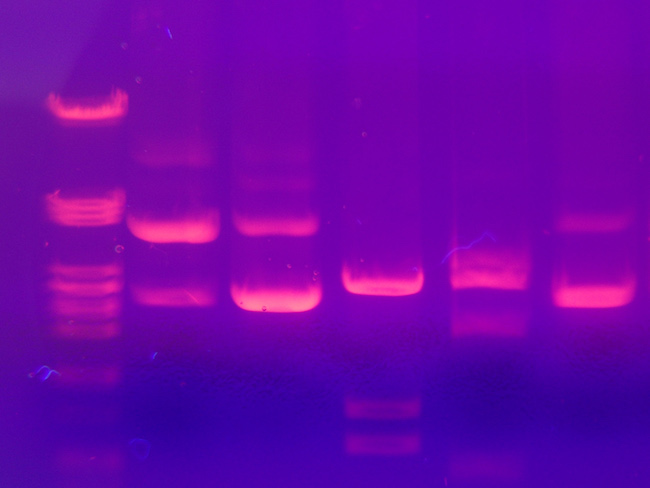
A DNA electrophoresis gel, which scientists use to separate pieces of DNA of different sizes. Some genetic tests use DNA electrophoresis to reveal gene mutations.
Germline vs somatic gene therapy
Somatic gene therapy is DNA treatment targeted at cells in a person’s body that are not passed on to the person’s children, ie somatic cells. The treatment that Dr. Hughes is developing for children with Batten disease is an example of somatic gene therapy.
Germline gene therapy is DNA treatment targeted at a person’s cells that produce reproductive cells, eggs or sperm. The treatment is then passed on to that person’s children and grandchildren.
- What would be the advantages of germline therapy?
- What problems can you think of that might make germline therapy unacceptable?
- Do you think germline therapy should be used in humans?
An editorial in the Nature journal talks about the ethics around germline editing used in human embryos. It refers to a recent example of genetic editing of human embryos where scientists used the technique to find out about how a gene works (the embryos were not allowed to develop into babies):
Take stock of research ethics in human genome editing – Nature, 2017
Taking away the choice of offspring to decide
There is now a new tool available that can very accurately edit the DNA in a cell without using viruses. It is called CRISPR-Cas9, and has been adopted from bacteria. In theory, it could be used to fix mutations in an embryo.

Issie Robertson, a teenager from Dunedin, wondered if modifying a human embryo to extend its life could be considered ethical. The sixteen-year-old even wrote an essay about these concerns that was published in the Journal of Medical Ethics.
Listen to Issie talk about her concerns on Radio New Zealand National:
Issie Robertson – Teen takes on bioethics – RNZ, 2017
You can read the abstract of her essay:
You can also watch news story about Issie:
Dunedin high school student trumps bioethicists
Watch a musical tribute/explanation/extravaganza about CRISPR-Cas9 by A Capella Science:
Social impact
- Will the high cost of gene therapy exclude people on middle and low wages, so that only the rich can access the technology?
More about the ethics of gene therapy
What are the ethical issues surrounding gene therapy? – resource from the U.S. National Library of Medicine
‘That’s $425,000 right there’ — the anxious launch of a gene therapy with a record sticker price – STAT, 2018. Luxterna is the first “true” gene therapy (in which a functional gene does the job of a defective one) to be approved for use in the USA.
Editing genomes of embryos
In Nov 2018, reports started to come in about the existence of the first genome-edited babies. A Chinese scientist claims to have edited embryos to disable the genetic pathway HIV uses to infect cells, and placed them in their mother’s womb. The pregnancy was successful, and the resulting two baby girls are apparently now at home with their parents.
The news was met with outrage from scientists and media commentators worldwide.
World’s first gene-edited babies created in China, claims scientist – The Guardian, 2018
Genome-edited baby claim provokes international outcry – Nature, 2018
‘Of course it’s not ethical’: shock at gene-edited baby claims – The Guardian, 2018
An alternative point-of-view: Gene-editing researcher: at least he gets the job done – Otago Daily Times, 2018
An update: Scientist who gene-edited babies is back in lab and ‘proud’ of past work despite jailing – The Guardian, 2024
Previous: Testing gene therapy for Batten disease in sheep
Return to the main Batten disease page
Other useful links:
