

Reflections on the International Peace Research Association (IPRA) Conference, 2025
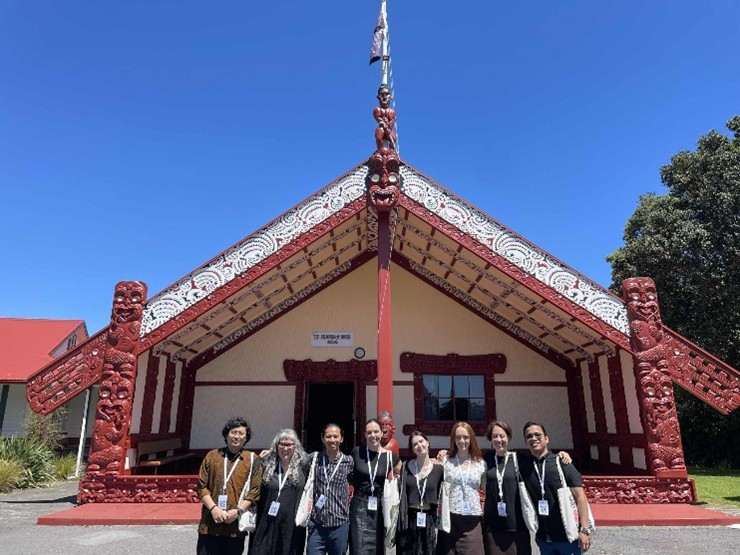 This photo was taken during the visit to the Owae Marae, which signalled the official start of the conference.
Seven students from the TAOR Masters student cohort, with Richard and Liana, journeyed to New Plymouth, Taranaki in order to attend the International Peace Research Association (IPRA) conference, from 3 – 10 November. What follows are some informal reflections about the trip by student attendees:
Kerryn Carson
First, a mihi to Liana and Richard for supporting me and the crew to attend the Conference, and Maia for her organisational support.
I also express my appreciation to the Trust who supported our attendance, I’m very grateful. The visit to Parihaka and te Whare Hononga were extra treats that really added depth to the experience that took it next level. There was a great balance of learning and having some fun with the team.
I had not attended a research focused conference before and didn’t know what to expect, so was a bit worried that our presentation would be poorly aligned! Turned out OK though 🙂
What I enjoyed about the presentations I saw were the diverse topics that were discussed, the inclusion of many different levels of presenter expertise and learning more about what’s happening on the ground, around the world, bringing international aspects of P&C into clearer focus.
I walked away with a hopeful sense that Peace and Conflict Studies is moving in a decolonial direction, and that there is an alignment between my work and the wider peace and conflict field. Looking forward to continuing my studies in 2026.
Again, my gratitude for being included – I really appreciated it.
Sophia Niblock
Firstly, I want to thank the trust for their generosity in funding our trip!
Attending the IPRA Conference in Taranaki was an incredibly enriching experience that extended beyond the formal sessions and presentations. The trip was not only an opportunity to engage with global perspectives on peacebuilding and conflict transformation but also a journey of personal reflection on what peace means in the context of our country. One of the most valuable aspects of the conference was hearing from Indigenous scholars and community leaders who grounded discussions of peace in whakapapa and collective responsibility. The way Māori concepts of peace are intertwined with language, land, and relationships offered a new way of thinking about peace as an ongoing process of restoration. It reminded me that sustainable peace requires relationships built on respect, reciprocity, and active listening.
A key insight I took away was how peace research is becoming increasingly action oriented. Many speakers shared community-based projects that directly engage with issues such as climate justice, indigenous rights, and decolonisation. This was inspiring, as it demonstrated that academic research can be rooted in practical, lived realities. It made me reflect on how I might carry this forward in my own work, ensuring that research contributes meaningfully to positive social change.
I particularly loved the steel pan talk, which showed how music can act as a tool for healing and resistance. The discussion revealed the cultural and historical significance of steel pan music in postcolonial contexts, and it reminded me of how art and creativity can bridge divides and build community. I also found the African delegate panel incredibly powerful. Their reflections on conflict and reconciliation highlighted the diversity of peace experiences across the continent and the strength of community-led responses to injustice.
Beyond the sessions, the trip was an incredible learning experience. Travelling through Taranaki and visiting significant sites such as Parihaka helped connect the theory of peace with the history of the land. Standing in places marked by both conflict and resilience deepened my understanding of how the past continues to shape our present and how acknowledging that history is essential for genuine reconciliation. Since returning, I have found myself reflecting on the concept of tino rangatiratanga and how it relates to peacebuilding in New Zealand. The conference encouraged me to think critically about what solidarity looks like, particularly in the context of supporting Māori and indigenous-led initiatives.
Overall, the IPRA Conference was an inspiring and thought-provoking experience that deepened my understanding of peace on both the global and local level. It reminded me that peace work begins with relationships between people, communities, and the environment. I am incredibly grateful to the Trust for making this experience possible! Thank you again.
Michaela Clark
In this reflection, I will look back on some of the key learnings and experiences that I have taken away from this trip. I will begin by looking into some of the cultural activities that we participated in on our travels followed by a reflection on some of the conference themes and panels, concluding with some of my key takeaways from the experience.
On one of the first days in Taranaki we participated in several cultural activities with the aims of learning about indigenous peace building practices and new ways of approaching reconciliation and peace building practices. On this day we traveled out to Parihaka and Te Whare Hononga. During this day we explored peace from a new lens with less focus on the purely academic side of peace building and more focus on the practical side of peace building. Learning about the resistance and peace work of the Māori communities in Taranaki in the past and present was essential for developing my knowledge on peace building and reconciliation practices.
The following days on the trip were spent at the conference proper, learning about the different research projects and academic works in the field of peace and resistance worldwide. One of the overarching focuses of the research in the conference was on decolonialism and including indigenous ontologies and epistemologies in academic contexts. As the conference was international there were many focuses and ideologies than I had previously been exposed to in a New Zealand context. This was beneficial as it allowed me to expand my critical thinking and consider societal issues that I had previously not thought much about.
Two of the presentations that particularly stood out to me among the various interesting panels were the plenary panel on African peace initiatives and a presentation on Steel Pan women in Trinidad and Tobago. Both of these panels gave me a lot to reflect on and were on topics that I had previously had little knowledge of. Reflecting on the conference as a whole, I learned a lot about various topics that I had previously not considered and gained lots of insight into a variety of different academic fields of research. I also feel that having both practical experiences such as the trip out to Parihaka and the more academic experiences such as the conference panels worked well together to allow me to learn more about real world resistance and peace building initiatives and academic peace building. Overall, the trip was a wonderful experience that expanded my academic horizons and taught me a lot about peace building and resistance.
Amer Hassan Salacop Sanggacala
I never imagined I’d live in Aotearoa New Zealand. Growing up as a Muslim minority in the Philippines, where stereotypes are commonplace, you learn early to keep your dreams small. When the 2017 Marawi Siege displaced my family and me, I thought that was the end of my education. For a time, I couldn’t see a future beyond survival. But I refused to stop. I promised myself that if learning survived, I would follow it wherever it led.
That promise carried me here, to a place I once only read about. Being the first Manaaki New Zealand Scholar of Meranaw descent already felt like a dream fulfilled. But this trip to the International Peace Research Association (IPRA) Conference in New Plymouth made it even more special. It added to my growing list of firsts: my first international conference, my first time meeting people whose names I’d once typed into bibliographies, and my first time feeling truly part of a global community of peace scholars.
Walking into that hall of nearly two hundred people was surreal. Some of the speakers were authors I’d cited in my own work; people whose ideas had helped shape my understanding of peace and justice. I initially came to listen, but I left wanting to share my own story: our story from Marawi and the Bangsamoro.
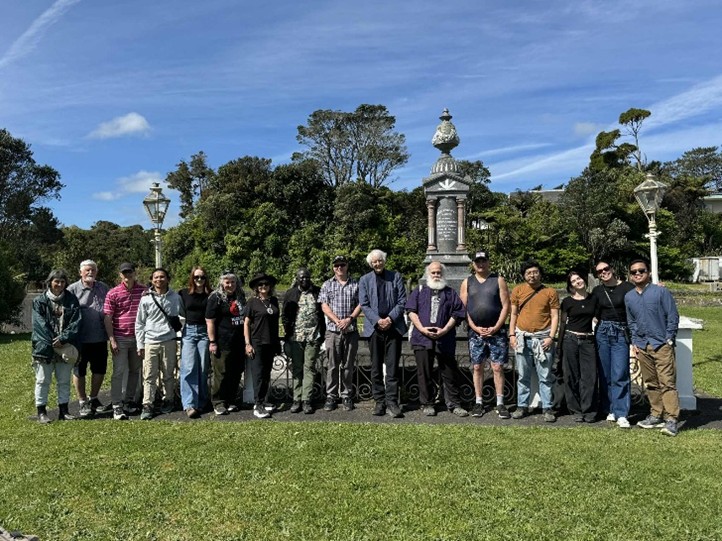 PhD student Tonga arranged a quick visit to Taranaki for the NCPACS cohort, along with distinguished guests.
It was fascinating to hear how cultures, histories, and struggles differ, and yet how deeply connected they are. From post-colonial trauma in the Pacific to racial inequality in Europe, and displacement in the Middle East, our contexts varied, but the longing for peace was the same. Listening to young scholars speak passionately about their communities gave me so much hope. Tamatoa Tepuhiarii’s research on the impact of nuclear testing on Indigenous peoples was especially powerful. We ended up brainstorming PhD topics together, and he offered to connect me with professors abroad who might be able to support my future study.
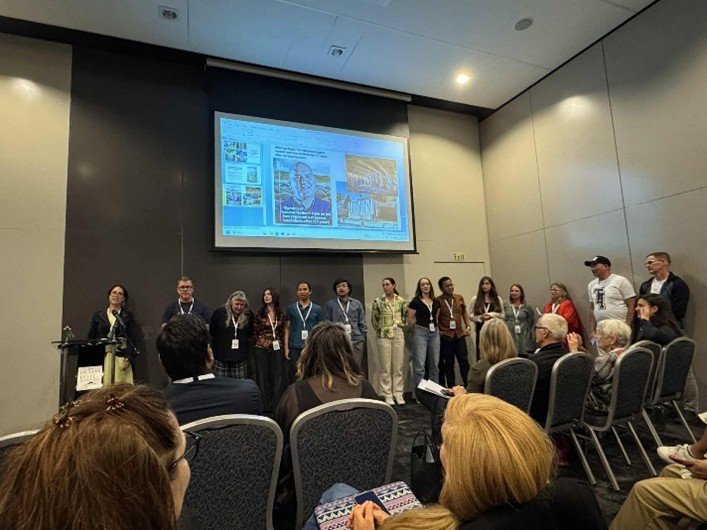 The NCPACS cohort and alumni came together to sing a waiata in honour of Liana after her presentation.
The networking opportunities were incredible, too! Prof. Garrett FitzGerald from the US mentioned forming a research team for the Bangsamoro parliamentary elections, and Dr Morgan Brigg from Australia shared a research idea that is relevant to my context. Dr Charles Wasike from Kenya warmly invited me to visit and promised to accommodate me (and even take me on a safari) if I ever find myself in Africa. I also connected with Dr Madinatu Bello from Ghana, who shared her journey as a DAAD scholar and gave me advice on future opportunities I could explore.
Moments like these reminded me that being from the Global South doesn’t mean being at the margins. It means bringing perspectives that the world needs to hear.
One of the biggest surprises came when I was elected as a Council Member of the Asia-Pacific Peace Research Association (APPRA) after connecting with its Secretary-General Rajib Timalsina. I never saw that coming. For someone who once thought his education was over, this recognition felt like life coming full circle. More than an honor, it’s an opportunity to grow and to make sure that voices like mine, and my community’s, are part of the regional conversation on peace.
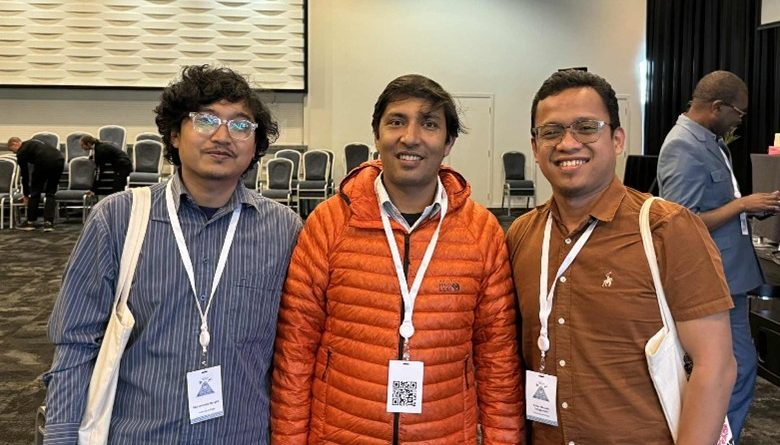 From left to right: fellow student Mohammad, newly elected IPRA Secretary-General Rajib Timalsina, and me.
Outside the conference halls, the experience was just as meaningful. Representing Otago with my classmates and professors was pure joy. We learned and sang waiata, shared what we knew about Māori history and the significance of the pōwhiri at Ōwae Marae, and discovered that 15 degrees can actually feel hot if you’re from Dunedin. Those small, funny moments made the trip even more memorable.
Being with our professors outside the classroom was another highlight. They looked out for us, laughed with us, and treated us as equals. It was heartwarming to see them not as lecturers, but as friends who deeply care about our growth. The last night, filled with singing, dancing, and celebration, felt like a perfect ending. But for me, it wasn’t an ending at all. I came home with a bigger sense of responsibility, a clearer vision, and a fuller heart.
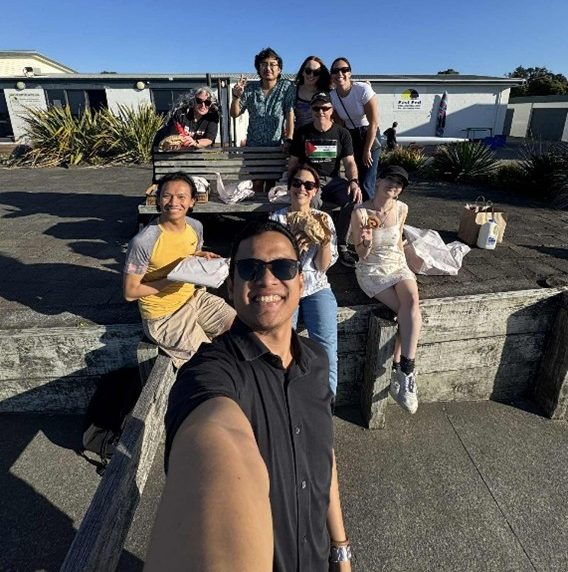 The NCPACS cohort enjoying fish and chips by the sea before the IPRA Conference began.
This conference reminded me why I do what I do. As someone from a city once torn apart by war, I know how heavy words like “recovery” and “peace” can be. But to stand in a room of people dedicating their lives to the same mission, that gave me hope.
To the Trust, thank you. You didn’t only send delegates—you changed lives. You reminded a former evacuee from Marawi that dreams are not meant to stay small. They are meant to grow, to travel, and to light the way for others.
I created a short video about our experience: https://www.instagram.com/ameridk/reel/DQy2uIbEoA-/
Brosh Amper
I thank the generosity and wisdom of Te Ao o Rongomaraeroa National Center for Peace and Conflict Studies’ Board of Trustees, who have made this trip possible. On the one hand, it felt like a school trip, with two of our supervisors and six of my classmates travelling, and a breather from the nine months of studying. On the other hand, it affirmed that academic endeavor is not just about knowledge production but must find its way to effect change in real-life situations.
This year’s International Peace Research Association (IPRA) conference featured a wide range of topics and activities around the themes of Peace, Resistance, and Reconciliation. A day after we arrived, we went to St. Mary’s Cathedral to see for ourselves the ongoing reconciliation efforts of the Anglican church with the Māori iwi. We then proceeded to Taranaki, where the tradition of non-violent resistance against the Crown was nurtured and upheld. Through a hikoi from the garden-as-place of resistance against formal learning and capitalist modes of living to the site of the prophet Te Whiti’s memorial, we learned about the contemporary Māori iwi’s efforts to live at the historic site and continually work towards the visions of their ancestors.
It was then that I learned that the choice of Aotearoa as the conference site is part of IPRA’s desire to decolonize. Decolonization has been a word thrown back and forth in the conference. While I heard sound ideas of decolonization across the conference, others, despite their well-meaning intentions, showed how whiteness and Western-centric knowledge and knowledge holders are privileged. Nonetheless, decolonization was manifested in centering community and indigenous voices throughout the conference. The conference began with a powhiri at the Te Atiawa marae and concluded with keynote addresses from Taranaki leaders. There were non-conventional conference activities such as workshops (poetry and regenerative peacework), film screening, dance performance, and a live-band presentation from Taranaki descendants. Moreover, powerful stories of resistance from academic and activist groups from the current occupied territories/nations were shared. In addition, the use of indigenous languages in paper presentations was encouraged. One of the keynotes featured indigenous ways of knowing and expressions of reconciliation. IPRA was not just a series of research presentations but was peppered with compelling stories, diverse languages, knowledge, and identities, and a range of emotions. We laughed, we cried, we remembered the past, and we hoped for the future.
I have previously learned in class that decolonization is land-based, diverse, emotional, creative, and rooted in the grassroots. It is never detached, never uniform, never objective, never rigid, never imposed. It is not a return to the past but learning traditional ways to create new futures. This conference showed how decolonization can be talked about and practiced in meaningful ways.
In an ethnographic poetry workshop, a German female delegate and I paired and reflected on Resistance. We wrote:
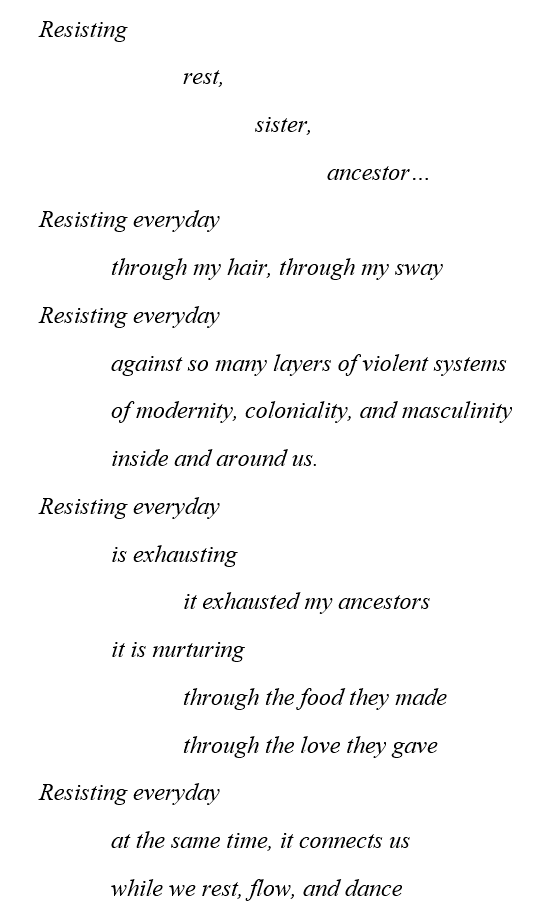
Like this combined poetry from two different perspectives (personal/societal) and nationalities (Filipino/German), decolonization is not neat, not an end. It is ongoing, dynamic, and evolving. May our personal and collective resistances return land to the care of the indigenous, bring us peace and reconciliation!
Muhammad Hasyim
What I Learned. The experience of the trip to Parihaka and Owae Marae, then to the IPRA 2025 Conference, was a learning opportunity far beyond my anticipation. It touched on history from Africa to the Pacific and a broad-based view of the fight for peace and justice across the planet. At Parihaka I was taught that even after the Crown’s 2017 apology, resolute demands for restorative justice are still urgent. Many of the lands taken after the 1881 invasion remain privately owned, which makes their return extremely difficult. While money could do for future purchases of land, it won’t replace the land itself. Their community’s drive for cultural restoration and sustainable living, notably through their food gardens, highlighted how Parihaka continues converting trauma into resilience.
The conference expanded my perspective even more, particularly in relation to the history of the Pacific as a “nuclear playground.” Pacific people are still confronting the aftermath of nuclear testing — health problems, environmental damage and political marginalization. And what hit me wasn’t just the carnage, but the resolve of communities on the Pacific who continue to pressure for demilitarization and environmental justice.
I also heard about genocide today and humanitarian catastrophe in Sudan: where many people are suffering mass displacement and violence while being ignored by the international community. Listening to these stories reinforced how global power structures influence which cases of suffering are observed and which are ignored. In Parihaka, the Pacific and Sudan, I found shared motifs of dispossession, resistance and community-driven survival. That reminded me that demands for justice are intertwined in some of the world’s most-widespread places, and times.
New Insights Gained. What I have learned from that is that nonviolent peace is not passive, it is a disciplined, deliberate and powerful form of resistance. Parihaka’s history made clear that in order to nonviolently commit, clarity, unity, and deep moral courage are keys. This transformed peace for me from an abstract ideal into an active process.
A second lesson was that reacting to harm by inflicting further harm only deepens cycles of violence. Whether in Aotearoa, the Pacific or Sudan, communities emphasized that true justice does not come from retaliation. Meaningful justice seeks accountability while still preserving humanity and protecting future generations. It helped me view peacebuilding as a process that changes by addressing root causes rather than just symptoms.
A third insight emphasized the importance of breaking silence. In the stories we saw, silence — enforced or desired — informed narratives of harm. In Sudan, global silence has permitted suffering to persist with little intervention. In the Pacific, silence hid decades of nuclear damage. From Parihaka, silence was reclaimed as a source of strength, reflection, and unity. These differences have taught me that silence is never neutral; knowing when to speak and when to listen is essential in seeking justice.
What I Have Reflected On Since Returning. Ever since returning from the hikoi and the IPRA 2025 Conference, I have been thinking and trying to connect the dots of experiences and the perception we have of responsibility. The stories of Parihaka, the Pacific, and Sudan still resonate with me. They remind me that learning needs to reach action. Once you face these truths, you can’t go back to being indifferent. I’ve been thinking about how I can represent the voices of the voiceless — not by speaking for them, but sharing accounts, challenging harmful narratives, and supporting justice-led movements. And I pondered, too, the influence of minor initiatives.
Although the injustices we have come to understand are huge, change often begins with small things like making amends: correcting misinformation; having hard conversations; fighting on a grassroots level; and staying informed. Parihaka’s legacy is proof that small acts of collective peace can make an impact on generations. The conference reminded that global movements usually begin when the participants in a community opt for bravery over silence.
My own life experiences overall have reinforced the importance of peace as an activity on a daily basis, and justice a lifelong journey. I have the conviction that despite my actions—big or small—they make a difference and that using my voice intentionally holds the stories that have been entrusted to us alive.
Courtney Taylor
We were lucky enough to attend IPRA’s 2025 conference in Taranaki, New Zealand. The conference took place 4 November to 8 November and included a jam-packed itinerary of presentations and roundtable events. As students, we were given the opportunity to pick and choose which speakers we wanted to attend and spent our timing bouncing across speakers.
Over the course of the conference, I thoroughly enjoyed learning about a range of topics and life experiences. I really enjoyed listening to and engaging in conversations about child brides in Thailand, African and Caribbean traditional drumming practices, the use of art in prisons, and research into the success and limitations of peace centres. These presentations provided me with valuable insights into research practices and lessons learnt. I also really enjoyed supporting current and graduated students from Otago’s very own peace centre and felt as if these presenters also appreciated our presence.
Beyond the topics themselves, I found the process of being at the conference itself very rewarding. Although I have been to conferences previously for work, I found IPRA’s conference an interesting mix of scholars who each had their own stories and lessons to share. As a result, morning tea, lunch and afternoon tea were always an exciting and fun opportunity to learn from these incredible individuals. Additionally, because most of the presenters were discussing their own research, we were able to learn more about the research process which was inspiring amidst our own dissertation endeavours.
Furthermore, I was grateful for the chance to visit Taranaki’s Anglican Church and Parihaka. On the Monday prior to the conference starting, we began our excursion with a visit to Taranaki’s Anglican Church that we had learned about during Liana’s class. Being able to hear from the Church and iwi members directly was an incredible experience, and walking around their shared space really brought to life class discussions. Following our Church visit, we voyaged to Parihaka where we were lucky enough to not only get a tour but also listen to past, present and future aspirations. I found this experience extremely exciting and loved learning more about the space, particularly the gardens and sacred tombs. I recognise that this was a once in a lifetime experience to visit Parihaka, and I am incredibly grateful that we were able to be welcomed on despite construction.
Finally, I thoroughly enjoyed the marae visit. Given the large international presence at the conference, the marae visit was an important way to recognise Māori culture in an authentic and meaningful way. Although I wish that Tonga and other iwi members were given the opportunity to speak first and for a longer duration, I thought that their presentation was incredibly moving and perfectly encapsulated what peace and conflict means to them. The act of listening to their stories at the marae and it being so close to the anniversary of Parihaka was incredibly moving, and certainly something that I will continue to remember and reflect on moving forward.
Overall, I had an incredible time at the conference with my fellow classmates and professors. We all certainly carried on conversations from this week and feel immense gratitude for having such a wonderful opportunity.