
How to handle South Dunedin’s future
 STRAND work was recently featured in a Otago Daily Time news article entitled “How to handle South Dunedin’s future”, Saturday, 27 April 2024, by Mary Williams.
Link to the article: HERE.
An excerpt of this work is below.
Follow-on funding application success – STRAND Project
STRAND team has successfully secured follow-on funding in the 2025 round of the Endeavour Fund – SMART Ideas. The project entitled “Financial stability and improved policies through spatio-temporal hybrid climate stress tests” will commence 1st October 2025.
- Contract value (GST excl): $1,000,000.00
- Contract term: 2 years
- Funding awarded in: 2025
- Principal Investigator/s: Prof. Antoni Moore
- Project Team: Prof. Ivan Diaz-Rainey, Dr. Greg Bodeker, Dr. Simon Cox, Prof. Ronald Peeters, Dr. Quyen Nguyen, Dr. Ryan Paulik.

Tough decisions as councillors look to protect south Dunedin from flooding
 South Dunedin as we know it may be about to change.
City and regional councillors will have to make tough decisions on how to protect south Dunedin and its 10,000 residents from future flooding.
The decision-makers are being guided by scientists who have painted the most accurate geological picture they’ve ever had.
“We expect that the sea will come up and push against the groundwater, we expect the rain will come down more and lift the groundwater,” said Simon Cox, GNS principal scientist.
See the link to the article here:
Flooding from Below: The Unseen Risks of Sea Level Rise
Researchers demonstrate a method for assessing how rising seas could raise groundwater levels, potentially transmitting flood hazards far inland.
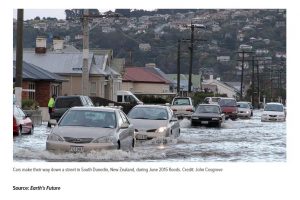
Source: Earth’s Future , EOS
As climate change continues to drive global sea level rise, many people living in coastal areas are already seeing the effects. Coastal erosion is accelerating and shifting coastlines inland, and storm surges are getting worse. But lurking beneath the surface is another major consequence that is thus far poorly understood: rising groundwater.
Evidence suggests that in some low-lying coastal regions with shallow groundwater, rising sea levels will drive a simultaneous rise in groundwater levels, with potentially serious risks for homes, businesses, and other infrastructure.
In a new paper focused on the coastal city of Dunedin, New Zealand, Cox et al. demonstrate a method for predicting how sea level rise might change groundwater levels and thereby increase inland flooding hazards. South Dunedin already experiences periodic flooding that will become even more challenging with sea level rise; the researchers describe the city as a poster child for New Zealand communities responding and adapting to climate change and rising seas.
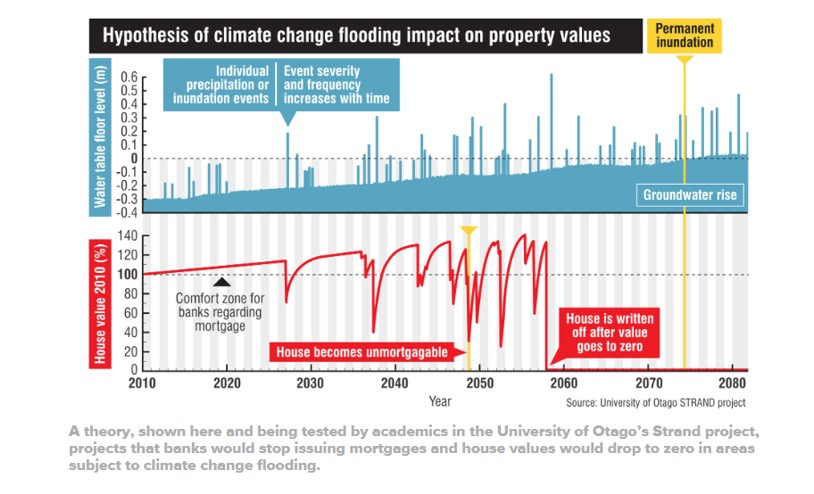
Climate change risks to property values
See the original article here
Extreme sea-levels from storms augmented by sea-level rise are potentially a threat to New Zealand’s property values and financial stability, according to a University of Otago expert.

Prof. Ivan Diaz-Rainey, PI, Finance
Professor Ivan Diaz-Rainey, of the Department of Accountancy and Finance, joined other prominent speakers at the Assembly of Investment Chairs’ seminar on Tuesday 29 November to discuss this year’s theme of ‘greenwashing, climate disclosures and impact investment’.
He took the opportunity to share the insights he has found 18 months into his three-year long Royal Society-funded Marsden project that partners with GNS Science, Bodeker Scientific, National Institute of Water and Atmospheric Research (NIWA) and the Reserve Bank of New Zealand.
Professor Ivan Diaz-Rainey Speaking at Climate Change, Insurance, Finance and Housing Workshop
Climate and Energy Finance Group (CEFGroup) Director & PI of the STRAND Marsden Project, Professor Ivan Diaz-Rainey, is presenting at the Climate Change, Insurance, Finance and Housing Workshop next Wednesday. Details below:
- Presentation Title: Implications of Climate Change Risk on Residential Property Values and Financial Stability
- Date and Time: Wednesday the 23rd of November, 1:00-1:25 pm New Zealand Time [Note that the workshop runs from 9am to 6pm]
- Registration Link: HERE
- Location: Decima Glenn, Level 3, Sir Owen G Glenn Building, 12 Grafton Rd, Auckland, New Zealand
- Full Program: Climate Change, Insurance, Finance and Housing Workshop
ABOUT THIS EVENT
Join us to hear from industry experts and academics on the implications of climate change on Aotearoa’s housing markets with the introduction of new government policies on managed retreat and adaptation and discuss the future of housing as we face the prospect of financial and insurance retreat. At the conclusion of the event, there will be networking opportunities.
The workshop hosted by Resilience of the Housing Market Research Group, a joint initiative of the University of Auckland – Business School Departments of Property and Commercial Law.
Lunch, morning and afternoon tea will be provided.
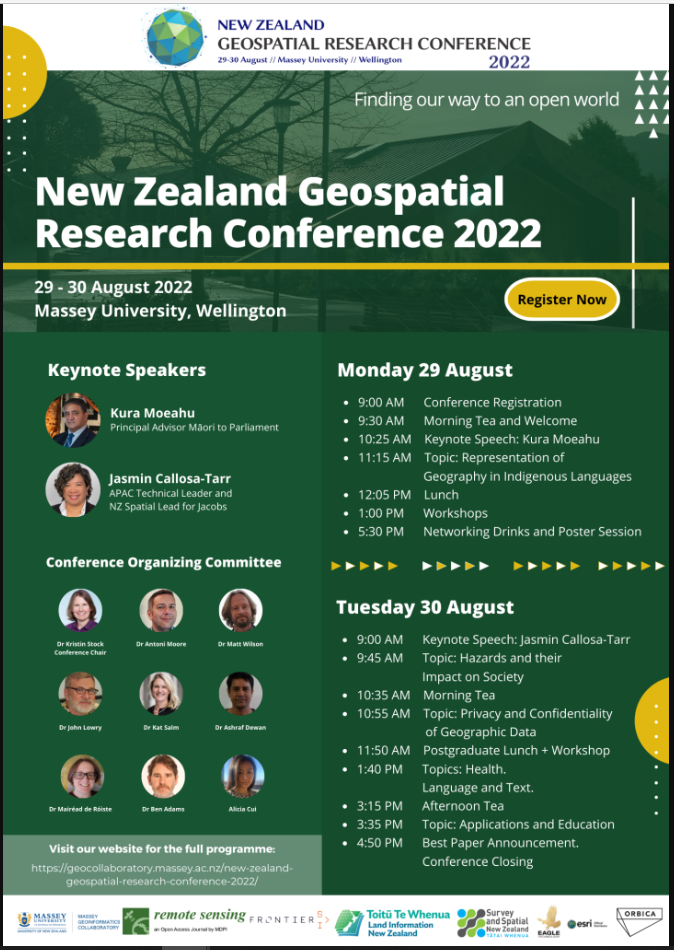
AP Antoni Moore presented at New Zealand Geospatial Research Conference and GeoCart conference
AP Antoni Moore, Associate Professor in Geographical Information Science at the School of Surveying, University of Otago and a co-Principal Investigator of the STRAND Marsden project, recently delivered two presentations on the project at the GeoCart’2022 and the 2022 New Zealand Geospatial Research Conference. AP Moore also delivered a keynote speaker entitled “Meta-Geovisualisation” at the GeoCart’2022. Details below:
- Presenting Author: AP Antoni Moore
- Title: Towards a Coastal Asset Risk Index (CARI) for Mapping Risk to
Property from Climate Change-Related Flooding Hazard - Date and Time: 15:30 am – 15:50am August 24th 2022
- Venue: National Library of New Zealand, Wellington
New Zealand Geospatial Research Conference 2022
- Presenting Author: AP Antoni Moore
- Title: Modelling the Effect of Climate Change: Related Flooding
Hazards (CCRFH) on Coastal Residential Property Values - Date and Time: 10:05 am – 10:15 am August 30th 2022
- Venue: Massey University, Wellington
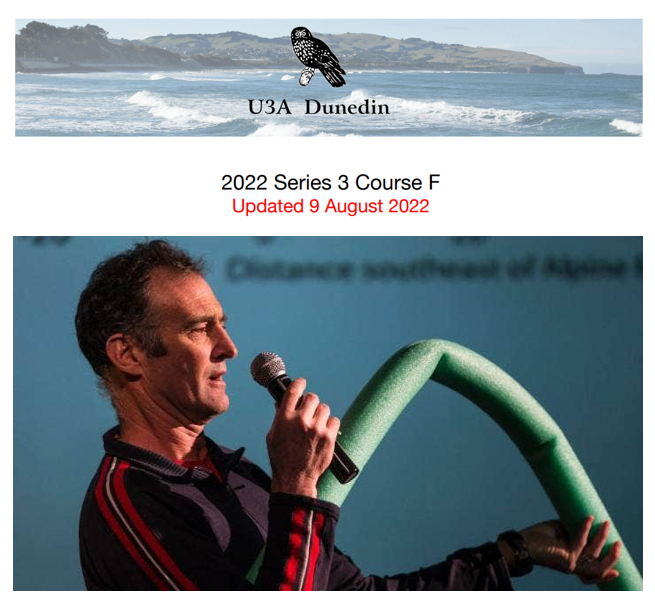
Dr Simon Cox delivered guest lecturers at U3A Dunedin
Dr Simon Cox, Principal Scientist at GNS Science and a team member of the STRAND Marsden project, recently delivered two guest lectures for “A sustainable Dunedin” course in U3A Dunedin with 75 attendees. Details below:
-
- Presenting Author: Dr Simon Cox
- Title:The geology and present hazard issues of South Dunedin.
and
Sea level rise, evolution of hazards and the future of South Dunedin
- Date and Time: 10 am – 12 noon September 9th 2022
- Venue: Leith Bowling Club, 2 Duke Street, North Dunedin
STRAND Marsden Project Seminar Presentations
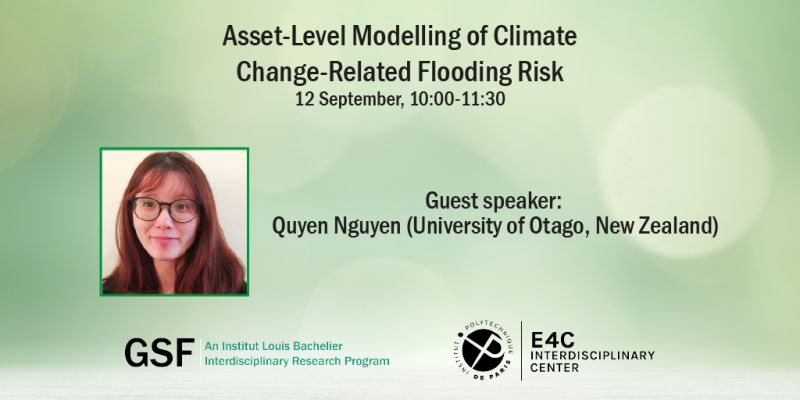
The Green and Sustainable Finance (GSF) transversal research programme of the Institut Louis Bachelier and the interdisciplinary Energy4Climate Center (E4C, Institut Polytechnique de Paris) hosted a joint seminar 10.00am-11.30am CEST on Monday the 12th of September, at the premises of Institut Louis Bachelier.
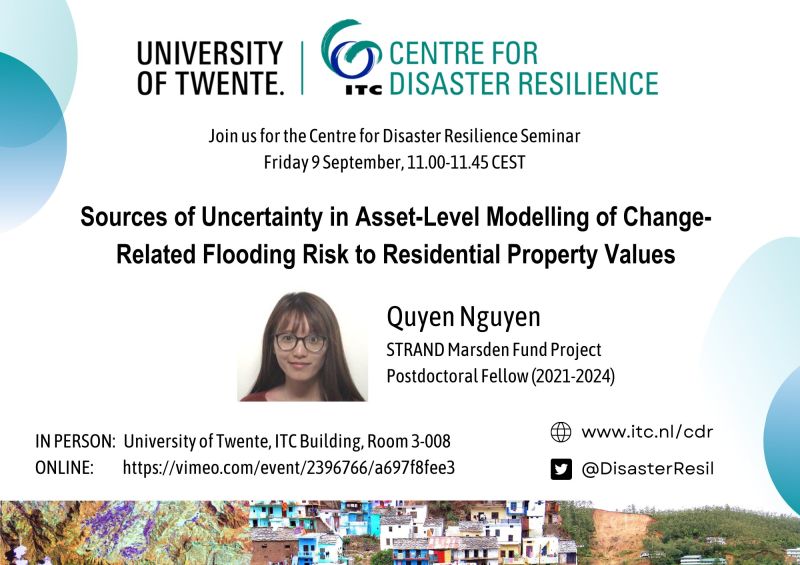
Dr Quyen Nguyen, CEFGroup’s STRAND Marsden Postdoctoral Fellow, presented their latest research on the topic of “Asset-Level Modelling of Climate Change-Related Flooding Risk” – parts of the STRAND project. The authors highlight the importance of uncertainty estimates when they relate to high impact public-interest decision-making.
Note that the working paper has also been presented to the ITC Centre for Disaster Resilience at University of Twente this Friday (9th September), 11.00-11.45am CEST. Recording is now publicly available HERE.
Climate change risk: Why are people still buying by the sea?
Climate change is real and happening right now, but many homeowners in at-risk areas are still not thinking realistically about what it means for their properties, experts say.
The news article is available HERE.
In recent months, there has been a succession of significant floods around the country, and that follows a number of one-in-100-year floods last winter. Continue reading
