University of Otago will host the 10th International HEPPA-SOLARIS meeting in 11-15 January 2027.
University of Otago will host the 10th International HEPPA-SOLARIS meeting in 11-15 January 2027.
Hannah has completed her PhD – congratulations on the excellent work! The group is very luck to keep her as a postdoc on our recently funded Research Programme.
The Ministry of Business, Innovation & Employment has awarded $10 mil (excl GST) to our 5-year program Building critical capability for space-based climate monitoring with next generation photonics!
The project team is led out of the University of Otago (Resonant Optics and Atmosphere and Climate groups), with key individuals placed at the Earth Science New Zealand, Paihau-Robinson Research Institute, and the Universities of Auckland, Canterbury, and Waikato. Key international partnerships include NASA/JPL, FMI, IAA, ANCDF Canberra, UC3MMadrid, and Colorado School of Mines. Key industry partners are Kea Aerospace, Whitika-LuxFidelity and Shamrock Industries. Community engagement will be led by Tūhura Otago Museum and Aerospace NZ.
More information here: https://www.otago.ac.nz/news/newsroom/$41-million-funding-success-for-otago-scientists
Thirst for Knowledge and the NZ International Science Festival put together a special panel discussion on Careers in Space on the 1 July 2025. Hannah and Annika took part as panelist. The panel also included the amazing Dr Michelle Taller who recently retired from the role of Assistant Director of Science at the NASA Goddard Space Flight Centre.
Congratulations to Hannah Kessenich for submitting her PhD thesis titled The dynamical drivers of long-lived Antarctic ozone holes! Hannah has lots of exciting research results to publish from her thesis and we are looking forward to making those available to the atmospheric science community.
Annika’s work explaining the physical mechanism from high altitude ozone loss to surface climate variability is now out: Seppälä, A., Kalakoski, N., Verronen, P.T. et al. Polar mesospheric ozone loss initiates downward coupling of solar signal in the Northern Hemisphere. Nat Commun 16, 748 (2025). https://doi.org/10.1038/s41467-025-55966-z
Welcome to the team Delta, Ouji and Lara! May the summer be both fun and productive! Lots of code will be written for sure.
Congratulations to Hannah for winning the best student talk prize at the NZ Meteorological Society’s Annual Conference in 2024! The judges commended Hannah for her communications and great graphics on very important work. Well done Hannah!
The rapid expansion of the space industry has resulted in an unprecedented pace of rocket launches and satellites to orbit. Over the past 15 years, rocket launches have nearly tripled, and the number of satellites orbiting Earth has surged tenfold. This has raised significant concerns about the environmental impacts of space activities. Current industry practice is to deorbit satellites at the end of their life by re-entering them into Earth’s atmosphere. This process is contributing to a growing environmental issue, which highlights a gap in our understanding of the impacts of re-entry on atmospheric chemistry and behaviour.
The re-entry of space debris, which releases hundreds of tons of metallic particles into the atmosphere annually, could have far-reaching consequences, including potential disruptions to the recovery of the ozone hole by introduction of new long-lived ozone depleting substance into the atmosphere. With projections estimating that up to 100,000 satellites could orbit the planet by the end of the decade, the threat of atmospheric contamination is becoming more pressing. High-altitude air pollution from rocket exhaust and satellite re-entries could persist for decades or centuries, with unanticipated consequences for our atmosphere and climate.
This PhD project, based at University of Otago, will provide key insights and recommendations for the management and mitigation of satellite atmospheric re-entry, by building on current understanding of the role of ozone in the atmosphere and climate system, as represented in the Community Earth System Model (CESM2).
For more information contact Associate Professor Annika Seppälä, or Dr Priyanka Dhopade (Department of Mechanical & Mechatronics Engineering, University of Auckland), who will co-supervise the project.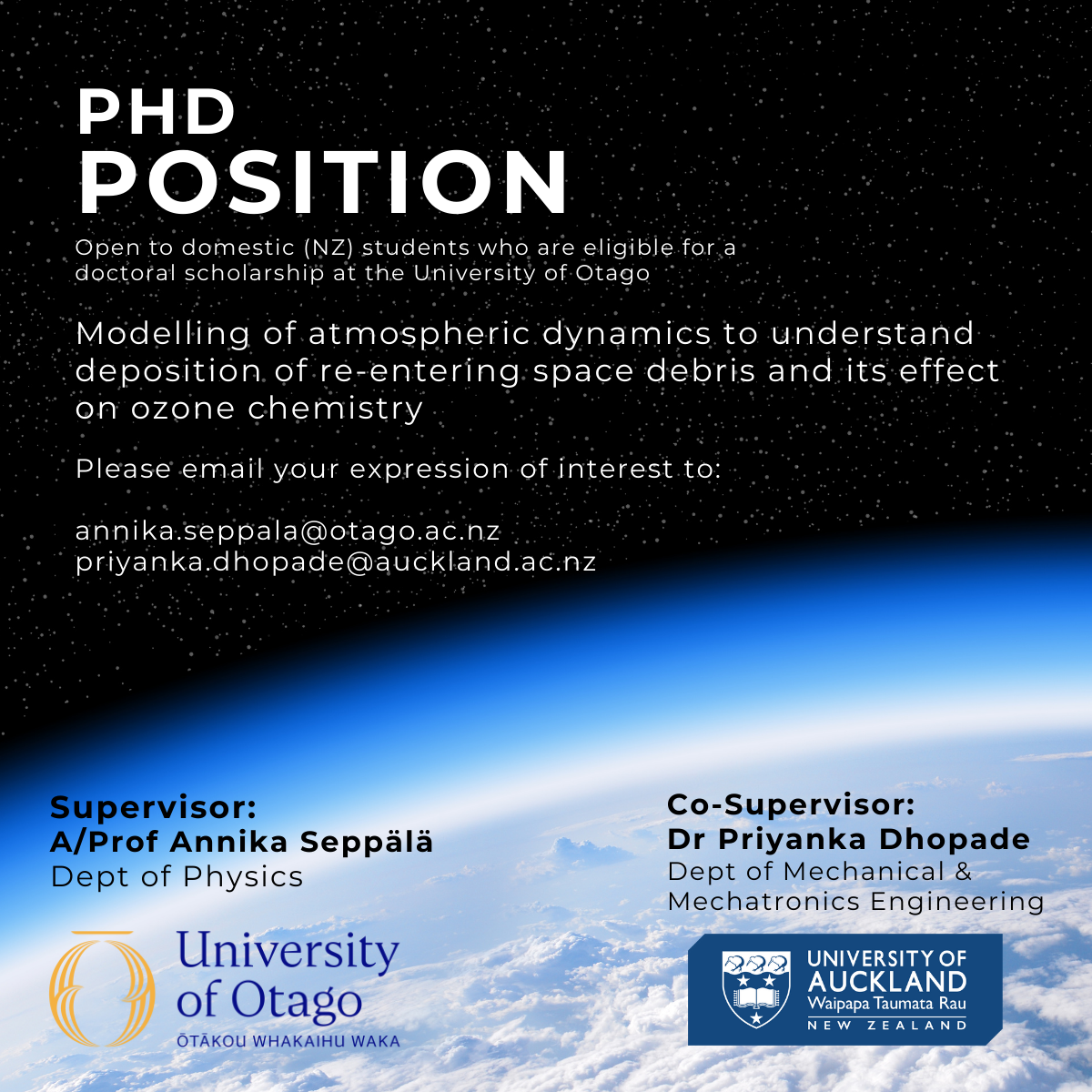
Our latest research article was published in Nature Comms. this morning New Zealand time: Kessenich, H.E., Seppälä, A. & Rodger, C.J. Potential drivers of the recent large Antarctic ozone holes. Nat Commun 14, 7259 (2023). https://doi.org/10.1038/s41467-023-42637-0.
The story took on a life of its own in the media, some of which reported very alarming headlines. We do not in fact report that the ozone hole in general is getting worse, it definitely continues on a track of slow recovery! Our results show that the very core of the ozone hole does not, as yet, show those sign of recovery. We also highlight the need for continued, comprehensive, monitoring of polar ozone and related species through the winter and spring seasons in the future.
Here is a blog post we wrote for the Earth and Environmental Sciences Community hosted by Nature: https://earthenvironmentcommunity.nature.com/posts/unravelling-recent-patterns-in-antarctic-ozone