Amir at KOALA in Auckland
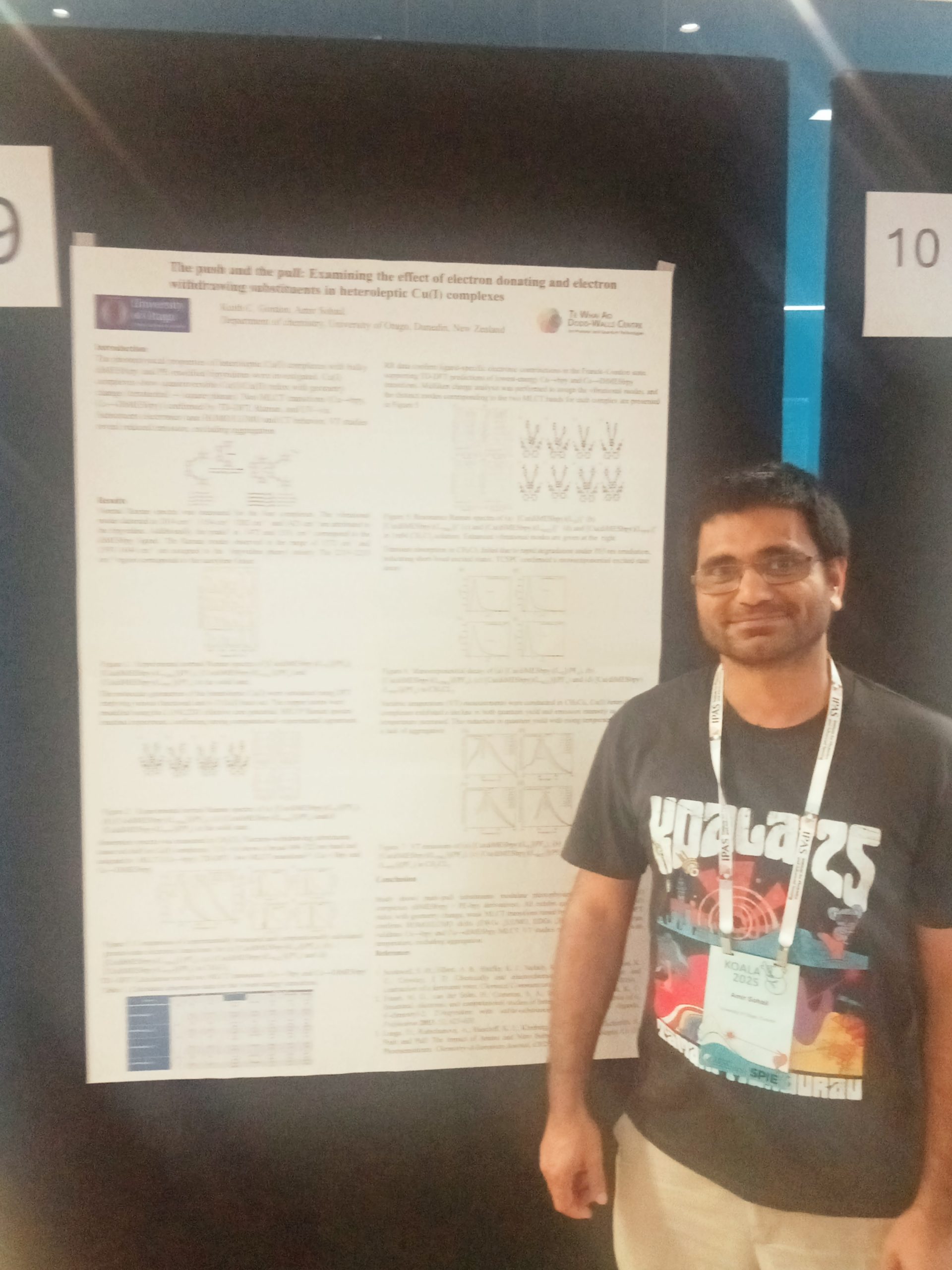
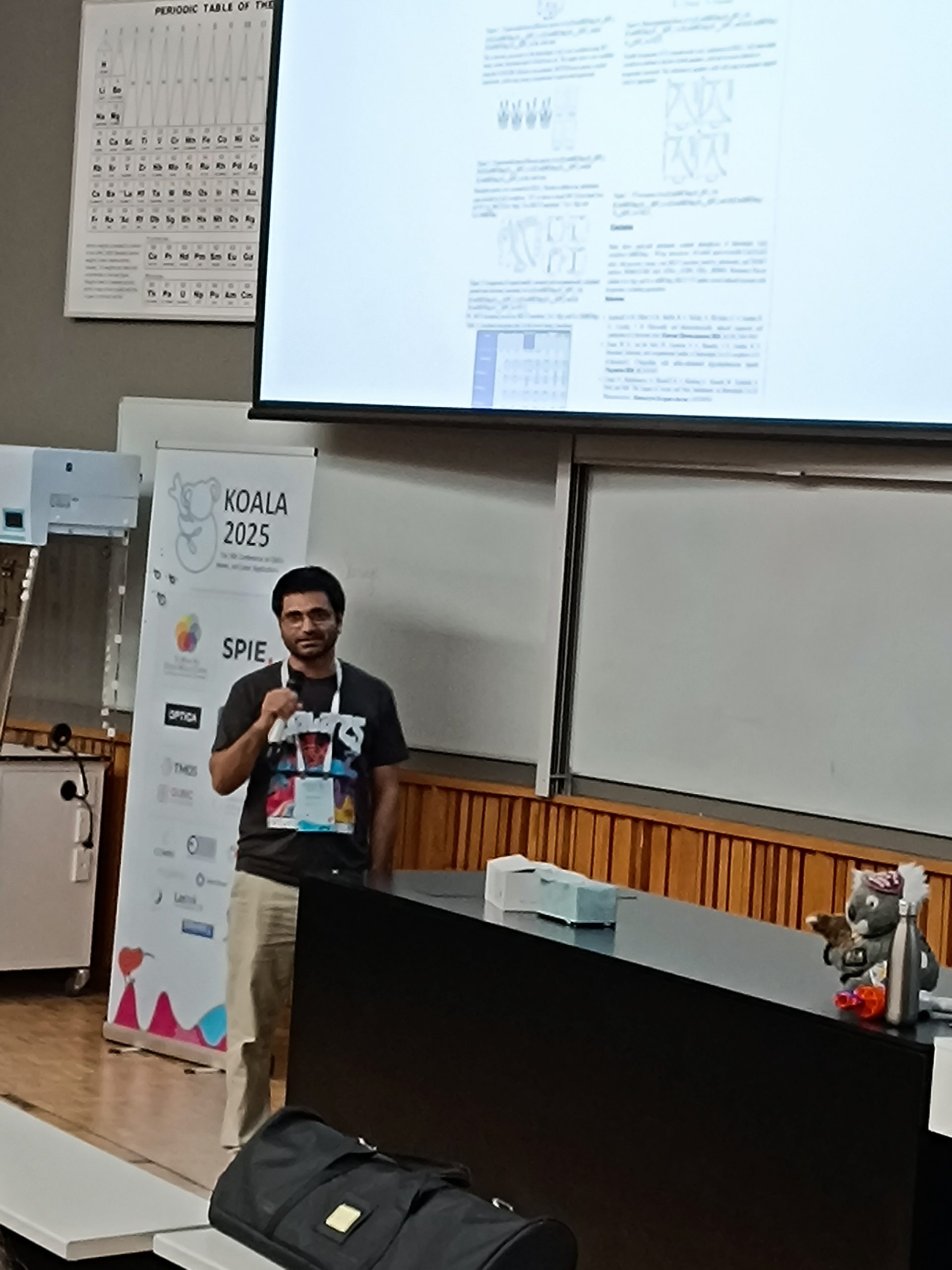
Amir recently attended the Konference on Optics, Atoms, and Laser Applications 2025 (KOALA). His poster entitled The push and the pull: Examining the effect of electron-donating and electron-withdrawing substituents in heteroleptic Cu(I) complexes was presented along with a flash talk.
The work described in the poster concnerns the photophysical properties of a series of heteroleptic Cu(I) complexes that incorporate the bulky ligand 4,4′-dimesityl-2,2′-bipyridine (diMESbipy), along with a family of 4,4′-bis(phenylethynyl)-2,2′-bipyridine derivatives bearing electronically modified phenyleneethynylene (PE) substituents. These derivatives include: 4,4′-bis(phenylethynyl)-2,2′-bipyridine (LH), 4,4′-bis((4-nitrophenyl)ethynyl)-2,2′-bipyridine (LNO₂), 4,4′-bis((4-methoxyphenyl)ethynyl)-2,2′-bipyridine (LOMe), and 4,4′-bis((perfluorophenyl)ethynyl)-2,2′-bipyridine (LPFP). Cu(I) complexes show quasireversible Cu(I)/Cu(II) redox with geometry change (tetrahedral → square planar). The MLCT transition was validated by TD‑DFT and Resonance Raman spectroscopy. Substituent electronics tune HOMO/LUMO energies and CT behavior. Variable Temperature (VT) emission study reveal reduced emission, indicating absence of aggregation phenomenon.