Latest ANZIC Bulletin, your chance to go to Greece!, and missed meeting
Hi all
Our last scheduled meeting was absorbed into Waitangi Day, and next month (March), I will be away as well. Fortunately there isn’t a huge amount of news so I’m happy to just post here and via email.
We have been notified of the latest ANZIC Bulletin:
In this issue:
-Expedition 381 open for applications
-News from the office
– Note that it contains a call for applications to join the Corinth Rift expedition in Greece later this year.
http://iodp.org.au/wp-content/uploads/ANZICs-Bulletin-Issue-1-16-Feb-2016.pdf
If you have any questions about the content of the Bulletin please contact me.
ALso, Jack Williams, PhD Student in Geology, recently had an article published in Scientific Drilling, namely:
Williams, J.N, Bevitt, J., Toy, V.G. 2017. A comparison of the use of X-ray and neutron tomographic core scanning techniques for drilling projects: insights from scanning core recovered during the Alpine Fault Deep Fault Drilling Project. Scientific Drilling 5, 1-8, doi: 10.5194/sd-5-1-2017
Jack – who was extensively involved in Alpine Fault drilling throughout his PhD also recently submitted his thesis – The damage zone of New Zealand’s Alpine Fault”.
Congratulations Jack!
I don’t have anything else to advise you of at present, but if anything comes in I will email it round and post here.
Cheers
Virginia
Call for ANZIC applications for IODP Expedition 381: Corinth Active Rift Development
Dear colleagues
We are now accepting ANZIC applications from scientists in our member institutions for scientific participation in an ECORD expedition in the Rift of Corinth in October-November 2017. We are guaranteed one scientific place. The links in the attachment provide more scientific background. Opportunities exist for researchers (including graduate students) in specialties in the following fields: paleontology, sedimentology, organic geochemistry, inorganic geochemistry, structural geology, paleomagnetics, physical properties, geophysics and petrophysics/downhole logging.
The applicants will either be part of 1) the limited offshore party (late 2017) and the onshore sampling party in Bremen in February 2018 or 2) the larger onshore sampling party. if you apply, please specify which option you would prefer. For the offshore phase of the expedition, they are particularly looking for the following fields: paleontology, sedimentology, organic geochemistry, inorganic geochemistry, physical properties, and petrophysics/downhole logging.
Background and objectives
This European-funded alternative platform expedition will drill three sites within the active Corinth Rift, Greece, where deformation rates are high, the syn-rift succession is preserved and accessible, and a dense, seismic database provides a high resolution fault network and seismic stratigraphy for the recent rift history but with limited chronology. In the Gulf of Corinth, the expedition can achieve an unprecedented precision of timing and spatial complexity of rift-fault system development and rift-controlled drainage system evolution in the first 1-2 Myr of rift history.
The expedition aims to resolve at a high temporal and spatial resolution how faults evolve, how strain is (re-)distributed, and how the landscape responds within the first few Myrs in a non-volcanic continental rift, as modulated by Quaternary changes in sea level and climate. High horizontal spatial resolution (~1-3 km) is provided by a dense grid of seismic profiles offshore that have been recently fully integrated, complemented by extensive outcrops and fault analysis onshore. High temporal resolution (~20-50ka) will be provided by seismic stratigraphy tied to core and log data from three carefully located boreholes to sample the recent syn-rift sequence.
Two primary themes will be addressed by the drilling integrated with the seismic database and onshore data. First, fault and rift evolutionary history (including fault growth, strain localization and rift propagation) and deformation rates: the spatial scales and relative timing can already be determined within the seismic data offshore. Dating of drill core will provide the absolute timing offshore, the temporal correlation to the onshore and the ability to quantify strain rates from individual faults to the whole rift scale. Second, the response of drainage evolution and sediment supply to rift and fault evolution: core data will define lithologies, depositional systems and paleoenvironment, including catchment paleo-climate, basin paleobathymetry, and relative sea level. Integrated with seismic data, onshore stratigraphy and catchment data, we will investigate the relative roles and feedbacks between tectonics, climate and eustasy in sediment flux and basin evolution. A multidisciplinary approach to core sampling integrated with log and seismic data will generate a Quaternary chronology for the syn-rift stratigraphy down to orbital timescale resolutions and resolve the paleoenvironmental history of the basin in order to address the objectives.
The expedition aims to drill, core, and log up to 750m-deep boreholes at three sites in the central and eastern Gulf of Corinth. The procurement process to contract platform and drilling services is currently being undertaken by ESO, and it is envisaged that the setup will involve a geotechnical vessel equipped with a coring rig, and outfitted with ESO’s laboratory containers.
Information webinar
To learn more about the scientific objectives of this expedition, life at sea, and how to apply to sail, please join us for a web-based seminar on Tuesday 14th February 2015 at 1pm GMT. To participate in the webinar, you will need access to the internet with a computer equipped with a speaker and microphone (optional). To register, please visit:
https://www.surveymonkey.co.uk/r/IODP381
Final: Special call for applications for IODP Expedition 375
- Dear colleagues
This is a final call for specialist positions on the Hikurangi Subduction Margin Expedition 375, the call first being sent out on January 13. It is for paleomagnetists and foraminifer, nannofossil, and radiolarian biostratigraphers, and is a great opportunity. The deadline is Monday 30 January, so please think about applying yourself, or suggest applying to appropriate colleagues or post graduate students.
With regards
Neville Exon
—————————-
Dear colleagues
Hikurangi Subduction Margin Expedition (375): 8 March – 5 May 2018
The Hikurangi Subduction Margin Expedition (375) applicant pool does not contain sufficient paleomagnetics and biostratigraphy, although many positions have been filled or provisionally filled after the initial call, including Laura Wallace as NZ co-chief scientist, and two other New Zealanders. We have been asked to issue a special call for paleomagnetists and foraminifer, nannofossil, and radiolarian biostratigraphers to all ANZIC scentists.
The operators say that they have a preference for especially experienced scientists, but they’d be happy to receive and consider any applicants. Since each of the onboard labs is very sparsely populated right now, they do need a high level of knowledge for at least some of those they might invite.
This is a great opportunity for ANZIC applicants to get aboard on an exciting expedition in our region, and not come under the ANZIC quota. We would need to receive any applications by Monday 30 January for brief consideration by the ANZIC Science Committee.
For more information about the expedition science objectives and the JOIDES Resolution Expedition Schedule see http://iodp.tamu.edu/scienceops/ – this includes links to the expedition web pages that provide the original IODP proposal and expedition planning information.
For shipboard scientist responsibilities see http://iodp.tamu.edu/participants/scientist_jobs.html.
Expedition 375 will investigate slow slip events (SSE) along the northern Hikurangi subduction margin (IODP proposals 781A-Full and 781A-Add). Hikurangi SSE recur every ~2 years so we can monitor changes in deformation rate and associated chemical and physical properties surrounding the SSE source area throughout an entire slow slip cycle. Sampling material from the sedimentary section and oceanic basement of the subducting plate and from primary active thrusts in the outer accretionary wedge, in combination with LWD data, will reveal the rock properties, composition, and lithological and structural character of the active faults involved in the SSE, as well as material that is transported downdip to the SSE source region. Coring and downhole measurements from four sites will be integrated with the LWD data collected during Expedition 372. In addition, borehole observatories will be installed at the thrust fault site and a site in the upper plate to monitor hydrologic, chemical, and physical processes during the SSE cycle.
ANZIC applications
Australians should visit www.iodp.org.au for a link to the application form, a completed version of which should be sent to Neville Exon (Neville.Exon@anu.edu.au) and Rob McKay (robert.mckay@vuw.ac.nz). New Zealanders should contact Giuseppe Cortese (NZODP@gns.cri.nz).
Applicants should bear in mind that their applications will be firstly reviewed by the ANZIC Science Committee and, if they pass that hurdle, by the expedition co-chief scientists. Clearly, they need to convince both groups that they would be excellent in the role.
The ANZIC Science Committee makes allowance for the relative opportunities of the applicants, so that early career researchers, including graduate students, have a good chance of selection. Note that non-tenured applicants must have a position at an Australian or New Zealand member institution for at least one year post-expedition and ideally more to enable them to carry out the necessary post cruise research.
As well as the form, applicants should provide:
1. Participation Plan and Budget (maximum of four pages): This should set out why they are interested in the expedition, how their skills suit the position applied for, what they would bring to the expedition, and the nature of their initial post-cruise research plans (including publication plans), and a brief outline of what budget they might need beyond that covered by their institution.
To maximise the return to ANZIC from the involvement of our scientists on expeditions, we ask that applicants endeavour to assemble a team, including ANZIC scientists, of potential land-based science party members, set out who has agreed to join that team if you are successful, and what they would aim to do post-cruise. The potential existence of such a team, which would provide additional analytical and scientific skills, would strengthen the applications. If all went to plan, the team members could become part of the land-based science party, and thus get early access to material from the vessel. Of course, final research plans will depend on the material actually recovered by the vessel, and negotiations aboard ship as to who does what.
2. Curriculum Vitae including selected publications (maximum of two pages)
3. Letter of support for non-tenured applicants by their supervisor: This should cover general support from the institution for the application, include an outline of the proffered post-cruise support, and indicate when the present position, or a new position, will end (at least one year post-cruise is required).
For ANZIC scientists all travel costs would be covered by ANZIC. In addition the ANZIC IODP Office may provide up to $A40,000 for post-cruise activities (mainly analytical costs) for Australian university and research institution scientists and post-graduate students, if funding cannot be obtained in any other way. Applications for such funding can only be made after expeditions are completed and samples are in hand. New Zealand has a less formal arrangement from which lesser sums may be obtained
The deadline for scientists to submit applications to ANZIC is Monday, 30 January, 2017. This is an excellent opportunity for scientists, doctoral students or post docs to collaborate with an international team of scientists. We know that students will have trouble with the long lead times but if things are possible and they’re interested, they should apply. Neville Exon and Rob McKay will be happy to provide advice for the applications, and help where possible with timing problems.
Yours sincerely
Neville
Neville Exon
ANZIC Program Scientist
02 6125 5131
Special call for participants on Exp 375 (Hikurangi)
Dear colleagues
Hikurangi Subduction Margin Expedition (375): 8 March – 5 May 2018
The Hikurangi Subduction Margin Expedition (375) applicant pool does not contain sufficient paleomagnetics and biostratigraphy, although many positions have been filled or provisionally filled after the initial call, including Laura Wallace as NZ co-chief scientist, and two other New Zealanders. We have been asked to issue a special call for paleomagnetists and foraminifer, nannofossil, and radiolarian biostratigraphers to all ANZIC scentists.
The operators say that they have a preference for especially experienced scientists, but they’d be happy to receive and consider any applicants. Since each of the onboard labs is very sparsely populated right now, they do need a high level of knowledge for at least some of those they might invite.
This is a great opportunity for ANZIC applicants to get aboard on an exciting expedition in our region, and not come under the ANZIC quota. We would need to receive any applications by Monday 30 January for brief consideration by the ANZIC Science Committee.
For more information about the expedition science objectives and the JOIDES Resolution Expedition Schedule see http://iodp.tamu.edu/scienceops/ – this includes links to the expedition web pages that provide the original IODP proposal and expedition planning information.
For shipboard scientist responsibilities see http://iodp.tamu.edu/participants/scientist_jobs.html.
Expedition 375 will investigate slow slip events (SSE) along the northern Hikurangi subduction margin (IODP proposals 781A-Full and 781A-Add). Hikurangi SSE recur every ~2 years so we can monitor changes in deformation rate and associated chemical and physical properties surrounding the SSE source area throughout an entire slow slip cycle. Sampling material from the sedimentary section and oceanic basement of the subducting plate and from primary active thrusts in the outer accretionary wedge, in combination with LWD data, will reveal the rock properties, composition, and lithological and structural character of the active faults involved in the SSE, as well as material that is transported downdip to the SSE source region. Coring and downhole measurements from four sites will be integrated with the LWD data collected during Expedition 372. In addition, borehole observatories will be installed at the thrust fault site and a site in the upper plate to monitor hydrologic, chemical, and physical processes during the SSE cycle.
ANZIC applications
Australians should visit www.iodp.org.au for a link to the application form, a completed version of which should be sent to Neville Exon (Neville.Exon@anu.edu.au) and Rob McKay (robert.mckay@vuw.ac.nz). New Zealanders should contact Giuseppe Cortese (NZODP@gns.cri.nz).
Applicants should bear in mind that their applications will be firstly reviewed by the ANZIC Science Committee and, if they pass that hurdle, by the expedition co-chief scientists. Clearly, they need to convince both groups that they would be excellent in the role.
The ANZIC Science Committee makes allowance for the relative opportunities of the applicants, so that early career researchers, including graduate students, have a good chance of selection. Note that non-tenured applicants must have a position at an Australian or New Zealand member institution for at least one year post-expedition and ideally more to enable them to carry out the necessary post cruise research.
As well as the form, applicants should provide:
1. Participation Plan and Budget (maximum of four pages): This should set out why they are interested in the expedition, how their skills suit the position applied for, what they would bring to the expedition, and the nature of their initial post-cruise research plans (including publication plans), and a brief outline of what budget they might need beyond that covered by their institution.
To maximise the return to ANZIC from the involvement of our scientists on expeditions, we ask that applicants endeavour to assemble a team, including ANZIC scientists, of potential land-based science party members, set out who has agreed to join that team if you are successful, and what they would aim to do post-cruise. The potential existence of such a team, which would provide additional analytical and scientific skills, would strengthen the applications. If all went to plan, the team members could become part of the land-based science party, and thus get early access to material from the vessel. Of course, final research plans will depend on the material actually recovered by the vessel, and negotiations aboard ship as to who does what.
2. Curriculum Vitae including selected publications (maximum of two pages)
3. Letter of support for non-tenured applicants by their supervisor: This should cover general support from the institution for the application, include an outline of the proffered post-cruise support, and indicate when the present position, or a new position, will end (at least one year post-cruise is required).
For ANZIC scientists all travel costs would be covered by ANZIC. In addition the ANZIC IODP Office may provide up to $A40,000 for post-cruise activities (mainly analytical costs) for Australian university and research institution scientists and post-graduate students, if funding cannot be obtained in any other way. Applications for such funding can only be made after expeditions are completed and samples are in hand. New Zealand has a less formal arrangement from which lesser sums may be obtained
The deadline for scientists to submit applications to ANZIC is Monday, 30 January, 2017. This is an excellent opportunity for scientists, doctoral students or post docs to collaborate with an international team of scientists. We know that students will have trouble with the long lead times but if things are possible and they’re interested, they should apply. Neville Exon and Rob McKay will be happy to provide advice for the applications, and help where possible with timing problems.
Yours sincerely
Neville
Neville Exon
ANZIC Program Scientist
02 6125 5131
Next scientific drilling consortia meeting 5 Dec 12pm
Hi all
I never had a ‘catch-up’ meeting for last month, but now its time for the next monthly meeting of Otago Scientific Drillers – this coming Monday 12pm in the staff club.
Here are a few agenda items, which I may add to by Monday and will eventually post to the blog:
ANZIC-IODP Marine Geoscience Masterclass at Otago will be in progress at the time of the meeting. After some lab training and tours at Otago on Monday, the 20 NZ- and Australian-derived late undergrad to early postgrad participants will be heading off to Doubtful Sound on Tuesday to jump on the Polaris and learn about sediment sampling and other marine geological/geophysical techniques. Chris Moy and Beth Fox (Waikato) are running a substantial part of the course.
I expect they will be too busy to report at this meeting but I hope we can look forward to a written short report and evaluation at the February meeting.
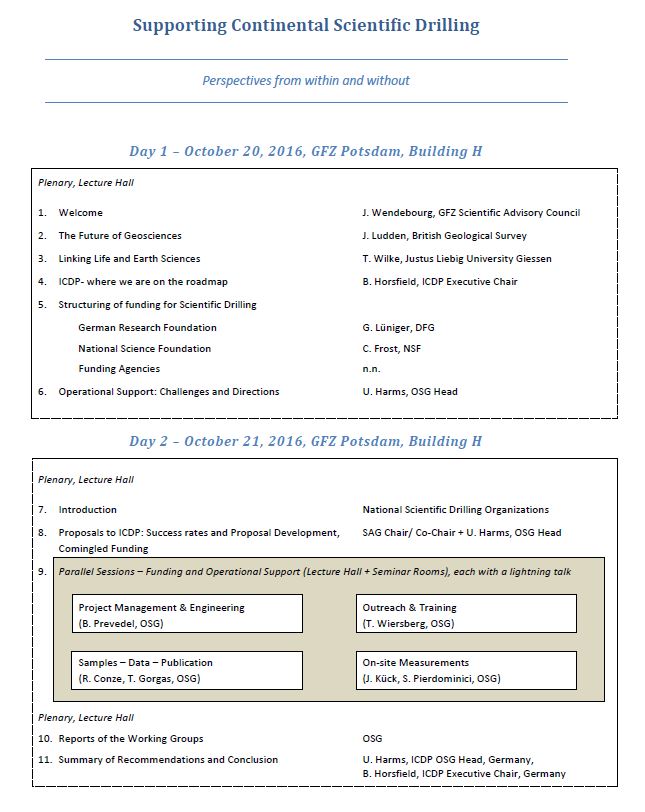
Report on ICDP’s 2016 Conference ‘Supporting Continental Scientific Drilling: Perspectives from Within and Without’.
I (Virginia) attended this as the sole NZ representative.
The conference program is attached so that you can read for yourselves exactly what was covered. In summary, over two days we first heard a lot of summary of the current activities of the Operational Support Group (OSG), and of the way that the ICDP consortium is structured – including how funding is acquired and allocated – and I am happy to talk more to anyone in person about what I learned from this if they are interested in applying to ICDP for any project support.
Then, we split into working groups to consider current practices and make recommendations for the next 5 years of OSG operation. There were 4 working groups, as indicated on the program. I participated in the ‘Data-Curation-Publication’ working group. I was impressed at the way this group interacted and think the recommendations we presented are excellent. I attach the document summarising these and can outline them in person at the meeting.
The two latest ANZIC IODP Bulletins can be found at:
http://iodp.org.au/wp-content/uploads/ANZICs-Bulletin-Issue-7-27-Oct-2016.pdf
http://iodp.org.au/wp-content/uploads/ANZICs-Bulletin-Issue-8-24-Nov-2016.pdf
Remember that the JR will be in NZ waters soon!
The Jodie’s Resolution (IODP boat) will sail around the NZ area in 2017 and 2018. Most of the applications to sail on expeditions have already been made and are currently being assessed by IODP. However, there will still be ample opportunities for NZ scientists to request and work with data or material from the cruises as shore-based scientists and I would like to ensure that Otago take full advantage of these opportunities. Virginia Toy and Andrew Gorman both have involvement in a large MBIE project that will fund associated science.
To stimulate others to think about opportunities, it would be good if someone (me?) were to summarise the expeditions and their objectives. I promise to do this soon.
Marsden:
Does anyone plan a Marsden proposal for this Jan that will draw on IODP or ICDP stuff? I would like to circulate one-pager proposals among ourselves for feedback. If you can participate in this process either as an advisor or a submitter, let me know by return email.
That’s all I have for now but please email me if you want me to add anything and otherwise, see you on Monday!
Virginia
ICDP_Workshop_DataManagement-Summary
Special Call for IODP Expedition 371 (Lord Howe Rise) – Applications due 7 Nov
Dear colleagues
We called for applications for IODP Expedition 371 earlier this year, and the highly ranked applicants are now being considered for the expedition by the co-chief scientists, one of whom is Rupert Sutherland of Victoria University Wellington. It is now apparent that there is a clear lack of highly experienced scientists in three areas: Sedimentology, Cenozoic calcareous nannofossil biostratigraphy, and Cenozoic radiolarian biostratigraphy. For shipboard scientist responsibilities see http://iodp.tamu.edu/participants/scientist_jobs.html.
Accordingly, a special call is being made for applications to fill these positions, with a deadline of November 7, 2016. This is a wonderful opportunity for suitable ANZIC scientists to join Expedition 371, which will sail from 27 July to 26 September 2017. The chance of an excellent applicant being accepted is clearly high, as a clear lack of expertise has been identified. For the sedimentological position, experience of shipboard core analysis, and ideally ODP/IODP experience, would clearly be an advantage. For the other two positions this is not really a factor.
Brief outline: The Tasman Frontier expedition (based on IODP Proposals 832-Full2, https://iodp.tamu.edu/scienceops/precruise/tasman/832-Full2.pdf, and 832-Add) will investigate the Eocene Tonga-Kermadec (TK) subduction initiation (SI) and evaluate whether a period of high-amplitude long-wavelength compression led to initiation of TK subduction or determine if alternative geodynamic models were involved. Core and log data from boreholes in the Norfolk Ridge, New Caledonia Trough, Lord Howe Rise and Tasman abyssal plain will provide constraints on seismic stratigraphic interpretations and the timing and length scale of deformation and uplift associated with the largest known global SI event and change in plate motion. The Paleogene and Neogene sediments will also constrain paleoceanographic changes caused by SI as well as tropical and polar climatic teleconnections and the transition from greenhouse to icehouse climate states in a region with large meridional variations in surface water properties in a strategic ‘Southern Ocean Gateway’ setting.
Applications are due by 7 Nov. Please contact Virginia Toy for more information.
Call for applications to make use of the R.V. Falkor
Dear colleagues
This is a call for expressions of interest for expeditions on the very well equipped R.V. Falkor: “Our select collaborators are provided with free access to the research vessel Falkor, its on-board research facilities and equipment, and associated expert technical, operational, and informational support.” Mike Coffin made good use of this vessel not so long ago.
This is a great opportunity to potentially get access to an excellent R.V. in 2019, with an interesting set of capabilities. The link provides a lot more information.
Think about forming a group to put in an application!
Cheers Neville
[“Schmidt Ocean Institute”]
Call for Expressions of Interest
Dear Colleague:
We are pleased to announce that Schmidt Ocean Institute has opened its annual call for Expressions of Interest in collaborative oceanographic research and technology development. Further details and submission guidelines are available at the following link: Schmidt Ocean Institute – Expressions of Interest in collaborative research cruises on R/V Falkor in 2019.
Submissions will be accepted through December 4, 2016. Should you have any questions about the SOI proposal process, kindly email your question to proposals@schmidtocean.org. Please feel free to forward this information to any your interested colleagues.
Thank you.
Schmidt Ocean Institute
See: http://schmidtocean.org/technology/robotic-platforms/4500-m-remotely-operated-vehicle-rov/
and http://schmidtocean.org/rv-falkor/ship-specifications/
This email was sent to neville.exon@anu.edu.au
You received this email because you expressed interest in receiving notifications for the Schmidt Ocean Institute Annual Call for Expressions of Interest.
Unsubscribe here
Sent by
SendinBlue
© 2016 Schmidt Ocean Institute
Christian Ohneiser’s notes from monthly meeting on 5 Sept 2016
Greetings all,
At today’s meeting we talked about EXP373 (813), and the Otago drilling blog.
EXP373 (813)
If you have an interest in Antarctica’s climate and ice history I encourage you to apply. This expedition will not use the JR which means few shipboard scientists and more shore based work. It is a great opportunity to get involved without the need for two months at sea. You will still have to participate in the onshore science party(OSP). The duration of the OSP depends on the quantity of core collected.
http://www.eso.ecord.org/expeditions/373/373.php.
Applications close on the Monday 12 September. If you would like to apply and don’t have documentation/details let me/Virginia know and I will forward you relevant material rather than spamming you all.
If you have a moment check out the new Otago drilling blog: https://blogs.otago.ac.nz/drill-otago/
New Scientist article about Sumatra Seismogenic Zone expedition
Sarah Kachovich (radiolarians) and Toby Colson (physical properties) are at sea on the JR drilling the incoming plate of the Sumatra Seismogenic Zone. An article has just appeared in the “New Scientist” about the expedition:
https://www.newscientist.com/article/2102382-floating-lab-drills-1-5km-below-sea-floor-to-study-megaquakes/
