

Asian Spectroscopy Conference 2020
Congratulations to Samanali, Josh Sutton and Fatema Ahmed from the Gordon group for their presentations at the virtual Asian Spectroscopy Conference (ASC) 2020 (https://event.ntu.edu.sg/asc2020/Pages/index.aspx ) hosted from Singapore. The meeting ran from Dec 8 to 10 and included 15 Plenary presentations, 30 invited talks and 27 poster presentations. A number of talks were pre-recorded as were the 3 minute poster presentations.
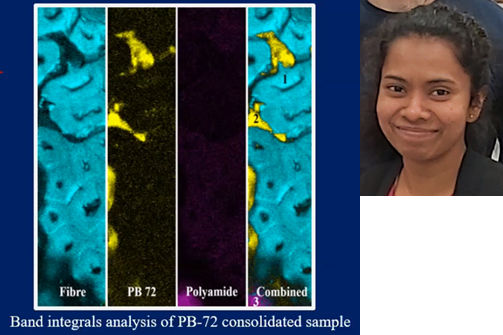
Samanali presented her work on vibrational spectroscopic applications for detecting of consolidated harakeke fibres in conservation. Samanali was able to show that the consolidants used in conservation coat the cells of the fibre thus imbuing the textile with greater strength. She was able to show this by taking cross sections of the fibre and conducting Raman mapping of those samples. The presence of the cells of the fibre are shown below in cyan and those of the consolidant in yellow.
Josh discussed the influence of changing from fluorenone to fluorenyl-malonitrile on the excited state dynamic of tetraphenylbenzene-fluorene based donor-acceptor systems.
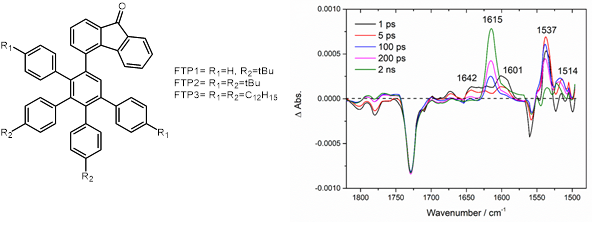
Some of the compounds Josh described and the time-resolved infrared spectra of the excited states.
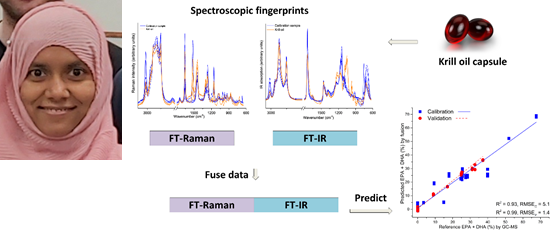
Fatema described her work on data fusion strategies for quantitative analysis of n-3 fatty acids in commercial krill oil. She was able to show that low level and mid level data fusion could improve quantitation for a number of fatty acids in oil samples.
Keith Gordon also presented as an invited speaker discussing the group’s work on the interplay of MLCT and ILCT states in rhenium(I) complexes. This summarised work from the last few years in which it has been shown that highly coloured ligand-baseds chromophores (ILCT systems) can dominate the excited state properties of metal complexes. These properties may be predicted from Marcus theory and yield unusual properties such as shorter excited state lifetimes in systems in which electrons are projected further away by excitation.
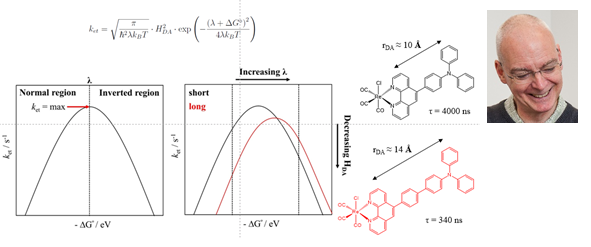
These findings offer a way of making new types of excited state that are not constrained by the properties of the metal in the complex. See: Georgina E. Shillito, Samantha E. Bodman, Joseph I Mapley, Christopher M. Fitchett, Keith C. Gordon “Accessing a long-lived 3LC state in a Ruthenium(II) phenanthroline complex with appended aromatic groups.” Inorganic Chemistry (2020) https://doi.org/10.1021/acs.inorgchem.0c02102, Georgina E. Shillito, Dan Preston, Philipp Traber, Johannes Steinmetzer, C. John McAdam, James D. Crowley, Pawel Wagner, Stephan Kupfer, and Keith C. Gordon. “Excited state switching frustrates the tuning of properties in TPA donor ligand Re(I) and Pt(II) complexes” Inorganic Chemistry (2020) 59, 6736–6746 https://doi.org/10.1021/acs.inorgchem.9b03691 and Jonathan E. Barnsley, Georgina E. Shillito, Christopher B. Larsen, Holly van der Salm, Raphael Horvath, Xue Zhong Sun, Xue Wu, Michael W. George, Nigel T Lucas and Keith C Gordon, Generation of microsecond charge-separated excited states in rhenium(I) diimine complexes; driving force is the dominant factor in controlling lifetime. Inorganic Chemistry (2019) 58, 9785-9795 https://doi.org10.1021/acs.inorgchem.9b00792 for some recent examples.