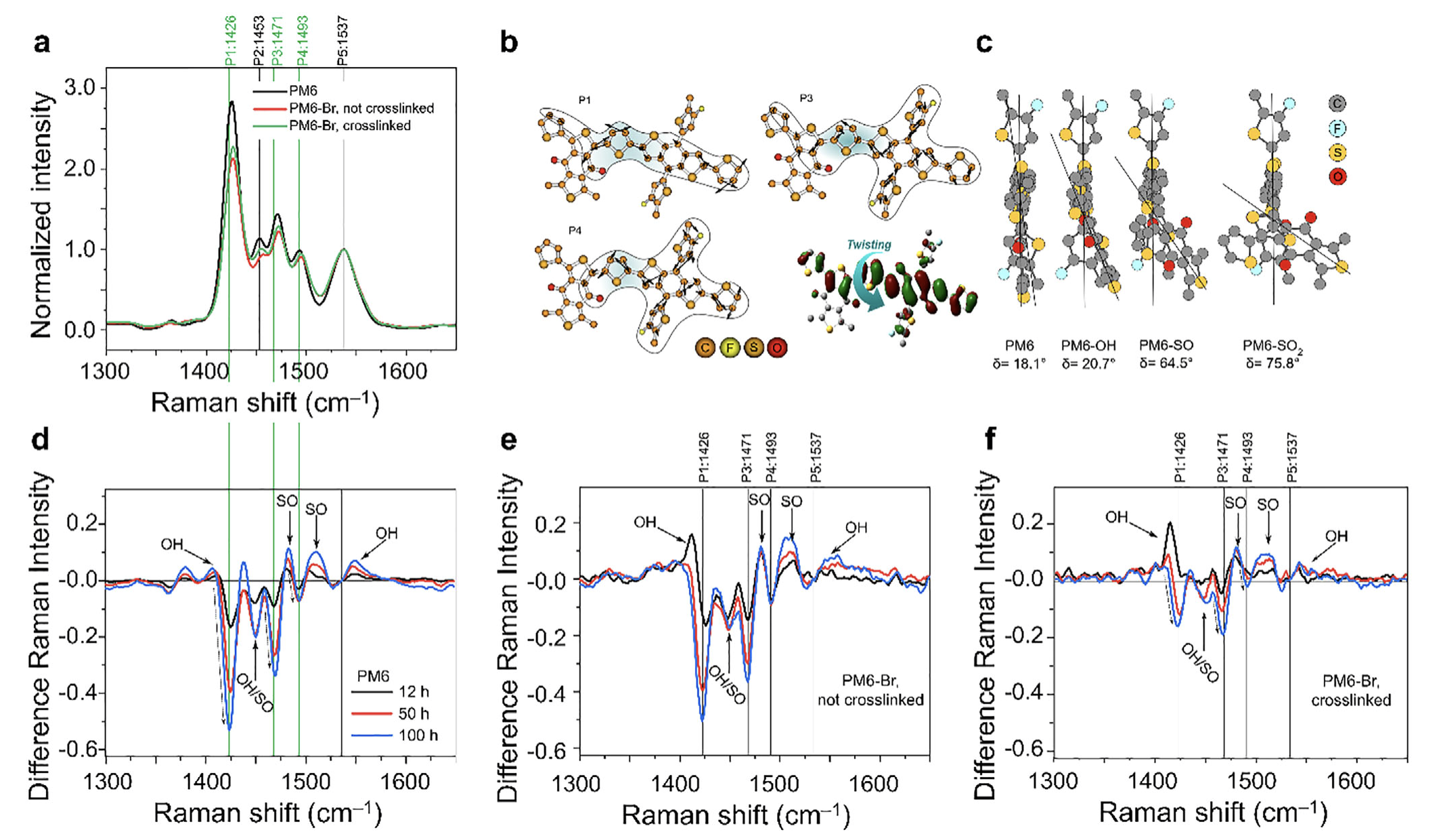
Khansa’s paper on organic solar cells has finally come out. Khansa was able to show by resonance Raman spectroscopy and time-dependent density functional theory (TD-DFT) that PM6 undergoes substantial photo-oxidation—specifically sulfur oxidation—resulting in energy level shifts, the formation of trap states, and molecular aggregation. Thus degraded cell perfomance. She was also able to compare rates of degradation showing that Raman signals associated with the conjugated backbone decrease more rapidly in PM6 than in PM6-Br, indicating more extensive structural degradation. The elucidation of these mechanisms provides possible solutions to make more durable organic solar cells.
a) Resonance Raman spectra of pristine PM6 and PM6-Br films, both before and after UV crosslinking. b) Calculated vibrational modes (with hydrogen atoms omitted for clarity) localized in the same regions as the HOMOorbital. These vibrational modes are aligned along the polymer backbone, which undergoes twisting during degradation and oxidation. c) Side view of the oxidized PM6 species, illustrating structural twisting compared to pristine PM6, as evidenced by changes in the dihedral angle ( ). d–f) Difference resonance Raman spectra of (d) PM6, e) PM6-Br before crosslinking, and f) PM6-Br after crosslinking, shown as a function of aging time relative to the fresh films.