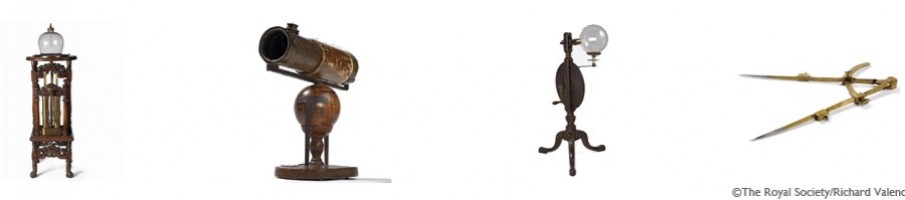
Antoine Le Grand, Robert Boyle and Speculative Philosophy
Peter Anstey writes…
Antoine Le Grand (1629–1699) was probably the most important Cartesian philosopher living in England in the latter decades of the seventeenth century. A Franciscan who was domiciled in England from 1656 until his death, he published a series of Latin works in the 1670s defending Descartes’ philosophy using the traditional approach of arguing from first (Cartesian) principles. The books include:
- Institutio philosophiae, London, 1672 (2nd edn 1680)
- Historia naturae, London, 1673 (2nd edn 1680)
- Dissertatio de carentia sensus & cognitionis in brutis, London, 1675.
Updated versions of these three books were subsequently brought together in an English translation that appeared in 1694 under the title An Entire Body of Philosophy According to the Principles of the Famous Renate Des Cartes, published by the entrepreneur Richard Blome. The title is apt because Le Grand’s magnum opus does indeed present a complete Cartesian philosophy, including metaphysics, logic, natural philosophy, and ethics.
Two of his works are of particular interest to students of early modern experimental philosophy. The first is his Historia naturae, variis experimentis & ratiociniis elucidata secundum principia stabilita in Institutione Philosophiae (The history of nature elucidated by various experiments and reasoning, according to the principles established in Institutes of [Cartesian] Philosophy). The first 1673 edition of this work was dedicated to Robert Boyle who is described in the dedication as a promoter of experimental philosophy [experimentis Philosophia]. The second 1680 edition is not dedicated to Boyle, but mentions the illustrious Bacon in its dedication to John Lumley.
One might expect, therefore, that Le Grand’s book will take the form of a Baconian natural history, after the manner of Boyle’s own natural histories. Yet what Le Grand presents is structured in a similar way to an Aristotelian textbook of natural philosophy but one founded upon Cartesian natural philosophical principles. The salient feature, however, is that it includes copious references to experiments that others have performed, all of them brought to the task of establishing the truth of Le Grand’s form of Cartesianism: ‘my intention in this work …. is to show that all the phenomena we observe throughout [nature] conform well to the principles in [my] Institutes of Philosophy‘ (Historia naturae, 1673, Preface). Le Grand’s Historia naturae then, can hardly be described as a contribution to the natural historical program of the experimental philosophers. It is to my knowledge, however, the earliest Cartesian natural history written in the wake of the emergence of experimental philosophy.
The second book of interest is Le Grand’s compilation, An Entire Body of Philosophy According to the Principles of the Famous Renate Des Cartes. The first part, the Institution of Philosophy, contains ten sub-parts. The last three sub-parts concern the nature of humans: the human body, the human mind, and ethics. When we drill down to the final chapter of the sub-part that pertains to the human body, we find that it concerns the nature and use of medicines.
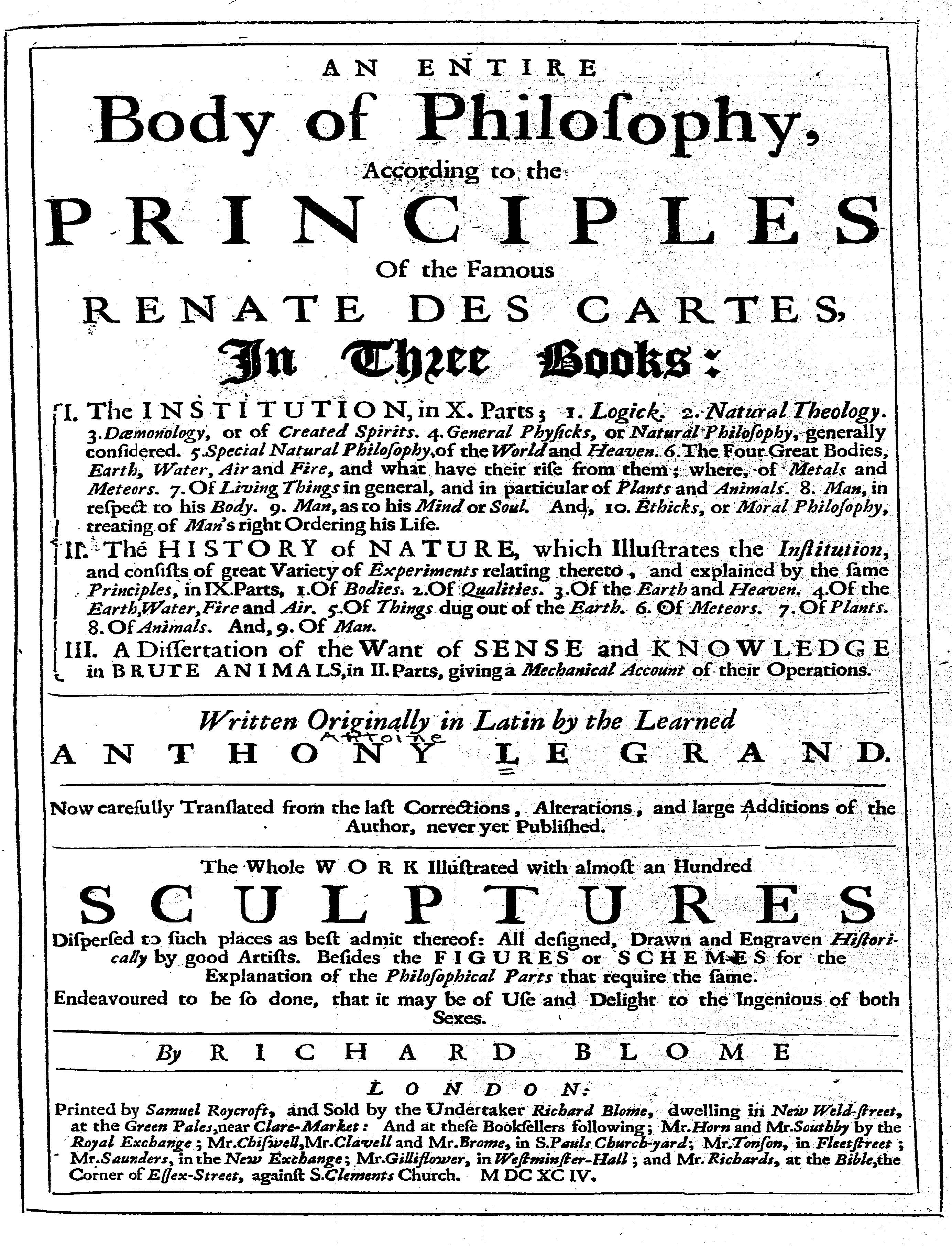
Le Grand, An Entire Body of Philosophy, London, 1694
This chapter is of singular interest because it contains a long discussion of specific medicines, that is, those remedies that were thought by some physicians to be especially efficacious in the cure of particular diseases. It turns out, however, that this long discussion of specifics is a plagiarised summary of the first dissertation of Boyle’s book On the Reconcileableness of Specific Medicines to the Corpuscular Philosophy (1685). Worse still, the publisher Richard Blome, claims on the title page that the whole book has been translated from the Latin originals, including ‘large Additions of the Author, never yet Published’. However, there is irrefutable evidence that the plagiarised material from Boyle’s Specific Medicines was taken directly from the original English edition, i.e. none of this material derives from a Latin original. So, what Le Grand has to say about specifics is exactly what Boyle said about them, sometimes word-for-word! Whether Le Grand is responsible for this or it is a presumptuous addition written or sanctioned by Blome is unknown, though the interweaving of the paraphrases with verbatim quotes from Boyle suggests that it does not derive from Le Grand himself who preferred to write in French and Latin.
Nevertheless, there are two important features of this act of plagiarism that pertain to speculative philosophy. First, where Boyle used the corpuscular hypothesis to explain the mode of operation of specific medicines, Le Grand appropriates Boyle’s corpuscular explanations in the defence of Cartesianism. Here we have a very good example of the compatibility of corpuscularianism and Cartesianism that Boyle highlighted in his early expositions of the speculative corpuscular hypothesis. (See Boyle’s Certain Physiological Essays, Works of Robert Boyle, eds Hunter and Davis, London, 1999–2000, 2: 87.)
Second, in spite Le Grand’s appropriation of some of the experimental evidence cited in Boyle’s book, it should not be thought that we have here a Cartesian doing experimental philosophy. For Boyle is explicit in a number of places in Specific Medicines that he is writing a speculative work providing speculative corpuscular explanations of the operation of specifics: ‘the ensuing discourse is for the main of a Speculative nature’ (ibid., 10: 353). Le Grand is doing the same. In fact, this characterises much of Le Grand’s use of experimental observations in the rest of his Entire Body of Philosophy: experimental evidence is not considered in its own right but is almost always brought to the aid of his defence of Cartesianism.
For example, like Jacques Rohault, he argues that the Torricelian experiment does not provide evidence for the existence of a vacuum because the glass tube has pores ‘which are penetratrable by the Subtil matter’ (An Entire Body of Philosophy, Part II, 6 = Historia naturae, 1673, 15). This use of experimental evidence is precisely what experimental philosophers opposed and the reason why Boyle was quite clear that he was indulging in speculation in Specific Medicines. In this Le Grand resembles some of the Cartesians in France; he was well apprised of the fruit of the new experimental philosophy of his day, but rather than contributing to it, he appropriated it in defense of Cartesianism.
If any readers know of other Cartesian natural histories from the 1670s I would be very keen to hear from you.
Nicolas Malebranche: Critic of Experimental Philosophy
Peter Anstey writes …
There were many critics of experimental philosophy in its early years. On this blog we have discussed the criticisms of Margaret Cavendish and Francis Bampfield, both of whom were English, and G. W. Leibniz, who was German. In this post we examine the views of the French philosopher Nicolas Malebranche who was highly critical of experimental philosophy too.
In the first edition of his The Search After Truth of 1674, Malebranche devotes the last section of Book Two to ‘Those who perform experiments’, and this section appears in all six subsequent editions of the book. (See The Search After Truth, eds T. M. Lennon and P. J. Olscamp, Cambridge: Cambridge University Press, 1997, pp. 159–60.)
He opens his treatment of the subject with some general comments that apply both to chemists and ‘all those who spend their time performing experiments’. Ostensibly, the criticisms are not directed at experimental philosophy per se, but towards experimental philosophers themselves. ‘Do not blame experimental philosophy [philosophie expérimentale]’, says Malebranche; it is the errors of its practitioners that he castigates.
He then proceeds to list seven faults, though ‘there are still many other defects … we do not pretend to cover them all here’ (p. 160).
First, their experiments are normally directed by chance and not by reason.
Second, they are ‘preoccupied with curious and unusual experiments’ rather than beginning with the simplest and building up from there.
Third, they seek out those experiments that will bring them profit, lucriferous experiments, as Bacon would call them.
Fourth, they don’t take enough care to note down ‘all the particular circumstances’ that pertain to the experiment at hand, the time of day, place, quality of the materials, etc.
Fifth, they draw too many conclusions from a single experiment, whereas it’s normally the case that one conclusion can only be drawn from many experiments.
Sixth, they only consider particular effects without ascending to ‘primary notions of things that compose bodies’ (p. 159).
And seventh, they often ‘lack courage and endurance, and give up because of fatigue or expense’ (p. 160).
None of these criticisms seem very serious, after all, it is easy to find exceptions to each one in the experimental practice of experimental philosophers in the 1660s and 1670s. One could hardly accuse Newton’s of being directed by chance in the construction of his experimentum crucis for establishing the heterogeneity of white light, even if his discovery of the oblong form of the spectrum of colours in his first experiment was unexpected or discovered by chance. Nor could one accuse Boyle of giving up on account of fatigue or expense in his air-pump experiments.
Yet the heart of Malebranche’s critique is found in the final paragraph of the section on the causes of the seven defects. He lists three causes: lack of application, misuse of the imagination, and, most importantly, judging the differences and changes among bodies only by sensation (p. 160).
This third cause is Malebranche’s real reservation about, not experimental philosophers, but experimental philosophy itself: for this cause implies an over-reliance on the senses, and by implication, an under-utilisation of reason, and, in particular, reasoning from clear and distinct ideas. The whole of Book One of The Search After Truth is given over to a discussion of the unreliability of the senses. For example, one rule of thumb that he sets out in Chapter 5 is: ‘Never judge by means of the senses as to what things are in themselves …’ (p. 24).
Of course, Malebranche is not averse to appealing to experiments and observations when they reinforce a point he is making (see Book I, chap. 12, pp. 56–7), however, the prioritising of experiment and observation above reasoning from pre-established principles and hypotheses – a central tenet of experimental philosophy – is not one of his epistemic values. Malebranche was opposed to experimental philosophy in principle, and not merely because of the ‘defects’ of its practitioners.
A New Volume on Early Modern Experimental Philosophy
Alberto Vanzo and Peter Anstey are pleased to announce the publication of Experiment, Speculation and Religion in Early Modern Philosophy, New York: Routledge, 2019.
This is the first collection ever published that is dedicated to the theme of early modern experimental philosophy. It contains studies of individual philosophers –– Bacon, Boyle, Cavendish, Hobbes, Locke and Newton –– as well as studies of the place of hypotheses, the relation between experimental philosophy and religion and a critical overview of the state of the field in contemporary scholarship.
Contents:
Introduction
Alberto vanzo and Peter R. Anstey
- Francis Bacon on Sophists, Poets and other Forms of Self-Deceit (Or, What can the
Experimental Philosopher Learn from a Theoretically Informed History of Philosophy?)
DANA Jalobeanu
- Robert Boyle and the Intelligibility of the Corpuscular Philosophy
Peter R. Anstey
- Cavendish and Boyle on Colour and Experimental Philosophy
Keith Allen
- Appeals to Experience in Hobbes’ Science of Politics
Tom Sorell
- Locke and the Experimental Philosophy of the Human Mind
Philippe Hamou
- Newton’s Scaffolding: The Instrumental Roles of his Optical Hypotheses
Kirsten Walsh
- What (Else) was Behind the Newtonian Rejection of ‘Hypotheses’?
Catherine Wilson
- From Experimental Natural Philosophy to Natural Religion: Action and Contemplation in the Early Royal Society
Elliot Rossiter
- Experimental Philosophy and Religion in Seventeenth-Century Italy
Alberto Vanzo
- Early Modern Experimental Philosophy: A Non-Anglocentric Overview
Dmitri Levitin
The Darker Side of Baconianism
Kirsten Walsh writes…
In my last post, I explained how Newton’s theory of the tides relied on empirical data drawn from all over the world. The Royal Society used its influence and wide-ranging networks to coordinate information gathering along trade routes, and thus construct a Baconian natural history. I pointed out that although the theory of the tides is considered a major theoretical achievement for Newtonian physics it was also a major empirical project and as such it is one of the major achievements of Baconian experimental philosophy. This case, however, also highlights how the Royal Society exploited its connections with politics and economics in pursuit of knowledge to benefit an elite monied class. In this post, I’m interested in exploring the connections between the Royal Society’s epistemic achievements and its being embedded within the political structures of the early modern world, particularly the rise of large trading empires.
If Bacon is considered to be the ‘Father of Modern Science’, then it’s worth reflecting on the nature of his legacy, and the role Baconianism played in shaping modern science. It is often tempting to split the objectivity and purity of science from the often complex, difficult, morally ambiguous world. In the same vein, reflections on the Royal Society and the birth of modern science often ignore the essential enabling role played by other of the British Empire’s activities: exploitative trade and slaving. Present-day philosophers of science increasingly reject the ‘value-free ideal’, recognising that scientific practice is best understood within its social, institutional and political context. If what are traditionally conceived of as non-epistemic values play an inextricable role in, say, modern medicine, then they likely do here as well. In this post, I’ll apply these ideas to the case of the tides, suggesting that it highlights a darker side of Baconianism.
The collection of tidal data was carried out by the Royal Society in cooperation with the Royal African Company and the East India Company. (When he discusses the Tonkin tides, for example, Newton appeals to data obtained by Francis Davenport, Commander of the Eagle—an East India Company vessel.) Both the Royal African and East India Companies engaged in extractive behaviours in their respective localities; extractive behaviours we now consider morally abhorrent (most strikingly the slave trade in Africa). While the Royal Society cannot be considered responsible for these acts, we might say that it played a role in legitimising, normalising and even celebrating them.
Indeed, these close ties between science and trade were present from the very inception of the Royal Society. The Royal Society and the Royal African Company received their second royal charters in the same year (1663) and were often thought of as sister companies. Thomas Sprat highlights these ties in his History of the Royal Society:
[I]f Gentlemen ‘condescend to engage in commerce, and to regard the Philosophy of Nature. The First of these since the King’s return has bin carry’d on with great vigour, by the Foundation of the Royal Company: to which as to the Twin-Sister of the Royal Society, we have reason as we go along, to wish all Prosperity. In both these Institutions begun together, our King has imitated the two most famous Works of the wisest of antient Kings: who at the same time sent to Ophir for Gold, and compos’d a Natural History, from the Cedar to the Shrub (Sprat, 1667: 407).
The two companies received their royal charters very soon after Charles II’s coronation. And both were held up as symbols of the Restoration—promises of prosperity to come. Sprat measures the success of the Royal Society largely in terms of its ability to exploit the trade network, praising the “Noble, and Inquisitive Genius” of English merchants (Sprat, 1667: 88). He writes:
But in forein, and remote affairs, their [i.e. the Royal Society Fellows’] Intentions, and their Advantages do farr exceed all others. For these, they have begun to settle a correspondence through all Countreys; and have taken such order, that in short time, there will scarce a Ship come up the Thames, that does not make some return of Experiments, as well as of Merchandize (Sprat, 1667: 86).
Sprat links the success of the Royal Society to its ability to exploit the trade networks; rhetoric which might have lent legitimacy and integrity to other actions carried out in the name of British supremacy.
Further, the direction of research reflected the economic and political interests of these trading companies. A history of tides was one of the projects suggested by Bacon in the appendix to his Novum organum, and as such, it is not surprising that the Royal Society committed resources to this project. However, the Royal Society could not have carried out this project without the support of British trade. A Baconian history of tides was necessarily a large-scale affair: information needed to be gathered from all over the globe. It wasn’t until the 17th century, when British trading companies sent ships all around the world, creating networks of merchants, priests and scholars, that such a project was even possible. But the knowledge that was produced was facilitated by, and in service of, those interests.
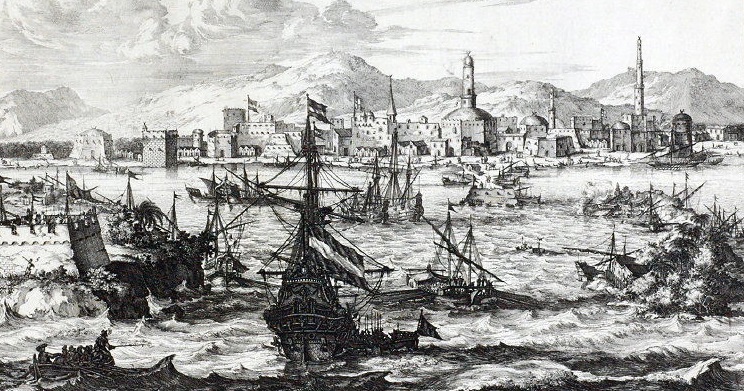
English, Dutch and Danish factories at Mocha (1680)
As global trade increased, knowledge of world-wide tidal patterns became increasingly important. European trading companies vied with one another for footholds in Africa and Asia and engaged in sea battles to gain political control in these regions (most notably the Anglo-Dutch Wars). Knowledge of tidal patterns was important both at sea, where failure to account for tidal flow could lead to navigation errors, and in narrower rivers and harbours—approaching a harbour with a shallow bar at low tide could mean a costly delay or worse. And so, the increasing importance of the tide problem and its increasing tractability stemmed from the same cause. Or, to put it another way, the direction of research was both enabled by, and carried out in the service of, the economic and political aspirations of British trade. In short, the trading empires did not merely enable the success of Newton’s work on the tides and other Royal Society projects; rather, they often directed and shaped them.
What conclusions should we draw from this? It comes as no surprise to historians, philosophers and sociologists of science that knowledge-production and the rest of society—including its exploitative, oppressive activities—are interwoven. However, the connection between natural philosophy and exploitative trade is only rarely made in presentations of the Royal Society’s work or Baconianism generally. Instead, science is often viewed as floating serenely and objectively above the darker aspects of early modern society. (This is surprising, given such rhetoric as Sprat’s.) But this case suggests that the Baconian requirement of information-gathering on a massive scale was enabled by—and perhaps itself worked to legitimate—the systems of trade which, often, represented the darkest parts of Western Europe. This is not to say that the Royal Society explicitly endorsed these features of the early modern world. Rather, the success of such large-scale Baconian projects may have tacitly whitewashed the social and political context.
What value is there in this sort of project? You might worry that, by casting a morally critical eye on the period, I lose my historian’s objectivity, believing myself to be coming from a position of superiority and moral maturity: a dangerous way to do historiography. Regardless of what objectivity might amount to in this context, I think it would be a mistake to couch the project in these terms. Rather, I am interested in what such cases can teach us about the nature of science, the value-free ideal and the role of value in science more generally. As such, this initial analysis leaves me with a few questions: Firstly, was the tidal data sullied, morally and/or epistemically, by the context of its collection? Secondly, if this data was morally sullied, were Newton and the others morally wrong to use it? Finally, what effect should this case have on our lauding of the early Royal Society as an exemplar of good science? How we eventually answer these questions at least partly depends on whether we think that the context of inquiry undermines the epistemic value of the project. In my next post, I’ll explore the idea that the epistemic injustice committed by the Royal Society in the name of Baconianism should undermine its status as exemplary.
Natural Histories and Newton’s Theory of the Tides
Kirsten Walsh writes…
Lately, I’ve been thinking about Newton’s work on the tides. In the Principia Book 3, Newton identified the physical cause of the tides as a combination of forces: the Moon and Sun exert gravitational pulls on the waters of the ocean which, together, cause the sea levels to rise and fall in regular patterns. This theory of the tides has been described as one of the major achievements of Newtonian natural philosophy. Most commentators have focussed on the fact that Newton extended his theory of universal gravitation to offer a physical cause for the tides—effectively reducing the problem of tides to a mathematical problem, the solution of which, in turn, provided ways to establish various physical features of the Moon, and set the study of tides on a new path. But in this post, I want to focus on the considerable amount of empirical evidence concerning tidal phenomena that underwrites this work.
Let’s begin with the fact that, while Newton’s empirical evidence of tidal patterns came from areas such as the eastern section of the Atlantic Ocean, the South Atlantic Sea, and the Chilean and Peruvian shores of the Pacific Ocean, Newton never left England. So where did these observational records come from?
Newton’s data was the result of a collective effort on a massive scale, largely coordinated by the Royal Society. For example, one of the earliest issues of the Philosophical Transactions published ‘Directions for sea-men bound for far voyages, drawn up by Master Rook, late geometry professour of Gresham Colledge’ (1665: 140-143). Mariners were instructed “to keep an exact Diary [of their observations], delivering at their return a fair Copy thereof to the Lord High Admiral of England, his Royal Highness the Duke of York, and another to Trinity-house to be perused by the R. Society”. With respect to the tides, they were asked:
“To remark carefully the Ebbings and Flowings of the Sea, in as many places as they can, together with all the Accidents, Ordinary and Extraordinary, of the Tides; as, their precise time of Ebbing and Flowing in Rivers, at Promontories or Capes; which way their Current runs, what Perpendicular distance there is between the highest Tide and lowest Ebb, during the Spring-Tides and Neap-Tides; what day of the Moons age, and what times of the year, the highest and lowest Tides fall out: And all other considerable Accidents, they can observe in the Tides, cheifly neer Ports, and about Ilands, as in St. Helena’s Iland, and the three Rivers there, at the Bermodas &c.”
This is just one of many such articles published in the early Philosophical Transactions that articulated lists of queries concerning sea travel, on which mariners, sailors and merchants were asked to report. In its first 20 years, the journal published scores of lists of queries relating to the tides, and many more reports responding to such queries. This was Baconian experimental philosophy at its best. The Royal Society used its influence and wide-ranging networks to construct a Baconian natural history of tides: using the method of queries, they gathered observational data on tides from all corners of the globe which was then collated and ordered into tables.
Newton’s engagement with these observational records is revelatory of his attitudes and practices relating to Baconian experimental philosophy. Firstly, especially in his later years, Newton was regarded as openly hostile towards natural histories. However, here we see Newton explicitly and approvingly engaging with natural histories. For example, in his discussion of proposition 24, he drew on observations by Samuel Colepresse and Samuel Sturmy, published in the Philosophical Transactions in 1668, explicitly offered in response to queries put forward to John Wallis and Robert Boyle in 1665:
“Thus it has been found by experience that in winter, morning tides exceed evening tides and that in summer, evening tides exceed morning tides, at Plymouth by a height of about one foot, and at Bristol by a height of fifteen inches, according to the observations of Colepress and Sturmy” (Newton, 1999: 838).
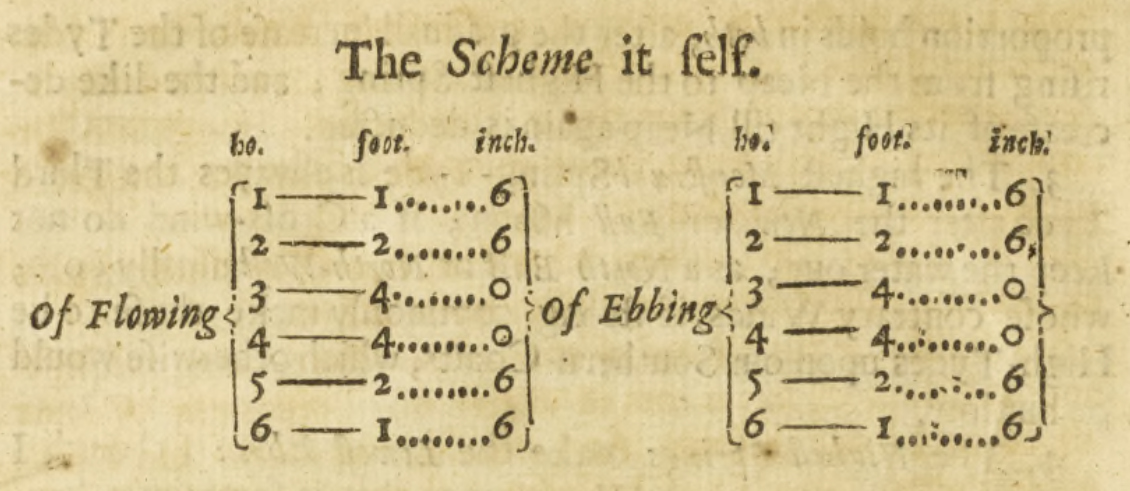
Colepresse’s Tidal Scheme for Plymouth, 1667
I have argued previously that Newton was more receptive to natural histories than is usually thought. The case of the tides offers additional support for my argument. Newton’s notes and correspondence show that, from as early as 1665, he was heavily engaged in the project of generating a natural history of the tides, although he never contributed data. And eventually, he was able to use these empirical records to theorise about the cause of the tides. This suggests that Newton didn’t object to using natural histories as the basis for theorising. Rather, he objected to treating natural histories as the end goal of the investigation.
Secondly, I have previously discussed the fact that Newton seldomly reported ‘raw data’. The evidence he provided for Phenomenon 1, for example, included calculated average distances, checked against the distances predicted by the theory. Newton’s empirical evidence on the tides, as reported in the Principia, was similarly manipulated and adjusted with reference to his theory. Commentators have largely either condemned or ignored this ‘fudge factor’, but such adjustments are ubiquitous in Newton’s work, suggesting that they were a key aspect of his practice. Newton recognised that ‘raw data’ had limited use: to be useful, data needed to be analysed and interpreted. In short, it needed to be turned into evidence. The Baconians appear to have recognised this: queries guide the collection of data, which is then ordered into tables in order to reveal patterns in the data. As this case makes clear, however, Newton’s theory-mediated manipulation of the data went beyond basic ordering, drawing on causal assumptions to reveal phenomena from the data.
Thirdly, this case emphasises Newton’s science as embedded in rich social, cultural and economic networks. The construction of this natural history of tides was an organised group effort. That Newton had access to data collected from all over the world was the result of hard work from natural philosophers, merchants, mariners and priests who participated in the accumulation, ordering and dissemination of this data. Further, the capacities of that data to be collected itself followed the increasingly global trade networks reaching to and from Europe. Newton’s work on the tides was the very opposite of a solitary effort.
On this blog, we have noted in passing, but not explored in depth, the crucial roles played by travellers’ reports and information networks in Baconian experimental philosophy. Newton’s study of the tides is revelatory of the attitudes and practices of early modern experimental philosophers with respect to such networks. I shall discuss these in my next post.
When did Locke and Boyle first meet?
Peter Anstey writes…
Until now the earliest evidence for Locke making Boyle’s acquaintance is a letter from Dr Ayliffe Ivye to Locke of 20 May 1660. This letter implies that Locke knew Boyle by this time and Ivye recommends to Locke that he ‘lett slippe no occasion’ to develop his acquaintance with Boyle (Locke Correspondence, ed. E. S. de Beer, vol. 1, p. 146). New evidence has now emerged that strongly suggests that Locke knew Boyle at least two years earlier, in 1658.
Locke’s earliest surviving medical notebook, Bodleian Library MS Locke e. 4, was in use in the 1650s. There appears to be no indication from its contents that Locke used it after 1658. In this notebook there are a number of entries deriving from a person called M. B. Could this refer to M[r] B[oyle]? The content of one of these entries confirms that it does.
On page 59 Locke made the following entry under the marginal title ‘Obstructio’:
A lady that had been sick a great while of the * & used very much physic to noe purpose was curd presently by useing her owne water M. B.
Locke almost certainly heard this from Boyle, because in Usefulness of Experimental Natural Philosophy (1663), which he was composing in the late 1650s, Boyle relates:
I knew an ancient Gentlewoman, who being almost hopeless to recover of divers Chronical Distempers (and some too of these abstruse enough) was at length advised, instead of more costly Physick, to make her Morning-draughts of her own Water; by the use of which she strangely recovered, and is, for ought I know, still well. (Boyle Works, eds Hunter & Davis, vol. 3, p. 385)
It is unlikely that this entry was made before 1658 because in this notebook, apart from some very early entries at the end, Locke seems to have made entries in chronological order and ‘Obstructio’ is preceded by references to Marin Cureau de la Chambre’s A Discourse on the Principles of Chiromancy (London, 1658) on pages 25–6.
There is an entry derived from M. B. that precedes the one quoted above (MS Locke e. 4, p. 43), it occurs after the entry from de la Chambre. So, there are no grounds on the basis of this notebook for claiming that Locke had met Boyle before 1658.
What all of this shows is that Locke met Boyle at the very time when the latter was formulating his new approach to natural philosophy that he came to call experimental philosophy.
Locke’s Experimental Philosophy of Ideas
A guest post by Kenny Pearce.
Kenny Pearce writes …
It is by now well-known that Locke intentionally sets his Essay in the context of Baconian natural history, the project of the Royal Society. This can be seen in Locke’s mention of several prominent members of the Society in the Epistle to the Reader, and his description of his own role as that of an “Under-Labourer … removing some of the Rubbish, that lies in the way of Knowledge” (Essay, Nidditch p. 10). It can also be seen in Locke’s explicit description of his project as following the “Historical, plain Method” (§1.1.2), and in his assertion to Stillingfleet that “if [his ‘way of ideas’] be new, it is but a new history of an old thing [i.e., human understanding]” (Works, 4: 134–135). Further, it is clear that the Essay was received as a contribution to Baconian natural history in the decades following its publication. For instance, in a footnote to his 1732 translation of William King’s Essay on the Origin of Evil, Edmund Law refers to the Essay concerning Human Understanding as “Mr. Locke’s excellent History of the human mind” (vol. 2, p. 308), and in his 1734 Philosophical Letters, Voltaire writes, “After so many thinkers had written the romance of the soul, there came a wise man [Locke] who modestly described its history” (Steiner p. 42).
But what exactly is this Baconian project, and what bearing should it have on our reading of Locke’s Essay? Thomas Sprat, the earliest historian of the Royal Society, describes its methods as follows:
The Society has reduc’d its principal observations, into one common-stock; and laid them up in publique Registers, to be nakedly transmitted to the next Generation of Men; and so from them, to their Successors. And as their purpose was, to heap up a mixt Mass of Experiments, without digesting them into any perfect model: so to this end they confin’d themselves to no order of subjects; and whatever they have recorded they have done it, not as compleat Schemes of opinions, but as bare unfinish’d Histories … For it is certain, that a too sudden striving to reduce the Sciences, in their first beginnings, into Method, and Shape, and Beauty; has very much retarded their increase … By their fair, and equal, and submissive way of Registring nothing, but Histories, and Relations; they have left room for others, that shall succeed, to change, to augment, to approve, to contradict them, at their discretion (Sprat, The History of the Royal-Society [1667], pp. 115–116).
According to Sprat, the key to the method of natural history is to “heap up a mixt Mass of Experiments” and observations (or ‘instances’ as Bacon liked to call them) without working them into a system. This is important because it will allow future generations of natural philosophers “to change, to augment, to approve, to contradict” the conclusions drawn by those who made the observations.
Law and Voltaire were, I believe, perfectly correct in regarding Locke’s Essay as a natural history of the human understanding, working within the Baconian methodological paradigm. This is not merely supported by Locke’s occasional uses of the words ‘history’ and ‘historical’, quoted above. It is also supported by Locke’s explicit descriptions of his methodology. For instance:
This, therefore, being my Purpose to enquire into the Original, Certainty, and Extent of humane knowledge; together, with the Grounds and Degrees of Belief, Opinion, and Assent; I shall not at present meddle with the Physical Consideration of the Mind; or trouble my self to examine, wherein its Essence consists, or by what Motions of our Spirits, or Alterations of our Bodies, we come to have any Sensation by our Organs, or any Ideas in our Understandings; and whether those Ideas do in their Formation, any, or all of them, depend on Matter, or no (Essay 1.1.2).
for [my account of the origin of ideas] I shall appeal to every one’s own observation and experience (Essay 2.1.1)
my design being, as well as I could, to copy nature, and to give an account of the operations of the mind in thinking, I could look into nobody’s understanding but my own, to see how it wrought … All therefore that I can say of my book is, that it is a copy of my own mind, in its several ways of operation. And all that I can say for the publishing of it is, that I think the intellectual faculties are made, and operate alike in most men (Works, 4: 138–139).
Further, in the actual text of the Essay, Locke does indeed appear to follow this method: he aims to describe, in an orderly fashion, the phenomena revealed by introspection. The case against innate knowledge and innate ideas in book one focuses primarily on arguing that no example of an innate idea or item of innate knowledge has yet been produced: there is no true specimen of such a thing in our register. Book two is then a detailed catalogue or register of ideas, and book four is a catalogue of instances of assent (knowledge and belief). (Book three, on language, was apparently an afterthought, not fitting neatly into the ‘method’ Locke originally proposed; see Essay 2.23.19.)
This line of interpretation has consequences for how we must understand Locke’s account of ideas. If Locke is following this kind of Baconian methodology then, although he does at various points seek to explain various phenomena, his ‘ideas’ cannot be understood as theoretical posits aiming to explain how we perceive external objects. Locke makes no attempt to explain “by what Motions of our Spirits, or Alterations of our Bodies, we come to have any Sensation by our Organs, or any Ideas in our Understandings” (Essay 1.1.2), and frequently admits that, although we can give mechanical explanations of the transmission of information from objects to the brain, the mind-brain interface remains utterly mysterious. Instead of attempting to solve this mystery, Locke aims simply to describe the ideas of which we are aware.
If this is correct, then, although there is a sense in which the Essay is a systematic treatment of the human mind, there is another sense in which Locke is an intentionally, self-consciously unsystematic thinker and the Essay is an intentionally unsystematic work. The Essay, as a natural history of the human understanding, is systematic in that Locke’s observations and the generalizations he draws from them are laid out in a reasonably orderly fashion, intending to be of use to future natural historians. But it also exhibits a Baconian skepticism about ‘grand systems’. The human understanding, Locke has observed, is (like most natural phenomena) messy and complex and, in Locke’s view, it would be a serious methodological error to try to massage this messiness out of the data. A neat and clean, elegant and systematic account of the human understanding would be a ‘romance’ and not a modest history.
(This post is based on a portion of a paper in progress, “Ideas and Explanation in Early Modern Philosophy.” You can read a draft here. Many thanks to Kirsten Walsh for the invitation to share these thoughts in this forum. Comments welcome below!)
Locke Studies goes online
Locke Studies makes Vols 14–16 freely accessible online
We are pleased to announce that Vols 8, 9 and 14–16 of Locke Studies are now freely available on the Locke Studies website<https://protect-au.mimecast.com/s/XhIpCD1jy9tMoolwflPWVy?domain=thejohnlockesociety.us15.list-manage.com>. The editorial team of the journal will continue to add back issues to the website as quickly as they are able to prepare them. Eventually the entire series of Locke Studies and The Locke Newsletter will be digitized and freely available. Hyperlinks to each article will be added to the entries in the Locke Bibliography<https://protect-au.mimecast.com/s/xX-0CE8kz9tnll5OiQruGS?domain=thejohnlockesociety.us15.list-manage.com> as they are published online.
Visit the Locke Studies Archive<https://protect-au.mimecast.com/s/k-TvCGvmB5iqBB5Ef1kf2t?domain=thejohnlockesociety.us15.list-manage.com>
2017 Issue of Locke Studies
The table of contents is available via the website, but the PDFs of the articles will not be made available until Jan 2019. Beginning with the 2018 issue, all new content will be open access immediately upon publication. Here is the table of contents for the 2017 issue of Locke Studies:
Recent Publications, pp. 5–38
JOHN C. ATTIG
Locke’s Orthography and the Dating of his Writings, pp. 39–47
J. R. MILTON
A Puzzle in the Print History of Locke’s Essay, pp. 49–60
PATRICK J. CONNOLLY
Locke’s Ontology of Relations, pp. 61–86
SAMUEL C. RICKLESS
Locke on Individuation and Kinds, pp. 87–116
JOSEPH STENBERG
Toland and Locke in the Leibniz-Burnett Correspondence, pp. 117–141
STEWART DUNCAN
Shaftesbury, Locke, and their Revolutionary Letter?, pp. 143–171
D. N. DELUNA
Locke and Hate Speech Law: A Critical Review, pp. 173–196
J. K. NUMAO
Locke’s Political Theology and the ‘Second Treatise’, pp. 197–232
JOANNE TETLOW
Locke and the Churchill Catalogue Revisited, pp. 233–241
JOHN SAMUEL HARPHAM
Workshop: Definitions in Early Modern Natural Philosophy, Logic and Mathematics
Workshop: Definitions in Early Modern Natural Philosophy, Logic and Mathematics
13 April 2018
SOPHI Common Room,
Level 8, Brennan MacCallum Building, A18
The University of Sydney
Sponsored by The Sydney Centre for the Foundations of Science
Schedule
10.00: Definitions as principles in early modern natural philosophy
Peter Anstey (Sydney)
11.00: From Pascal to Arnauld and Nicole: definitions in Port Royalist works
Laura Kotevska (Sydney)
12.00: Lunch
13.30: Logic in definitions and the search for the definition of continuity
James Franklin (UNSW)
14.30: Newton’s definitions
Kirsten Walsh (Nottingham)
15.30: Discussion
16.00: Close
See here for further information and registration.
Organiser: Peter Anstey
‘To treat of God from Phenomena’
Kirsten Walsh writes…
In my last few posts, I’ve discussed some of the lesser-known aspects of Newton’s work. In my first post on this topic, I talked generally about how we might consider Newton’s chymistry, theology and Church history to be methodologically continuous with the experimental philosophy of the Principia and the Opticks. And in my second post I considered Newton’s alchemical tract, now referred to as ‘Of Natures obvious laws and processes in vegetation’, and identified several features that seem to highlight Newton’s early (albeit tacit) commitment to experimental philosophy.
In today’s post, I’ll begin to discuss an important but relatively understudied aspect of Newton’s work: his theological methodology. Since this blog is primarily concerned with early modern experimental philosophy, I’m going to start with the famous passage from the General Scholium to the Principia: “to treat of God from phenomena is certainly a part of natural philosophy”. The meaning of the first part of the statement is clear: we have epistemic access to God via our observations of the world. And so, from the phenomena, we can learn about God’s nature and divine will—in the same way that we can learn about, say, gravity. But in what sense is this ‘a part of natural philosophy’? That is, how does this statement fit with Newton’s stated views regarding that topic?
In the General Scholium, Newton explains that, while the laws of motion explain why celestial bodies move in Keplerian orbits, they cannot explain how celestial bodies come to be in their present orbits. And so, he writes, “This most elegant system of the sun, planets, and comets could not have arisen without the design and dominion of an intelligent and powerful being”. Prima facie, examples such as this don’t fit with Newton’s natural philosophical method. He seems to employ non-empirical background assumptions about the nature of God’s intervention to plug gaps in his theory. This looks dangerously close to feigning hypotheses. Moreover, from these assumptions, he seems to leap right to the first cause, blocking further scientific inquiry, and contradicting the ‘satis est’ attitude he adopts in his natural philosophy.
I think, however, that Newton’s treatment of God from phenomena is more consistent with his method of natural philosophy than it first appears. But to recognise this, we need to look more closely at how Newton approaches God from the phenomena. In fact, Newton treats of God from phenomena in several different ways. One approach is to move directly from the phenomena to the nature of God’s interactions with the world. For example, in the General Scholium, Newton notes that all celestial bodies move in regular orbits, which tells us that neither planets nor comets encounter any kind of resistance in their orbits. Newton uses the lack of resistance to argue that celestial bodies do not move through vortices but through empty space. However, this phenomenon also reveals that, while God is omnipresent and substantial, he is not material:
God is one and the same God always and everywhere. He is omnipresent not only virtually but also substantially; for action requires substance. In him all things are contained and move, but he does not act on them nor they on him. God experiences nothing from the motions of bodies; the bodies feel no resistance from God’s omnipresence (Principia, Cohen & Whitman translation, pp. 941-942).
Another way Newton approaches God is to ask after the nature of his interventions. Here, Newton identifies explanatory gaps between phenomena and theory, and asks whether God could be acting, and if so, what is the nature of that action? For example, in a letter to Bentley Newton notes that that his theory of universal gravitation can explain the motions of the planets, but not their original sizes or positions in the solar system. The latter, he concludes, can only be explained by divine intervention. That God works to achieve such perfect balance in the system of the world tells us that he is “not blind and fortuitous, but very well skilled in mechanics and geometry”. Here, the insight is that gravity can destabilise the system of the world—and so the physical world constantly tends towards decay. Thus, God is required to use his skills of design and maintenance to prevent this from happening.
Neither approach looks like ‘feigning hypotheses’. For one thing, Newton doesn’t allow his thinking about God to justify or constrain his theorising. Rather, God is introduced after the physical theory has been established to see what it can teach us about the nature of his intervention. And for another thing, Newton’s ideas about God don’t result from speculation, but from rigorous study of both scripture and the natural world, and the careful application of reason. It is from our post-Enlightenment perspective that rigorous study of scripture seems to fall outside of natural philosophy.
Moreover, Newton’s introduction of God doesn’t stop inquiry. Rather, it raises further questions about how and why God intervenes on the system of the world. And these, in turn, lead back to physical inquiry. For example, Newton’s discussions about God’s role in the sizing and positioning of the planets leads to a fruitful inquiry about the specific compositions of the planets and why the biggest planets are furthest from the Sun. That the inquiry continues highlights the fact that Newton doesn’t view the cause of a given phenomenon as either natural or supernatural: every phenomenon is generated by both natural and supernatural causes. That is, physical objects act on one another as natural causes, subject to physical and mathematical laws, but God is the first-cause, and hence, behind all actions. And so, when Newton treats of God from phenomena, the inquiry doesn’t end there.
Finally, as a good experimental philosopher, Newton knows that we only have direct epistemic access to the evidence of our senses, so our knowledge of God is necessarily limited. However, as he makes clear in query 28 of the Opticks, we mustn’t be put off by our inability to discover the first cause directly. Instead, we must work to uncover intermediate causes—proximate causes—and work slowly to uncover deeper and deeper levels of causes until we come to the first cause. And, importantly, these intermediate causes can also reveal the nature of God:
And these things being rightly dispatch’d, does it not appear from Phænomena that there is a Being incorporeal, living, intelligent, omnipresent, who in infinite Space, as it were in his Sensory, sees the things themselves intimately, and thoroughly perceives them, and comprehends them wholly by their immediate presence to himself… And though every true Step made in this Philosophy brings us not immediately to the Knowledge of the first Cause, yet it brings us nearer to it, and on that account is to be highly valued (Optics, Dover edition, p. 370).
